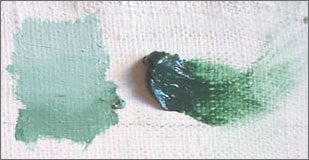
The name green earth is applied to several different minerals, but most importantly in medieval painting is the light, cold green of celadonite, a natural mineral found chiefly in small deposits in rock in the area of Verona, Italy. The specific mineral composition of the pigment varies depending on its source, influencing its exact hue and working properties. Today the color is usually a durable mixture of chromium oxide, black, white and ochre, since the natural product is scarcely obtainable.
The mass tone of green earth is an unexciting, dull green. Mixed with oil it is transparent and soapy in texture, like a clay. The color varies according to its origin, ranging from a light bluish gray with a greenish cast to a dark, brownish olive. It is lightfast and chemically stable, making it a reliable choice for lasting works of art.
However, green earth was much used in painting. Medieval artists used green earth pigment extensively as a preparatory underpainting for the representation of flesh tones. A uniform unmodulated paint in the areas was laid in where the flesh was to be represented which neutralized the effect of the pinks and reds of the subsequent flesh tints (fig. 1). In order to achieve a clean and smooth surface on which to paint, painters prepared wood panels with layers of gesso (a mixture chalk and glue), which was usually white. If the pinks of flesh were directly painted onto the white gesso, a "sunburn" effect in the flesh is produced. The green earth which now dominates many of the paintings of the period may be the result of the lighter flesh tones which have faded.
Green Earth in Vermeer's Painting
fig. 1The Virgin and Child with Saint Dominic and Saint Aurea, and Patriarchs and Prophets (detail showing green earth underpaint)
Duccio
1312–15 (?)
Egg tempera on wood, 61.4 x 39.3 cm.
National Gallery, Londonfig. 2The Guitar Player (detail)
Johannes Vermeer
c. 1670–1673
Oil on canvas, 53 x 46.3 cm. Iveagh Bequest, London
Although uncommon, green earth has been identified in works by various seventeenth-century Dutch artists. Its use as an underpaint in flesh tones by Hendrick ter Brugghen in his Jacob reproaching Laban painted in 1627, is likely to have been prompted by interest in Italian painting practice at that time. However, Vermeer is perhaps unique in his extensive use of the green pigment as a shading over the flesh tones.
In Vermeer's painting, green earth was found mixed with white-lead and a little lead-tin yellow in the lighter tones of the trompe-l'œil curtain of Vermeer's early Girl Reading a Letter at an Open Window. In a recent analysis, unusually, green earth has been combined with ultramarine to paint the dress of the Young Woman seated at a Virginal. Helen Howard, David Peggie and Rachel Billinge, "Vermeer's Palette," Vermeer and Technique, National Gallery.
Vermeer repeatedly used green earth for flesh tone shadows later in his career, such as theGirl with a Red Hat, Girl with a Flute, The Guitar Player (fig. 2), A Lady Standing at a Virginal(fig. 3), A Lady Seated at a Virginal, and The Allegory of Faith, but this practice has not been observed elsewhere among high-life genre paintings by his peers.E. Melanie Gifford and Lisha Deming Glinsman, "Collective Style and Personal Manner: Materials and Techniques of High-Life Genre Painting," in Vermeer and the Masters of Genre Painting by Adriaan E. Waiboer, Arthur K. Wheelock, and Blaise Ducos, exh. cat. (New Haven: Yale University Press in association with the National Gallery of Ireland, 2017). The effect of green earth in these pictures is not always readily visible in reproductions, but when seen directly it is quite evident and to most viewers, a bit unsettling. The aesthetic effect is more decorative than it is naturalistic. The effect of green earth can clearly be seen in the painting of the neck of The Guitar Player(fig. 2).
In an investigation of the Lady Standing at a Virginal, Lady Seated at a Virginal, and The Guitar Player, the London National Gallery conservation team found that "in Lady Seated at a Virginal, the largest area of blue in the painting is her dress, but here ultramarine has been combined with green earth to produce a distinctive blue-green colour. Mixtures of ultramarine and green earth, often applied over an underpaint of green earth combined with black, have also been used for the patterned curtain in this painting. "Since silica is not one of the colourless accessory minerals usually present along with blue lazurite in natural ultramarine, it is possible that the pigment, adulterated with finely ground silica, was purchased unknowingly by Vermeer. It is also possible that Vermeer himself sought to extend the expensive natural ultramarine pigment, and, since green earth was used in the underlying layer, it is possible that a little silica-rich green earth, was added to the blue pigment. That Vermeer may have been struggling financially towards the end of his career and thus using poorer quality or adulterated pigment is underscored by his use of old/worn paint brushes."Helen Howard, David Peggie and Rachel Billinge, "Vermeer's Palette," Vermeer and Technique, National Gallery.
After a multi-year investigation of ther four paintings traditionally attibuted to Vermeer, in 2022, National Gallery of Art of Washington rejected their Girl with a Flute from its foursome for various reasons, among which is that "the painter of Girl with a Flute did not use the stock of supplies that was in Vermeer’s studio at the time he painted Girl with a Red Hat [which also contains green earth in the shadows of the figure's flesh]. Vermeer’s idiosyncratic use of green earth for shadows in the flesh tones of his later works clearly made a strong impression on the other artist. But PLM (polarizing light microscopy) analysis shows that where Vermeer mixed a deep blue-green version of green earth with yellow and brown earth pigments to delicately modulate the color of the shadowed flesh, the painter of Girl with a Flute used a paler green earth pigment with large glassy particles that were not observed in Girl with the Red Hat. This discrepancy suggests that the two artists used different batches or grades of green earth, or even obtained their pigments from different sources."Marjorie E. Wieseman et al., "Vermeer’s Studio and the Girl with a Flute: New Findings from the National Gallery of Art," Journal of Historians of Netherlandish Art 14, no. 2 (Summer 2022). For this and other techncal issues, they now classify the paintings as work from the artist's studio, even though no such studio is know and some of the most credible Vermeer specialists continute to beleive the work is indeed by the hand of Vermeer, albeit possibly retouched.
Although green earth had been employed in an analogous way by some mannerists schools in Europe, after the fifteenth century, umbers and other brownish earth pigments were used in both the deeper and lighter shadows of the flesh. These tones have a warmer tone and create a far more natural effect than green earth. In the Netherlands, some artists of the Utrecht school were known to have used green earth in flesh tones. Since more than one scholar believes that the young Vermeer may have completed his apprenticeship in Utrecht, it is possible that the young artist became familiar with the technique in those years. Just why Vermeer used the technique in his later paintings remains an open question. A widely accepted theory is that Vermeer utilized the green hue to enhance the contrast between the face's shadowed region and its light pink side—achieved using the vibrant red vermilion.
Green earth was also used extensively elsewhere in Vermeer's ouevre, for example, to produce a variety of mixed blue/green colours as in the inset landscapes and for the cool light in the window of Lady Standing at a Virginal, where it is combined with lead-tin yellow.
Comprehensive Resources on Vermeer's Painting Techniques