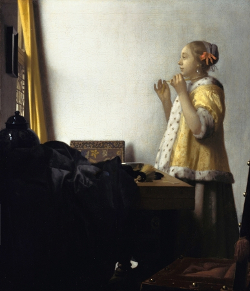
Woman with a Pearl Necklace
(Vrouw met parelsnoer)c. 1662–1665
Oil on canvas, 55 x 45 cm. (21 5/8 x 17 3/4 in.)
Staatliche Museen Preußischer Kulturbesitz, Gemäldegalerie, Berlin
inv. 912B
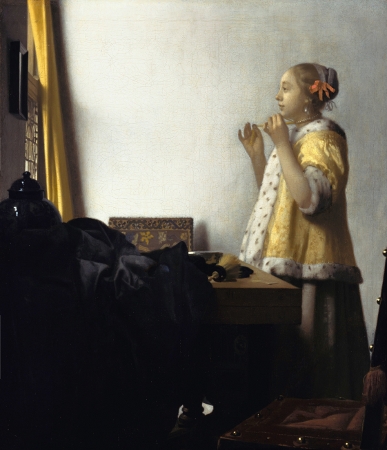
The textual material contained in the Essential Vermeer Interactive Catalogue would fill a hefty-sized book, and is enhanced by more than 1,000 corollary images. In order to use the catalogue most advantageously:
1. Scroll your mouse over the painting to a point of particular interest. Relative information and images will slide into the box located to the right of the painting. To fix and scroll the slide-in information, single click on area of interest. To release the slide-in information, single-click the "dismiss" buttton and continue exploring.
2. To access Special Topics and Fact Sheet information and accessory images, single-click any list item. To release slide-in information, click on any list item and continue exploring.
The fur-trimmed morning jacket

A Young Woman Composing Music (detail)
Gabriel Metsu
1662–1663
Oil on panel, 57.8 x 43.5 cm.
Mauritshuis, The Hague
Since it appears conspicuously in five other paintings, including a large-scale version in the Mistress and Maid, Vermeer must have treasured this elegant morning jacket. We can reasonably assume that it is the same item worn by both the seated woman in the Mistress and Maid and in A Lady Writing because the ermine-tipped black spots are distributed in much the same manner, at least in the area below the woman's neck. In the present picture, however, both the trim and satin are executed with a delicacy that can be appreciated only in front of the real picture.
By observing the treatment of the trim, it becomes apparent how dissimilar Vermeer's approach to painting was from that of his contemporaries in the fijnschilder genre, with whom his work is often associated. While they represented each individual hair with truly microscopic accuracy, Vermeer synthesizes the essence of its fluffy softness with imperceptible shifts in tone and cloud-like contours. Two similar jackets with a similar cut, both blue and without the telltale spots of ermine, are represented in The Concert and the Woman Holding a Balance.
In the mid-1660s or after, such garments were represented in an enormous number of Dutch genre interiors, in a wide variety of colors. Metsu often painted them bright red or lime green. Gerrit ter Borch painted them with mute purple, light yellow, or blue. They were worn by middle and upper-class women and served as protection against the long gelid Dutch winters while performing household chores. The fur trim was once thought to be ermine, although Dutch costume expert Marieke de Winkel states that even in the inventories of the wealthiest women, ermine is never mentioned. It was more likely to have been white squirrel, mouse, or even cat.
In Vermeer's death inventory of 1676, a "yellow satin mantle with white fur trimmings" was found in the groote zael (great hall) of the artist's home, which likely belonged to his wife, Catharina.
The mirror
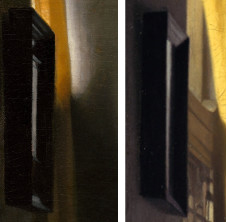
Mirrors appear four times in Vermeer's works. A smaller one hangs in an analogous position in the Woman Holding a Balance. The mirror's black frame is presumably made of ebony, although Dutch artisans excelled in producing imitations of precious imported woods.
Mirrors have always been depicted extensively in Western paintings. In 17th century Dutch paintings, women depicted before mirrors are a recurring and evocative theme, whose underlying meaning often went beyond the simple act of looking or vanity. The mirror could symbolize a range of concepts. On one hand, it might allude to the transience of beauty and the passage of time, reminding viewers of the fleeting nature of youth and life itself. On a more surface level, it could be a straightforward representation of daily life and the role of personal grooming in a woman's routine.

Girl Standing before a Mirror
Caspar Netscher
1668
Oil on canvas, 58 x 28 cm.
Art Institute of Chicago, Chicago
However, deeper interpretations suggest that the mirror acted as a tool for self-reflection, both literally and metaphorically. The woman gazing into the mirror might be contemplating her own inner thoughts, emotions, and identity. In a society where women's roles were evolving and where their interior lives weren't always openly discussed, such moments of private introspection were profoundly meaningful.
According to Cesare Ripa's Iconologia, the mirror is one of the attributes of Prudence, as it enables self-knowledge. Vermeer was familiar with Ripa's treatise since two of his allegorical paintings were composed with it in hand. The Dutch artist and humanist Otto van Veen related the elements of truth and love to a mirror's reflection in his emblem "Cleer and Pure."

Girl with a Mirror, an Allegory of Profane Love
Love
Paulus Moreelse
1627
Oil on canvas, 105.5 x 83 cm.
Fitzwilliam Museum, Cambridge
On the other hand, a few scholars believe that the mirror points to a favorite theme in Dutch painting, the Vanitas. However, the work's pervasive serenity is more consonant with positive metaphorical associations.
Mirrors were typically made by applying a reflective coating, often silver or mercury, to the back of a sheet of glass. This coating process required skill and expertise, as the glass had to be perfectly smooth and free from imperfections to ensure a clear reflection. Dutch craftsmen were renowned for their expertise in producing high-quality glass and mirrors. Cities like Amsterdam, Leiden and Delft were known for their glass workshops and mirror-making establishments.
The frames of mirrors were crafted with intricate designs and often adorned with elaborate carvings. These frames were created from various materials, including wood, ebony and even tortoiseshell, displaying the artistic and technical prowess of Dutch craftsmen.
The yellow curtain
Woman with a Pearl Necklace (detail)
Johannes Vermeer
c. 1662–1665
Oil on canvas, 55 x 45 cm.
Staatliche Museen Preußischer
Kulturbesitz, Gemäldegalerie, Berlin
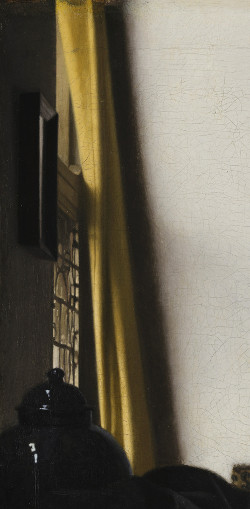
This drawn-back curtain appears to be similar to that of the Woman Holding a Balance, painted in the same years as the present work. Its warm tone, slightly different from the lemon hue of the girl's morning jacket, creates a rare dissonance that must be seen directly to be appreciated. Moreover, the two patches of yellows link the two sides of the painting that are divided by the empty gulf of the white wall. The structure of the window compares favorably to that of the Girl Interrupted in her Music, The Music Lesson, the Woman with a Lute and the Woman with a Water Pitcher.
The orthogonals of the window do not join at the same point as the orthogonal of the table right-hand edge. This inaccuracy is unusual for Vermeer.
The empty chairs
Some writers believe that the empty chairs that populate Vermeer's interiors were meant to allude to a male presence, perhaps a suitor, just outside the picture. However, no historical evidence supports such a conjecture. A chair, in this case, just may have been a chair, or a compositional device meant to bind the figure tightly to the rest of the composition.
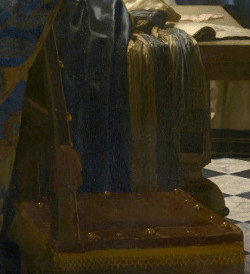
Neutron autoradiography has revealed that Vermeer had originally positioned a cittern on the now-empty chair, with its back side to the spectator. Whether it was painted out to alter the work's symbolic meaning or to simplify the composition cannot be determined. In various paintings, the artist eliminated objects whose symbolic meaning would have been perhaps too readily understood by his contemporaries, wishing, perhaps, to avoid overt didactic statements in favor of a more elusive form of poetry. The chair's design and Bordeaux upholstery appear identical to those of the two chairs in The Art of Painting, painted some years later. The perfectly circular highlights on the shiny brass studs of the chair create an almost physical sensation of spatial distance from the mass of dark paint in the lower half of the composition, which otherwise would have appeared flat and uneventful.

The young girl with a necklace
While none of Vermeer's women can be called conventional beauties, the young girl with a necklace is, perhaps, one of the least striking. Her sleepy gaze (according to one writer, "dreamy"), ski-jump nose and receding forehead do little to qualify her as one of the painting's most memorable passages. And although the painting was not intended as an individualized portrait, the fact that she is viewed in profile exacerbates the lack of empathy.
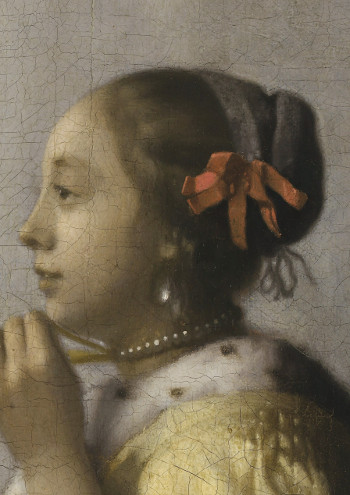
The profile view, in fact, was the preferred view for ancient coins with Roman and Byzantine emperors and Renaissance portraits, probably because it projects an aura of timeless authority. Different from the impersonal patterning of the profile, the direct gaze reduces the barrier between the viewer and the sitter. Character and momentary moods are revealed via eye contact, volume and asymmetry (both anatomical and chiaroscural). Moreover, the profile prohibits the painter from creating a sense of physical weight or bulk, necessary to suggest the presence of the psyche. After the Renaissance, portrait painters avoided full-profile portraits in favor of the three-quarter pose, which became overwhelmingly preferred during the Baroque era.

Profile Portrait of a Young Lady (Simonetta Vespucci?)
Sandro Botticelli
c. 1476
Oil on panel, 57.8 x 43.5 cm.
National Museums in Berlin, Gemäldegalerie, Berlin
The poetic presence of Vermeer's women, including that of the present work, is conveyed not so much by the treatment of their physiognomy but through posture, dress, context and the exceptional care with which they are composed and painted.
The girl's pearl necklace, oversized drop pearl earrings and stylish hairdo with a red ribbon indicate she belonged to the upper crust of Dutch society. The star ribbons attached to her hairdo were fashionable at the time.
The red hair-ribbon accessory, sometimes referred to as a "star ribbon" by costume experts, was popular in the third quarter of the 17th century, particularly after the early 1660s. The same itme can be seen in another painting by Vermeer, A Lady Writing. Often crafted from luxurious materials such as silk or fine threads, and sometimes embroidered with gold or silver, these embellishments were tied around braided hair. The choice of a star, in particular, may have been symbolic—representing not only the celestial but also a nod to navigational stars, highlighting the Netherlands' dominant role in global sea exploration and trade.
The Chinese ginger jar

Examples of Chinese porcelain in the Stedelijk Museum Het Prinsenhof, Delft
When Chinese porcelain, or kraakporselein as the Dutch called it, reached Europe, all those who handled it were amazed. It made native products look hopelessly primitive. The colors were both sharp and brilliant, and the walls of the finest pieces were unbelievably transparent. The first Dutch shipments arrived in 1602 after Dutch traders had seized the Portuguese ship San Iago. Buyers flocked to Amsterdam from all of Europe, and demand soon reached a feverish pitch. Fortunes were gambled to secure shipments from the Orient, and kraakporselein commerce reaped enormous profits for VOC shareholders.
Kraakporselein soon became the subject of many Dutch paintings. It denoted luxury and far-off exotic worlds. Some still-life painters, including one of the greatest still-life painters of all time, Willem Kalf, made their reputations also on their ability to capture its luxurious appearance.
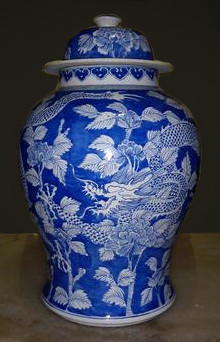
Most scholars have ignored the identity or eventual symbolic meaning of Vermeer's vase, which is probably a Japanese ginger jar. Such jars were originally used to store rare commodities of the time such as salt, herbs, oil and ginger. They were called "ginger jars" because they often contained ginger when they were exported to the West.
In a recent study of the porcelain jar in the present pictures, Christina An and Menno Fitski have shed much light on this mysterious object. They determined that the shape of the cartouches and the overall decoration scheme of Vermeer's jar align with a distinctively Japanese, not Chinese, prototype, as previously held. Furthermore, the turmoil in China following the fall of the Ming dynasty had a significant impact on the export of porcelain. Due to widespread warfare, both domestic Chinese trade routes and porcelain manufacturing kilns in Jingdezhen were disrupted, making it impossible for the Dutch East India Company (VOC) to order porcelain to specification. Fortunately, by the 1650s, Japan's relatively nascent porcelain production had achieved a level of sophistication that enabled it to handle special orders, and beginning with the mid-17th century, it was to Japan, not China, that the VOC directed its new orders for Asian porcelain. The sudden halt of the Chinese porcelain supply during these years also served as a significant catalyst for Delftware in Vermeer's hometown of Delft, leading to its eventual dominance in an industry devoted to imitating this widely coveted Asian commodity.
In any case, when Vermeer painted Woman with a Pearl Necklace in the years 1662-1665, the Japanese porcelain he portrayed a highly desirable and expensive piece from the very latest available range.
Vermeer's rendition remains a tour de force of pictorial skill. While the jar's form and decorative pattern are barely indicated, its lustrous surface is rendered by the carefully placed staccato highlights that indicate an unseen window, which shows how much Vermeer was captivated by light. Not a single piece of porcelain was listed in Vermeer's probate inventory.
The background upholstered chair

Chair in floral design from the Delft or Gouda workshop, c. 1660–1680
This remarkable chair may be the same one that can be seen in The Geographer and in The Concert. This type of chair appears to have been of more or less local Delft manufacture and it is hardly possible to find similar upholstery in the paintings of masters who came from elsewhere. In the Municipal Museum at Delft, there are preserved six of the 41 chairs delivered in 1661 by Maximiliaan van der Gucht, the famous Delft tapestry weaver, to the town for the use of the members of the Town Council, "The Forty." Unfortunately, they are rarely on public display.
Van der Gucht's tapestries were highly regarded for their intricate designs, vibrant colors and skilled craftsmanship. These tapestries often depicted elaborate scenes from mythology, history, or nature and they were valued not only for their visual appeal but also for their warmth and ability to insulate large spaces.
The finishing touches to the morning toilette
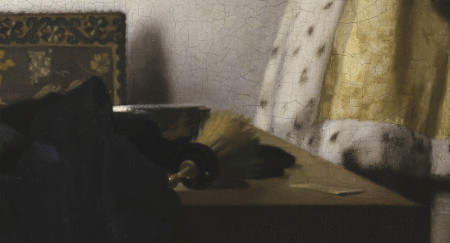
The demure young woman appears to be adding the finishing touches to her morning toilette. She is captured at the moment she tightens the yellow ribbons of her pearl necklace. Despite the young woman's preoccupation with pearls, no jewelry box appears in the pciture, but a basin, a powder brush and, on the near corner of the table, a fine-toothed comb (also good for removing lice). These motifs—together with the focus upon a mirror—stand for purification, the need to cleanse and purify the soul. It has been said that Vermeer exchanged a "negative" for a "positive" meaning when he eliminated a map and stringed instrument from the composition.
As Walter Liedtke wrote, "This intellectual concept, meant for the experienced art lover, would not have been his primary reason for revisiting the painting repeatedly."
The white-washed wall

The Goldfinch
1654
Oil on panel, 33 x 32 cm.
Mauritshuis, The Hague
This striking expanse of stark white-washed wall provides the perfect backdrop for the poetic interaction between the young girl and the mirror she gazes into. This compositional choice becomes even more significant when we recall that Vermeer had originally included a large wall map behind the girl, reminiscent of the figure/ground relationship in the Woman in Blue Reading a Letter. The reason for Vermeer's dramatic alteration of the initial composition layout remains unknown.
The most notable artistic precedent for prominently featuring a blank wall is Carel Fabritius' renowned painting, The Goldfinch. Art historians have speculated that Fabritius' work might have been a signboard for some commercial purpose due to the nail holes along its borders. The simplicity of the small bird against a pure white background would undoubtedly have struck Vermeer, just as it does to anyone today fortunate enough to have seen Fabritius' masterpiece.
The goldfinch was a popular pet in the Netherlands during that time, often kept in captivity and admired for its bright colors and cheerful song. The goldfinch's tethering to a chain in Fabritius' painting can be interpreted as a subtle reminder of captivity or transience. In other paintings, the goldfinch might symbolize religious or moral themes, such as the Passion of Christ, resurrection, or the fleeting nature of life.
Dutch furniture: an extendable table
A Man Weighing Gold (detail)
Cornelis de Man
c. 1670
Oil on canvas, 81.8 x 67.6 cm.
Private collection
The Golden Age of the Netherlands brought about a significant transformation in the role of homes and their furnishings. During this period, houses became adorned with a wide variety of sophisticated items, including intricately carved linen cupboards, various types of tables such as extendable, tea and gaming tables, along with imported goods like Turkish carpets, Chinese porcelain, Venetian mirrors, Japanese lacquerware and quilts from India. The competition from foreign markets spurred local production to reach new heights in terms of quality and diversity.
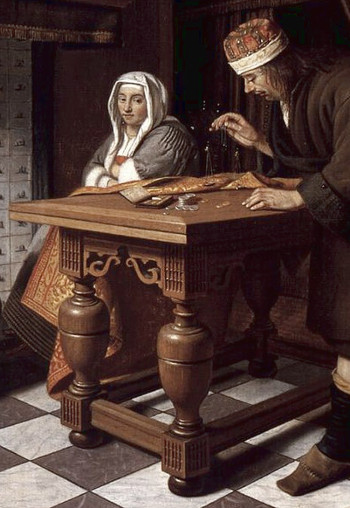
The extendable table featured in Vermeer's painting appears multiple times in his interiors and was a common subject in Dutch art of that era. It was considered a luxury item and served as a symbol of affluence. A similar type of table can be observed in Man Weighing Gold (c. 1670) by Cornelis de Mann.
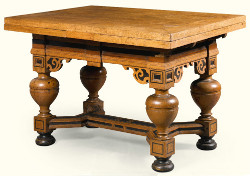
The Rijksmuseum holds a comparable extendable table, characterized by its distinctive bulbous legs. These legs, resembling buns, led to the Dutch term balpoot (literally "ball foot") for this style of furniture. During the 17th century, however, the table was known as a draw-leaf table due to its ability to be extended by pulling out extra leaves. The table's frame beneath the tabletop is adorned with volutes, while the legs are connected by a double Y-frame stretcher. The use of rosewood veneer over oak, along with ebony decorations, adds to its visual appeal. The dimensions of the table are 78.5 x 125 x 84 cm.
Tables during the 17th century were regarded as expensive possessions. Many households made do with simple arrangements, such as placing planks on top of two barrels, showcasing the diverse range of furnishings available to different segments of society during that era.
The blue tablecloth
The draping of the blue tablecloth across the extendable table exhibits similarities in terms of folds and positioning when compared to its depiction in Vermeer's Woman Holding a Balance. The arrangement of meandering folds introduces a visual contrast to the rigid geometric structure of the composition. The somewhat subdued color of the tablecloth, which may have been more vibrant originally, could potentially be attributed to fading over time. Neutron autoradiography, a technique that unveils hidden layers of dark paint, has revealed that the tablecloth was once pulled back further to the left. This adjustment exposed more of the black and white floor tiles situated beneath the table's top surface. It is plausible that Vermeer made this alteration to prevent the intricate arrangement of illuminated tiles from diverting the viewer's attention away from the central interplay between the woman and her reflected image in the mirror.
The gray skirt
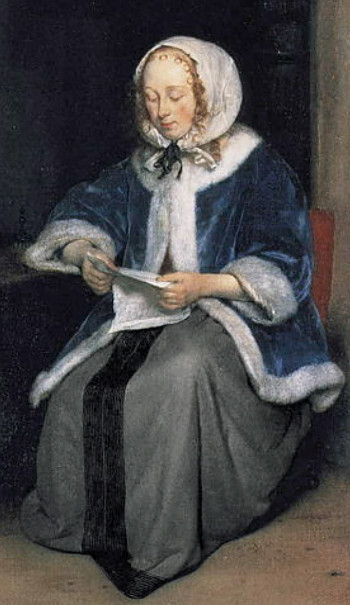
A Lady Reading a Letter (detail)
Gerard ter Borch
c. 1660
Oil on canvas, 51 x 38 cm.
Museum of Fine Arts of Lyon
Although often overlooked in most reproductions, the inclusion of a few faint and inconspicuous black stripes at the forefront of the skirt suggests that it resembles a type of attire frequently depicted in Dutch genre painting. A comparable gray skirt, also featuring subtle decorative stripes, can be observed in Vermeer's Woman in Blue Reading a Letter. A similar article of clothing is showcased more prominently in a variety of refined interior scenes created by Gerard ter Borch, such as A Lady Reading a Letter. Given the substantial folds of the garment, it is reasonable to assume that it was designed to shield women from the cold Dutch winters while they carried out their household tasks.
special topics
- Was the porcelain jar based on an original Japanese design or a specific Dutch request?
- Ideals of beauty & cosmetics
- Artistic collaboration
- Theme & composition
- Looking under Vermeer's painting
- Vermeer's debt to Gerrit ter Borch
- Was Vermeer influenced by Chinese art?
- Mirrors in art
- What kind of a man was Vermeer?
- The importance of contours in Vermeer's art
- The whitewashed walls of Jacobus Vrel
- Listen to period music
Critical assessment
Out of the iconography of Vanity Vermeer has fashioned an image of great purity and innocence, and he tenderly cherishes it as such. The moment of happiness of the painting is characterized by an almost complete absence of ego. The woman appears not so much to be admiring the pearls in the mirror as selflessly, even reverently, offering them up to the light: it is as if we were present at a marriage.
Edward A. Snow, A Study of Vermeer, 1979
The signature

Inscribed on tabletop: (IVM in ligature).
(Click here to access a complete study of Vermeer's signatures.)
Dates
1662–1665
Albert Blankert, Vermeer: 1632–1675, 1975
c. 1664–1665
Arthur K. Wheelock Jr., The Public and the Private in the Age of Vermeer, London, 2000
c. 1663–1664
Walter Liedtke, Vermeer: The Complete Paintings, New York, 2008
c. 1662–1665
Wayne Franits, Vermeer, 2015
(Click here to access a complete study of the dates of Vermeer's paintings).
Technical report
The support is a fine, plain-weave, linen with a thread count of 21.6 x 15 per cm² The original tacking edges are still present. The top tacking edge is wider than the others and appears to have been folded double. Marks from the original strainer bars are evident along the top and right edges. The support has been lined and placed on a stretcher larger than the original strainer.
Over an off-white ground, black underpainting indicates the shadows of the woman's back. An ocher layer on top of the ground may cover the entire painting. It is not covered by any other paint layers in parts of the figure and the stained glass window The woman's yellow jacket is underpainted with white, followed by lead-tin yellow in the light parts and two layers of a black and yellow ocher mixture in the shadows. The flesh tints are composed of various mixtures of white, ocher and black, well blended into one another. The pearl necklace was painted wet-in-wet white over a gray/ocher layer.
* Johannes Vermeer(exh. cat., National Gallery of Art and Royal Cabinet of Paintings Mauritshuis - Washington and The Hague, 1995, edited by Arthur K. Wheelock Jr.)
Provenance
- (?) Pieter Claesz. van Ruijven, Delft (d. 1674);
- (?) his widow, Maria de Knuijt, Delft (d. 1681);
- (?) their daughter, Magdalena van Ruijven, Delft (d. 1682);
- (?) her widower, Jacob Abrahamsz Dissius (d. 1695);
- Dissius sale, Amsterdam, 16 May, 1696, no. 36;
- Johannes Caudri, Amsterdam (before 1809);
- Caudri sale, Amsterdam, 6 September, 1809, no. 42, (to Ths. Spaan);
- D. Teengs sale, Amsterdam, 24 April, 1811, no. 73 (to Gruyter);
- Sale, Amsterdam, 26 March, 1856, no. 93 (to Philip);
- Henry Grevedon, Paris (before 1860);
- Thoré-Bürger (Etienne Joseph Théophile Thoré), Paris (c. 1860–1868);
- Thoré-Bürger et al. sale, Brussels, 22 April, 1868, no. 49 (to Sedelmeyer for Suermondt);
- Barthold Suermondt, Aachen (1868–1874);
- acquired in 1874 as part of the Suermondt collection by the Gemäldegalerie, Staatliche Museen zu Berlin (inv. 912B).
Exhibitions
- Paris 1866
Exposition rétrospective tableaux anciens empruntés aux galeries particulières
Palais des Champs-Elysées
not in cat. - Paris 1914
Hundred Masterpieces: A Selection from the Pictures by Old Masters
Sedelmeyer Gallery
52, no. 24 and ill. - New York May 17–June 13, 1948
Paintings from the Berlin Museums Exhibited in Co-operation with The Department of The Army
Metropolitan Museum of Art
14, no. 138 and ill., as "Young Woman with a Pearl Necklace" - Philadelphia June 19–July 7, 1948
Paintings from the Berlin Museums Exhibited in Co-operation with The Department of The Army
Philadelphia Museum of Art
14, no. 138 and ill., as "Young Woman with a Pearl Necklace" - Chicago July 15–August 4, 1948
Masterpieces of painting saved from the German Salt Mines: Property of the Berlin Museums
The Art Institute of Chicago.
14, no. 138 and ill., as "Young Woman with a Pearl Necklace" - Boston August 14–August 31, 1948
Paintings from the Berlin Museums Exhibited in Co-operation with The Department of The Army
Boston Museum of Fine Arts
14, no. 138 and ill., as "Young Woman with a Pearl Necklace" - Detroit September 10–September 26, 1948
Paintings from the Berlin Museums Exhibited in Co-operation with The Department of The Army
Museum of Fine Arts
14, no. 138 and ill., as "Young Woman with a Pearl Necklace" - Cleveland October 6–October 22, 1948
Paintings from the Berlin Museums Exhibited in Co-operation with The Department of The Army
Cleveland Museum of Art
14, no. 138 and ill., as "Young Woman with a Pearl Necklace" - Minneapolis (MS) November 2–November 17, 1948
Paintings from the Berlin Museums Exhibited in Co-operation with The Department of The Army
Minneapolis Institute of Arts.
14, no. 138 and ill., as "Young Woman with a Pearl Necklace" - San Francisco December 11–December 29, 1948
Paintings from the Berlin Museums Exhibited in Co-operation with The Department of The Army
M.H. de Young Memorial Museum
14, no. 138 and ill., as "Young Woman with a Pearl Necklace" - Los Angeles January 4–January 22, 1949
Paintings from the Berlin Museums Exhibited in Co-operation with The Department of The Army
County Museum of Art
14, no. 138 and ill., as "Young Woman with a Pearl Necklace" - St Louis January 31–February 17, 1949
Paintings from the Berlin Museums Exhibited in Co-operation with The Department of The Army
Saint Louis City Art Museum
14, no. 138 and ill., as "Young Woman with a Pearl Necklace" - Philadelphia February 27–March 14, 1949
Paintings from the Berlin Museums Exhibited in Co-operation with The Department of The Army
Carnegie Institute
14, no. 138 and ill., as "Young Woman with a Pearl Necklace" - Toledo March 22–March 31, 1949
Paintings from the Berlin Museums Exhibited in Co-operation with The Department of The Army
Toledo Museum of Art.
14, no. 138 and ill., as "Young Woman with a Pearl Necklace" - Amsterdam June 17–September 17, 1950
120 Beroemde schilderrijen uit het Kaiser-Friederich-Museum te Berlijn
Rijksmuseum
56, no. 112 and ill. 107 - Washington D.C November 12, 1995–February 11, 1996
Johannes Vermeer
National Gallery of Art
152–155, no. 12 and ill. - The Hague March 1–June 2, 1996
Johannes Vermeer
Mauritshuis
152–155, no. 12 and ill. - Madrid February 19–May 18, 2003
Vermeer y el interior holandés. Museo Nacional del Prado
174–175, no. 36 and ill. - Rome November 11, 2008–February 15, 2009
Da Rembrandt a Vermeer: Valori civili nella pittura fiamminga e olandese del '600 Fondazione Roma
Museo del Corso
104–105, no. 33 and ill. - Tokyo June 13–September 17, 2012
From Renaissance to Rococo: Four Centuries of European Drawing, Painting and Sculpture
National Museum of Western Art - Paris February 20–May 22, 2017
Vermeer and the Masters of Genre Painting: Inspiration and Rivalry
Musée du Louvre - Dublin June 17–September 17, 2017
Vermeer and the Masters of Genre Painting: Inspiration and Rivalry
National Gallery of Ireland - Washington D.C. October 22, 2017–January 21, 2018
Vermeer and the Masters of Genre Painting: Inspiration and Rivalry
National Gallery of Art - Tokyo October 5, 2018 –February 3, 2019
Making the Difference : Vermeer and Dutch Art
Ueno Royal Museum - Dresden June, 4–September 12, 2021
Vermeer: On Reflection
Gemäldegalerie Alte Meister, Dresden - Amsterdam February 10– June 4, 2023
VERMEER
Rijksmuseum
no. 19 and ill.
(Click here to access a complete, sortable list of the exhibitions of Vermeer's paintings).
| Vermeer's life |
In a death inventory of the English sculptor Jean Larson, who lived in the Hague, is listed "a head by Vermeer." Some critics believe it may have bee the Girl with a Pearl Earring. In the early to mid-1660s Vermeer refined all the qualities of his mature style. In his orderly designs, Vermeer gave new life to familiar patterns of contemporary genre painting by closely studying the subtleties of appearance. |
| Dutch painting |
Pieter de Hooch paints Young Woman Weighing Gold Jan Steen: paints The Christening Feast. Frans Hals, one of the most fashionable portraitists of his time and now in his late sixties, paints two of his most significant group portraits, the Regents and Regentesses of the Old Men's Alshouse at Haarlem. Owing to his dire poverty he will be given a small allowance by the town of Haarlem. |
| European painting & architecture |
Nicola Poussin paints Apollo and Daphne John Vanbrugh, Eng. architect and dramatist, is born. Christopher Wren: Sheldonian Theatre, Oxford. Francisco de Zurbaran, Spanish painter, dies. |
| Music |
The French horn becomes an orchestral instrument. Oratorio: Christmas Oratorio by Heinrich Schütz at Dresden. |
| Literature |
William Shakespeare - the second impression of the Third Folio, which added seven plays to the thirty-six of the First Folio and the Second: Pericles, Prince of Tyre and six works from the Shakespeare Apocrypha. Thomas Killigrew and the King's Company stage Killigrew's The Parson's Wedding with an all-female cast. Killigrew attempts a similar all-female production of his play Thomaso, though the project is never realized. |
| Science & philosophy |
Robert Hooke discovers the Great Red Spot (an extremely persistent storm) on Jupiter and uses it to determine the period of Jupiter's rotation, which is astonishingly less than ten hours despite Jupiter's great size. Giovanni Alfonso Borelli, calculates the orbit of a comet and finds that it is a parabola (not a circle, ellipse, or line as expected in various earlier theories). Descartes' Traité de l'homme et de la formation de foetus (treatise on man and the formation of the fetus), printed posthumously, describes animals as purely mechanical beings; that is, there is no "vital force" that makes animals different from other material objects. Christiaan Huygens proposes that the length of a pendulum with a period of one second should be the standard unit for length. |
| History |
Aug 29, Adriaen Pieck/Gerrit de Ferry patented a wooden firespout in Amsterdam. New Amsterdam handed over by Peter Stuyvesant to the English, who renames the city New York Amsterdam passes a regulation banning the sale of "rotten, spoiled, or defective spinach, cucumbers, and carrots, ears of corn, radishes, or other fruits [vegetables] because pride could not be taken in or from such things." Slavery is introduced into the Caribbean island of Montserrat and will not be abolished until 1834. The Black Death kills 24,000 in old Amsterdam while the English are taking Nieuw Amsterdam. The plague spreads to Brussels and throughout much of Flanders, and in December it kills two Frenchmen in London's Drury Lane. Men who put the dead into the deadcarts keep their pipes lit in the belief, now widespread, that tobacco smokers will somehow be spared. Samuel Pepys buys forks for his household, but most Englishmen continue to eat with their fingers and will continue to do so until early in the next century lest they be considered effete or, in the opinion of some clergymen, even sacrilegious. A man going out to dinner has for centuries brought his own spoon and knife, the spoon being folded into the pocket and the knife carried in a scabbard attached to the belt; more men now carry folding forks as well. The Kronenbourg Brewery founded in Alsace will continue into the 21st century to produce beer. |
Ideals of beauty & cosmetics
Although Vermeer could have chosen his themes independently, it is hardly out of the question that he had a sort of loose collaboration with his patron Pieter van Ruijven and his wife Maria de Knuijt, both belonging to Delft's wealthy patrician class. In fact, John Michael Montias believes that the Van Ruijvens and Vermeer maintained a relationship that went beyond that of a simple painter and client.
Van Ruijven, like Vermeer, was ambitious. In 1669, he paid sixteen thousand guilders—a staggering sum—to acquire land near Schiedam, which conferred upon him the title of Lord of Spalant. This acquisition can be considered a 17th-century example of social mobility. The Van Ruijvens may have facilitated Vermeer's experimental working methods by providing him with a sort of stipend. A precedent existed for such financial arrangements in the competitive Dutch art market. Van Ruijven almost certainly knew of this practice from Pieter Spierincx, a distant cousin, who had secured the right of first refusal on the works of art by Gerrit Dou, the most sought-after painter of the time.
Van Ruijven's wife, Maria de Knuijt, had contributed a significantly larger share of money to the marriage than he had, and her taste must have influenced their acquisitions. Moreover, recent archival discoveries show that she lived only a few doors down from where Vermeer grew up on Voldersgracht and was also mentioned as an art connoisseur in her own right. Indeed, the domestic scenes in Vermeer's compositions might have been designed to appeal to a woman's gaze as much as to a man's. According to art historian Lisa Vergara, as a supporter of the Orthodox wing of the Reformed Church, de Knuijt might have particularly appreciated the chaste dignity that characterizes Vermeer's portrayals of femininity.
With such a backdrop, Vermeer, the Van Ruijvens might have discussed art not only in general terms but also in relation to Vermeer's compositions and subject matter, many of which they would have acquired for their own home.
Artistic collaboration

Young Woman Standing before a Mirror
(detail)
Frans van Mieris
1670
42.9 x 31.6 cm.
Alte Pinakothek, Munich
A woman at her toilette was a popular theme among Dutch genre painters in the 1650s and 1660s. A likely iconographic prototype for Vermeer's work is Young Woman before a Mirror (c. 1662) by Frans van Mieris. However, Vermeer seems to have purged his composition of explicit sensuality and the extravagant color scheme present in Van Mieris' version.
Arthur K. Wheelock Jr. pointed out that in the present work the artist "minimized the apparent physical activity of the figure, portraying her at the moment she has the ribbons pulled tautly. Her thoughts may be inward, but they are expressed through her gaze, which reaches across the white wall of the room to the mirror next to the window. The whole space between her and the side wall of the room thus becomes activated with her presence. It is a subtle yet daring composition, one that succeeds because of Vermeer's acute sensitivity to the placement of objects and to the importance of spaces between these objects."
Gregor Weber has recently suggested that the meditative attitude of the young girl—and the figure of Woman Holding a Balance—may have its origin in Catholic devotional literature, presented in a way that is completely new. A few years later, around 1670-1674, when Vermeer painted the Allegory of the Faith, he once again addressed these aspects of religious, spiritual reflection. This additional dimension in the works of art, which was certainly related to Vermeer's conversion to the Catholic faith, thus speaks to the inner values of the human being. In relation to the Vanitas themm Weber also points out, "In a work by the Calvinist poet Jacob Cats, a wise old man assumes the role of the admonisher who has entered the chamber of a young woman and finds her at her dressing table with mirror, pearl necklaces, powder puffs, and perfumes. He tells her that 'beauty' should be more than just external: 'Neen, neen, mijn weerde ziel, wy moeten verder poogen; / Wy moeten hooger sien als op den lust der oogen;/ Wy moeten schoone zijn, en dat aen alle kant,/ Jae tot de gronden selfs, gelijk een diamant' (No, no, dear soul, we must aspire for more, we must set our sights higher than the pleasures of the eyes. We must be purer, and that from every side, down to the essence even, like a diamond).
Theme & composition
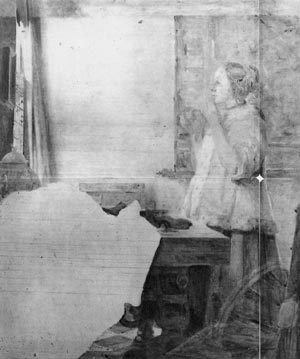
The essential composition we now see was not Vermeer's original concept. Neutron autoradiography has revealed that the artist made critical changes in the composition. By extending the shape of the great folds of the slate-blue tablecloth in the still life, he eliminated a number of black and white floor tiles and more of the table's intricate structure. As a result, the viewer's attention is now drawn to the upper part of the composition. Another important modification was the exclusion of a musical instrument, most likely a cittern, which lay propped up diagonally on the foreground chair.
However, the most startling alteration was the exclusion of a large wall map that surrounded the standing girl. This map absorbed her presence and obfuscated the line of her gaze toward the mirror. The map was very likely the same one that appears in The Art of Painting.
According to Arthur K. Wheelock Jr., the "map, representing the physical world, and the musical instrument, referring to sensual love, would have given a context for interpreting the mirror and the pearls negatively rather than positively. Indeed, the sensual, earthy connotations are similar to those associated with Vrouw Wereld. The Vrouw Wereld (the Lady World) was a well-known allegorical figure dating back to medieval times who personifies worldly pleasures and transience." By removing the map and musical instrument, Wheelock proposes that Vermeer transformed the image into a poetic statement, evoking the ideals of purity and truth.
From technical evidence, Vermeer seems to have restretched the original canvas over a smaller frame, reducing its dimensions to tighten the composition. Subsequent restorers, noting that the painted composition extended over the edges of the stretcher, enlarged the format to what they believed were its original dimensions.
A precursor
A Young Woman at her Toilette
Gerrit ter Borch
c. 1650–1651
Oil on panel, 7.5 x 34.5 cm.
Metropolitan Museum of Art, New York
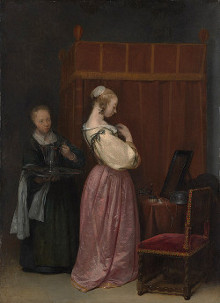
Although Vermeer could have drawn on a number of Dutch paintings of women absorbed in their own beauty, none are as intimate as Gerrit ter Borch's A Young Woman at her Toilette. In Vermeer's work, the young lady puts her final touches on her morning toilette, fastening her pearl necklace, while Ter Borch's figure ties her chemise. Both gaze into a mirror, unaware of their surroundings, making the spectator feel as if he were an intruder.
Prior to Ter Borch's work, the theme of women adorning themselves in front of mirrors had been conceived as warnings against vanity. Ter Borch, perhaps reflecting a positive shift in Dutch attitudes toward women and the private lives of individuals, transformed the subject by focusing on the simplicity and sincerity of female conduct. Ter Borch's half-sister Gesina was the model for the central figure.
Ter Borch made an enormous contribution to the development of interior painting in the Netherlands, and his work was avidly collected and emulated by many artists. He is, perhaps, the only Dutch genre artist who was able to rival Vermeer in the depth and sympathetic treatment of ordinary women. Nonetheless, although Ter Borch may have been more capable of capturing the nuances of female physiognomy than Vermeer, his scenes lack the sense of design and, above all, the sense of three-dimensional space that extends the figure's interior life in Vermeer's paintings.
The VOC & influence of Chinese imports on European life & art

The Port of Middelburg (detail)
Adriaen van de Venne
1615
Oil on panel, 63.2 x 131.6 cm.
Rijksmuseum, Amsterdam
* The VOC (Verenigde Oostindische Compagnie), also known as the Dutch East India Company, was the world's largest trading company in the 17th century. It all started with spices from Asia—pepper, nutmeg, cinnamon and many more. Their aromas and flavors completely transformed ordinary European bread, cakes and stews. These flavorings came from halfway around the world on hundreds of ships carrying thousands of Dutch mariners over millions of miles of dangerous ocean routes. In Asia, these 17th-century adventurers struck trade agreements with local rulers and became familiar with the people and customs of China, India, Japan, Indonesia, Sri Lanka and Vietnam. Many stayed on. Some became spectacularly wealthy. Yet, the human cost of the first global capitalist enterprise was sometimes high.
Those who sailed back to Amsterdam found ready markets for the Asian luxuries packed in their ships. The desire for these amazing objects—to see them, feel them, own them—spread throughout Europe. Gossamer-thin Indian cotton made Dutch wool look drab. A Chinese porcelain cup felt weightless compared to a European stoneware mug. Displaying and wearing treasures made by Asian artists became the rage. As Dutch trade grew, so did Amsterdam. It flourished as the largest, most dynamic city in 17th-century Europe, a center for the arts and sciences. VOC journeys to Asia were long, complicated and risky—but often highly lucrative. Through these voyages, the Dutch developed a vast network in Asia, establishing more than 600 trading centers, from Persia to Japan. Some were simple shacks on a beach; others were fortified cities. They set up their Asian capital at Batavia (now Jakarta). Dutch merchants bought cotton textiles in India and bartered them for other goods elsewhere in Asia. Most VOC profits came from this inter-Asian trade. The Dutch also brought Asian luxuries—lacquer, porcelains, silks and cottons—back to Europe to sell there.
It is known that among the vast quantities of exotic Chinese imports, oriental drawings also found their way to Europe during the time of Vermeer, but they appear to have had negligible influence on Dutch painting. Imitations of Chinese mannerisms seem to have been limited to Delft ceramic painters who copied and elaborated upon imported porcelain for local markets. Nonetheless, early Vermeer writers, who were closer to the 18th-century style known as chinoiserie, speculated that the ineffable atmosphere of Vermeer's paintings may have been influenced by oriental art.
In À la recherche du temps perdu, Marcel Proust evoked the Orient to describe the beauty of Vermeer's painting in his famous passage about a tiny section of Vermeer's View of Delft. He wrote about the last day in the life of a fictitious French writer and art lover, Bergotte: "The circumstances of his death were as follows. A fairly mild attack of uremia had led to his being ordered to rest. But, an art critic having written somewhere that in Vermeer's View of Delft (lent by the Gallery at The Hague for an exhibition of Dutch painting), a picture which he adored and imagined that he knew by heart, a little patch of yellow wall (which he could not remember) was so well painted that it was, if one looked at it by itself, like some priceless specimen of Chinese art, of a beauty that was sufficient in itself."
* "From "Tulips to delftware: How Asian imports transformed Dutch life," https://www.gardinermuseum.on.ca/tulips-delftware-asian-imports-transformed-dutch-life/ (Gardinder Museum)The meanings of mirrors
A Girl with a Mirror
Paulus Moreelse
1627
Oil on canvas
The Fitzgerald Museum, Cambridge
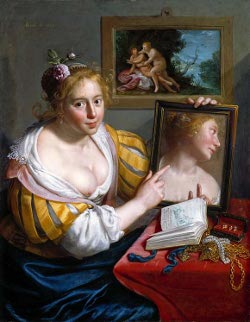
The oracle of Apollo at Delphi urged the ancient Greeks to "know thyself," and mirrors have often been used as symbols of wisdom and self-knowledge. However, the mirror can just as easily imply vanity or an excessive amount of self-regard. The danger of over-admiring one's mirror image is encapsulated in the ancient Greek myth of Narcissus, the beautiful boy who fell in love with his reflection in a pool.
In the ancient world, mirrors were made of highly polished metal, usually copper. The Romans are generally credited with developing glass mirrors, but these were not widely used until around 1500 when convex mirrors were produced in Germany. Venetian glassmakers developed the kind of flat, silvered mirrors we know today. In those times, no other civilization produced glass mirrors. Renaissance painters are known to have extensively utilized mirrors to examine reality more objectively. The availability of high-quality glass and silvering techniques made the Netherlands a significant hub for the production of mirrors in the 17th century.
In ancient art, the mirror is often associated with the realm of women and does not necessarily carry any symbolic value, although it was an attribute of the Roman goddess Venus.
In Christian art, the mirror came to symbolize the eternal purity of the Virgin Mary. In the visual arts, the mirror can have other positive meanings as well. The allegorical figures of Prudence and Truth were often depicted carrying mirrors.
From the Renaissance onward, Vanity and Deception were the connotations the mirror carried most often, rather than Truth and Prudence. A work by Vermeer's contemporary, Paulus Moreelse, typifies this distrust as an allegory of Lasciviousness or Vanity: just as the mirror is dishonest, a carrier of pure illusion, so is this girl's beauty an illusion, as transitory and shallow as her reflection in the glass.
Some painters skillfully made use of the mirror to show us something we would otherwise not be able to see; perhaps the reflection of an object or person outside the scope of the painting. Vermeer displayed both the girl's hidden face and the artist's easel set at a distance from the scene, which unfolds in The Music Lesson. In Woman with a Pearl Necklace and Woman Holding a Balance, the viewer can see nothing but a sliver of light, presumably reflected from the illuminated figure.
Mirrors have been potent props in allegories and are often identified as attributes of various gods and saints, virtues, senses and vices. When Vermeer used mirrors as props in his own works, he was no doubt fully aware that one of the principal functions of art, as defined by contemporary art theorists, was to faithfully mirror nature.
Vermeer's persona
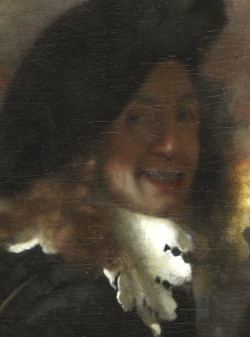
No historical evidence has survived that directly concerns Vermeer's persona, or how he may have interacted with his clients or fellow artists. Certainly, the outward appearance of his painting would suggest a balanced and contemplative gentleman, even though there were many cases in which the world depicted by an artist had little or nothing to do with his known character or personal circumstances. Circumstantial evidence would seem to suggest that Vermeer's personality did not stray too far from what we might deduce from his art: he was even-tempered, confident, controlled and likely graced with above-average social skills. It is presumed that the only surviving effigy of Vermeer is the background figure in his early bordello scene, The Procuress.
Vermeer was repeatedly elected headman of the Guild of St. Luke (the association which furthered the interests of Delft's artists and artisans). No doubt, this job demanded diplomatic qualities as well as the esteem and trust of the guild's heterogeneous members. Art historians have repeatedly underlined that Vermeer was able not only to live and prosper but also to positively relate with his domineering Catholic mother-in-law during the years of his artistic activity. No evidence suggests he ever fell out with her. Furthermore, the artist was able to secure and maintain a vital relationship with a rich Delft patron, Pieter van Ruijven and his wife Maria D de Knuijt, who together had purchased more than half of his entire artistic output. Van Ruijven's wife granted Vermeer a copious sum of money in her last testament, an unusual, if not unique, occurrence. In any case, it is doubtful that Vermeer fit the bill of the eccentric artist, then as now, in vogue among the public.
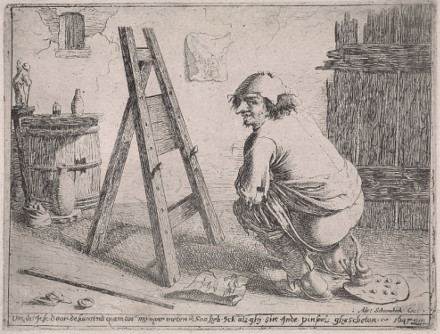
Painter Defacting on Palette and Brushes
Aert van Waes
1645
Etching, 16.2 x 21.4 cm.
Rijksmuseum, Amsterdam
Not all artists aspired to the same level of social acceptance as Vermeer. In fact, as the art historian Ingrid A. Cartwright informs us, the popular motif of Dutch "bohemian-type artists" toiling away in disheveled studios proves that many painters had dropped their noble robes of the pictor doctus and had embraced behaviors that art theorists and the culture at large disparaged. Writers from the second half of the 15th century onward made frequent mentions of artists' eccentricities, foibles and oddities, which were equated with nonconformity, individuality and creative superiority. Biographers reported artists' personal oddities while humanizing their otherwise mystifying profession, allowing viewers to picture the personalities residing behind the brushstrokes.
More likely, Vermeer aspired to bequeath an image of himself as the supremely accomplished artist, a genius guided by divine grace, as conceived in the Italian Renaissance. The aspiration to guarantee himself a place in history is nowhere better exemplified in visual terms than in his ambitious Art of Painting, a painted hymn to his profession and extraordinary talent.
Painting edges

The problem of rendering the quality of edges is a crucial aspect of pictorial representation. As the American painter and author of the first Vermeer monograph published in America, Philip Hale, wrote, primitive painters almost universally made, as amateurs still make, their edges too sharp. As a consequence, whatever the merit of their work may be, they tend to appear hard and dry. Leonardo da Vinci was perhaps the first painter to study edges systematically and employ both hard and soft ones. Many of his followers, and even more so the school of Correggio, tended to paint their edges almost uniformly soft.
The best 17th-century Dutch painters studied their edges attentively, and so one thinks less of the hardness or softness of their work than is the case when viewing Great Masters of other nations. Their good paintings simply look right in this respect. Vermeer was notably successful in creating something so like the aspect of nature that the spectator takes the edges for granted. It is likely that Vermeer studied closely the works of Gerrit ter Borch, who perhaps, more than any other painter in history, understood the necessity of varying contour to accurately evoke a natural sense of form, space and light in painting.
In the present work by Vermeer, there is a notable variety of contours. The back edge of the girl's yellow jacket is surprisingly blurred. The naked eye would not have seen it that way. But the painting conveys the idea of incomparable softness of the fabric and roundness of the form. Had Vermeer opted for a sharp contour, the figure of the girl would have appeared flattened and closer, almost attached, to the background wall.
The difficulty in understanding how to portray edges is caused by the fact that we do not normally see blurred edges in nature since our eyes are constantly focusing and refocusing to guarantee the sharpest and most comprehensible image possible. This is especially true with objects as close to the viewer as those in the paintings of Vermeer. The painter must subvert, as it were, what he normally sees in favor of what he knows will be more effective in painting.
Plain white-washed walls
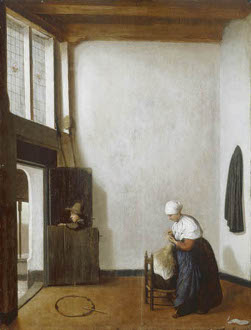
Interior with a Woman Combing a Little Girl's Hair
Jacobus Vrel
c. 1654/1662
Oil on oak, 55.9 x 40.6 cm.
Detroit Instituteof Art, Detroit
Although Vermeer's plain white-washed walls are often taken for granted as historical chronicles, they constitute a tour de force of painting technique and are crucial in creating the atmosphere of his interiors. Generally, Vermeer's treatment of the white-washed-wall motif is linked to Carel Fabritius and, of course, Pieter de Hooch.
However, there exists another painter who delighted in painting simple walls: Jacobus Vrel, a charmingly idiosyncratic minor master whose place in art history was slightly more than negligible, but has been recently reconsidered upward. Some critics have called him "Vermeer's forunner."
The works of Vrel have traditionally been confused with those of Vermeer and De Hooch. Some of his canvases bear signatures that have been altered to read "Vermeer" or "De Hooch." Vrel's technique is unusual for the Dutch school in that he rejected finicky detail in favor of a broad depiction, remarkable for its controlled simplicity.
One might easily suppose that the provincial autodidact Vrel must have taken the lead from Vermeer or De Hooch. However, his only dated painting, from 1654, suggests that rather than following, he anticipated the two Delft artists' interest in domestic themes and light effects. His Interior with a Woman at a Window, dated 1654, proves it was made four years before any known Delft-style interiors or courtyards by De Hooch. Art historians generally date Vermeer's first interiors from about 1657. Equally perplexing is the fact that Vrel depicted a series of simple town views that cannot fail to suggest the unpretentiousness of Vermeer's Little Street.
Ideals of beauty in 17th-century Netherlands
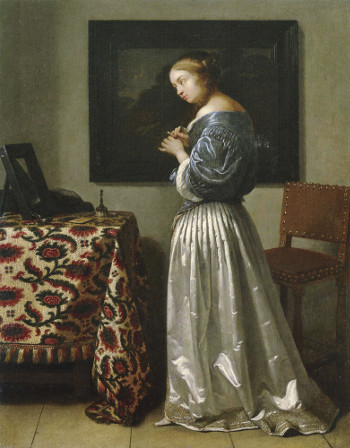
Young Woman at her Toilet
Caspar Netscher
c. 1665
Oil on panel, 42.5 x 33 cm.
Private collection
The woman donning a pearl necklace in Vermeer's picture is presumably putting the final touches on her morning toilette. On the table lies a powder brush and a fine comb. An unidentifiable box behind these objects may be associated with her morning activities, perhaps serving as a container for her necklace or cosmetics.
In the 17th century, both men and women cared about their appearance. In an age when men believed that a woman's "first merit is that of beauty" (and many women no doubt thought the same), women of the upper classes took great care to present their bodies and faces in the most attractive manner. The ideal woman should have a fair complexion, a round or oval face and a well-proportioned nose. Large, moist, dark eyes, a high forehead and a small double chin were also appreciated. The mouth should be small but with full lips. Blond hair was also considered beautiful, so some women, plucked their eyebrows, dyed their hair or shaved an inch or two from their foreheads (a high forehead was cinsidered a sign of intelligence).
To conform to the current ideal of beauty—which not every woman was naturally blessed with—women utilized cosmetics and various practices that today would be considered repulsive or even dangerous. Various books and pamphlets circulated with recipes and advice on how to improve one's appearance. In one such book, already published in 1608, a chapter was entitled Delights for Ladies to Adorn Their Persons, Tables, Closets, and Distillatories: With Beauties, Banquets, Perfumes and Waters.

Face
Anonymous, after Abraham van Diepenbeeck (1600–1676)
Engraving, 140 x 96 mm.
Rijksmuseum, Amsterdam
To redden lips and cheeks, vermilion, an orange-red pigment derived from mercury, was employed—no doubt with unhealthy effects. Fortunately, some women used harmless substances to color their cheeks, such as red ocher or a tincture of boiled crabs.
In the later 16th century, white lead was revived as a way of attaining a pale complexion, which was a sign of well-being and wealth (poor women had to work outdoors and thus were suntanned). The dangers of lead carbonate were unknown, but it was believed to be effective in treating certain skin pathologies. The use of lead carbonate produced quite the opposite effects, including hair loss, inflamed eyes, damaged teeth and even blackened skin. Lead poisoning could also lead to death. It was also believed that lighter skin could be achieved by bathing the skin in one's own urine. To soften the skin, a French chemist recommended women wash "with rosewater mixed with wine, else make a decoction of the rinds of lemon."
Vermeer's nuanced depiction of women's morning rituals opens a window into the complexities of 17th-century beauty standards and practices. Although we often romanticize the past, understanding the risks associated with beauty practices of the era adds depth to our appreciation of these classic works of art. While cosmetics were dangerous and potentially lethal, the desire to conform to societal standards compelled women to take these risks. How many of Vermeer's subjects, one wonders, may have suffered the ill effects of such beauty rituals?
Judging by the face of Vermeer's young lady, it would seem that if she did use cosmetics, she used them sparingly.
Was the porcelain jar based on an original Japanese design or a specific Dutch request?
Recently, Christina An and Menno Fitski published an in-depth study of the porcelain jar we see in the present picture, some of which is as follows.
The Netherlands began its official porcelain trade with Japan around 1655, according to records from the VOC (Dutch East India Company). These records highlight that Japanese porcelain was exceptionally profitable in Holland. In 1661, the VOC sent a specific request to Japan for various porcelain items, including "large bowls and pots." To streamline the process, Delftware models were dispatched to Japan in the same year to clarify the exact requirements. By November 1662, Dutch shipments from Japan included porcelain items crafted based on these Delftware models. Consequently, Japanese porcelain inspired by Delftware models began appearing in the Netherlands as early as 1663.
Despite these shared characteristics, two critical factors argue against the possibility that Vermeer's jar was modeled after a Delftware example. First, the Japanese porcelain jars of the period significantly outperformed their Delftware counterparts in terms of glossiness. Vermeer represented this in his painting through pronounced highlights, likely capturing the effect of light from a second, unseen window. Second, the Japanese porcelain jar closely aligns with Vermeer's painted version in both the height of its neck and, most notably, the unique shape of its lid. In contrast, a painting by Cornelis De Man features a Delftware jar with a completely different lid silhouette.
 Antonio Vivaldi