To access the an INTERACTIVE STUDY of any painting in the catalogue, click on the title or thumbnail of the work below.
AUTHENTICITY There are thirty-four paintings which modern scholars overwhelmingly agree should be attributed to Johannes Vermeer of Delft. Three works are included in this catalogue that have not received unanimous acceptance: Saint Praxedis, Girl with a Flute and A Young Woman Seated at the Virginals (the latter not to be confused with the London National Gallery picture of similar title and motif).
- After being initially accepted only by Arthur K. Wheelock Jr. as an authentic work by Vermeer, leading scholar Gregor Weber has also enlisted the Saint Praxedis to Vermeer, but many scholars continue to reserve doubts. It has been listed in an appendix as work "A."
- The Girl with a Flute was recently ousted from Vermeer's oeuvre by the National Gallery of Art, maintaining it is a work by an unknown frequenter of Vermeer's studio. Many scholars still accept it as authentic. It is accepted as no. 25 in the Essential Vermeer catalogue.
- A Young Woman Seated at the Virginals (again, not to be confused with the London National Gallery picture of similar name and motif) was proposed as an authentic work Vermeer by leading a Vermeer expert Walter Liedtke and included it in his Vermeer: The Complete Catalogue of 2008 (no. 36). Since then Arthur K. Wheelock Jr., Wayne Franits and the curators of the Rijksmuseum 2023 Vermeer exhibition have also accepted it as authentic.
Nonetheless, the lack of open scholarly discussion regarding this work has encouraged the author of this site to label this work as questionable. Current acceptance is largely based in scientific evidence which, however, has proven that the painting originated in the seventeenth century. It is the opinion of the author that further research and scholarly discussion is necessary. It has been listed in an appendix as work "B."
DATING Since only three Vermeer's paintings are dated by his own hand, the dates of each picture proposed in the Essential Vermeer catalogue covers the range of those estimated by four authoritative scholars of Dutch art and Vermeer: Albert Blankert (Vermeer: 1632–1675, 1975), Arthur K. Wheelock Jr. (The Public and the Private in the Age of Vermeer, 2000), Walter Liedtke (Vermeer: The Complete Catalogue, 2008) and Wayne Franits (Vermeer, 2015). Catalogue numbers were calculated by averaging their total estimates.
For a complete table of estimated dates, including those the recent 2023 Vermeer retrospective at the Amsterdam Rijksmuseum, click here.
TITLES Over the years, scholars and museums have given a number of titles to each of Vermeer's paintings. For the sake of uniformity, the titles used in this catalogue are those found in Arthur K. Wheelock's Vermeer and the Art of Painting (pp. 169–186).
VISITING THE REAL PAINTINGS Although digital imaging technology as applied to works of art has reached unparalleled levels of sophistication, experiencing a real painting cannot be adequately duplicated by such means. For this reason, the author of this website strongly encourages readers to visit the works which interest them most whenever it is possible. In any case, although EV makes best efforts to maintain the whereabouts of each painting up to date, ALWAYS contact the art collection where the paintings(s) you wish to see are housed BEFORE making travel plans.
Click here for a sortable table of all paintings by Vermeer.
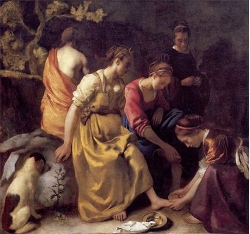
Diana and her Companions
c. 1653–1656Oil on canvas
98.5 x 105 cm. (38 3/4 x 41 3/8 in.)
Koninklijk Kabinet van Schilderijen Mauritshuis, The Hague
museum contact | visitor information
TEMPORARY EXHIBITION
Girl with a Pearl Earring
Nakanoshima Museum of Art
August 21-September 27, 2026
https://vermeer2026.exhibit.jp/
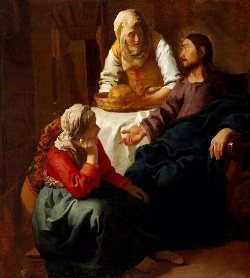
Christ in the House of Martha and Mary
c. 1654–1656Oil on canvas
160 x 142 cm. (63 x 55 7/8 in.)
National Gallery of Scotland, Edinburgh
museum contact | visitor information
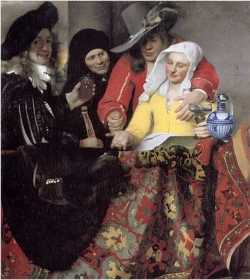
The Procuress
1656Oil on canvas
143 x 130 cm. (56 1/8 x 51 1/8 in.)
Gemäldegalerie Alte Meister (Old Masters Picture Gallery), Dresden
museum contact | visitor information
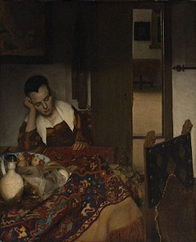
A Maid Asleep
c. 1656–1657Oil on canvas
87.6 x 76.5 cm. (34 1/2 x 30 1/8 in.)
Metropolitan Museum of Art, New York
museum contact | visitor information
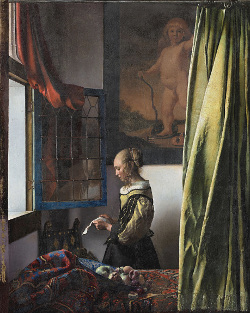
Girl Reading a Letter at an Open Window
c. 1657–1659Oil on canvas
83 x 64.5 cm. (32 3/4 x 25 3/8 in.)
Gemäldegalerie Alte Meister
(Old Masters Picture Gallery), Dresden
museum contact | visitor information
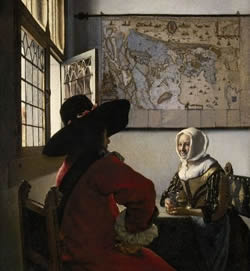
Officer and Laughing Girl
c. 1657–1660Oil on canvas
50.5 x 46 cm. (19 7/8 x 18 1/8 in.)
Frick Collection, New York
museum contact | visitor information
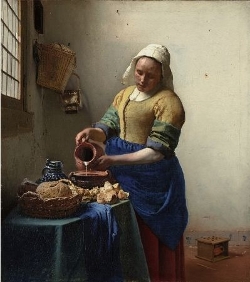
The Milkmaid
c. 1657–1661Oil on canvas
45.5 x 41 cm. (17 7/8 x 16 1/8 in.)
Rijksmuseum, Amsterdam
museum contact | visitor information
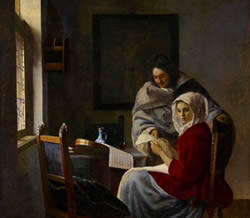
Girl Interrupted in her Music
c. 1658–1661Oil on canvas
39.3 x 44.4 cm. (15 1/2 x 17 1/2 in.)
Frick Collection, New York
museum contact | visitor information
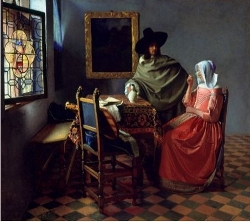
The Glass of Wine
c. 1658–1661Oil on canvas
65 x 77 cm. (25 5/8 x 30 1/4 in.)
Staatliche Museen Preußischer Kulturbesitz, Gemäldegalerie, Berlin
museum contact | visitor information
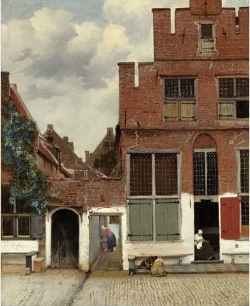
The Little Street
c. 1657–1661Oil on canvas
54.3 x 44 cm. (21 3/8 x 17 3/8 in.)
Rijksmuseum, Amsterdam
museum contact | visitor information
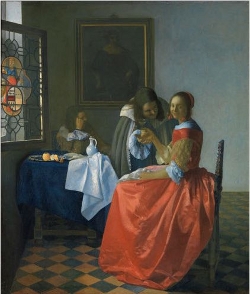
The Girl with a Wine Glass
c. 1659–1662Oil on canvas
78 x 67 cm. (30 3/4 x 26 3/8 in.)
Herzog Anton Ulrich-Museum, Braunschweig (Brunswick)
museum contact | visitor information
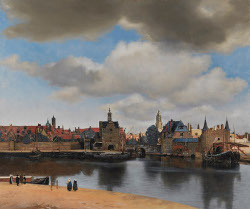
View of Delft
c. 1660–1663Oil on canvas
98.5 x 117.5 cm. (38 3/4 x 46 1/4 in.)
Koninklijk Kabinet van Schilderijen Mauritshuis, The Hague
TEMPORARY EXHIBITION
Girl with a Pearl Earring
Nakanoshima Museum of Art
August 21-September 27, 2026
https://vermeer2026.exhibit.jp/
museum contact | visitor information
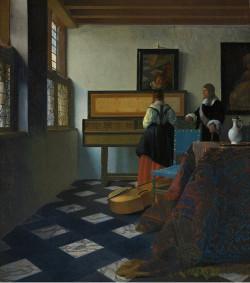
The Music Lesson
c. 1662–1665Oil on canvas
73.3 x 64.5 cm. (28 7/8 x 25 3/8 in.)
The Royal Collection, The Windsor Castle
museum contact | visitor information
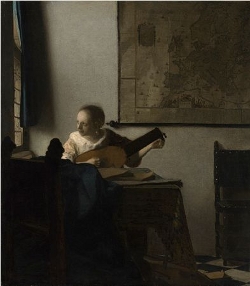
Woman with a Lute
c. 1662–1665Oil on canvas
51.4 x 45.7 cm. (20 1/4 x 18 in.)
Metropolitan Museum of Art, New York
museum contact | visitor information
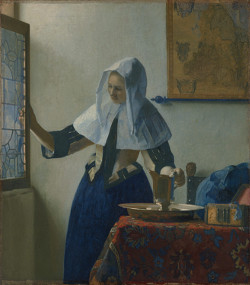
Young Woman with a Water Pitcher
c. 1662–1665Oil on canvas
45.7 x 40.6 cm. (18 x 16 in.)
Metropolitan Museum of Art, New York
museum contact | visitor information
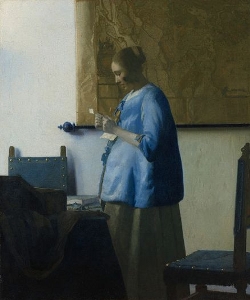
Woman in Blue Reading a Letter
c. 1662–1665Oil on canvas
46.5 x 39 cm. (18 1/4 x 15 3/8 in.)
Rijksmuseum, Amsterdam
museum contact | visitor information
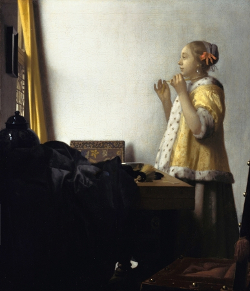
Woman with a Pearl Necklace
c. 1662–1665Oil on canvas
55 x 45 cm. (21 5/8 x 17 3/4 in.)
Staatliche Museen Preußischer Kulturbesitz, Gemäldegalerie, Berlin
museum contact | visitor information
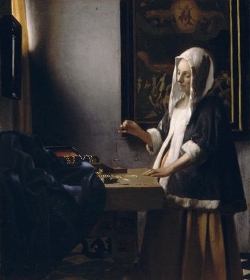
Woman Holding a Balance
c. 1662–1665Oil on canvas
42.5 x 38 cm. (16 3/4 x 15 in.)
National Gallery of Art, Washington D.C.
museum contact | visitor information
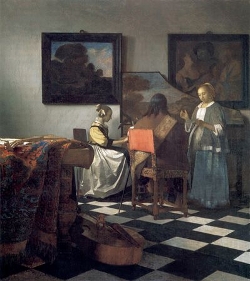
The Concert
c. 1663–1666Oil on canvas
72.5 x 64.7 cm. (28 1/2 x 25 1/2 in.)
Isabella Stewart Gardner Museum, Boston
museum contact | visitor information
Painting not on display
Vermeer's Concert was stolen on March 18, 1990 and has not been recovered. Click here for information.
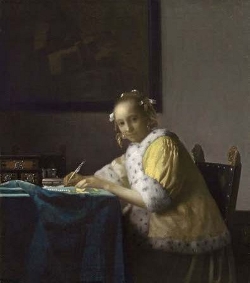
A Lady Writing
c. 1662–1667Oil on canvas
45 x 39.9 cm. (17 3/4 x 15 3/4 in.)
National Gallery of Art, Washington D.C.
museum contact | visitor information
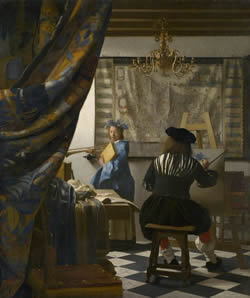
The Art of Painting
c. 1662–1668Oil on canvas
120 x 100 cm. (47 1/4 x 39 3/8 in.)
Kunsthistorisches Museum, Vienna
museum contact | visitor information
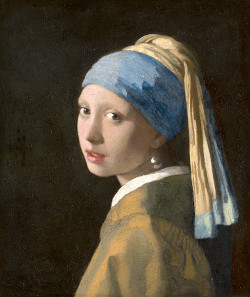
Girl with a Pearl Earring
c. 1665–1667Oil on canvas
46.5 x 40 cm. (18 1/4 x 15 1/4 in.)
Koninklijk Kabinet van Schilderijen Mauritshuis, The Hague
museum contact | visitor information
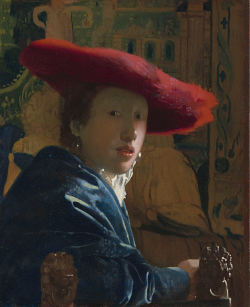
Girl with a Red Hat
c. 1665–1667Oil on panel
23.2 x 18.1 cm. (9 1/8 x 7 1/8 in.)
National Gallery of Art, Washington, D.C.
museum contact | visitor information
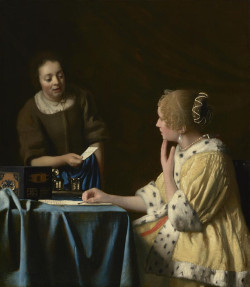
Mistress and Maid
c. 1666–1668Oil on canvas
90.2 x 78.7 cm. (35 1/2 x 31 in.)
Frick Collection, New York
museum contact | visitor information
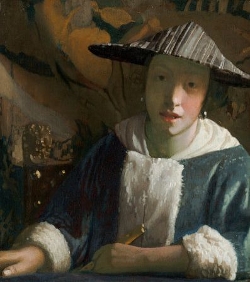
Girl with a Flute
c. 1665–1670Oil on panel
20 x 17.8 cm. (7 7/8 x 7 in.)
National Gallery of Art, Washington D.C.
museum contact | visitor information
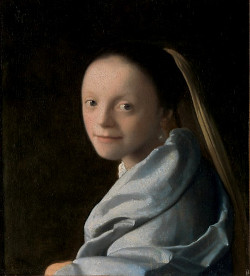
Study of a Young Woman
c. 1665–1674Oil on canvas
44.5 x 40 cm. (17 1/2 x 15 3/4 in.)
Metropolitan Museum of Art, New York
museum contact | visitor information
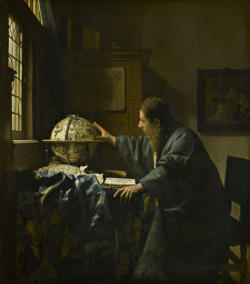
The Astronomer
1668Oil on canvas
50 x 45 cm. (19 5/8 x 17 3/4 in.)
Musée du Louvre, Paris
museum contact | visitor information
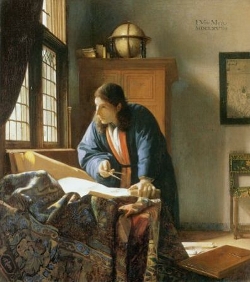
The Geographer
c. 1668–1669Oil on canvas
53 x 46.6 cm. (20 7/8 x 18 1/4 in.)
Städelsches Kunstinstitut, Frankfurt am Main, Germany
museum contact | visitor information
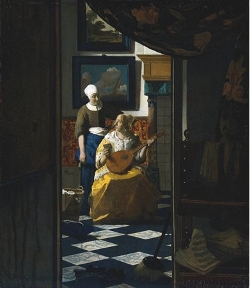
The Love Letter
c. 1667–1670Oil on canvas
44 x 38.5.cm. (17 3/8 x 15 1/8 in.)
Rijksmuseum, Amsterdam
museum contact | visitor information
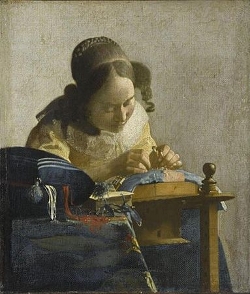
The Lacemaker
c. 1669–1671Oil on canvas (attached to panel)
24.5 x 21 cm. (9 5/8 x 8 1/4 in.)
Musée du Louvre, Paris
museum contact | visitor information
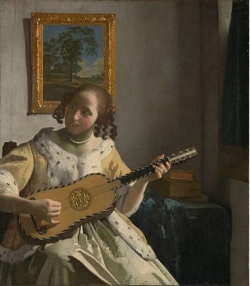
The Guitar Player
c. 1670–1673Oil on canvas
53 x 46.3 cm. (20 7/8 x 18 1/4 in.)
Kenwood House English Heritage as Trustees of the Iveagh Bequest, London contact | visitor information
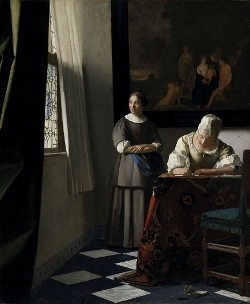
Lady Writing a Letter with her Maid
c. 1670–1671Oil on canvas
71.1 x 58.4 cm. (28 x 23 in.)
National Gallery of Ireland, Dublin
museum contact | visitor information
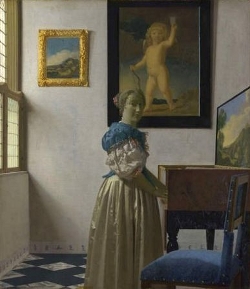
A Lady Standing at a Virginal
c. 1670–1674Oil on canvas
51.7 x 45.2 cm. (20 3/8 x 17 3/4 in.)
National Gallery, London
email contact | visitor information
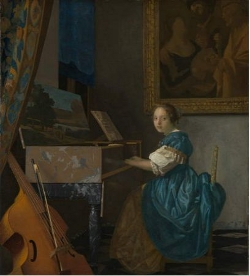
A Lady Seated at a Virginal
c. 1670–1675Oil on canvas
51.5 x 45.5 cm. (20 1/4 x 17 7/8 in.)
National Gallery, London
email contact | visitor information
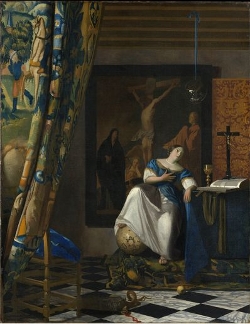
Allegory of Faith
c. 1670–1674Oil on canvas
114.3 x 88.9 cm. (45 x 35 in.)
Metropolitan Museum of Art, New York
museum contact | visitor information
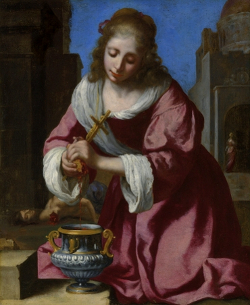
Saint Praxedis
(attributed to Vermeer)1655
Oil on canvas
101.6 x 82.6 cm. (40 x 32 1/2 in.)
Kufu Company Inc., on long-term loan to the National Museum of Western Art, Tokyo
contact | visitor information
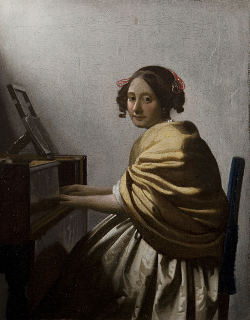
A Young Woman Seated at the Virginals
(attributed to Vermeer)Oil on canvas
c. 1670
25.2 x 20 cm. (9 7/8 x 7 7/8 in.)
The Leiden Collection, New York contact | visitor information