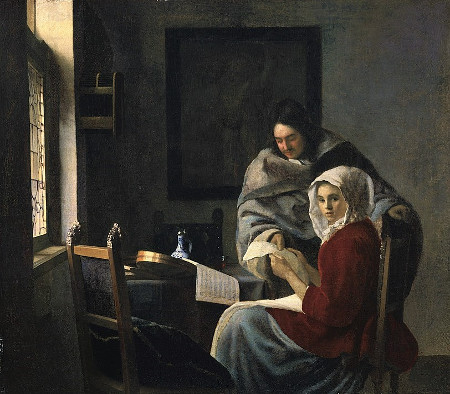
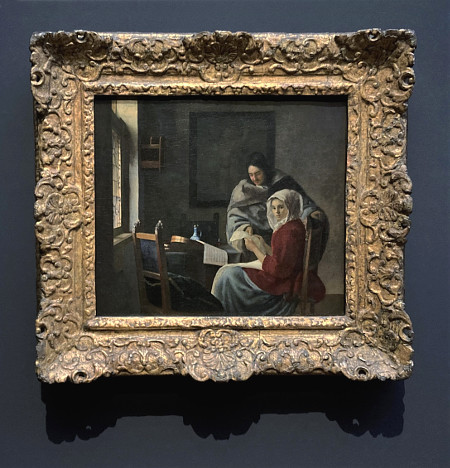
Girl Interrupted in her Music
(Onderbreking van de muziek)c. 1658–1661
Oil on canvas
39.3 x 44.4 cm. (15 1/2 x 17 1/2 in.)
Frick Collection, New York
acc. no. 11.1.125
The textual material contained in the Essential Vermeer Interactive Catalogue would fill a hefty-sized book, and is enhanced by more than 1,000 corollary images. In order to use the catalogue most advantageously:
1. Scroll your mouse over the painting to a point of particular interest. Relative information and images will slide into the box located to the right of the painting. To fix and scroll the slide-in information, single click on area of interest. To release the slide-in information, single-click the "dismiss" buttton and continue exploring.
2. To access Special Topics and Fact Sheet information and accessory images, single-click any list item. To release slide-in information, click on any list item and continue exploring.
Cupid as a "picture-within-a-picture"
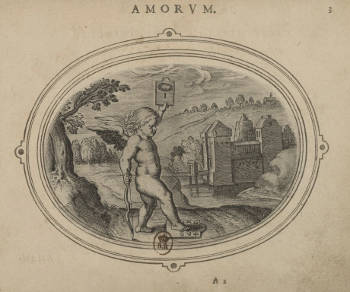
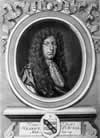
Amorum emblemata ("Perfectus amor non est nisi ad unum")
Otto Vaenius
Engraving, 1608
Antwerp: [Typis Henrici Swingenii] Venalia apud Auctorem, 1608
Much has been written about the Cupid picture-within-a-picture that hangs on the background wall. Until the painting underwent restoration in 1907, this element was concealed by an expanse of wall with a small violin hanging from a nail. Such depictions were frequently used as a visual tool, offering supplementary insights or commentary—often with a moralistic tone—on the scene depicted beneath.
The artwork has been associated with two visual references: firstly, a Cupid reminiscent of the style of Vermeer's contemporary, Cesar van Everdingen; and secondly, an illustration from an emblem book.
For this particular composition, the depiction of Cupid might serve as a warning to the young duo. Their musical engagement appears to mask the underlying romantic intentions of the young gentleman. Eddy de Jongh suggests that the portrayal of a Cupid with a raised hand was likely influenced by a widely-recognized emblem book by Otto van Veen, emphasizing the principle that one should be devoted to a single lover. Vermeer scholar Walter Liedtke, however, has highlighted that Vermeer's rendition omits several elements present in Van Veen's original. As a result, Vermeer's Cupid might simply convey the idea that love permeates the scene. Another interpretation posits that if the Cupid in Vermeer's painting is holding a blank card rather than a tablet, it could imply that love can be unpredictable. Given the deteriorated condition of this portion of the painting, its full narrative may remain elusive.
It's worth noting that the prominently featured Cupid might have been a part of the esteemed art collection owned by Vermeer's mother-in-law, Maria Thins. One should keep in mind that paintings, except in specific instances, were generally more affordable than other luxury items like jewelry or silverware during that era. In Dutch households, paintings had roles beyond simply being valuable art pieces.
The courting cavalier
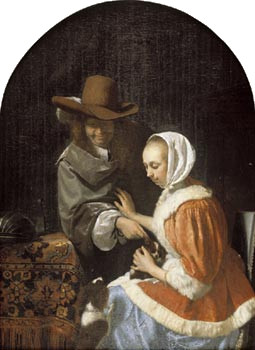
Teasing the Pet
Frans van Mieris
1660
Oil on panel, 27.5 x 20 cm.
The Hague, Mauritshuis
The dapper cavalier gently leans toward a young woman, offering support to the sheet music she holds. Although the cavalier's gaze is downcast, his intention to let music and a touch of red wine further his romantic intent is unmistakable. Vermeer might have taken cues from artworks like Jan Steen's Music Master or Frans van Mieris' Teasing the Pet. However, he modified the body language and facial expressions of his subjects to create a more subdued ambiance.
Such depictions of gentlemen might echo a prevalent literary motif of the period. Men, overwhelmed by romantic passion, were likened to mice ensnared in traps, to cats menacingly lurking nearby, to squirrels spinning endlessly in caged wheels, to stags pierced by arrows, or even to insects lured by the flame of candles.
Regrettably, time and past restoration efforts have taken a toll on the cavalier's cloak, leaving it almost obliterated.
Wine, music making and courtship
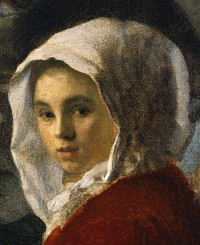
Consistent with his manner, Vermeer often borrowed themes and compositions from prominent interior painters of his era. The archetypes for this piece depict a man and woman deeply engrossed in their musical pursuits, seemingly oblivious to an onlooker. In this artwork, reminiscent of the earlier Girl with a Wine Glass, Vermeer employs a visual technique that adds depth to the narrative, urging the viewer to become an active participant. Rather than engaging with the cavalier, the young woman momentarily diverts her gaze towards the observer, putting on hold her interaction with the oblivious cavalier. Recent research at the Rijksmuseum has revealed that the girl's gaze was initially more inwardly directed. However, Vermeer subsequently adjusted the position of her eyes, choosing to establish direct eye contact with the viewer.
Marieke de Winkel, a noted Dutch costume scholar, highlights that the headgear donned by the young woman was not only decorative but also functional, preserving the hairstyle before and after grooming.
The Low Countries earned renown for their cloth production since medieval times. This industry remained a cornerstone of the Dutch economy, witnessing a significant boost from the influx of textile artisans from the southern regions. Haarlem, in particular, was celebrated for its linen. Artisans there excelled in refining and bleaching both locally-woven fabrics and those imported from across Europe. This bleached linen found its way into garments like caps (mutsen), aprons, shawls, collars and cuffs—items frequently depicted in Vermeer's oeuvre.
Regrettably, segments of the painting, including the young girl's skirt and jacket, have borne the brunt of time and overzealous restoration. Among the two subjects, perhaps only the visage of the young woman retains some semblance of its initial subtlety.
The Dutch songbook
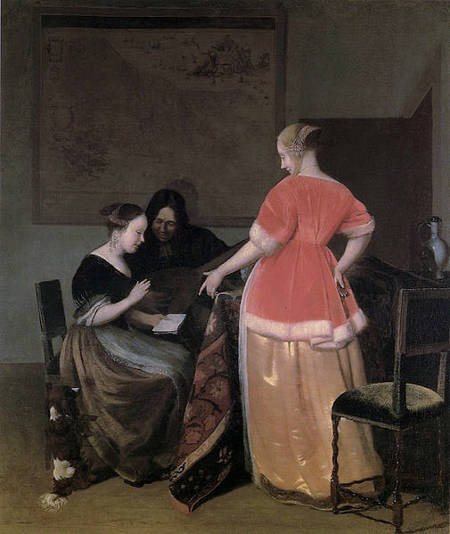
The Music Lesson
Jacob Ochtervelt
c. 1667
Oil on canvas, 69 x 58 cm.
Reiss-Engelhorn-Museen, Mannheim, Germany
Although we know nothing of Vermeer's tastes in music and the arts, the people he chose to represent would have ideally belonged to the haute bourgeoisie who wrote and spoke several languages and who collected European poetry and songbooks. Songbooks, one of which can be observed on the table (complete with musical notation), played a conspicuous role in the rituals of modern courtship, the theme of the present work.
Since Dutch music was in great part uninventive, Dutch songbooks contained many French as native airs. Amateur musicians, like the two which Vermeer represents in this painting, probably collected them in numbers. Music making provided the ideal ground on which both parties could approach each other without the presence of parents or older guardians.
Young musicians had a vast choice of foreign and local songbooks, which were called liedboeken, or collections of love songs. The Dutch music expert Louis Peter Grijp pointed out how these books frequently reflected the local culture containing references to favorite meeting places for lovers, taverns, etc. Some songs proclaimed the beauty of local women over those of other towns while others demonstrated a growing affection for national Dutch identity. The dedicatory preface of Den Nieuwen Lust-Hof, one such music book, was to the "Young Ladies of the Netherlands." One author from Utrecht complained that the local youth had not purchased his previous works because they had preferred the more elaborate songbooks of Amsterdam and Haarlem.
Some songbooks included risqué lyrics while others were polite. In a single volume, one may occasionally find refined Petrarchan-inspired love songs, vulgar songs of prostitutes, festive drinking as well as pious hymns and even patriotic tunes. While many emphasized moral integrity, the readers themselves were never directly admonished, evidently assuming that they were already of impeccable character.
The ceramic wine jug

At the still life's core, nestled behind the cittern's wooden structure, stands a slender-necked vase adorned with blue patterns and capped with silver. This piece is likely a wine jug crafted in Delft, a major hub for porcelain production in the Netherlands. The Dutch East India Company, or VOC, was instrumental in importing similar porcelain from China in vast amounts, expanding its trade networks globally. However, by 1645, these imports plateaued, catalyzing a notable shift in Dutch craftsmanship. Earthenware artisans from Delft, Haarlem and possibly Rotterdam had been attempting to replicate the esteemed Chinese porcelain since the 1620s, albeit with modest success. Following extensive experimentation, they eventually mastered the craft, producing delicate, white-glazed earthenware accentuated with blue motifs reminiscent of the Chinese style. Delft emerged as the industry's epicenter, repurposing defunct beer breweries to house expansive pottery workshops. In time, their imitation porcelain became so sophisticated that it found markets even in China.
At the pinnacle of its prominence, Delft boasted over thirty active potteries, manufacturing everything from utilitarian household items to ornamental panels. While the quintessential Delftware is characterized by its blue-on-white aesthetic, select pieces showcased a spectrum of hues. Notably, Royal Delft—previously known as Porceleyne Fles or Porcelain Bottle and established in 1653—continues its storied legacy, producing ceramics to this day.
The birdcage: someone else's idea
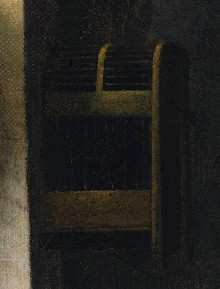
In 1899, Hofstede de Groot expressed concerns that the birdcage and violin, the latter of which previously positioned on the backdrop wall where now a sizable painting of Cupid is displayed, seemed recently painted. The current conservator of the Frick Collection shares this view, believing the birdcage was added by a subsequent artist. While birdcages frequently adorned Dutch interior paintings and carried a myriad of symbolic connotations, these interpretations do not align with Vermeer's original vision for this particular work.
Moreover, recent examination of the picture show that a second window was originally included in the corner of the room, with a translucent blue curtain in front of the upper windows, exactly as in Vermeer's The Glass of Wine.

Boy in a Window with a Birdcage
Pieter Cornelisz. van Slingelandt
Oil on panel, 10.1 x 7.6 cm.
Private collection
In any case, the birdcage, a frequent motif in Dutch Golden Age painting, is a symbol laden with rich connotations. At first glance, a birdcage naturally symbolizes confinement or restriction, reflecting perhaps the societal or domestic boundaries placed upon individuals, especially women. However, delve a little deeper, and the songbird trapped within speaks to the fragility and transience of life, mirroring our own delicate existence. In scenes featuring couples or domestic settings, the birdcage morphs into a beacon of fidelity and chastity. Here, the caged bird's inability to roam speaks to themes of loyalty. Yet, in a different light, the songbird could be a symbol of restrained sensuality or amorous desires.
Among the artists who deftly employed this symbol, Jan Steen stands out. His works, always brimming with symbolism, occasionally use the birdcage to underscore the scene's moral tones. Take, for instance, The Merry Family, where the birdcage, subtly positioned in the background, might hint at the depicted family's unrestrained chaos. Frans van Mieris the Elder's The Poultry Seller prominently showcases a birdcage, instilling depth and layered meaning into the picture's otherwise uneventful scene.
The "Spanish" chair
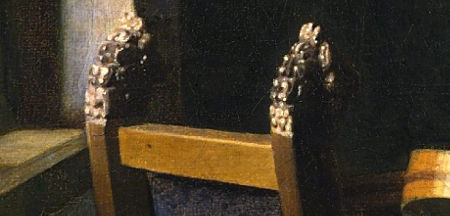
In this picture, Vermeer has depicted three so-called Spanish chairs. The exquisitely detailed chair in the foreground, which has been spared the damage from overzealous past restorations, stands out as one of the most striking elements of the painting. The hand-carved lion-head finials at the back are as though they were sculpted with robust flicks of luminous paint, reminiscent of the "circles of confusion"—optical distortions created by the camera obscura, an early precursor to contemporary photographic cameras. A cushion, adorned with deep blue velvet, graces the chair's seat.
The brass studs and the lozenge patterns on the chair in the background recur frequently in the genre paintings of that period, attesting to the widespread appeal of such furniture. The name "Spanish chairs" is derived from the embossed leather used in their upholstery.
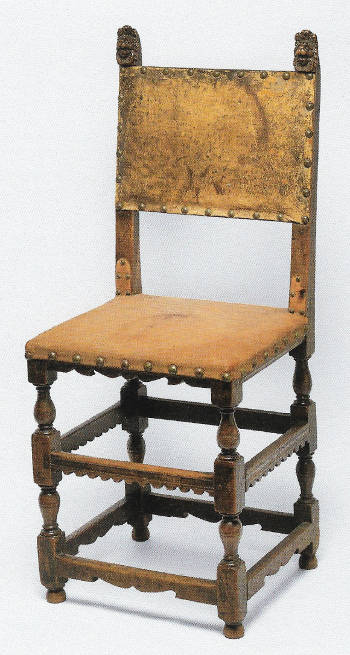
The wood used for these chairs was usually oak or walnut, both of which are sturdy and carve well. The intricately carved lion head finials that appear in various works by Vermeer, as well as in other Dutch genre pieces, would have been the handiwork of skilled artisans who hard their own guild, rather than the chair makers themselves. Furniture makers often collaborated with or employed specialized carvers for these detailed tasks.
The unfortunate fate of the red jacket
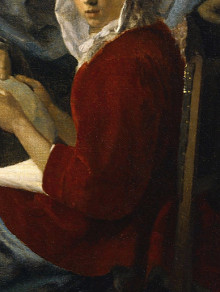
Regrettably, the red garment worn by the girl has suffered from overzealous past restorations, resulting in a flattened appearance that lacks material definition.
It is highly probable that Vermeer utilized a prevalent painting technique known as glazing to achieve the cherry-red hue of the garment. The attire was initially modeled using the brightest red accessible to artists of that period—natural vermilion with a noticeable orange tint, interspersed with traces of black in the most profound shadows and hints of white to illuminate the folds. Once this paint layer was fully dried, one or more thin coatings of transparent red madder, a deep ruby red pigment, were applied atop to impart depth and a translucent quality to the garment.
The method of glazing that Vermeer likely used was not unique to him but was a staple in the repertoire of many Dutch Golden Age painters. This meticulous process allowed for a luminous quality, where light could pass through the multiple thin layers of paint and reflect back to the viewer, creating a radiant and vivid effect. Such techniques highlight the painstaking efforts and advanced knowledge artists of the time possessed, not only about painting but also about the physical properties of their materials.
Wine-drinking and ritualized seduction?

The connection between the wine glass and joviality is evident in numerous 17th-century merry companies. These scenes evolved from the beloved feast imagery of the previous century, typically featuring opulently dressed individuals indoors, indulging in drinking, gambling, playing music and occasionally, partaking in romantic endeavors. However, by the latter half of the 17th century, these lively gatherings had considerably mellowed, often spotlighting only two or three figures, or even a sole individual. As a result, the act of wine drinking began to carry nuanced meanings.
In the current composition, the wine glass has been depicted with such understatement that it could be easily overlooked. Nonetheless, it serves a crucial role, subtly augmenting the theme of a deliberate yet highly formalized attempt at seduction. Indeed, both wine drinking and music making—recurring motifs in Vermeer's interiors—were symbols of love during the 17th century.
Etiquette guides of the era advised against consuming a glass of wine in one gulp; instead, it was recommended to savor it over two or three sips. In Vermeer's depiction, the untouched wine glass seemingly underscores the restraint exercised by both individuals as they delicately navigate their budding romantic rapport.
The painting's poor condition

No expert eye is needed to recognize the deteriorated state of much of the current work. The ebony-framed Cupid, previously overpainted with a patch of flat wall and a hanging violin, is now barely discernible. The modulation of the gray background wall lacks precision, and substantial areas of the canvas surface show signs of wear. Although this deterioration diminishes some of the work's original nuances, there remain passages of exquisite craftsmanship.
This deterioration might account for some of the artwork's apparent anomalies. In such a room, one might anticipate some kind of tiling that complements the elaborate window. Instead, we observe an undefined section of flat brown paint in the lower right-hand corner.
The same Cupid, previously seen in the background of the earlier Girl Reading a Letter at an Open Window, was painted over. It was proportionally more prominent than in the current piece. This notable discrepancy in scale serves as a reminder for modern viewers that Vermeer often took liberties in his seemingly naturalistic depictions. The same Cupid, typically attributed to Cesar van Everdingen, is prominently featured in one of the artist's later works, A Lady Standing at a Virginal.
The light-filled window
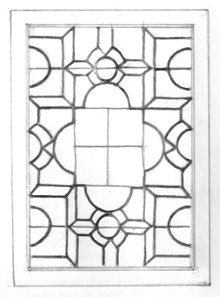
Along with the black and white marble flooring, one of the most defining features of Vermeer's interiors, along with the black and white marble flooring, is the leaded, multi-paned window evident in the current piece. The window displays a sophisticated pattern of interconnected squares, circles and semi-circles, centering on a panel of four squares framed by four semi-circles. Vermeer employed this specific design in eight instances, though in some cases, it's subtly presented. Its most distinct portrayal is in The Music Lesson. In six artworks, the leaded panes are filled with plain, transparent glass. However, in The Girl with a Wine Glass, The Glass of Wine and the Woman Writing a Letter with her Maid, the central design is accentuated by a detailed, colored coat of arms. Although the square-and-circle configuration is consistent in the Woman with a Water Pitcher and the Woman with a Lute, the windowsill in these pieces seems less refined compared to the intricately crafted one in the current piece. Additionally, the latter is seamlessly aligned with the background wall. Such variations suggest different rooms are represented, especially if we take into account the artist's rigorous adherence to his subject.

A Girl in a Window with a Bunch of Grapes
Attributed to Gerrit Dou
1662
Oil on panel, 38 x 29 cm.
Galleria Sabauda, Turin
Hans Slager, a Dutch archivist, has noted that, so far, of the eight windows in Vermeer's work that feature the same central, quatrelobed geometric design as in the Girl Interrupted in her Music, only three have been identified in the works of other artists. One is by Gerrit Dou (1613-1675), titled Girl at Window with a Bunch of Grapes, dated 1660, and is housed in the Royal Collection Trust, UK. Another nearly identical piece by Dou from 1662 is in a private collection belonging to Prinz Eugen von Savoyen in Vienna/Turin. There's also one by Pieter Cornelisz Slingelandt (1640-1691), titled Lacemaker Buying a Cock Through the Window, located in Gemäldegalerie Alte Meister, Dresden, from 1672.
Dutch houses from the 17th century often featured expansive windows that took up a substantial portion of the wall. This architectural characteristic is notably captured in artworks from the era, such as Vermeer's Music Lesson. The windows in Vermeer's paintings typically consist of four sections, commonly referred to as "lights." The upper two lights are fixed and immovable, whereas the lower two are designed to be opened, pivoting inwards into the interior. This multi-paned design was primarily due to both the manufacturing limitations of the time and the fragility of the glass These functional designs not only allowed for ventilation but also played a crucial role in regulating light, a feature that Dutch artists often masterfully utilized to highlight and shade various elements within their compositions.
The clear glass panes (as opposed to stained or heavily leaded windows) were a feature that artists would use to their advantage to play with light and shadow in their paintings. A common feature in these windows was the use of lead strips, referred to as "cames" in English, to hold together smaller panes of glass. This "lattice" pattern created by the lead strips is evident in many Dutch paintings, casting intricate patterns of light and shadow on interior scenes.
The most common type of glass available during Vermeer's time was called "cylinder glass" or "broad sheet glass." To make it, a large bubble of molten glass was blown, then cut open and flattened, resulting in a broad sheet. This process, however, led to imperfections and waviness in the glass, which is why perfectly clear, large panes were difficult to produce. This waviness is evident in many paintings of the period—particularly evident in Vermeer's Officer and Laughing Girl—, where the light refracting through the windows has a unique, slightly distorted quality. The production of glass in the 17th century was centered around certain regions in Europe due to the availability of raw materials and expertise. The forested regions of Northern Europe, especially in areas of present-day Belgium, Germany and Northern France, were significant centers for glass production. The forests provided the vast amounts of wood needed to fuel the furnaces, while river networks facilitated the transportation of raw materials and finished goods. The Netherlands, given its trade prowess, also had access to imported glass.
Windows in these paintings often carried symbolic weight. An open window might symbolize access to the outside world or a connection between public and private spheres. Reflections in the windows could be used to introduce elements of a narrative or convey moral messages.
The gentleman's cloak

Both the abraded light-gray cloak of the gentleman and the petticoat of the young girl are in such poor condition that is not easy to understand what the cause may be. Both their modeling and colors are weak by Vermeer's standards. However, there exists significant evidence that the painting was heavily retouched after it left Vermeer's studio. The hazy painting-within-a-painting was only discovered after its restoration in 1907; it had been covered up by a wall and a hanging violin. Conservation specialists have revealed that the birdcage is a later addition. The muddled insensitive modeling of the girl's red jacket is also uncharacteristic of Vermeer's technique of this time.
The condition of both the gentleman's worn cloak and the young girl's petticoat makes it challenging to discern their original state. Their design and hues appear subpar by Vermeer's measures. Notably, there's ample evidence indicating substantial retouching after the painting departed from Vermeer's studio. The obscured painting-within-a-painting only came to light post its 1907 restoration; previously, it was masked by a wall and a suspended violin. Experts in conservation have ascertained the birdcage as a subsequent inclusion. Furthermore, the vague and inept shaping of the girl's red jacket diverges from Vermeer's typical techniques during that period.
In 17th-century Netherlands, clothing was particularly expensive. Men typically wore breeches, waistcoats and doublets. The doublets had a square neckline revealing the shirt beneath. The affluent displayed their wealth through ornate hats, stockings and shoes. While black was a popular color due to its association with wealth and sophistication, brighter colors like reds, blues and yellows were also prevalent. Patterns, particularly stripes, were fashionable. However, the vast trade networks of the Dutch East and West India Companies meant that Dutch fashion was influenced by global trends. This brought in exotic fabrics, patterns and accessories to Dutch wardrobes.
While the rich flaunted their wealth through clothing, the middle class and poorer citizens wore simpler attire, often of wool or linen. The Netherlands also had sumptuary laws, which restricted the wearing of certain fabrics, furs and adornments to specific classes, ensuring that people dressed "according to their station."
The cittern
On the table lies a stringed musical instrument known as the cittern, positioned at such a highly oblique angle that it might be unidentifiable except to those familiar with period instruments. Clear musical notes can be discerned on the open page next to the cittern. The two figures appear to discuss another piece of sheet music, devoid of visible notes, held by both the young woman and her companion. The cittern's shape bears more resemblance to a modern banjo than to a lute. Like the lute, it's crafted entirely from wood. However, it shares the banjo's characteristic of being strung with wire, lending the cittern its distinct metallic sound. Its flat-backed design made it more straightforward and economical to produce than the lute. Additionally, it was more user-friendly, compact and durable. The cittern, embraced by all societal classes, was a favored instrument for informal musical sessions, akin to the contemporary use of the guitar. Despite their popularity, few citterns from the 17th century remain today.
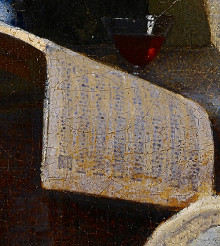
Prior to the early 17th century, the cittern was typically in the hands of professional musicians. However, by the mid-17th century, it was more commonly associated with amateur players. Initial playing techniques mirrored that of the lute. During the sixteenth and early 17th centuries, music composed for the cittern was in tablature form, specifying finger-plucking of the strings rahter than true musical notation. As time progressed, the technique evolved to favor strumming basic chords with a plectrum.
The cittern's popularity in the 17th century can also be attributed to its versatility. It could accompany a wide range of musical genres, from courtly songs to popular tunes, and its resonant sound made it suitable for both indoor salons and outdoor gatherings. Its depiction in artworks like Vermeer's provides a window into the domestic and social life of the time, underscoring the instrument's role in both intimate and communal musical experiences.
Two notable manuscripts from the mid-17th century, Robert Edwards' Commonplace Book and the Millar/Macalman manuscript, offer insights into the instrument's repertoire. nterestingly, each represents a different style of the instrument. Edwards favored the diatonic cittern, an instrument with some missing or partial frets on its fingerboard, leading to the absence of certain notes. This unique design, particularly popular in France and the Low Countries, simplified the playing of certain challenging chords. Contrastingly, Macalman's chromatic cittern was capable of producing all twelve notes of the chromatic scale.
Both manuscripts comprise mostly secular pieces framed as vocal solos with accompaniment, as well as purely instrumental compositions, varying widely in intricacy, elegance and technical demand.
The signature
No signature appears on this work.
(Click here to access a complete study of Vermeer's signatures.)
Dates
1662
Albert Blankert, Vermeer: 1632–1675, 1975
c. 1660–1661
Arthur K. Wheelock Jr., The Public and the Private in the Age of Vermeer, London, 1997
c. 1658–1659
Walter Liedtke, Vermeer: The Complete Paintings, New York, 2008
c. 1658–1659
Wayne Franits, Vermeer, 2015
(Click here to access a complete study of the dates of Vermeer's paintings).
Critical assessment
The fine, plain-weave linen, boasting a thread count of 14 x 15 per cm², still features its original tacking edges. Selvedges are present on both the left and right sides. The support has undergone glue/paste lining. The double ground layer is composed of a white base, which contains chalk, lead white and umber, followed by a reddish-brown layer. In several areas, such as around the figures and the wine jug, the ground remains exposed. It also overlaps slightly onto the tacking edges.
Certain elements like parts of the window, the red dress, the chair and many highlights were executed using the wet-in-wet technique. Impasto is evident in the highlights, the fruit and the red skirt of the figure in the window. Ultramarine features prominently in various parts of the painting: the window, the background, the tablecloth and as underpaint in the shadows of the girl's red dress. Adjustments were made to the positioning of the heads of the standing man and the girl, as well as the bows in her hair. Certain sections of the artwork, such as the wall segment between the male figures and the girl's arm and cuff, seem to be incomplete. The medium in the ultramarine mixtures has degraded, resulting in the pigment appearing discolored.
* Johannes Vermeer (exh. cat., National Gallery of Art and Royal Cabinet of Paintings Mauritshuis - Washington and The Hague, 1995, edited by Arthur K. Wheelock Jr.)
Provenance
- Pieter de Smeth van Alphen, Amsterdam (Van Alphen sale, 12 August, 1810, no. 57, to J. de Vries);
- Henry Croese et al. sale, Amsterdam, 18 September, 1811, no. 45, to Roos;
- Cornelis Sebille Roos (1811–1820); Roos sale, Amsterdam, 28 August, 1820, no. 64, to Brondgeest or to N.N.;
- Samuel Woodburn sale, London (Christie's), 24 June, 1853, no. 128, to Smith or directly to Gibson;
- Francis Gibson, Saffron Walden (d. 1858); his daughter, Mrs Lewis Fry, Clifton, near Bristol;
- [Lawrie & Co., London]; [Knoedler, New York, 1901];
- Henry Clay Frick, New York (1901-d. 1919);
- The Frick Collection, New York (acc. no. 11.1.125).
Exhibitions
- London 1900
Exhibition of Pictures by Dutch Masters of Seventeenth Century
Burlington Fine Arts Club
26, no. 23 as "The Music Lesson," lent by Lewis Fry, Esq., M. P. - St. Louis 1904
St. Louis World's Fair
73, no. 93, as "The Music Lesson" lent by Mr. Henrey C. Frick, Pittsburg - New York September 25–October 9, 1909
The Hudson-Fulton Celebration
Metropolitan Museum of Art
no. 138, as "The Music Lesson" lent by Mr. Henry C. Frick, New York - New York June 3–November 2, 2008
Frick's Vermeers Reunited
Frick Collection
no catalogue - Dresden September 10, 2021
Vermeer: On Reflection
Gemäldegalerie Alte Meister, Dresden - Amsterdam February 10– June 4, 2023
VERMEER
Rijksmuseum
no. 12 and ill. - Pittsburg April 6, 2024–July 14, 2024
Vermeer, Monet, Rembrandt: Forging the Frick Collections in Pittsburgh and New York
Frick Pittsburg - New York June 18, 2025–September 8, 2025
Vermeer’s Love Letters
Frick Collection
(Click here to access a complete, sortable list of the exhibitions of Vermeer's paintings).
Picture-within-pictures
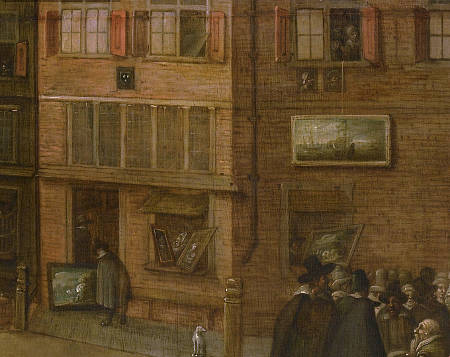
The Quack (detail)
Anonymous Dutch painter
c. 1619–1625
Oil on panel, 67 x 90.7 cm.
Rijksmuseum, Amsterdam
Vermeer's compositions frequently feature so-called pictures-within-pictures, making art its own subject in many respects. This recurring motif in Vermeer's works isn't merely a personal preference; it mirrors the reality of the time: paintings were more prevalent in the Netherlands than anywhere else in the world.
Foreign travelers to the Netherlands during the 17th century often expressed astonishment at the sheer number of paintings they encountered. British traveler Peter Mundy, in a frequently cited diary entry from 1640, observed, "As for the art of Painting and the affection of the people to Pictures, I think none other go beyond them." Indeed, paintings adorned nearly every setting except for the Reformed churches. Beyond the homes of affluent merchants, Mundy noted that even bakers, cobblers, butchers and blacksmiths owned at least one piece of artwork.
With the shift away from painting being an exclusive domain of the church, aristocracy, or the extremely wealthy, the nature and appearance of artworks underwent significant changes. The burgeoning urban elite recognized that paintings, much like luxury items, could serve as potent symbols of power—treasures to be keenly acquired and displayed with pride. As a result, paintings also evolved into a form of easily transportable goods in Holland, the epicenter of global trade. Their manageable size and relatively compact nature facilitated their introduction into the market.
The Dutch Golden Age, spanning the 17th century, was a period of tremendous prosperity for the Netherlands. As the text above mentioned, art became democratized, moving beyond the confines of the elite. Additionally, the rise of the merchant class not only altered the economic landscape but also influenced cultural and artistic tastes. This shift led to the proliferation of genres like still life, landscapes and domestic scenes—themes that resonated with the broader populace, rather than just the elite.
Vermeer's "love affair" with Cupid

Cupid Preparing His Bow
Jacob Huysmans after Anthony van Dyck
between 1650–1696
Oil on canvas,
Private collection
Cupid, known as Eros in ancient Greek mythology, is the god of desire, erotic love, attraction, and affection. He has been a favorite subject of artists since ancient times. The motif of Cupid was popularly used in Baroque painting, either by itself or in various mythological scenes. In Vermeer's paintings, he appears—either partially or fully—four times as a picture-within-a-picture.

Cupid Holding a Glass Orb
Caesar van Everdingen
c. 1655–1660
Oil on canvas,
Private collection
As has often been noted in Vermeer literature, "a Cupid" could mean either a statue or a painting of the winged god of love. The painting that Vermeer used as a model was first attributed by German art historian Gustav Delbanco in 1928 to Caesar van Everdingen, a Dutch Golden Age portrait and history painter who painted numerous depictions of similarly proportioned naked putti (nude child figures, often with wings). Based on the chronology of Vermeer’s paintings, the inclusion of the same Cupid four times, albeit with slight variations, over a 15-year period makes it highly probably that Vermeer had this work in his home. This is reinforced by the fact that the probate inventory of Vermeer’s estate, compiled in 1676, two months after his death, mentions an artifact "from the upstairs backroom" referred to as "Cupid," which could be this painting.
Art historians have tried to track Vermeer's Cupid in the vast history of auctions and sales of art, but it has proved impossible to find. Interestingly, based on Vermeer canvases, they tried to estimate the size of the real Cupid painting – it should be approximately 115 x 85 cm, which is quite large.
Another question is: what did Vermeer wish to convey with the now-lost Cupid? Did its meaning change according to its context? Numerous art historians and Vermeer experts such as Walter Liedtke, Aurthur K. Wheelock Jr. and Gregor Weber have attemtped furnish plausable explanations. However, as Weber pointed out, the exact meaning Vermeer intended may be elusive, but the deliberate alterations in how he portrayed the Cupid across different works were likely intended to give a more nuanced meaning to the scene unfolding in the foreground. Perhaps this kind of puzzle would have delighted a 17th-century audience familiar with the similar emblematic images that abounded in emblematic literature.
In A Maid Asleep, although barely visible in reproductions, Cupid strides forth "triumphantly," trampling over two masks cast upon the ground. Perhpas the cause of the "dozing" (tipsy?) maid's condition is in fact, Cupid's working.

Girl Reading a Letter at an Open Window
Johannes Vermeer
In the Girl Reading a Letter at an Open Window, Cupid tramples on a mask, a motif not seen in the Late Lady Standing at a Virginal. Here, the mask is a readily understood metaphor for deceit. In other words, in matters of the heart, Cupid rejects deceit in favor of sincerity.
In the Girl Interrupted in Her Music, the inclusion of the standing, nude god of love underscores the amorous nature of the encounter between the lady and her company. Because it was overpainted in the past and subsequently restored, the paint layer of Cupid is severely abraded. Originally, it would have been easier to discern how Cupid seems to comment on the man’s seductive wiles from behind the latter’s back. Both the woman and Cupid peer at the viewer, drawing them directly into Vermeer’s painted scene.
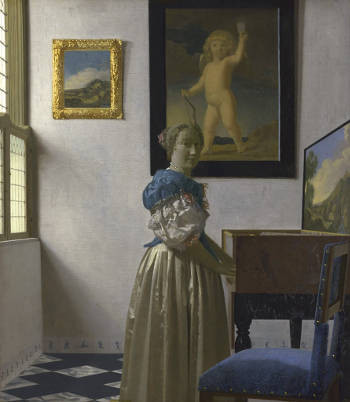
A Lady Standing at a Virginal
Johannes Vermeer
In the last depiction, in Lady Standing at a Virginal, Cupid is pictured standing, rendered in lighter, airier tones than in the preceding versions. He holds a blank card, reminiscent of the Cupid in another emblem from Otto van Veen’s popular "Amorum emblemata." However, there, Cupid holds a tablet inscribed with the number "1." Meanwhile, with his foot, he tramples on the numbers 2 to 10 on another tablet. The caption explains that true love can be directed to "one person alone." Strangely, no mask appears at his feet in Vermeer's work.
Scholars have been unable to explain precisely why Vermeer would have included the Cupid so frequently in his own works, especially considering he must have had many other works to choose from that he traded, like many artists of the time, to supplement his income.
Whatever the Vermeer's intentions, the painted Cupid belongs to the pictorial tradition of portraying a full-figure, life-size Cupid alone, combined with symbolic gestures and motifs. Other great painters from this time, such as Rembrandt, who painted Cupid blowing a bubble in 1634, popularized this motif. The little god of love was also often presented with a golden balance, a pair of scales, and, of course, wings.
Dutch cleanliness
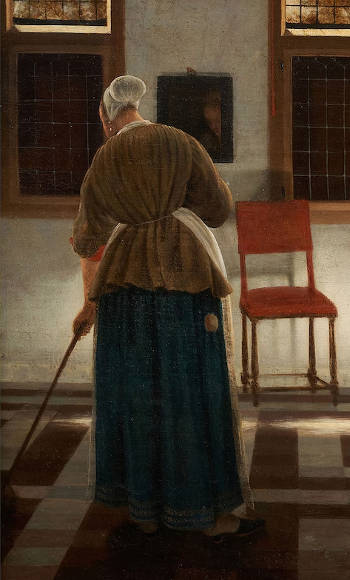
Room in a Dutch House (detail)
Pieter Janssens Elinga
1668–1672
Oil on canvas, 61.5 x 59 cm.
The Hermitage, St. Petersburg
If Delft was considered Holland's cleanest town, then Vermeer surely earned his reputation as Delft's most meticulous painter.
In a comprehensive study of 17th-century Dutch hygiene, historians Bas van Bavel and Oscar Gelderblom highlighted that out of over 250 travel accounts by foreigners visiting the Northern Netherlands from 1438 to 1795, 75 of these—primarily by German, English and French travelers—commented on Dutch cleanliness.
One of the earliest known observations about Dutch cleanliness, dated 1517, comes from the secretary of an Italian cardinal touring the Netherlands. He remarked upon the common practice of mopping floors and wiping feet before entering private residences. The Dutch were occasionally ridiculed for what some deemed a national fixation on cleanliness.
Travelers to Dutch towns consistently observed the regular cleaning of windows and doorsteps in private homes. They also noted the impeccable maintenance of halls, stairwells, front rooms and furniture. The kitchen, in particular, with its hearth and dishes, was often described as spotless. Visitors frequently expressed surprise at the local custom of wearing slippers indoors, a practice even extended to guests.
However, this attention to cleanliness was not limited to private dwellings. Long before the systematic enhancement of public and personal hygiene became a primary concern in Western Europe during the 19th century, the Dutch were already prioritizing it. Public spaces such as markets, barges and inns were meticulously maintained. Numerous French and German travelers remarked on the immaculate state of stables and abattoirs. They observed that Dutch farmers routinely washed their cows and trimmed their tails to maintain cleanliness. Streets were consistently swept and layered with sand, and the cleaning efforts often extended to canals and marketplaces in various towns and villages.
The emphasis on cleanliness in the Dutch Golden Age reflect very practical concerns of a society living below sea level, where stagnant water and poor sanitation could lead to health issues. The attention to hygiene was not just a cultural quirk but had roots in the practical necessities of daily life in the Low Countries.
Pieter de Hoogh & Vermeer
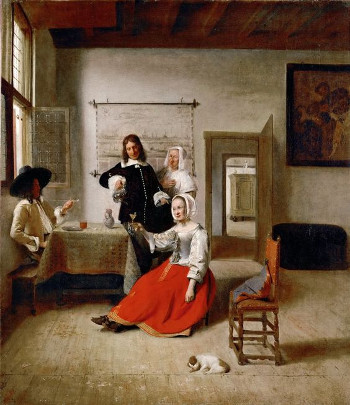
Young Woman Drinking
Pieter de Hooch
1658
Oil on canvas, 69 x 60 cm.
Musée du Louvre, Paris
While the specific thematic intentions behind Vermeer's works may remain elusive, it's evident that he pursued a rigorous intellectual agenda in his more intricate compositions. The theme of the artwork in question, centered around courtship and love, had already been explored by Dutch artists several decades prior. It's likely that Vermeer's exploration into this realm was influenced by Pieter de Hooch.
Though De Hooch is perhaps the most immediate source of inspiration for this composition, Vermeer's work sets itself apart due to its approach to more intricate compositional and thematic challenges. In contrast to De Hooch's figures, which often come across as rigid and somewhat doll-like, Vermeer's subjects are brought distinctly to the forefront, exuding a sense of naturalism coupled with a deep insight into their emotional states. Furthermore, De Hooch's subjects sometimes seem disconnected from the three-dimensional space of the painting, with their postures appearing less organic and their emotions not as subtly conveyed as in Vermeer's pieces. While Vermeer grappled with weighty moral themes, such as the Last Judgment, Vanitas and religious faith, De Hooch tended towards lighter subjects, emphasizing the banalities domestic life. Nevertheless, historian Simon Schama recognizes De Hooch's significant contribution, noting that his interiors offer "the first sustained image of parental love that European art has shown us."
Art historian Peter Sutton posits an intriguing theory: the woman and child frequently depicted in De Hooch's works could very well be representations of the artist's own wife and son, with the familiar settings possibly being rooms from his home. In contrast, none of Vermeer's models have been definitively identified, although the young girl in Girl Reading a Letter at an Open Window, Woman in Blue Reading a Letter—who appears to be pregnant— and othe pictures, suggest she was the artist's wife, Catharina Bolnes.
The Dutch emblem book: Amorum Emblemata
Intense debate emerged in the twentieth century about the degree to which Dutch genre painters drew upon literary sources to augment the narratives in their artworks. The imagery in two of Vermeer's paintings, The Art of Painting and The Allegory of Faith, is widely believed to be influenced by Cesare Ripa's Iconologia. Furthermore, certain props, potentially the background Cupid in the present artwork, might reference figures from prevalent emblem books, which saw publication rates nearly rivaling that of the Sacred Bible.

Emblems of Love, engraved in bronze by the efforts of Otto Vaeni of Batavia-Leiden. Emblems of Love. With verses in Latin, English, and Italian
Otto van Veen
1608
15.1 x 19.1 cm.
Antwerp
The Amorum Emblemata stands out as one of the most pivotal Dutch emblem books. Designed by Otto van Veen, it was initially published in Antwerp in 1608 in three multilingual editions: Latin, French & Dutch; Latin, Italian & French; and Latin, English & Italian. Owing to its immense success and acclaim, several subsequent editions and adaptations emerged, and its illustrations inspired decorative artists across Europe.
By creating a compilation of love emblems, Van Veen participated in a movement that originated in Amsterdam in 1601. This trend began with the release of Quaeris quid sit Amor, a set of twenty-four love emblem prints crafted by the artist Jacques de Gheyn, complemented by Dutch verses from Daniel Heinsius.
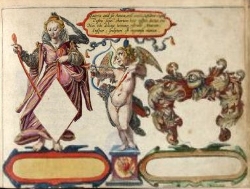
Quaeris quid sit Amor (title page)
Jacques de Gheyn
1601
Amsterdam University Library, Amsterdam
The Quaeris quid sit amor? stands as the inaugural love emblem book in the Dutch language. Published, likely in 1601, it initially lacked a specific title. As a result, it's often known by two titles today: Quaeris quid sit amor?, derived from the opening phrase on the title page, or Emblemata amatoria, a title adopted in subsequent reprints. The authorship of the 1601 edition is attributed to Theocritus à Ganda, which later was revealed to be a pseudonym of Daniël Heinsius. This pseudonym offered clues discernible to his contemporaries: "Theocritus" translates to "Daniël" in Greek, and "à Ganda" means "from Ghent" in French, which is Heinsius's hometown. In contrast, Van Veen's work is more extensive, comprising 124 emblems. The accompanying romantic maxims, which elucidate the images, often derive from Ovid but not exclusively. Catered to a young audience, the book portrays love as a dominant force, suggesting that embracing it leads to happiness.
The concept of love, as depicted in emblem books of the Dutch Golden Age, is emblematic of broader societal values and norms of the time. The proliferation of such books reflects the importance placed on romantic relationships, courtship and social dynamics in the 17th-century Dutch society. The emblems, with their fusion of visual artistry and poetic text, offer unique insights into how love, passion and relationships were perceived and valued.
The Dutch room
Architect Witold Rybczynski observed that many contemporary visitors believed the Netherlands was pioneering in nurturing a significant middle class. This shift saw Dutch families moving away from the public domains of medieval homes.

Interior with a maid, a girl with a dog, and a map of Dordrecht
Abraham van Strij
Oil on panel, 66 x 81 cm
Private collection
Concurrently, there emerged a distinction between workspaces and homes, with men predominantly in workplaces and women overseeing the household. This era also marked an increase in children spending more time at home compared to the Middle Ages. Rybczynski posits that as Dutch men increasingly engaged in outside work, women, who primarily focused on child-rearing, assumed greater control over household affairs.
Affluent Dutch households had a plethora of furnishing options. Local artisans crafted robust, intricately carved furniture, while glassware was either imported from Germany or manufactured locally. The Middle East supplied exotic carpets, and vast amounts of porcelain were imported from China. An English visitor once remarked on Dutch homes, saying they were "not necessarily spacious, but they exuded neatness, boasted attractive exteriors and were impeccably furnished. The pristine condition and meticulous arrangement of the furniture gave the impression of a display rather than functional use."
Dutch songbooks

Den nieuwen verbeterden lust-hof, gheplant vol uytgelesene, eerlijcke, amoreuse ende vrolijcke ghesanghen, als mey, bruylofts, tafel, ende nieu jaers liedekens, met noch verscheyden tsamen-spreeckinghen tusschen vryer en vryster...
Dirck Pietersz Pers (engraving after David Vinckboons)
c. 1610
Later vellum, manuscript title on spine
Private collection
A cittern, a Delft ceramic vase, a subtle glass of wine and a musical score sheet adorn the table. The paper links the man and woman, perhaps, a motif inspired by Frans van Mieris's Teasing the Pet, where a gentleman playfully engages a lady using her lapdog. Like Van Mieris's work, the caller flirts with the woman.
In Vermeer's era, the cittern witnessed a resurgence, becoming a beloved instrument of the mid-17th century. Notably, Vermeer depicted it more than any other instrument. Although its shape resembles the lute, the cittern has its unique history and sound. Its brass strings generate a bright tone, akin to a contemporary banjo, but a well-tuned cittern might remind one of a virginal's timbre. The cittern's golden age spanned the 16th and 17th centuries, esteemed for both vocal accompaniment and dance music. It inspired many intricate compositions, demanding significant technical prowess for solo performances.
Interestingly, music authority Albert P. de Mirimonde observed that the musical notes in three of Vermeer's works that show musical score lack coherence. Whether this was an oversight or intentional remains a mystery.
During the 17th century, the Dutch Golden Age, the Netherlands experienced an unparalleled cultural, scientific, and artistic Renaissance. Amidst this backdrop, songbooks became particularly popular, acting as mirrors to the era's tastes and sensibilities, although French and Italian music was more sought-after. Dutch songbooks came in various forms, with expansive collections catering to the educated elite and simpler versions for the wider public. Within their pages, one could find an eclectic mix of genres, from passionate love songs and lively drinking tunes to solemn religious hymns and moralistic narratives. As the printing press made its mark and Amsterdam rose as a global trading hub, these Dutch songbooks reached far beyond the country's borders, interacting with other European musical traditions.
While predominantly in Dutch, the songbooks often featured songs in other languages, especially French, a nod to the era's vibrant cultural exchanges. Many were adorned with intricate illustrations, with engravings and woodcuts that painted a vivid picture of the songs' themes or simply added a touch of decorative flair. Most provided just the melody with accompanying lyrics, designed either for pure vocal performance or to be played by amateur musicians using common instruments of the day. Beyond mere entertainment, some of these songbooks carried a didactic purpose, aiming to impart moral lessons, religious teachings, or insights into contemporary events. As artifacts of their time, the 17th-century Dutch songbooks not only entertained but also provided a rich tapestry of insights into the lives and values of the Dutch during their most celebrated epoch.
A linen cap

Dutch costume specialist, Marieke de Winkel, highlights that the linen cap, called a hooftdoek, donned by the young woman not only added ornamental flair but also safeguarded her hairstyle during dressing rituals. The hooftdoek was typically made of white linen or sometimes cotton. The material was chosen for its breathable quality and the ability to be bleached to a crisp white, which was a symbol of purity and cleanliness.
In 17th-century Dutch society, a woman's hair was often associated with sensuality. Thus, concealing the hair with a hooftdoek signified modesty, especially for married women. In some portraits, the way the hooftdoek was worn could provide clues about the sitter's marital status, religious beliefs, or regional identity. The way the hooftdoek was worn could vary. Some were tied under the chin, while others were wrapped around the neck or pinned at the back. The style could sometimes indicate the specific region of the Netherlands from which the wearer hailed.
But the hooftdoek was not just a Dutch phenomenon. Variations of these simple headscarfs were worn across Europe, but the specific styles and the prevalence in portraiture make the Dutch hooftdoek particularly notable.
As with many fashion trends, the use of the hooftdoek declined towards the end of the 17th century and into the 18th century. Socio-cultural shifts, changes in fashion and evolving notions of female modesty contributed to its decreased prevalence.
Historically, the Low Countries stood as hubs for cloth production since medieval times. This trade was the cornerstone of the Dutch industrial realm, flourishing further with the influx of textile artisans from southern regions. Haarlem, in particular, was renowned for its linen. Artisans there honed their craft in bleaching and refining both locally-woven fabric and imports from across Europe. This pristine linen became the material of choice for garments like caps, aprons, night shawls, collars and cuffs - items recurrently featured in Vermeer's artworks.
About Dutch music
While Vermeer's personal preferences in music and the arts remain an enigma, the subjects he selected for portrayal likely belonged to the haute bourgeoisie. These were individuals fluent in multiple languages and collectors of European poetry and songbooks. A songbook, replete with musical notes, is discernible on the table, underscoring its central role in contemporary courtship rituals.
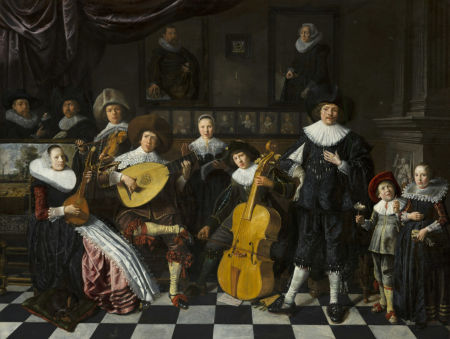
Portrait of the Painter's Family (detail)
Jan Miense Molenaer
c. 1636
Oil on panel, 62.3 x 81.3 cm.
Frans Hals Museum, Haarlem
Dutch music, often perceived as lacking originality, meant that Dutch songbooks featured as many French compositions as they did native ones. Amateur musicians, such as the duo depicted by Vermeer, would likely have amassed a considerable collection of these songbooks. Engaging in music created an environment conducive for budding relationships, absent the supervision of elders or parents.
Emerging musicians of the time had an extensive array of both foreign and native songbooks at their disposal. These songbooks, known as "liedboeken", comprised primarily love songs. Louis Peter Grijp, a Dutch music connoisseur, highlighted how these publications echoed local cultural nuances, referencing favored spots like taverns where lovers would meet. While some songs celebrated the allure of local women over their counterparts from different towns, others resonated with a burgeoning sense of Dutch nationalism. For instance, the dedicatory preface of Den Nieuwen Lust-Hof was dedicated to the young ladies of the Netherlands. However, there were also critiques; an author from Utrecht bemoaned that his prior works had been overlooked in favor of the more opulent songbooks from Amsterdam and Haarlem.
The range of songs in these books was diverse. Some were characterized by their risqué content, while others maintained decorum. A single compilation could house sophisticated love songs influenced by Petrarch, alongside bawdy tales, celebratory drinking songs, religious hymns and nationalistic melodies. Although many of these books underscored the importance of moral virtue, they seldom castigated their readers, presuming their inherent moral standing.
Interior setting & courtship imagery
By the mid-17th century, when Vermeer began producing his iconic interiors, scenes of courtship in Dutch middle-class settings had already gained immense popularity. Prior to the 1630s, such depictions predominantly showcased outdoor garden parties, called "love parties" or in Dutch, buitenpartijen, animated by the playful interactions of young men and women. Along with David Vinckboons, Willem Buytewech, was among the earliest proponents of this curious genre.
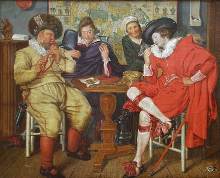
Merry Company
Willem Buytewech
c. 1620–1624
Oil on canvas, 103.5 x 84.3 cm.
Koninklijk Museum voor Schone Kunsten Antwerpen
However, when Buytewech lost interest in the outdoor garden motif—or there were no longer so commercially attractive a before—he brought his foppish youths indoors.
Buytewech, affectionately termed "Geestige Willem" or "Witty Willem", was a pivotal figure in this transition, despite the limited scope of his surviving paintings. His vibrant representations of dandies, fashionable women, soldiers and spirited wenches initiated the "Merry Company" genre. As Buytewech transitioned from garden scenes, he brought his stylish young subjects indoors, surrounded by opulent furnishings, including silverware, paintings and expansive wall maps. These very elements would later appear in the works of Vermeer and his contemporaries. The women in Buytewech's scenes donned the latest attire, including silk skirts and intricately embroidered bodices. While today's viewers might find Buytewech's work somewhat simplistic, art historian Wayne Franits emphasized the significance of these pieces, noting, "Buytewech's depictions of elegant gatherings, despite their confined nature, laid the foundation for one of the most beloved themes in 17th-century Dutch genre painting."
Buytewech's figures, seemingly psychologically distant and at times humorously disjointed from one another, paved the way for the delicate dialogues and intricate body language seen in later works. These characters were often similar in age and social status, allowing for deeper interactions within a limited space.
There's a degree of ambiguity regarding the interpretation of Buytewech's themes among Dutch art historians. Contemporary literature often suggests that Buytewech sought to criticize the frivolity of young men, reminding them of life's fleeting nature. Conversely, some believe he portrayed these young men realistically, focusing more on humor than moralizing—the Dutch society of the time was well-versed in societal norms. Furthermore, Buytewech might have derived inspiration from popular literature and theatrical farces of his time.
Although such genre scenes were often frowned upon by the conventional art hierarchy, the progressive Dutch art theorist Gérard de Lairesse acknowledged the occasional appearance of "little dramas" within them. These pieces stood in stark contrast to the grand narratives of historical events and religious themes, which were traditionally deemed the sole appropriate subjects for art. Nevertheless, these courtship-themed artworks, despite their high price tags, became coveted acquisitions among the upper echelons of society.
Listen to period music
The Voice of the Ghost [1.62 MB]
Anthony Holborne
performed by Lee Santana
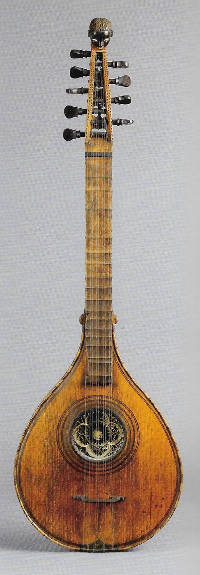
The Cittern
In the milieu of the Italian Renaissance humanism, the cittern was perceived as a revival of the classical Greek kithara, despite its more apparent evolution from the medieval citole. This instrument bears a resemblance to the fiddle when considering its plucked variant.
The construction and tuning of the cittern varied notably across regions. England, France and parts of northern Europe favored the smaller four-course variant, while Italian musicians gravitated towards the more expansive six-course version.
The 16th and 17th centuries marked the pinnacle of the cittern's prominence. Particularly in Italy and England, it garnered respect as an ideal complement to vocal performances and dance tunes. A rich repertoire was composed specifically for the cittern, characterized by its complexity and technical demands.
A significant number of 17th-century Dutch paintings featuring the cittern testify to its widespread appeal during that era. Its sturdy design, attributed to its flat back, made it a more resilient and economical choice compared to the delicate lute. Additionally, its portability and user-friendly nature rendered the cittern a favorite among the middle and upper echelons of society, particularly for accompanying songs and dances.
The cittern presents a slender, round or pear-shaped body that narrows from its base to its neck. Its flat-back design was simpler and cheaper to construct than the lute. Crafted primarily from a singular wood piece, only the soundboard and fingerboard were affixed separately. Its distinctive and lively timbre stems from its metal strings, which are typically plucked with a quill or plectrum. This vibrant sound profile significantly contributed to the instrument's enduring charm.
Vermeer inspires himself
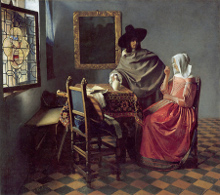
The Glass of Wine
c. 1658–1661
Oil on canvas, 65 x 77 cm.
Staatliche Museen Preußischer
Kulturbesitz, Gemäldegalerie, Berlin
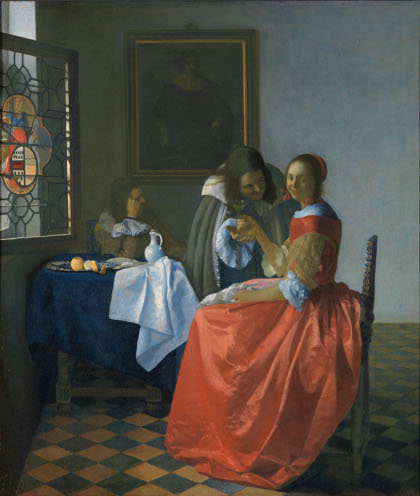
The current painting exhibits numerous parallels with The Glass of Wine, which is more expansive and intricate in its composition. Both pieces depict a distinguished gentleman attending to a young woman in her affluent abode, capturing a nuanced moment of formalized courtship. In each painting, the man stands behind the woman seated in the foreground. To the left, a table adorned with various objects is visible, and an identically positioned chair appears in both, suggesting more than mere decorative intent. Vermeer's still life in these compositions remains consistent, characterized by a piece of Delft ceramic, music books, a cittern and notably, a glass of wine in Girl Interrupted in her Music.
Determining which of the two paintings precedes the other is challenging, though many consider The Glass of Wine as the masterwork. Technically, its execution shines, yet it's worth noting the lamentable state of preservation of Girl Interrupted in her Music. When observed closely, the latter unveils traces of a potentially superior artwork. Structurally, both paintings favor a width over height and seemingly adopt a circular composition, fostering an intimate connection between the subjects. The solemn background imagery in each piece further adds depth, providing silent commentary on the unfolding scenarios.
A notable distinction is how the figures, table and chair in the current painting are sharply truncated at the bottom. Absent is the detailed flooring, making viewers feel more immersed in the scene. The direct gaze of the girl in this work contrasts starkly with the passive observance in The Glass of Wine. This might be Vermeer's intentional deviation from his own design or perhaps an adaptation of styles championed by Pieter de Hooch.
While the resemblances between the paintings are undeniable, no expert has proposed they're more than successive interpretations of a similar theme. Both are perceived as stand-alone masterpieces, distinct in their presentation.
Pictorial commentators
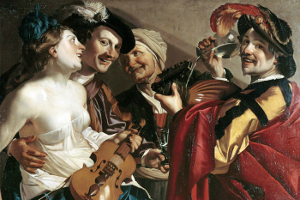
Loose Company
Dirck van Baburen
1623
Oil on canvas, 108 x 153 cm.
Mainz, Landesmuseum
Leon Battista Alberti, the Italian architect and art writer, is credited with inventing linear perspective, penned De Pictura in 1435, a work that became one of the western tradition's most influential art treatises. Alongside his discussions on perspective, Alberti provided comprehensive instructions for creating paintings. He proposed that artists could incorporate a commentator to guide viewers, helping them discern where to focus and which visual connections to make. This well-informed insider bridges two realms—the world within the painting and the external one—being part of the art without being the subject of it.
While their purpose might have been less distinguished, pictorial commentators were prevalent in Dutch genre paintings. These semi-comical figures, often self-portraits embodying a cunning character privy to secrets, became a recurring element in numerous bawdy bordello scenes by Utrecht Caravaggists. An example of this is the figure on the far left in Vermeer's Procuress, widely believed to be a self-portrait of the artist. This comical persona, represented by Vermeer, seems to serve primarily to prompt viewers to set aside their inhibitions and revel in the depicted merriment.
However, as Vermeer shifted his focus to the domestic settings of the haute bourgeoisie, the young women in his paintings appeared more contemplative than merely being part of a jovial scene. In the discussed painting, the young lady's gaze is markedly more mysterious than her cheerful counterpart in Girl with a Wine Glass. If she was envisioned as a pictorial representative of the artwork's subdued narrative, she appears reticent, if not completely silent. Her enigmatic expression seems to invite or even urge viewers to overlay their own sentiments onto the depicted narrative.
In exploring the relationship between Vermeer's works and the concept of the "pictorial commentator" introduced by Alberti, it's worth noting the difference in context. Alberti's Renaissance Italy was marked by a fervent rediscovery of classical knowledge, leading to a burst of innovations in various fields, including art. His concept of a "commentator" was rooted in this milieu, seeking to create a structured, intellectual way for viewers to engage with paintings.
In contrast, the Dutch Golden Age, when Vermeer painted, was characterized by a booming economy, urbanization and a strong middle class that had both the wealth and the desire to commission and purchase art. Dutch art of this period often focused on scenes from daily life, with artists seeking to capture the nuances of light, texture and emotion. Vermeer's introspective figures, such as the woman in the painting under discussion, can be seen as a continuation of Alberti's idea, but adapted to the tastes and values of 17th-century Dutch society. Instead of providing clear guidance, these figures invite viewers to engage in a more personal and perhaps introspective manner, reflecting the complexities and ambiguities of human emotion and experience.
Music making
Although Vermeer's courting young couple is not actively engaged in music making, the cittern on the table and the opened music book make it clear that the picture belongs to this popular motif. In the second half of the 17th century, the association between music and love was well established in the arts and the musical duet was a metaphor for an amorous relationship. Here, Vermeer disguises the cavalier's pressing but polite attentions by means of a momentary interruption of the girl's gaze directed outside the narrative structure of the painting towards the viewer. Walter Liedtke notes that the cavalier belongs to a type of man that appears often in Vermeer's compositions: in the company of women, they are "mere attendants. They seek possession and lose themselves." Music making was one of the activities which permitted young people to freely associate with each other.
One of the unique features of Dutch genre painting is its interest in creating realistic scenes of everyday life which, paradoxically, contain symbolic content indicating that there is more to the picture than what meets the eye. As Arthur K. Wheelock Jr. wrote, "Few artists created scenes as lifelike as those of Vermeer, and none were as capable of creating figures in these interiors whose mental states seem to transcend the everyday."
Recent technical fndings
Technical investigation has revealed numerous additional facts about Girl Interrupted at her Music, which is much smaller than the other two works. For instance, various research techniques determined that the birdcage is most likely a later overpainting that does not belong in the picture. Moreover, a second window was originally included in the corner of the room, with a translucent blue curtain in front of the upper windows, exactly as in The Glass of Wine. Advanced research on the canvas weave in which the threads of the fabric were counted and compared with those in other paintings by Vermeer, yielded another remarkable find. Girl Interrupted at her Music must have been painted a few years later than was previously assumed, because it appears to have come from the same piece of prepared canvas as Young Woman with a Water Pitcher, whose dating is estimated as being no earlier than 1662. Evidently, Vermeer did not paint these three representations in direct succession, but revisited the other two compositions, as it were, in Girl Interrupted at her Music. In doing so, he zoomed in more on the figures and omitted some iconic elements, such as the tiled floor and the stained-glass window.
special topics
- Dutch cleanliness
- Courtship in the Netherlands
- The Dutch emblem book: Amorum Emblemata
- The Dutch room
- Vermeer's "love affair" with Cupid
- Looking out of the picture
- Dutch Songbooks
- Pictures-within-pictures
- A linen cap
- About Dutch music
- Interior setting & courtship imagery
- Vermeer inspires himself
- Pictorial commentators
- Music making
- Recent technical findings
- Listen to period cittern music