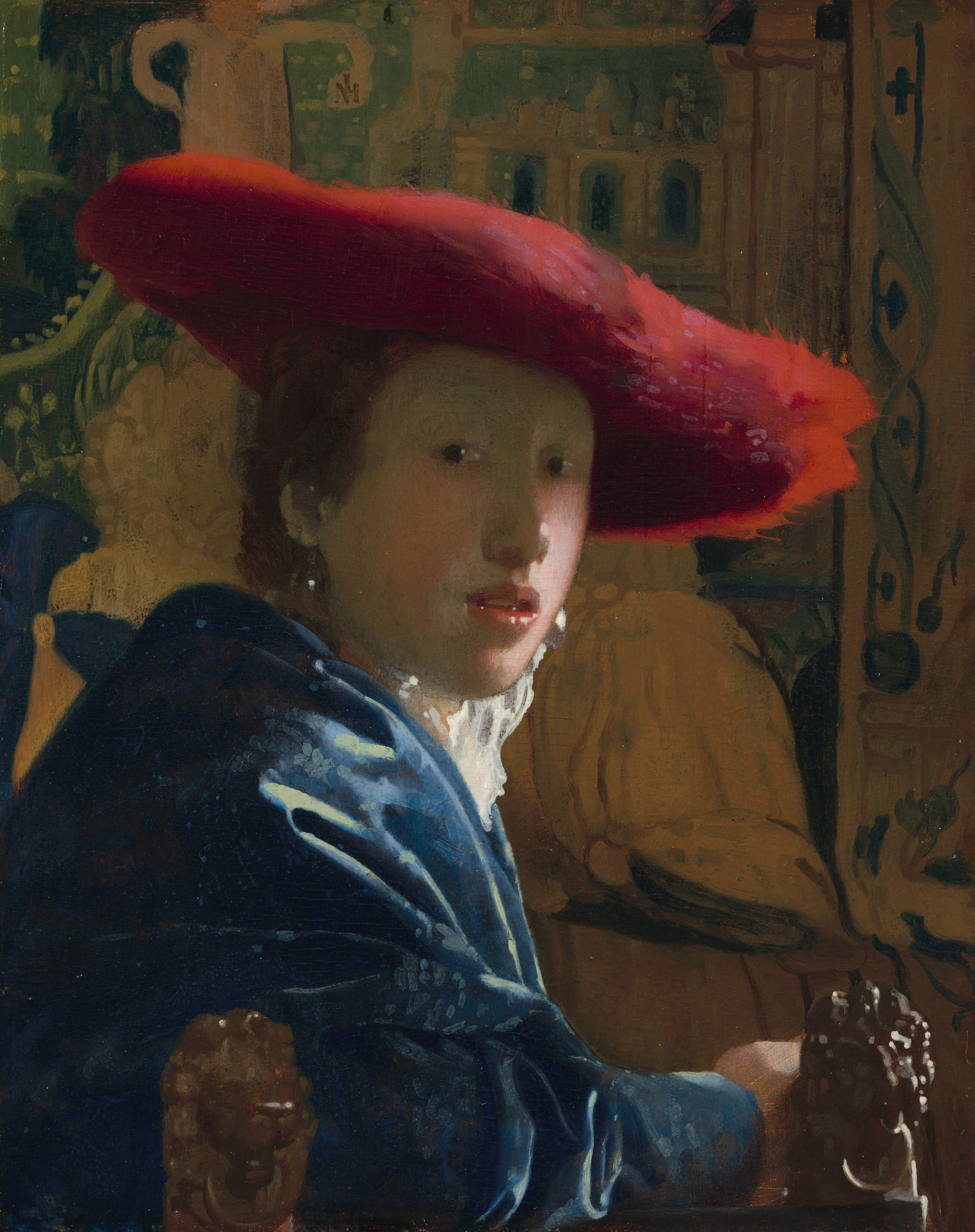
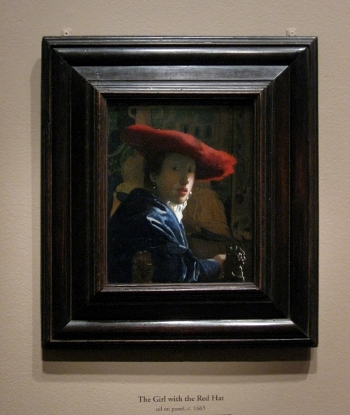
Girl with a Red Hat
(Meisje met de rode hoed)c. 1665–1667
Oil on panel, 23.2 x 18.1 cm. (9 1/8 x 7 1/8 in.)
National Gallery of Art, Washington, D.C.
acc. no 1937.1.53
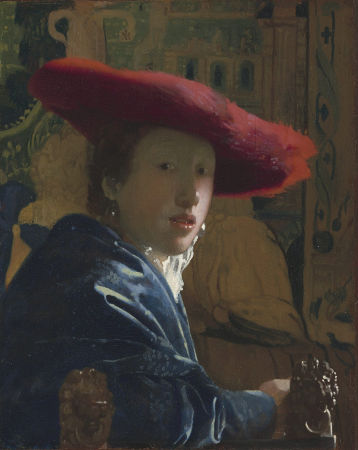
The textual material contained in the Essential Vermeer Interactive Catalogue would fill a hefty-sized book, and is enhanced by more than 1,000 corollary images. In order to use the catalogue most advantageously:
1. Scroll your mouse over the painting to a point of particular interest. Relative information and images will slide into the box located to the right of the painting. To fix and scroll the slide-in information, single click on area of interest. To release the slide-in information, single-click the "dismiss" buttton and continue exploring.
2. To access Special Topics and Fact Sheet information and accessory images, single-click any list item. To release slide-in information, click on any list item and continue exploring.
The red hat
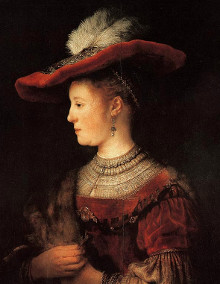
Saskia van Uylenburg in a Red Hat (detail)
Rembrandt van Rijn
Oil on canvas, c. 1633–1642
Gemäldegalerie, Alte Meister,
Staatliche Kunstsammlungen, Kassel
This eccentric red hat lacks an exact prototype in either Dutch fashion or Dutch painting, leaving one to ponder how Vermeer might have encountered it. Only Rembrandt or Michael Sweerts, two Dutch painters who took delight in depicting exotic headgear, might have been capable of creating a picture that so uniquely, marrying an unusual garment with a common visage, resulting in a work of profound human import.
Absent concrete evidence, Vermeer expert Walter Liedtke posits that Vermeer might have modeled the hat's design on some now-lost art source and possibly fabricated its material specifically for this painting, perhaps by attaching fur pelt or feathers to a hat similar to the one seen in the Girl with a Flute. While recent writers have characterized the hat's material as cloth, leather, or velvet, its indistinct, fragmented contour suggests feathers. Nonetheless, the illusionistic representation of uncommon fabrics or furs served as an identifying feature of the tronie, diminutive studio works intended to pique the buying interest of prospective buyers.
The hat was crafted using the glazing technique. This dual-step process yields a luminosity and depth unattainable with simple opaque paint. Here, the basic form's light and color were initially established with shades of vermilion red and black, setting a somewhat muted monochrome foundation. Once completely dried, this preliminary undercoat was glazed with a dense, crystal-clear ruby red pigment known as red madder, imparting a distinctive luminescence. This glaze also acted as a protective barrier for the vermilion, which has a propensity to darken upon atmospheric exposure.
The background tapestry
The design of the wall tapestry behind the girl's head is challenging to discern. Its border is visible running downward along the right side of the piece. Textile specialists identify the design as being from the late 17th century, originating from southern Holland, akin to other tapestries found in Vermeer's paintings. Walter Liedtke believes it is likely an impressionistic representation of a Giant Leaf tapestry from the Spanish Netherlands, evoking the forests of the New World.

Giant Leaf tapestries were inspired by actual tropical plants and drawings brought back by explorers of the New World, at the very end of the 15th and the early 16th century. Weaving hubs like Enghien, Grammont and Audenarde are known to have produced large-leaf verdure tapestries. Yet, it's likely that numerous other cities crafted similar pieces. The prevailing thought is that the majority of weaving centers in southern Flanders engaged in creating these tapestries. Even towns within the Marche district of France might have produced some. However, pinpointing the exact origins of these tapestries is challenging due to the infrequent appearance of town marks on them and the lack of detailed descriptions in 16th-century records.
The background tapestry
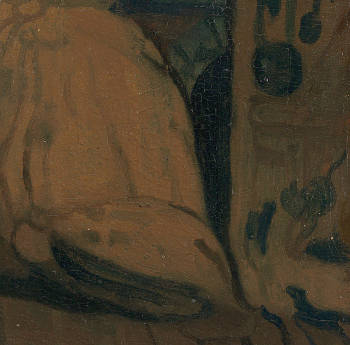
The design of the wall tapestry behind the girl's head is challenging to discern. Its border is visible running downward along the right side of the piece. Textile specialists identify the design as being from the late 17th century, originating from southern Holland, akin to other tapestries found in Vermeer's paintings. Walter Liedtke believes it is likely an impressionistic representation of a Giant Leaf tapestry from the Spanish Netherlands, evoking the forests of the New World.
Giant Leaf tapestries were inspired by actual tropical plants and drawings brought back by explorers of the New World, at the very end of the 15th and the early 16th cntury. Weaving hubs like Enghien, Grammont and Audenarde are known to have produced large-leaf verdure tapestries. Yet, it's likely that numerous other cities crafted similar pieces. The prevailing thought is that the majority of weaving centers in southern Flanders engaged in creating these tapestries. Even towns within the Marche district of France might have produced some. However, pinpointing the exact origins of these tapestries is challenging due to the infrequent appearance of town marks on them and the lack of detailed descriptions in 16th-century records.
Who posed for the painting?

Although some authors suggest that one of Vermeer's daughters posed for the Girl with a Pearl Earring, the piece wasn't intended as a portrait. The meticulous manner in which Vermeer captured her androgynous features implies it was rendered from life. Instead, this painting is a quintessential example of the tronie.
Tronies were paintings ideated autonomously by the artist and made available for general sale. The artist had complete freedom in selecting the subject, attire and method. In contrast, the origin and creation of an authentic portrait entail a distinct approach. As art historian R. H. Fuchs notes, "No category in visual art is as traditional as portraiture. A portrait doesn't merely serve as a likeness to be kept for future generations; it's also an emblem of esteem, signifying one's societal status. A person seeking a portrait inherently sees value in his identity, regardless of context and tends to be wary of how he appears. Typically, as the annals of portraiture confirm, he gravitates toward the time-tested paradigm—a design that has consistently demonstrated its value."
Therefore, the bizarre red hat, the absence of clear facial details, the equivocal lighting and the depiction of a moist, parted mouth refute any suggestion that this painting was a commissioned portrait.
The twin lion-head finials
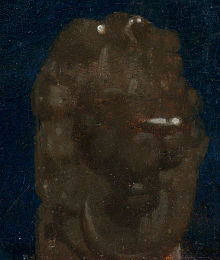
The twin lion-head finials in the painting's lower foreground have garnered significant scholarly interest. Their unique depiction reminds many Vermeer experts of certain traits associated with the image produced by the camera obscura, marked by its fragmented tones, subtle sheen and spherical pointillé highlights.
Albert Blankert, one of the few scholars who disputes the authenticity of this work, argues that the portrayal of the chair relative to the girl's position deviates from the artist's typical fidelity to reality. If the finials indeed belonged to the girl's chair, they wouldn't face the viewer as depicted in Vermeer's version. This suggests that Vermeer might have exercised artistic discretion by turning the finials to face the viewer, or the chair featuring the finials stands in front of the one the girl occupies. Wilenski suggested that Vermeer used a mirror.
Moreover, the finials are misaligned. The left finial is noticeably larger than its counterpart on the right and tilts slightly rightward. Despite these irregularities, a majority of modern historians assert that such discrepancies don't invalidate the painting's association with Vermeer, emphasizing its uniquely emotive essence and masterful paint application.
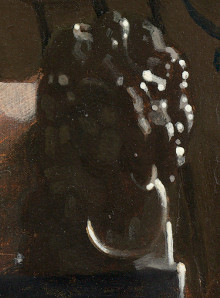
The twin lion-head finials in the painting's lower foreground have garnered substantial scholarly interest. Their distinct depiction reminds many Vermeer experts of particular traits evident in images produced by the camera obscura, characterized by its fragmented tones, subtle sheen and pointillé highlights.
Albert Blankert, one of the few scholars challenging the authenticity of this work, argues that the chair's representation, relative to the girl's position, diverges from the artist's typical commitment to accurately representing reality. If the finials truly belonged to the girl's chair, they wouldn't face the viewer as depicted. This leads to the possibility that Vermeer might have exercised artistic discretion by adjusting the finials' orientation towards the viewer, or the chair featuring the finials stands in front of the one the girl occupies.
Additionally, the alignment of the finials appears off. The left finial is noticeably larger than the right and tilts slightly to the right. Despite these inconsistencies, many modern historians assert such discrepancies don't diminish the painting's association with Vermeer, emphasizing both its technical mastery and emotive depth.
The white cravat
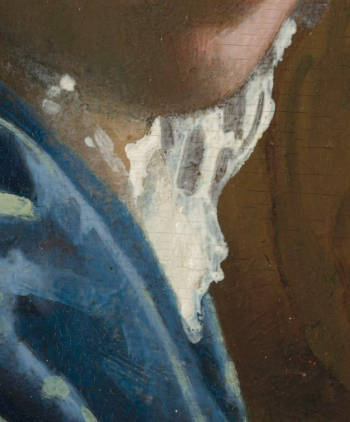
The candid white cravat worn by the figure demonstrates Vermeer's penchant to experiment with pictorial techniques. If examined closely, it can be seen that various shadows of the cravat were produced not darkening the white paint with gray, but by digging into the white paint with the wooden tip of the brush's handle xposing the darker layer of paint beneath.
The cravat—Liedte beleives it should not be called cravat, but simply a scarf—broadly resembles those seen in earlier tronies (for example, by Govert Flinck) and male neckware in portraits of the 1660s onward. However, the brilliant white material comes up unusually high on the neck of Vermeer's figure, most likely for artistic reasons rather than any fashion in Dutch dress.
The term "cravat" comes from the French word "cravate," a corruption of "Croat," as it was derived from the military dress of Croatian mercenaries seen in France during the Thirty Years War. This fashion item was quickly adopted by the French and spread throughout Europe, becoming a standard component of men's fashion in the upper classes. Over time, the cravat evolved into different forms, influencing the development of other types of neckwear such as ascots, bow ties, and neckties. The style can vary from a simple, loosely tied knot to more elaborate and styled arrangements.
The blue shoulder wrap

Self Portrait as a Painter
Frans van Mieris
1667
Oil on panel and gilt, 19.5 x 15.5 cm.
Surrey, Polesden Legacy, The National Trust
The young girl sports a red feathered hat and a swath of bluish, satin-esque fabric nonchalantly draped over her shoulders and arm. This casual pose and unconventional attire suggest the painting wasn't conceived as a formal portrait but rather as a spontaneous study.
Regardless, the girl's attire should be perceived not as an actual garment but as a vivacious prop, momentarily devised for the scene, similar to the attire seen in the self-portrait by Frans van Mieris. For contemporary viewers, it would have been evident that Van Mieris did not paint his daily subjects while adorned in a brocade-edged felt hat and a lustrous satin robe.
An interesting aspect of Vermeer's technique is the yellowish tint of the highlights, which in actuality, should have been more subdued. This method was similarly employed in Woman Holding a Balance. While the shade might have deepened over the years, it appears more likely that this deviation was a deliberate artistic choice. Scholars studying Vermeer have related this unique "optical" gleam to the visuals produced by the camera obscura when capturing similar textures.
special topics
Critical assessment
For a painter who excelled in the observation of light, nothing was a more suitable vehicle than the present picture: a bust-length figure of a woman wrapped with a luxurious material, an outrageous hat, moist lips set between glistening pearls and daylight streaming in from a nearby window on the right. That the model has a distinctive, somewhat androgynous features and conveys a certain attitude (which would have been needed to carry off such a costume) adds considerably to the work's "curiosity," a term routinely employed by connoisseurs of the period to express admiration.
Walter Liedtke, Vermeer and the Delft School, 2001
The signature

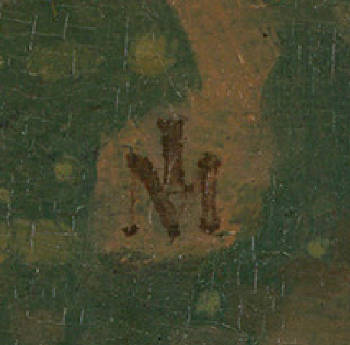
Inscribed upper-left center; (IVM in Ligature)
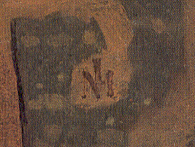
(Click here to access a complete study of Vermeer's signatures.)
Dates
c. 1665–1666
Arthur K. Wheelock Jr., The Public and the Private in the Age of Vermeer, London, 2000
c. 1665–1667
Walter Liedtke, Vermeer: The Complete Paintings, New York, 2008
c. 1666–1667
Wayne Franits, Vermeer, 2015
(Click here to access a complete study of the dates of Vermeer's paintings).
Technical report
The support is probably oak, with a vertical grain. A slightly larger cradle 24.3 x 19.2 cm. (9 9/16 x7 9/16 in.) and wooden collar protect the edges of the panel. X-radiography shows, over the white chalk ground, a portrait of a man with a large hat. The Girl with a Red Hat was painted directly over this earlier image. The painting is in remarkably good condition, with only slight abrasion to the thin glazes of the face and a few scattered minor losses.
* Johannes Vermeer (exh. cat., National Gallery of Art and Royal Cabinet of Paintings Mauritshuis - Washington and The Hague, 1995, edited by Arthur K. Wheelock Jr.
The painting in its frame
Provenance
- (?) Pieter Claesz. van Ruijven, Delft (d. 1674); (?) his widow, Maria de Knuijt, Delft (d. 1681);
- (?) their daughter, Magdalena van Ruijven, Delft (d. 1682);
- (?) her widower, Jacob Abrahamsz Dissius (d. 1695);
- Dissius sale, Amsterdam, 16 May, 1696, no. 38, 39 or 40 [tronien];
- La Fontaine sale, Paris, 10 December, 1822, no. 28;
- Louis Marie, Baron Atthalin, Colmar (1823–1856);
- Gaston, Baron Laurent-Atthalin, Limay, Seine-et-Oise (1856–1911);
- his widow, Baroness Laurent-Atthalin, Pairs (1911–1925);
- [Knoedler Galleries, London and New York, 1925];
- Andrew W. Mellon, Pittsburgh and Washington, D.C. (1925–1932);
- The A. W. Mellon Educational and Charitable Trust, Pittsburgh (1932–1937);
- National Gallery of Art, Washington, DC, Andrew W. Mellon Collection (acc. no. 1937.1.53).
Exhibitions
- New York 1925
Loan Exhibition of Dutch Masters of the Seventeenth Century
M. Knoedler & Co
no. 1. - Cambridge 1927
Loan exhibition for the opening of the new building
Fogg Art Museum
no catalogue - New York 1928
A Loan Exhibition of Twelve Masterpieces of Painting
M. Knoedler & Co
no. 12 - Washington D.C 1995–1996
Dutch Cabinet Galleries
National Gallery of Art
brochure, fig. 11 - Washington D.C November 12, 1995–February 11, 1996
Johannes Vermeer
National Gallery of Art
160–165, no. 14 and ill. - The Hague, March 1–June 2, 1996
Johannes Vermeer
Mauritshuis
160–165, no. 14 and ill. - Washington D.C May 17–August 9, 1998
A Collector's Cabinet
National Gallery of Art
no. 60 - Washington D.C 1999
Johannes Vermeer, The Art of Painting
National Gallery of Art
brochure, fig. 11 - New York March 8–May 27, 2001
Vermeer and the Delft School
The Metropolitan Museum of Art
no. 74 and ill. - London June 20–September 16, 2001
Vermeer and the Delft School
The National Gallery
no. 74 and ill. - Madrid February 19–May 18, 2003
Vermeer y el interior holandés
Museo Nacional del Prado
176–177, no. 37 and ill. - Rome 27 September, 2012–20 January, 2013
Vermeer: Il secolo d'oro dell'arte olandese
Scuderie del Quirinale
216, no. 49 and ill. - Raleigh (NC) October 12, 2014–January 4, 2015
Small Treasures: Rembrandt, Vermeer, Hals and their Contemporaries
231, no. 43 and ill. - Tokyo October 5, 2018 –February 3, 2019
Making the Difference : Vermeer and Dutch Art
Ueno Royal Museum - Washington D. C. October 8, 2022–January 8, 2023
Vermeer's Secrets
National Gallery of Art - Amsterdam February 10– June 4, 2023
VERMEER
Rijksmuseum
no. 24 and ill. - Amsterdam 7 June–10 October, 2023
Six Vermeers
Gallery of Honour, Rijksmuseum
- Antwerp October 20, 2023–January 21, 2024
Turning Heads; Bruegel, Rubens and Rembrandt
October 20, 2023–January 21, 2024
Koninklijk Museum van Schone Kunsten in Antwerpen
(Click here to access a complete, sortable list of the exhibitions of Vermeer's paintings).
A hidden portrait
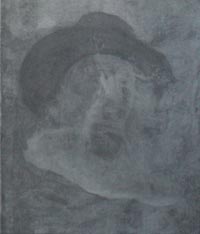
Intriguingly, x-ray images and neutron reflectograms disclosed that beneath Vermeer's depiction, there exists a bust-length portrait of a man wearing a wide-brimmed hat, crafted with thick and expansive brushstrokes. Before overlaying the previous image, Vermeer inverted it, likely to prevent any distraction from the existing composition. This underlying male portrait led Arthur K. Wheelock Jr. to postulate Carel Fabritius as the possible artist behind the piece, even though no solid evidence precludes the possibility of Vermeer being its creator. Wheelock notes that upon Vermeer's passing, he had in his possession two small tronies by Fabritius, potentially related to Vermeer's auxiliary painting commerce. Conversely, Walter Liedtke posits that Vermeer would unlikely obliterate a piece by an artist he deeply respected.
Portrait or tronie?
Man in Oriental Dress
Frans van Mieris
1665
Oild on panel, 14.0 x 11.2 cm.
The Picture Gallery of Willem V,
The Hague
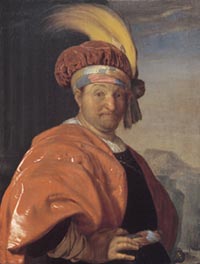
The Girl with a Red Hat is categorized as a tronie, an archaic term denoting a style of painting popularized by Rembrandt and his disciples. Most Dutch tronies used living models, often being the artists themselves, their kin, or peers. Yet, these weren't crafted as formal portraits; instead, they were prominently displayed in the artist's studio to entice potential buyers. Typical subjects for tronies encompassed elderly men, alluring young women, figures dressed as "Turks," or spirited soldiers. Artists gravitated towards attire that seemed particularly foreign, granting them an avenue to flaunt their adept painting skills—a prominent mark of a proficient artist during that era. The 17th century bore witness to a fervent demand for tronies, which stood as a distinct genre. These paintings also functioned as a reservoir of diverse facial characteristics and emotions, later to be incorporated into historical artworks.
Vermeer's repertoire includes three known tronies. John Larson, a sculptor active in both Hague and London, possessed a painting documented in an August 1664 inventory as "a tronie by Vermeer," appraised at 10 guilders. In the Dissius auction of 1696, where 21 of Vermeer's creations were auctioned, two paintings were identified as tronies.
Possible pendant

The term "pendant" originates from the Latin word pendere, meaning "to hang." In the realm of art, a pendant refers to a pair of paintings designed to be displayed side by side. Typically, pendants maintain a consistent format and share matching frames. In Dutch households, it was commonplace for pendants to be positioned on either side of architectural features such as doors or fireplaces.
Several Vermeer experts posit that Girl with a Red Hat and Girl with a Flute were conceptualized as a pendant pairing. Both artworks depict a young girl donning an unusual hat, illuminated under similar lighting, with a backdrop featuring a casually draped tapestry. Furthermore, both pieces are crafted on panels and bear comparable dimensions.
According o Walter Liedtke, in contrast to Vermeer's larger ironies, Girl with a Pearl Earring and Study of a Young Woman, which appear to represent charming Dutch girls dressed up in items found around the studio and 'Indian' garments that were owned by Vermeer or his wife, both the Girl with a Red Hat and Girl with a Flute are more exotic in flavour, with their display of fabrics throughout, strange hats, enormous "pearl" earrings and rather peculiar faces, with in this case a long drooping nose, full lips and endless arching eyebrows vaguely reminiscent of Thai sculpture.
Painted on panel
Out of the 35 (?) extant Vermeer paintings, only two pieces, Girl with a Flute and Girl with a Red Hat, were executed on a medium other than canvas. Specifically, Girl with a Red Hat was painted on a thin oak panel featuring a vertical grain. Interestingly, Vermeer's death inventory from 1676 mentions 10 unpainted canvases and 6 unpainted panels in his studio. This suggests that Vermeer's apparent preference for canvas might not be as pronounced as the makeup of his remaining works suggests.
Experts in Vermeer's oeuvre have posited various theories, primarily aesthetic ones, regarding his choice of panel for Girl with a Flute. Paint tends to glide more effortlessly on the slick, rigid surface of a panel, lending itself to a more calligraphic style, as observed in this painting. Arthur K. Wheelock Jr. hypothesized that Vermeer opted for a panel as he aimed to mimic the ethereal sheen characteristic of images produced by the camera obscura. Yet, the immaculate smoothness of the panel also facilitates achieving the utmost detail that oil paint allows. It's also worth pondering whether Vermeer's choice was motivated by a more mundane reason. Vermeer might have found the panel a suitable base for a swiftly produced, marketable piece, with hopes of drawing a prospective buyer using an appealing depiction. It's essential to note that in the final stages of Vermeer's professional life, the war with France had instigated a significant downturn in the art market, impacting Vermeer's financial standing.
While the 17th century marked a significant transition to canvas as a preferred medium, the tradition of panel painting persisted, especially for smaller, intricate works. Oak, with its durability and fine grain, was the wood of choice, often sourced the Baltic region. The oak was radially cut to reduce the potential for warping. On occasion, artists also opted for Baltic Fir, especially for larger panels, as it was more affordable, albeit less robust.
The process of preparing these panels was meticulous. Initially, a piece of wood devoid of knots and imperfections was chosen to guarantee a smooth canvas for the artist. For larger works multiple boards were seamlessly joined together, their edges beveled and glued to present a unified surface. This wood would then undergo a drying process, sometimes extending for several years, to ensure its stability and resistance to future warping.
Once ready, the panel would be primed for painting. A ground, often a concoction of chalk or lead white mixed with a binder like oil or glue, was applied, providing both protection against the absorption of paint and a refined surface for the artwork. In some instances, the wood was also treated with a layer of animal glue, known as "sizing", to further seal the panel and deter it from soaking up the paint's oil.
The art of panel preparation was a specialized craft. The craftsmen, known as "paneelmakers", were experts in their field, distinct from the painters yet working in close conjunction with them. A substandard panel prone to warping or cracking could spell disaster for the painting it bore.
Distinctive lighting
Self Portrait as a Young Man
Rembrandt van Rijn
c. 1628–1629
Oil on oak pane, 22.6 x 18.7 cm.
Rijksmuseum, Amsterdam
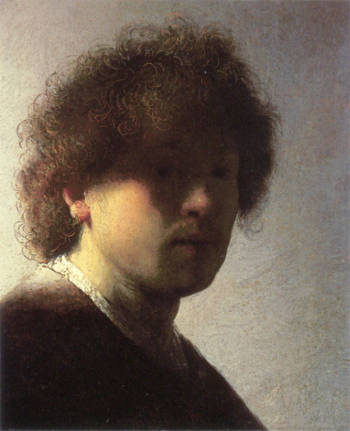
The distinctive lighting in this work is often traced to early self-portraits by Rembrandt van Rijn. Walter Liedtke, a renowned scholar on Vermeer, noted that while Vermeer might not have had direct access to Rembrandt's early works, Rembrandt's talented students, Flinck and Bol, had made such expressions a recognized pictorial convention by the 1650s and 1660s.
Interestingly, the deep shadows on the young girl's face are rendered in a muted green tone, specifically green earth, which becomes evident upon observing the original. Vermeer used this distinctive shade in other late paintings for similar passages of flesh. By the 17th century, artists typically employed warm brown for the deeper shadows of flesh, though this technique was embraced by some Utrecht Caravaggists. John Michael Montias, a biographer of Vermeer, proposed that the young Vermeer might have trained in Utrecht. However, making a definitive connection based on this specific technical or stylistic approach remains speculative.
Painted from a camera obscura screen?
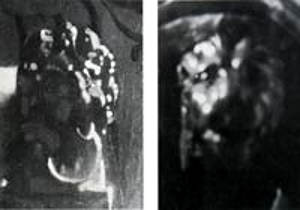
Among Vermeer's paintings, this particular piece most closely resembles the type of image produced by an instrument known as the camera obscura, an optical precursor to the modern photographic camera.
While the extent to which Vermeer and other 17th-century Dutch artists utilized the camera obscura for composing their paintings remains a topic of heated debate among experts, it is clear that the images it produced exhibit many of the characteristics found many of Vermeer's work.
Charles Seymour observed objects similar to those in Vermeer's painting under comparable lighting conditions through an authentic 19th-century camera obscura and discovered that the resulting images shared qualities with those of Vermeer's paintings, particularly, those of theforeground lion-head-finials of the Girl with a Red Hat.
Why did Vermeer use green earth in the shadows?
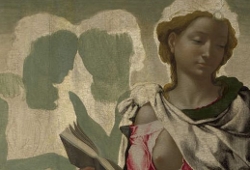
The Virgin and Child with Saint John and Angels (detail)
Michelangelo
c. 1497
Tempera on panel, 104.5 x 77 cm.
National Gallery, London
One of the most curious techniques in Vermeer's later works is his use of the muted green natural earth pigment in the shadows of the flesh. In both Girl with a Red Hat and its pendant, he Girl with a Flute, green earth is visible to the naked eye, although it may not always be discernible in reproductions. The reason for Vermeer's adoption of this technique has left art historians puzzled.
Green earth was commonly used by medieval and early Renaissance painters as a base tone for flesh to counteract the stark whiteness of the gesso preparation on panels. When the required pinks and reds for flesh are applied over white gesso, they can create an overly rosy "sunburn" effect. Essentially, flesh was modeled over the dry, flat layer of green earth with lighter mixtures of white, red lakes and yellow ochre, resulting in a natural pearlescence resembling skin tones. However, many of these works now appear greener than originally intended due to the fading of red pigments.
An unfinished work by Michelangelo provides insight into the artistic methods of the period. It shows that artists constructed their compositions incrementally, a method modern painters tend to avoid, and illustrates the use of a flat layer of green earth beneath the flesh tones.
Vermeer's approach likely differed from Michelangelo's. Instead of a flat, unmodulated layer of green earth, Vermeer might have applied it only to shadowed areas, blending it wet-in-wet with pink flesh tones where light and shadow met.
While some Mannerist painters from Utrecht incorporated green earth in their depictions of flesh, their artistic and aesthetic aims differed significantly from Vermeer's, making a direct link between their techniques and Vermeer's seem unlikely. Following its use in his experimental tronies Vermeer applied this green earth in several of his later paintings in the flesh tones of his figures, including The Geographer, The Guitar Player, Allegory of Faith, Lady Seated at a Virginal and Lady Stading at a Virginal.
Listen to period music
 Jan Dismas Zelenka
Trio sonata ZWV 181, no. 1, Adagio ma non troppo [972 KB]
http://www.amazon.com/Jan-Dismas-Zelenka-Knut-Sonstevold/dp/B0008FMHQW/ref=sr_1_9?ie=UTF8&s=music&qid=1258287965&sr=1-9