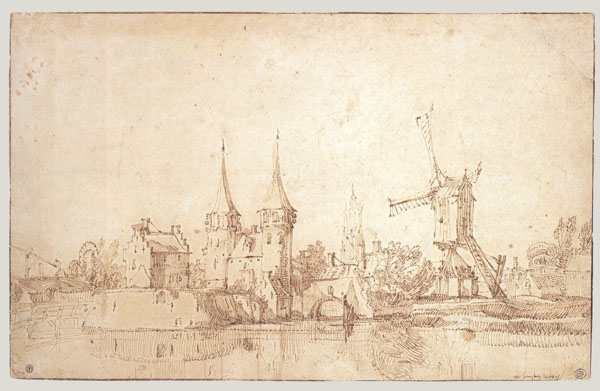
The Oospoort (The East Gate) at Delft
Jan van de Velde the Youngerpen and brown ink
19.1 x 30.4 cm.
Musée de l'École National Supérieure des Beaux-Arts, Paris
Jan van de Velde the Younger
Born into an artistic family, Jan van de Velde II (1593–1641) was encouraged to develop his talent in an inspirational and supportive creative environment. Van de Velde's parents moved to Rotterdam a few years prior to his birth, but later relocated to Haarlem where Jan "the younger" would learn skill in many forms of art. He, along with brother Willem and cousin Esaias van de Velde, developed his craft in Haarlem. His father, a master calligrapher, had strong intentions for Jan to be taught by a draughtsman. Jacob Matham, stepson of Hendrik Goltzius, instructed Jan in engraving in 1613 and a year later he became a member of Haarlem's artists' guild of Saint Luke. Although art historians still consider him a truly underrated printmaker, he produced over five hundred prints during his career and works such as Peasants and Goats near Ruins (c.1615) demonstrate Van de Velde's skill in creating picturesque etched views near Haarlem.
Focusing on rural life and everyday domestic genre scenes, he frequently based his drawings and etchings on other Baroque artists, either copying their works or borrowing motifs for his own compositions. He reproduced the works of such artists as Willem Buytewech, Frans Hals and even his cousin Esaias. Buytewech's and Van de Velde's prints have a number of stylistic and thematic similarities, but Van de Velde's landscapes reflect a keen appreciation of nature and the rustic countryside that was not emphasized in other Dutch artists' works. Van de Velde's landscapes tend to present an historic devotion to the ancient Dutch world combined with a prosaic emotional response to nature.
by Kathryn Koca
http://www.knox.edu/x1139.xml
- Willem van Aelst (2)
- Balthasar van der Ast (6)
- Hendrick Avercamp (3)
- Dirck van Baburen (7)
- Jacob Adriaenz. Backer (3)
- David Bailly
- Ludolf Bakhuysen
- Bartholomeus van Bassen
- Cornelis Bega
- Gerrit Berckheyde (2)
- Gillis Gillisz de Bergh
- Jan van Bijlert (7)
- Jan de Bisschop (2)
- Abraham Bloemaert (4)
- Pieter De Bloot
- Ferdinand Bol (3)
- Hans Bollinger
- Paulus Bor (2)
- Ambrosio Bosschaert (7)
- Jan Both
- Leonaert Bramer (4)
- Salomon de Bray (2)
- Quiringh van Brekelenkam (4)
- Jan Gerritszoon van Bronchorst (2)
- Adriaen Brouwer (5)
- Hendrick ter Brugghen (6)
- Hendrick van der Burch (5)
- Willem Buytewech (6)
- Abraham van Calraet (2)
- Jacob van Campen
- Jan van de Cappelle(3)
- Pieter Claesz (4)
- Pieter Codde (6)
- Adriaen Coorte (9)
- Josse van Craesbeeck (2)
- Aelbert Cuyp (6)
- Philip van Dijk
- Gerrit Dou (10)
- Willem Drost (2)
- Hendrick Dubbels
- Jacob Duck (4)
- Karel Dujardin (3)
- Willem Duyster (5)
- Gerbrand van den Eeckhout
- Pieter Jansens Elinga
- Cesar van Everdingen (5)
- Allaert van Everdingen
- Carel Fabritius (5)
- Goveart Flinck
- Frans Francken the Younger
- Aert de Gelder
- Cornelis Gijsbrechts
- Jan van Goyen (6)
- Frans Hals (3)
- Dirck Hals (5)
- Jan Davidsz. Heem (6)
- Maerten van Heemskerck
- Bartholomeus van der Helst (4)
- Jan van der Heyden (8)
- Meyndert Hobbema (3)
- Gerard van Honthorst (8)
- Pieter de Hooch (12)
- Van Hoogstraten (9)
- Gerard Houckgeest (4)
- Jan van Huysum (3)
- Willem Kalf (4)
- Jan van Kessel
- Philip Koninck (2)
- Gérard de Lairesse (5)
- Pieter Lastman
- Judith Jansdochter Leyster (5)
- Jan Lievens (4)
- Jacob van Loo (7)
- Nicolaes Maes (9)
- Cornelis de Man (5)
- Gabriel Metsu (12)
- Michiel Janz. van Mierevelt (3)
- Frans van Mieris (8)
- Jan Miense Molenaer (5)
- Pieter Molijn (2)
- Paulus Moreelse (2)
- Pieter Mulier
- Michiel van Musscher (5)
- Aert van der Neer (3)
- Eglon van der Neer (3)
- Caspar Netscher (5)
- Jacob Ochervelt (8)
- Jacob van Oost (2)
- Adriaen van Ostade (5)
- Antonie Palamedesz (6)
- Adam Pijnacker (5)
- Egbert van der Poel (2)
- Jan Porcellis (4)
- Pieter Symonz. Potter
- Paulus Potter (7)
- Pieter Jansz. Quast (2)
- Rembrandt van Rijn (complete oeuvre)
- Jacob van Ruisdael (8)
- Solomon van Ruisdael (7)
- Rachel Ruysch (2)
- Pieter Saenredam (3)
- Godfried Schalcken (6)
- Hercules Segers (2)
- Hendrick Sorg (4)
- Jan Steen (8)
- Harmen Steenwyck (3)
- Matthias Stom (2)
- Michael Sweerts (6)
- David Teniers the Younger
- Gerrit ter Borch (15)
- Willem van de Velde (7)
- Jacob van Velsen
- Johannes Verkolje (2)
- Jan Cornelisz Verspronck (4)
- Abraham de Verwer
- Simon de Vlieger
- Hendrick van Vliet (2)
- Daniel Vosmaer (4)
- Jacobus Vrel (8)
- Jacob van Walscapelle (2)
- Jan Baptist Weenix (2)
- Jan Wijnants (3)
- Emanuel de Witte (6)
- Philips Wouwermans (2)