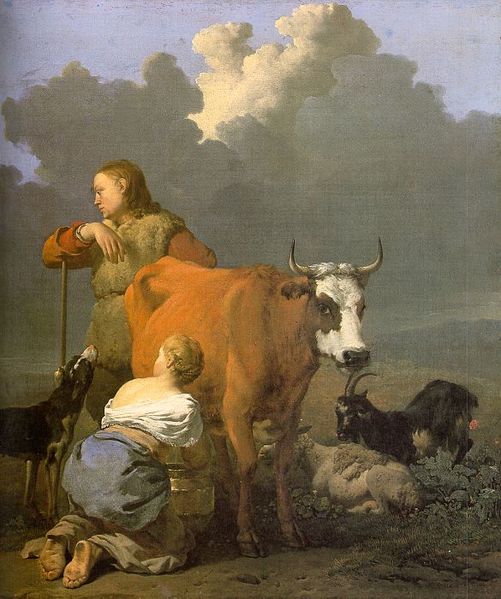
Woman Milking a Red Cow
Karel Du Jardinc. 1657
Oilon canvas, 81 x 75 x 6 cm.
Nationalmuseum, Stockholm
Karel DU JARDIN
Amsterdam 1621/2 (?)- Venice 1678
Although most of Du Jardin's pictures are Italian landscapes in the manner of Nicolaes Berchem, who is believed to have been his master, his art shows a wide variety of subject matter and technique. He also painted a few large pictures like the Conversion of Saul (in the National Gallery, London) but these lack the precision and concentration of his small-scale pictures. There are also a few excellent portraits, most of which depict a young man. Although the sitters differ, almost all of them have at one time been described as self-portraits.
Du Jardin did not make any contribution to the development of the Italianate landscape which was evolved by Jan Both and continued by Berchem, but he practiced the genre with a skill and perfection which make him outstanding of the group. He was also good at painting animals and occasionally his pictures come close to those of Paulus Potter.
Jan Both concentrated on the general effect of his landscapes, which are meant to be viewed as a whole, but Du Jardin preferred his pictures to be read at close quarters. The atmosphere has a milky quality rather than the olden glow used by most of his contemporaries.
His career was complex and is best summarized as follows: Rome before 1650; Amsterdam 1650; Lyons; Amsterdam 1652; The Hague 1656; Amsterdam 1659; Rome 1675; Venice 1678. His pictures show remarkably little evidence of these continuous moves and, without dates on them, they remarkably difficult to pin-point to a particular time in his career.
- Willem van Aelst (2)
- Balthasar van der Ast (6)
- Hendrick Avercamp (3)
- Dirck van Baburen (7)
- Jacob Adriaenz. Backer (3)
- David Bailly
- Ludolf Bakhuysen
- Bartholomeus van Bassen
- Cornelis Bega
- Gerrit Berckheyde (2)
- Gillis Gillisz de Bergh
- Jan van Bijlert (7)
- Jan de Bisschop (2)
- Abraham Bloemaert (4)
- Pieter De Bloot
- Ferdinand Bol (3)
- Hans Bollinger
- Paulus Bor (2)
- Ambrosio Bosschaert (7)
- Jan Both
- Leonaert Bramer (4)
- Salomon de Bray (2)
- Quiringh van Brekelenkam (4)
- Jan Gerritszoon van Bronchorst (2)
- Adriaen Brouwer (5)
- Hendrick ter Brugghen (6)
- Hendrick van der Burch (5)
- Willem Buytewech (6)
- Abraham van Calraet (2)
- Jacob van Campen
- Jan van de Cappelle(3)
- Pieter Claesz (4)
- Pieter Codde (6)
- Adriaen Coorte (9)
- Josse van Craesbeeck (2)
- Aelbert Cuyp (6)
- Philip van Dijk
- Gerrit Dou (10)
- Willem Drost (2)
- Hendrick Dubbels
- Jacob Duck (4)
- Karel Dujardin (3)
- Willem Duyster (5)
- Gerbrand van den Eeckhout
- Pieter Jansens Elinga
- Cesar van Everdingen (5)
- Allaert van Everdingen
- Carel Fabritius (5)
- Goveart Flinck
- Frans Francken the Younger
- Aert de Gelder
- Cornelis Gijsbrechts
- Jan van Goyen (6)
- Frans Hals (3)
- Dirck Hals (5)
- Jan Davidsz. Heem (6)
- Maerten van Heemskerck
- Bartholomeus van der Helst (4)
- Jan van der Heyden (8)
- Meyndert Hobbema (3)
- Gerard van Honthorst (8)
- Pieter de Hooch (12)
- Van Hoogstraten (9)
- Gerard Houckgeest (4)
- Jan van Huysum (3)
- Willem Kalf (4)
- Jan van Kessel
- Philip Koninck (2)
- Gérard de Lairesse (5)
- Pieter Lastman
- Judith Jansdochter Leyster (5)
- Jan Lievens (4)
- Jacob van Loo (7)
- Nicolaes Maes (9)
- Cornelis de Man (5)
- Gabriel Metsu (12)
- Michiel Janz. van Mierevelt (3)
- Frans van Mieris (8)
- Jan Miense Molenaer (5)
- Pieter Molijn (2)
- Paulus Moreelse (2)
- Pieter Mulier
- Michiel van Musscher (5)
- Aert van der Neer (3)
- Eglon van der Neer (3)
- Caspar Netscher (5)
- Jacob Ochervelt (8)
- Jacob van Oost (2)
- Adriaen van Ostade (5)
- Antonie Palamedesz (6)
- Adam Pijnacker (5)
- Egbert van der Poel (2)
- Jan Porcellis (4)
- Pieter Symonz. Potter
- Paulus Potter (7)
- Pieter Jansz. Quast (2)
- Rembrandt van Rijn (complete oeuvre)
- Jacob van Ruisdael (8)
- Solomon van Ruisdael (7)
- Rachel Ruysch (2)
- Pieter Saenredam (3)
- Godfried Schalcken (6)
- Hercules Segers (2)
- Hendrick Sorg (4)
- Jan Steen (8)
- Harmen Steenwyck (3)
- Matthias Stom (2)
- Michael Sweerts (6)
- David Teniers the Younger
- Gerrit ter Borch (15)
- Willem van de Velde (7)
- Jacob van Velsen
- Johannes Verkolje (2)
- Jan Cornelisz Verspronck (4)
- Abraham de Verwer
- Simon de Vlieger
- Hendrick van Vliet (2)
- Daniel Vosmaer (4)
- Jacobus Vrel (8)
- Jacob van Walscapelle (2)
- Jan Baptist Weenix (2)
- Jan Wijnants (3)
- Emanuel de Witte (6)
- Philips Wouwermans (2)