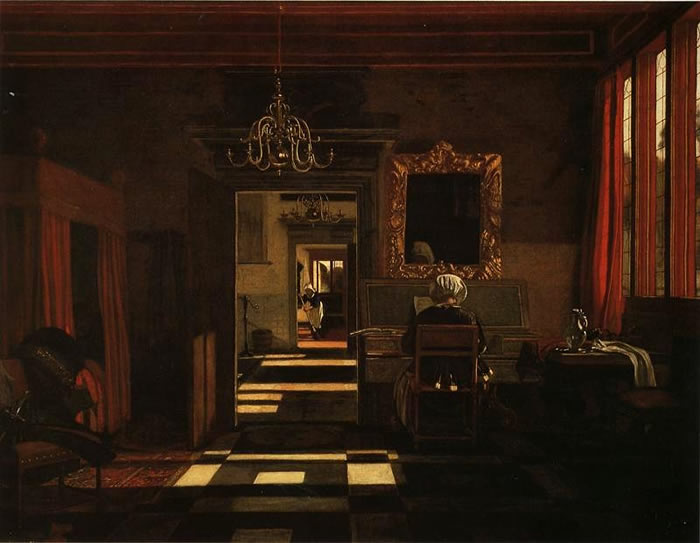
Interior with a Woman at the Virginals
Emanuel De Wittec. 1660
Oil on canvas, 77.5 x 104.5 cm.
Museum Boijmans van Beunningen, Rotterdam
Emanuel de WITTE
Alkmaar c. 1616/18-Amsterdam c. 1691–1692
Emanuel de Witte occupies an important place in the development of Dutch painting in the middle years of the seventeenth century, both in the painting of church interiors and domestic interior scenes. He appears to have been trained in Alkmaar and was a member of the guild there in 1636. He then spent a short time in Rotterdam and by about 1641 was living in Delft. It was there that his style was formed a style which was to have some influence on the next generation of painters. He painted a number of rather somber interior scenes in which the fall of light plays an important part, and it may well be that he had a certain influence on Pieter de Hooch and even on Nicolaes Maes, who was influenced by the Delft school.
Most of de Witte's middle years were devoted to the painting of church interiors. He had moved to Amsterdam in 1652, thus avoiding the explosion of the powder magazine in Delft two years later. A surprisingly high proportion of de Witte's church interiors are imaginary, and it is difficult to see why people wanted pictures of church interiors which did not exist. By contrast, for instance, nearly all Hendrick van der Vliet's surviving church interiors depict the two churches in Delft. De Witte's work is somber in mood, with contrasts of light and shade and with a certain air of mystery quite unlike the feeling of most Dutch church interiors. For accuracy of tone and atmosphere it is necessary to look at Pieter Saendredam. In his last years in Amsterdam de Witte diversified his subject matter and painted several market scenes of a peculiar intimacy. He also painted one especially beautiful evening seascape which is in the Rijksmuseum, Amsterdam.
- Willem van Aelst (2)
- Balthasar van der Ast (6)
- Hendrick Avercamp (3)
- Dirck van Baburen (7)
- Jacob Adriaenz. Backer (3)
- David Bailly
- Ludolf Bakhuysen
- Bartholomeus van Bassen
- Cornelis Bega
- Gerrit Berckheyde (2)
- Gillis Gillisz de Bergh
- Jan van Bijlert (7)
- Jan de Bisschop (2)
- Abraham Bloemaert (4)
- Pieter De Bloot
- Ferdinand Bol (3)
- Hans Bollinger
- Paulus Bor (2)
- Ambrosio Bosschaert (7)
- Jan Both
- Leonaert Bramer (4)
- Salomon de Bray (2)
- Quiringh van Brekelenkam (4)
- Jan Gerritszoon van Bronchorst (2)
- Adriaen Brouwer (5)
- Hendrick ter Brugghen (6)
- Hendrick van der Burch (5)
- Willem Buytewech (6)
- Abraham van Calraet (2)
- Jacob van Campen
- Jan van de Cappelle(3)
- Pieter Claesz (4)
- Pieter Codde (6)
- Adriaen Coorte (9)
- Josse van Craesbeeck (2)
- Aelbert Cuyp (6)
- Philip van Dijk
- Gerrit Dou (10)
- Willem Drost (2)
- Hendrick Dubbels
- Jacob Duck (4)
- Karel Dujardin (3)
- Willem Duyster (5)
- Gerbrand van den Eeckhout
- Pieter Jansens Elinga
- Cesar van Everdingen (5)
- Allaert van Everdingen
- Carel Fabritius (5)
- Goveart Flinck
- Frans Francken the Younger
- Aert de Gelder
- Cornelis Gijsbrechts
- Jan van Goyen (6)
- Frans Hals (3)
- Dirck Hals (5)
- Jan Davidsz. Heem (6)
- Maerten van Heemskerck
- Bartholomeus van der Helst (4)
- Jan van der Heyden (8)
- Meyndert Hobbema (3)
- Gerard van Honthorst (8)
- Pieter de Hooch (12)
- Van Hoogstraten (9)
- Gerard Houckgeest (4)
- Jan van Huysum (3)
- Willem Kalf (4)
- Jan van Kessel
- Philip Koninck (2)
- Gérard de Lairesse (5)
- Pieter Lastman
- Judith Jansdochter Leyster (5)
- Jan Lievens (4)
- Jacob van Loo (7)
- Nicolaes Maes (9)
- Cornelis de Man (5)
- Gabriel Metsu (12)
- Michiel Janz. van Mierevelt (3)
- Frans van Mieris (8)
- Jan Miense Molenaer (5)
- Pieter Molijn (2)
- Paulus Moreelse (2)
- Pieter Mulier
- Michiel van Musscher (5)
- Aert van der Neer (3)
- Eglon van der Neer (3)
- Caspar Netscher (5)
- Jacob Ochervelt (8)
- Jacob van Oost (2)
- Adriaen van Ostade (5)
- Antonie Palamedesz (6)
- Adam Pijnacker (5)
- Egbert van der Poel (2)
- Jan Porcellis (4)
- Pieter Symonz. Potter
- Paulus Potter (7)
- Pieter Jansz. Quast (2)
- Rembrandt van Rijn (complete oeuvre)
- Jacob van Ruisdael (8)
- Solomon van Ruisdael (7)
- Rachel Ruysch (2)
- Pieter Saenredam (3)
- Godfried Schalcken (6)
- Hercules Segers (2)
- Hendrick Sorg (4)
- Jan Steen (8)
- Harmen Steenwyck (3)
- Matthias Stom (2)
- Michael Sweerts (6)
- David Teniers the Younger
- Gerrit ter Borch (15)
- Willem van de Velde (7)
- Jacob van Velsen
- Johannes Verkolje (2)
- Jan Cornelisz Verspronck (4)
- Abraham de Verwer
- Simon de Vlieger
- Hendrick van Vliet (2)
- Daniel Vosmaer (4)
- Jacobus Vrel (8)
- Jacob van Walscapelle (2)
- Jan Baptist Weenix (2)
- Jan Wijnants (3)
- Emanuel de Witte (6)
- Philips Wouwermans (2)