Modern art aficionados should recognize that the art world of the twentieth century bears little resemblance to the era of Johannes Vermeer. In the seventeenth century, the concept of private art galleries, eagerly anticipated international exhibitions, critical art reviews in newspapers, and extensive art commentary was virtually non-existent. Dutch painters, largely viewing themselves as mere skilled craftsmen, rarely documented their thoughts about themselves or their work. The general Dutch populace was not acutely aware of their living amidst the 'Golden Age of Dutch Painting,' and the way art was appreciated and discussed then differs markedly from our modern perspectives.
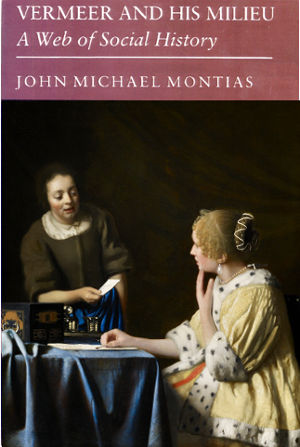
John Michael Montias
1989
The primary historical records concerning seventeenth-century Dutch artists, including Vermeer, are predominantly legal and transactional documents — notarial depositions, business records, and municipal clerical entries. These documents often present an individual's life from a rather adversarial viewpoint, lacking a comprehensive or balanced portrayal of their personal and professional experiences. For instance, significant life events like Vermeer's baptism, marriage, and burial are documented in the vellum-bound registers of Delft's Old and New Churches, but these only offer sparse glimpses into his life.
Regarding Vermeer's early years, the trail goes cold after his baptism in 1632 until he marries Catharina Bolnes in 1653. While subsequent archival records don't reveal much about Vermeer's personality, they do provide a clear picture of his family background and social environment.
The cornerstone of our understanding of Vermeer's life and times is John Michael Montias' seminal work, Vermeer and His Milieu: A Web of Social History. This book is a must-read for anyone intrigued by Vermeer or the artistic context of his time, as it forms the bedrock of all subsequent research on the artist. Montias embarked on an exploratory journey into the life of this enigmatic figure, unearthing surprising details: Vermeer's grandfather was a convicted counterfeiter, his grandmother ran illicit lotteries, and Vermeer himself fathered thirteen children, dying penniless at forty-three. These revelations underscore the fact that much remains to be discovered about Vermeer, a fascinating artist shrouded in mystery.
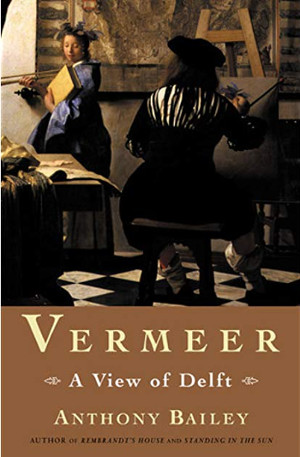
Anthony Bailey
2001
Anthony Bailey's Vermeer: A View of Delft is another vibrant addition to literature on the Dutch master, offering an accessible and engaging narrative. Bailey skillfully intertwines the life stories of Vermeer's contemporaries, including the renowned scientist Anton Van Leeuwenhoek, and delves into Vermeer's possible Catholic faith in a predominantly Protestant Netherlands. His approach of structuring the book around individual paintings adds a unique dimension, allowing readers to journey through Vermeer's life and times.
Bailey commences with the catastrophic gunpowder explosion in Delft in 1654, a pivotal event in Vermeer's life, and concludes with an exploration of how Vermeer's art resonated through the ages — from influencing Marcel Proust's writings to being a subject of Han van Meegeren's infamous forgeries.
This book is not only a treasure for general readers but also a valuable resource for art history enthusiasts, thanks to its comprehensive perspective and Bailey's captivating writing style. It is a highly recommended read for both general and art history collections, promising to enrich one's understanding of Vermeer and his era.
In order to ensure reasonable loading time, this timeline has been divided into five sections.
1668: Vermeer's Age, 36
VERMEER'S LIFE & ART |
 The Geographer Johannes Vermeer c. 1668–1669  The Astronomer Johannes Vermeer c. 1668 Vermeer signs and dates The Astronomer, 1668. The only other dated painting by Vermeer is the early The Procuress. Some scholars believe that Delft citizen Antonie van Leeuwenhoek, who is by then internationally recognized for his studies in optics and scientific observations, poses for The Astronomer, although portraits of Van Leeuwenhoek bear little resemblance to the seated man in Vermeer's picture. |
DUTCH PAINTING |
Rembrandt van Rijn paints Return of the Prodigal Son. Gabriel van de Velde paints Golfers on the Ice.  The White Horse Philips Wouwerman 1650 Philips Wouwerman, a successful Dutch painter, dies. He is the most celebrated member of a family of Dutch painters from Haarlem, where he worked virtually all his life. He becomes a member of the painters' guild in 1640 and is said by a contemporary source to be a pupil of Frans Hals. The only thing he has in common with Hals, however, is his nimble brushwork, for he specialized in landscapes of hilly country with horses - cavalry skirmishes, camps, hunts, travelers halting outside an inn, and so on. In this genre he is immensely prolific. |
EUROPEAN PAINTING & |
Johann Lukas von Hildebrandt, Austrian architect, is born. Bernini sculpts a terra cotta study for one of the angels of Rome's Port Santa Angelo. |
MUSIC |
Nov. 10, Francois Couperin, composer and organist (Concerts Royaux), is born in Paris, France. Danish organist-composer Diderik Buxtehude, 31, is named organist at the Marienkirche in Lübeck, succeeding Franz Tunder (whose daughter, Anna, he marries). His sacred Abendmusiken concerts will be presented each year during Advent on the five Sundays before Christmas. Buxtehude's cantatas and instrumental organ work will have a strong influence on other composers. Mar. 5, Francesco Gasparini, composer, is born. |
LITERATURE |
Apr. 13, John Dryden (36) becomes first English poet laureate. |
SCIENCE & PHILOSOPHY |
 Sir Isaac Newton at 46 Godfrey Kneller 1689 Robert Hooke writes Discourse on Earthquakes. Sir Isaac Newton invents the reflecting telescope, building the first telescope based on a mirror (reflector) instead of a lens (refractor). Anthony van Leeuwenhoek makes the first accurate description of red corpuscles. The Delft scientist is born in the same year as Vermeer and in the twentieth century is often associated to the artist for their interest in optics although there is no evidence of any contact between them. Chemist Johann R. Glauber dies at Amsterdam March 10 at age 63. |
HISTORY |
Mar. 26, England takes control of Bombay, India. Mar. 27, English king Charles II gives Bombay to the East India Company. Sept. 16, King John Casimer II of Poland abdicates the throne. Louis XIV of France purchases a 112 carat blue diamond from John Baptiste Tavernier for 220,000 livre. Tavernier was also given a title of nobility. Feb. 7, the Netherlands, England and Sweden conclude an alliance directed against Louis XIV of France. |
1669: Vermeer's Age, 37
VERMEER'S LIFE & ART |
 The Lacemaker Johannes Vermeer c. 1669–1671 Vermeer's mother, Digna Baltens, leases the inn Mechelen to a shoemaker for three years. She and her husband had owned in the place for 28 years. afterward she goes to live with her daughter Gertruy on the Vlamingstraat, in Delft. Vermeer and his wife bury another child in the Oude Kerk. Pieter Teding van Berckhout, who is from an important family in the Hague, visits Vermeer twice and enters in his diaries his impressions. In May 14, 1669, Van Berckhout writes: "Having arrived in Delft, I saw an excellent painter named Vermeer," stating also that he had seen several "curiosities" of the artist. He arrives in Delft accompanied by Constantijn Huygens and his friends, the member of parliament Ewout van der Horst and ambassador Willem Nieupoort. Huygens is an artistic authority in his own day, maintaining contacts with the famous Flemish painters Peter Paul Rubens and Anthony van Dyck and recording in his own diary some remarkably insightful comments about the art of Rembrandt van Rijn. Van Berckhout must have been deeply impressed by the work he sees in Vermeer 's studio, since he returns for another visit less than a month later. On June 11, Van Berckhout notes: "I went to see a celebrated painter named Vermeer" who "showed me some examples of his art, the most extraordinary and most curious aspect of which consists in the perspective." This time Van Berckhout used the term "celebrated" rather than "excellent" in describing Vermeer. This testifies that Vermeer had achieved a significant reputation. What is most interesting about this visit is that Vermeer's studio (like Dou and van Mieris) is evidently a major cultural destination. In the late 1660s, Vermeer's style becomes increasing stylized. A strongly touch calligraphic is evident in The Lacemaker. The still life of the latter picture is so highly abstracted that it is difficult to determine which objects are represented. |
DUTCH PAINTING |
Oct. 4, Rembrandt dies, eleven months later after his son, Titus, in 1668, only 27 years of age. His beloved Hendrickje dies in 1663. |
EUROPEAN PAINTING & |
Le Vau begins remodeling Versailles. The semicircular Sheldonian Theater at Oxford, England, designed by Christopher Wren, is completed. |
MUSIC |
Royal patent for founding Academie Royale des Operas is granted to Pierre Perrin. Marc' Antonio Cesti, Italian composer, dies. The first Stradivarius violin is created by Italian violinmaker Antonio Stradivari, 25, who serves his apprenticeship in his home town of Cremona in Lombardy to Nicola Amati, now 73, whose grandfather Andrea Amati designed the modern violin. The younger Amati improves on his grandfather's design and teaches not only Stradivari but also Andrea Guarnieri, 43, who also makes violins at Cremona. |
LITERATURE |
|
SCIENCE & PHILOSOPHY |
 Nicolas Steno Arnold Geulincx, Dutch philosopher, dies. Nicolaus Steno begins the modern study of geology. Nils Steensen's Prodromus is first published in Italy and translated to English two years later. It explains the authors determination of the successive order of the earth strata. Emperor Leopold I sanctions the foundation of a higher school in Innsbruck, Austria. This is considered to mark the founding of the University of Innsbruck. A General History of the Insects by Jan Swammerdam presents a preexistence theory of genetics that the seed of every living creature was formed at the creation of the world and that each generation is contained in the generation that preceded it. |
HISTORY |
Pope Clement IX dies at Rome December 9 at age 69 after a 2½-year reign in which he has encouraged missionary work, reduced taxes, and extended hospitality to Sweden's former queen Kristina. He will not be replaced until next year. Feb. 1, French King Louis XIV limits the freedom of religion. Mar. 11, Mount Etna in Sicily erupts killing 15,000. Sept. 27, The island of Crete in the Mediterranean Sea falls to the Ottoman Turks after a 21-year siege. |
1670: Vermeer's Age, 38
VERMEER'S LIFE & ART |
French influence, where elegance and grace were more important than the traditionally objective values, begins to be favored by Dutch painters.  The Love Letter Johannes Vermeer c. 1667–1670 In the years surrounding 1670 Vermeer paints The Love Letter. This small canvas shows abstract qualities in which reality is reduced to a series of flat, interlocking planes. The increased stylization and technical refinement of his later works is not unique to him but common to many Dutch painters of the late 1670s. Vermeer's mother is buried in the Nieuwe Kerk in Delft, February 13. Gertruy Reynier Vermeer, Vermeer's sister, is buried at the beginning of May in the Nieuwe Kerk in Delft. Vermeer inherits Mechelen from his mother, July 13. The painter rents it to a shoemaker caller Van Ackerdyck. Vermeer is appointed for a second time headmen of the Guild of Saint Luke. Delft pop. 15,000 |
DUTCH PAINTING |
|
EUROPEAN PAINTING & |
Louis Le Vau, French architect, dies. Landscape architect André Lenôtre lays out the Champs-Elysées at Paris. |
MUSIC |
Molière's Le Bourgeois Gentilhomme includes a ballet with music by court composer Jean Baptiste Lully, 38, who has come to France from his native Florence and changed his name from Giovanni Battista Lulli. The ballet is so popular that four performances are requested in the space of 8 days. |
LITERATURE |
Feb. 10, William Congreve, English writer (Old Bachelor, Way of the World), is born. John Ray prints a book of aphorisms such as: Blood is Thicker than Water and Haste Makes Waste." |
SCIENCE & PHILOSOPHY |
Italian scientist Giovanni Borelli (1608–1679) attempts to use artificial wings for flying. London clockmaker William Clement improves the accuracy of clocks by inventing anchor-shaped gadgets (escapements) that control the escape of a clock's driving force. Parts of Baruch de Spinoza's "Tractatus Theologico-Politicus" are published anonymously. Spinoza shows that the Bible, if properly understood, gives no support to the intolerance of religious authorities and their interference in civil and political affairs. The book creates a furor. It will provoke widespread denunciations as it goes through five editions in the next 5 years. Spinoza moves to The Hague to gain the protection of influential friends. Now 37, he suffers from tuberculosis after years of inhaling glass dust produced by his lens-grinding. |
HISTORY |
Cardinal Emilio Altieri (b. 1590) becomes Pope Clement X. May 2, The Hudson Bay Company is chartered by England's King Charles II to exploit the resources of the Hudson Bay area. The Dutch merchant marine becomes larger than that of England, France, Spain and Portugal combined. Cafe Procope, the first cafe in Paris, begins to serve ice cream. France's Louis XIV founds Les Invalides at Paris to house up to 7,000 disabled soldiers. |
1671: Vermeer's Age, 39
VERMEER'S LIFE & ART |
 Lady Writing a Letter with Her Maid Johannes Vermeer c. 1670–1671 In July Vermeer appears before the notary Assendelft to acknowledge that he had received an inheritance of 148 guilders from his sister's estate. |
DUTCH PAINTING |
Adriaen van Ostade paints Travelers Resting. |
EUROPEAN PAINTING & |
Lionel Bruant: Hôtel des Invalides, Paris (- 1675). Christopher Wren: The Monument (- 1677) to commemorate the Great Fire of London in 1666. |
MUSIC |
Feb. 19, Charles-Hubert Gervais, composer, is born. Dec. 1, Francesco Stradivari, Italian violin maker and son of Antonius, is born. The French Académie de Royale Musique opens March 3 in the Salle du Jeu de Paume de la Bouteille. Jean Baptiste Lully will take over the Paris Opéra beginning next year and run it until 1687, rebuilding the house after fires that destroys it in 1678 and 1681. |
LITERATURE |
Apr. 6, Jean-Baptiste Rousseau, French playwright, poet (Sacred Odes & Songs), is born. Molière writes his farce Les Fourberies de Scapin (The Wiles of Scapin or Scapin the Cheat). |
SCIENCE & PHILOSOPHY |
In Germany Gottfried Wilhelm Leibnitz devises a mechanical calculator to add, subtract, multiply and divide. Astronomer Jean Picard visits the observatory of the late Tycho Brache on Hven Island, Sweden, to determine its exact location in order that observations there can be compared with precision to those made elsewhere. He returns to Paris with copies of Brahe's work and will use them to help him obtain an accurate measurement of the length of a degree of a meridian (longitude line) for use in computing the size of the Earth. |
HISTORY |
c. 1671 First printed reference to an alphabet rhyme, a rhyme composed to help children learn their letters. |
1672: Vermeer's Age, 40
VERMEER'S LIFE & ART |
 The Guitar Player Johannes Vermeer c. 1670–1673 Vermeer leases Mechelen to an apothecary for six years. In May Vermeer travels with two other headmen of the Saint Luke guild of Delft to The Hague in order to appraise a collection of disputed Italian paintings. Since one of the members of the expedition, Johannes Jordaens had spent many yeas in Italy, and Vermeer probably never left the Netherlands, it is likely that he is chosen for his importance as the headmaster of the guild. The commission testifies before a notary that the works are "great pieces of rubbish and bad paintings." Vermeer's earnings from his paintings after the French invaded the Netherlands of this year is probably considerably lower that those of the 1660s. His family is also very large by Dutch standards: only two or three children are usual. The artist's economic problems worsen owing to his particularly low rate of production and restricted clientele. The refined sense of balance in Vermeer's compositions of the 1660s give way to a new dynamic direction in the early 1670s. In The Guitar Player, Vermeer rejects balance in favor of a highly asymmetric compositions. The figure of the young girl seems to literally burst off the canvas. The music of the guitar, much bolder than that of the lute, had become popular in these years. |
DUTCH PAINTING |
|
EUROPEAN PAINTING & |
Christopher Wren: Saint Stephen's, Walbrook, London |
MUSIC |
Apr. 6, Andre Ardinal Destouches, composer, is born. First public concert at Whitefriars, London, is given by violinist John Banister. The baroque guitar begins to become popular in Holland. A fine example can be seen in Vermeer's Guitar Player. The lute, by this time, begins to take on associations with an idealized past. The Académie Royale de Danse is founded by Louis XIV. In 1661 it is amalgamated with the Paris Opéra and becomes the Paris Opéra Ballet. |
LITERATURE |
William Temple writes Observations upon the United Provinces of the Netherlands. |
SCIENCE & PHILOSOPHY |
Flexible hose, used for fighting fires, are invented by the Dutch landscape painter Jan van der Heyde and his son. |
HISTORY |
Apr. 29, King Louis XIV of France invades the Netherlands. The Dutch Republic economy and the art market virtually collapses. Jun. 15, The Sluices are opened in Holland to save Amsterdam from the French. The Royal African Co. is granted a charter to expand the slave trade. Its stockholders include philosopher John Locke. The operation supplies English sugar colonies with 3,000 slaves annually. Political lynching of the statesman Johan and Cornelis de Witt by Orange supporters in The Hague. Netherlands's third war with England initiates the economic decline of Holland. The Dutch organize a system of relief for the poor, who have been previously provided for by prosperous merchants. With Dutch trade declining and the country at war, the merchants can no longer afford to be so generous. |
1673: Vermeer's Age, 41
VERMEER'S LIFE & ART |
 A Lady Standing at a Virginal Johannes Vermeer c. 1670–1674 June 27, another child of Vermeer is buried in the family grave in the Oude Kerk. Vermeer rents family inn Mechelen, that he had inherited, to his namesake an apothecary, for six years at 180 guilders a year, which is 10 guilders less that what was obtained from the shoemaker. July 21, Vermeer sells two bonds totaling eight hundred guilders, one of which, worth 500 guilders, is in the name of Magdalena Pieters (1655–1682), daughters of Pieter Claesz. van Ruijven, from whom Vermeer had borrowed money in 1657. |
DUTCH PAINTING |
Willem van de Velde paints Three Ships in a Gale. Adriaen van Ostade paints The Violin Player. Mar. 28, Adam Pijnacker (51), Dutch landscape painter, etcher, is buried. |
EUROPEAN PAINTING & |
Salvator Rosa (b. 1612) Spanish painter, dies. Christopher Wren is knighted. |
MUSIC |
Buxtehude begins at Lubeck his famous "Abendmusiken" concerts. |
LITERATURE |
Feb. 17, Molière, French author, dies. |
SCIENCE & PHILOSOPHY |
Dec. 28, Joan Blaeu (77), Dutch cartographer, publisher (Atlas Major), dies. Leibniz conceives a calculator that uses Pascal's adding machine as its basis but that can also multiply and divide. He finally builds the device some 20 years later. Antonie van Leeuwenhoek has by this time developed simple, single-lens microscopes with magnification up to 275 times (a device with a biconvex lens he grinds himself) and begins to send the English Royal Society letters on his discoveries. |
HISTORY |
Willem III of Orange saves Amsterdam and the province of Holland from France's Louis XIV by opening the sluice gates and flooding the country, an operation is directed by mathematician and Amsterdam burgomaster Johan van Waveren Hudde, now 45. Willem is supported by Friedrich Wilhelm, elector of Brandenburg, who concludes a separate peace with Louis and retains most of his possessions in Clèves. University of Innsbruck is founded. Feb. 20, the first recorded wine auction is held in London. Dutch forces retakes New York and Delaware |
1674: Vermeer's Age, 42
VERMEER'S LIFE & ART |
Pieter van Ruijven, prominent Delft citizen and Vermeer's principal patron, dies. Van Ruijven had purchased about 20 of Vermeer's works, almost half of his total artistic output. Vermeer's name appears on the register of the Delft militia. He is described, third on the list, as a schutter, or marksman, of the first rotten, or squadron, of the third company or vendel. This was the Orange company whose members are recruited from the quarter of the city where Vermeer and his family was living with his step-mother, Maria Thins. Leonaert Bramer, friend of the Vermeer family for many years and noted painter of Delft, belongs to the same company. The fact that Vermeer is accepted in the Delft militia testifies to his high social standings. June, Maria, Vermeer's eldest daughter, marries the son of a prosperous Delft silk merchant Johannes Gilliszoon Cramer who follows his father's profession. The wedding is held in Schipluy, as Maria's parents' wedding had taken place, and presumably, with Catholic sacraments. Reynier Bolnes, Vermeer's father-in-law, dies. Vermeer travels to Gouda to settle the estate. Delft tax register list more than 200 houses worth more than 20,000 guilders. A carpenter or mason earned about 500 guilders a year. |
DUTCH PAINTING |
|
EUROPEAN PAINTING & |
Philippe de Champaigne, French painter, dies. Jun. 21, Sir Christopher Wren begins to rebuild St Paul's Cathedral in London, replacing the old building which had been destroyed by the Great Fire. |
MUSIC |
Feb. 21, Johann Augustin Kobelius, composer, is born. Lully: Alceste, opera Paris. |
LITERATURE |
Jun. 20, Nicholas Rowe, poet laureate of England, is born. Nov. 8, John Milton (65), English poet, dies. His work includes Paradise Lost, Paradise Regained, and Samson Agonistes. Milton loses one eye at 36 and the other when he is 44. The Great Historical Dictionary, or Anthology of Sacred and Secular History (Le grand Dictionnaire historique ou Mélange curieux de l'histoire sacré et profane), compiled by clergyman Louis Moréri, is published at Lyons. Its focus is on biographical and historical articles. It will be translated into German, Italian and Spanish as well as English, and it will appear in 20 editions by 1759 |
SCIENCE & PHILOSOPHY |
Louis Moreri: Le Grand Dictionnaire historique, first encyclopedic reference work on history. Mar. 4, John Flamsteed is appointed first Astronomer Royal of England. Newton delivers his Discourse on Light and Colour to the Royal Society. Antonie van Leeuwenhoek of Delft discovers "invisible" small animals using the first of more than 400 simple microscopes that he will produce. Chamberlain since 1660 to the city's sheriff, Leeuwenhoek has sufficient income to devote considerable time and attention to his avocation of grinding lenses and using them to study tiny objects which he has isolated from ponds, rainwater, well water, and other sources. |
HISTORY |
Feb. 9, English reconquers NY from Netherlands. Feb. 19, Netherlands and England signs the Peace of Westminster. NYC became English. May 20, John Sobieski becomes Poland's first King. The Treaty of Westminster February 9 ends the 2-year war between England and the Dutch. It returns New York and Delaware to England (see 1673), freeing the English to expand their trade and grow prosperous while Europe is embroiled in depleting warfare. England's Charles II begins wearing long waistcoats, introducing a fashion that encourages men to wear their watches in their waistcoat pockets instead of from their necks. |
1675: Vermeer's Age, 43
VERMEER'S LIFE & ART |
 Lady Seated at a Virginal Johannes Vermeer c. 1670–1675 Vermeer borrows one thousand guilders, a considerable sum equivalent to about two year's earnings of a mason, from an Amsterdam merchant. Maria Thins empowers Vermeer to collect and administer money owed to her son. Vermeer is buried in the Oude Kerk, July 20. He leaves an impoverished widow and eleven children, ten of whom are still minors. Vermeer had probably painted very little in his last years. His death is described by his wife, "as a result and owing to the great burden of his children, having no means of his own, he had lapsed into such decay and decadence, which he had so taken to heart that, as if he had fallen into a frenzy, in a day or day and a half had gone from being healthy to being dead." The burial registers of the Oude Kerk mention on December 15, 1675: "Jan Vermeer, artist of the Oude Langendijk, in the Oude Kerk." Catharina is left with ten children and an enormous debt. She is able to survive only through the loving help of her mother Maria Thins. A plea to her creditors strikes a final sad note of the artist's brief life: "during the ruinous war he not only was unable to sell any of his art but also, to his great detriment, was left sitting with the paintings of other masters that he was dealing in." |
DUTCH PAINTING |
Jacob van Ruisdael paints Jewish Cemetery. |
EUROPEAN PAINTING & |
Sir Christopher Wren begins rebuilding Saint Paul's Cathedral, London (1710) |
MUSIC |
In France Lully composes Thesee. The librettist is Philippe Quinault. This work establishes the tragedie lyrique operatic form. Antionio Vivaldi (d. 1741), Italian composer, is born. He receives his early training from his father, a violinist at Saint Mark's, Venice, and later studies with Giovanni Legrenzi. Ordained a priest in 1703, Vivaldi spends most of his life after 1709 in Venice, teaching and playing the violin and writing music for the Pietà, one of Venice's four music conservatories for orphaned girls. Although he produces quantities of vocal music (including 46 operas), he is remembered chiefly for his instrumental music—sonatas; concerti grossi, including four famous ones known as The Four Seasons; and 447 concertos for violin and other instruments. He helps standardize the three-movement concerto form later used by J. S. Bach and others. Vivaldi's brilliant allegros and impassioned slow movements are greatly admired by Bach, who arranged 10 of the solo concertos for other instruments. After Vivaldi's death, his music was forgotten, but in the early twentieth century, his works are rediscovered. Vivaldi's style is characterized by driving rhythm, clarity and lyrical melody. |
LITERATURE |
|
SCIENCE & PHILOSOPHY |
Spinoza finishes his Ethics (begun 1662). Romer calculates the speed of light. |
HISTORY |
Jun. 28, Frederick William of Brandenburg crushes the Swedes. Oct. 4, Christian Huygens patents the pocket watch. |