


No.5 "In which a gentleman is washing his hands
in a perspectival room with figures, artful and rare, by ditto" 95-0
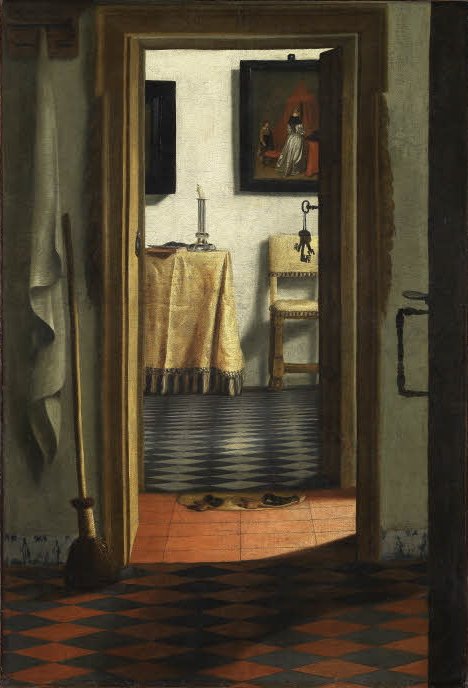
View of an Interior, or The Slippers (traditional title, given in the 19th century)
Samuel van Hoogstraten
Between 1654 and 1662
Oil on canvas, 103 x 70 cm.
Musée du Louvre, Paris
The most surprising and suggestive catalogue description in the Dissius auction catalogue refers to a now- lost composition, "In which a gentleman is washing his hands in a perspectival room with figures, artful and rare..." The picture fetched 95 guilders, making it one of the highest priced works of the auction.
The "perspectival room" had been experimented other times by Vermeer in the early A Maid Asleep and the later The Love Letter. This pictorial device, also called doorkijkje, was practiced by other Dutch genre painters such as De Hooch (Couple with a Parrot) and Samuel van Hoogstraten (The Slippers). Curiously, Vermeer's Love Letter, De Hooch's Couple with a Parrot and Van Hoogstraten's Slippers have in common a broom which leans against the foreground doorway.
As Vermeer expert Albert Blankert has pointed out, no other Dutch genre painting displays a gentleman washing his hands. The hand washing theme was most probably an allegory of the cleansing of one's soul.
 or anything else that isn't working as it should be, I'd love to hear it! Please write me at: