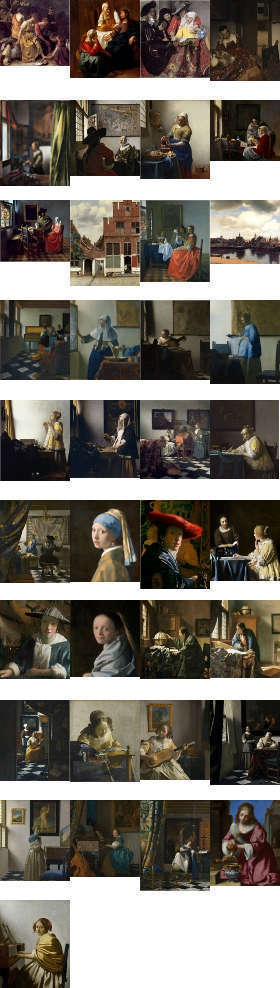


The Dissus Sale of 1696
No. 3 " The portrait of Vermeer in a room with various
accessories,
uncommonly beautiful painted by him" 45-0
Portrait of an Artist in His Studio
Michiel van Musscher
Bass Museum
Miami Beach, Florida

The Art of Painting
Johannes Vermeer
VERMEER'S PAINTING
- COMPLETE VERMEER CATALOGUE
- Vermeer's paintings in scale
- museum locations of Vermeer's paintings
- geographical distribution of Vermeer's work
- Vermeer's signatures
- Vermeer paintings in their frames
- the Baron Rolin Woman at a Virginal
- Vermeer's clients and patrons
- missing Vermeer's
- Saint Praxedis: missing the mark
- the Dissius auction
- eyewitness accounts of Vermeer's paintings
- Vermeer's lost self-portrait
- erroneous attributions and fakes
- the Procuress: evidence for a Vermeer self-portrait
VERMEER'S PAINTING TECHNIQUE
- Vermeer's palette
- details of Vermeer's painting technique
- Vermeer and the camera obscura
- Virtual reconstruction of woman with a water pitcher
TIMELINES
MUSIC IN VERMEER'S TIME
VERMEER'S LIFE
- Vermeer's life
- chronology of Vermeer's life
- Johannes and Catharina
- Vermeer the man
- Vermeer's children
TIMELINES
DELFT & DUTCH PAINTING
- the school of delft
- the saint luke's guild of delft
- dutch master gallery
- the golden age of dutch painting
- economics in dutch 17th c. painting
- rembrandt (an E.V.sister site)
DELFT
VERMEER EVENTS
DUTCH PRONUNCIATION (MP3)
E.V. INTERVIEWS
EXTERNAL SOURCES
PRINTS AND POSTERS
BOOKSHOPS
- Vermeer related books
- dutch art
- old master painting technique
- videos, novels & poetry inspired by Vermeer
- Vermeer's painting technique
MUSEUMS
RESEARCH
- in-depth bibliography
- Johannes Vermeer bookshop
- glossary of art terms
- dating of Vermeer's paintings
- map of current painting locations
- museum websites with Vermeer's paintings
- online dutch art resources
MISC.
- proust and Vermeer:"petit pan de mur jaune."
- the han van meegeren case
- brush with fate: a behind the scenes view girl in hyacinth blue
- lace and lacemaking in vermeer's time
- Constantijn Huygens
VERMEER VIDEOS
copyright@ 2001-2008 Jonathan Janson


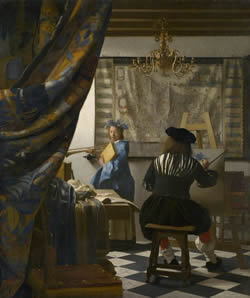
Although the well known The Art of Painting in Vienna might conceivably fit the brief description, most scholars reject this hypothesis principally on the basis of the low price paid for the picture. The "portrait of Vermeer in a room" was sold for only 45 guilders while works of far smaller dimensions such as the Milkmaid and Woman Holding a Balance fetched 175 guilders and 155 guilders respectively. It is unlikely that a richly complex work such as The Art of Painting was not appreciated by the same public that seemed competent enough to distinguish the Milkmaid from lesser works of approximately the same size. Its ingenious perspective accuracy alone would have surely attracted greater interest. Vermeer's art in fact, was once noted by a contemporary connoisseur precisely for his ability in the use of perspective. Moreover, the art and practice of perspective was widely studied and held in high esteem and would have been an added value to the aesthetic qualities of a work of art\. If we add the painting's extraordinary illusionist quality and the notable pictorial technique (again, both elements of painting that were held in high consideration) it seems impossible that the Art of Painting could have been underestimated, and even penalized to such a degree.

The Artist's Studio
Michiel van Musscher
whereabouts unknown
Taking into consideration yet another piece of archival documentation, the above observations acquire further validity. In April 1699 in Amsterdam in an auction of Herman van Swoll is described so: "a seated woman with several (symbolic and allegorical) meanings, representing the New Testament by Vermeer of Delft, vigorously and glowing painted." The price paid was 400 guilders, a considerable sum. The painting, no doubt, can be identified as the Allegory of Faith in the Metropolitan Museum of Art. It must be remembered that the two paintings, the Art of Painting and the Allegory of Faith, are very similar in dimensions and compositional complexities. However modern criticism sees fit to judge the relative artistic worth two works (the Art of Painting is universally considered one of Vermeer's most significant paintings while the Allegory of Faith is usually thought of as a rather uninspired late work), the fact that the Art of Painting could be valued as little as a tenth of the Allegory of Faith seems incomprehensible by any standards, modern or antique. By the above considerations we hoped to have shown that the painting sold in the 1679 auction described as "portrait of Vermeer" was not the well known the Art of Painting.
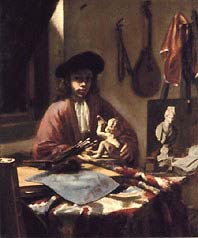
In the earlier part of the twentieth-century a small painting which now is in the Bass Museum in Miami, Florida was believed by some to be the lost self-portrait. Other than the picture's resemblance to the catalogues description, there existed (whose whereabouts is no longer known) a seventeenth-century engraved copy of the same painting which bares the inscription "Ver Meer pinxit." The inscription, however had been added by a later hand. The painting is now attributed to Michiel van Musscher (1645-1705) by the Bass Museum as Portrait of a Young Artist. For further information on the lost self-portrait see Vermeer's Lost Self-Portrait.
The Sinfonia (Family Portrait)
Michiel van Musscher
1671
Van Musccher is also the author of another picture which has been traditionally linked to Vermeer's oeuvre, a fact which which in itself is a rarity since we may count on the fingers of a hand the number of pictures by Dutch artists which were directly influenced by Vermeer work. The now lost Artist's Studio (above left) was obviously inspired by Vermeer's Art of Painting although nothing else is known in regards to contact between the two artists.
According to Houbraken, Van Musscher received his eclectic artistic training in Amsterdam, studying first with the history painter Martinus Zaagmolen (c. 1620-69) in 1660, then with Abraham van den Tempel in 1661, followed by lessons with Gabriel Metsu in 1665. He completed his studies in 1667 in the studio of Adriaen van Ostade. The following year van Musscher returned briefly to Rotterdam before settling permanently in Amsterdam in 1668.
Van Musscher became one of the most successful portrait painters of the final quarter of the seventeenth century. He specialized in portraiture and the painting of genre pieces. His style shows influences of his former master Gabriel Metsu and of Frans van Mieris. His technique is smooth and refined, but nonetheless freer and more robust than that of the fijnschilders of Leiden. Van Musscher is outstanding in the representation of fabrics.