


Johannes de Renialme - "A Grave Visitation, by van der Meer"
"The earliest mention of a painting by Vermeer concerns a youthful work (perhaps) along the lines of Christ in the House of Martha and Mary. A June 22, 1657 inventory of the Amsterdam "gentleman art dealer" Johannes de Renialme mentioned "A Grave visitation by van der Meer,"1 for the price of 20 guilders. This was a fairly substantial price—though far from spectacular—for a young master who was more or less unknown in Amsterdam.2
De Renialme had registered in the guild of Delft in 1644. He had probably become acquainted with Vermeer's father, Reynier Janz., who also dealt in artworks, through the Notary Willem de Langue, with whom De Renialme was in contact. Various other Delft artists, including Bramer, Anthonie Palamedesz, and Hendrick van Vliet, were represented in the inventory of his possessions.
It remains unclear, however, whether the words "Grave Visitation" describe a biblical, New Testament theme showing the visit of the three Maries to the tomb of Christ on Easter Sunday or, alternatively, to a contemporary scene depicting the tomb of William of Orange in Delft's Nieuwe Kerk. The tomb a was a major attraction and the subject of many paintings and drawings.
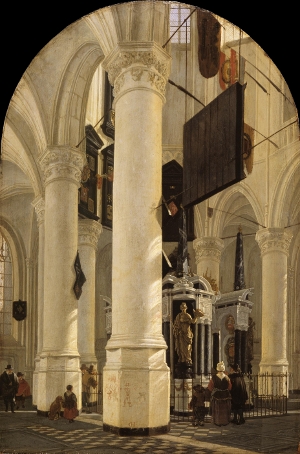
Interior of the Nieuwe Kerk,
Delft, with the Tomb of
William the Silent
Gerard Houckgeest
1650
Oil on panel, 126 x 89 cm.
Hamburg, Kunsthalle
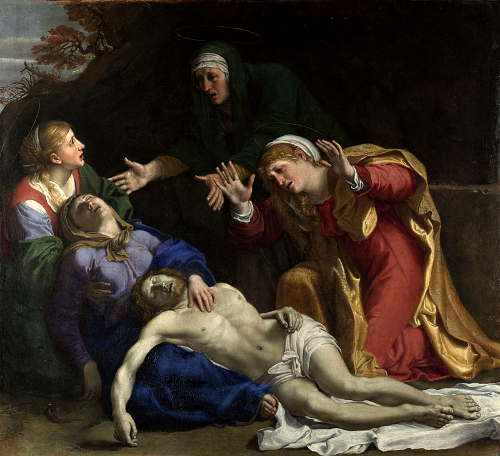
The Dead Christ Mourned ("The Three Maries")
Annibale Carracci
c. 1604
Oil on canvas, 92.8 x 103.2 cm.
National Gallery, London
De Renialme (c. 1600–1657) was active in Amsterdam and Delft between 1640 and 1657 and was know to have dealt in Italian works of art as well as the works of illustrious Dutch painters such as Rembrandt, Hercules Seghers, Jan Lievens and Salomon Koninck. Among his clients was Frederick William, Elector of Brandenburg. De Renialme came from a distinguished family of based in Antwerp and Venice. There is no evidence that he had any training in art, but was known to have practiced as goldsmith and jeweler; he also traded in jewellery. De Renialme was married four times. Upon his death his inventory of 538 artworks (13 paintings by Rembrandt) was valued at the considerable sum of 36,512 guilders.
† FOOTNOTES †
- Arthur K. Wheelock Jr., exh. cat. Johannes Vermeer, eds. Arthur K. Wheelock Jr. and Ben Broos, London and New Haven: Yale University Press, 1995,–48.
- John Michael Montias, Vermeer and His Milieu: A Web of Social History, Princeton, NJ: Princeton University Press, 1989, 14.
 or anything else that isn't working as it should be, I'd love to hear it! Please write me at: