The Camera Obscura and Pointillé
It is now generally accepted that Vermeer employed a simple, box-like device, called the camera obscura as an aid to his painting, although there is great debate as to exactly to what extent he used it. Philip Steadman, a London architect turned Vermeer scholar, provided convincing circumstantial evidence—the camera obscura leaves no physical marks of its use in painting—that Vermeer may have even projected image of the camera obscura directly on his canvas where he then comfortably traced its principal outlines with a brush and paint.
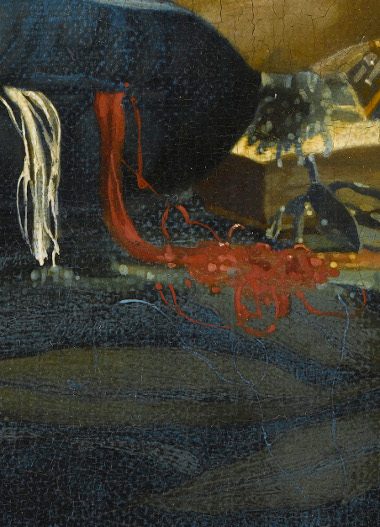
The camera obscura greatly restricts the complexities of visual phenomena thereby facilitating the painter's job of translating natural phenomena to a simpler reality of paint. Its imperfect lens also produces the so-called halations, or "disks of confusion""Disks of confusion," also known as "circles of confusion," are optical effects that occur when light rays converge at a point just before or beyond the image plane in a camera or the eye, resulting in a blurred or unfocused area. When light from a point source does not quite converge or comes together to form a sharp point on the sensor or film, it spreads out, forming a tiny circle instead. This effect is especially noticeable in photographs with a shallow depth of field, where only a small portion of the image is in focus and the out-of-focus regions show these characteristic soft circles. which can be seen in many Vermeer paintings as globular dots of light-toned paint (pointillé).This term describes the small dots of impasto (thick lumps of paint) applied to the surfaces of his pictures in order to imitate the halations inherent to the peripheries of gleaming objects projected by the camera obscura. Although Vermeer likthat Vermeer applied to mimic the optical effects (disks of confusion) produced by the primitive optical system of the camera obscura. Although he may have initially used pointillé to duplicate what could be seen through the camera obscura, he soon realized their independent aesthetic potential. For example, in The Milkmaid, pointillé are used to impart an extraordinary tactile quality to such objects as the chunks of bread. In fact, the chunks are encrusted with so many pointillés that these dots of paint seem to exist independently of the forms they describe.Wayne Franits., The Cambridge Companion to Vermeer (Cambridge Companions to the History of Art) (Cambridge: Cambridge University, 2001), 18.
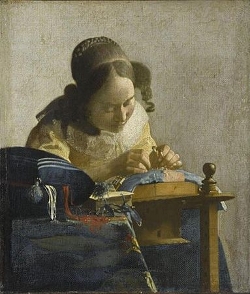
Johannes Vermeer
c. 1669–1671
Oil on canvas on panel, 24.5 x 21 cm.
Musée du Louvre, Paris
In no other work of Vermeer can the optical distortions of the camera obscura is so evident as in the late Lacemaker. The foreground objects of the still life have been painted according to an optical reality similar to that created by the camera obscura rather than the conceptual reality. Some of the objects are either no longer recognizable or barely so. The threads that issue from the large blue sewing cushion have been transformed into a delightful red and white foam that unceremoniously spills out on the table. The contrast between the world of the still life suspended in its luminous dissolution and the almost painful clarity of the young woman absorbed in her domestic chore, constitutes one the most visually gratifying passages in all of Vermeer's art. With typical eloquence, the influential art writer Lawrence Gowing would pay tribute to the artist's use of pointillé so:
The striking thing about Vermeer's pointillé is that, however deft, they do not characterize more emphatically the particular shapes of the objects they depict. Indeed, the round, soft lights spread and blend as if received by some minutely granular retina which diffuses a little the points of greatest luminosity. The tassels on the cushion of The Lacemaker have an enticing and baffling bluntness of focus. It is easy to imagine how sharply the bands of her book, and the silks which were recorded by De Groot as feathers, would have been characterized by the touch of any other painter of the school.Lawrence Gowing, Vermeer (Oakland CA: University of California Press, 1997), reprint edition, 22.
Although Vermeer certainly incorporated the camera obscura an essential part of his working method, the minuscule Lacemaker possesses a human significance that a mechanical device can neither suggest nor create.