When the reconstruction of Vermeer's original composition of the Young Woman Holding a Pitcher is compared to the actual picture, it appears somewhat contrived, even cluttered, which consequentially diminishes the importance of the figure. It is possible that the artist had initially intended the foreground chair and the initial position of the map to frame the young woman's open gesture and stabilize her leaning pose. However, rather than appearing sustained by the additional compositional elements, the woman seems physically gripped by her environment and her movement blocked. By eliminating the chair and the figure-map overlap, the grace of her sweeping, opened-armed gesture and her thoughtful presence are more freely expressed. With characteristic acumen, Wheelock observes that "by removing the chair and changing the position of the map, Vermeer preserved the purity of the white wall between the woman and the window, thus allowing the light to flow directly onto her, uninterrupted by any visual interference."Wheelock Jr., Arthur K. Johannes Vermeer. (Exh. cat. London and New Haven: Yale University Press, 1995), 148. Moreover, the tiny channel of light gray wall that flows discreetly between the rolin ball of the map's rod and the right-hand contour of the figure's headdress in the new version allows the wall to physically extend itself uninterrupted from the left to the right of the figure enhancing the sense of the natural unity of its flat surface. Wheelock has also hypothesized that the change in the map's position "may have also been determined by iconographic considerations."Wheelock Jr., Arthur K. Vermeer and the Art of Painting. (New York and New Haven: Yale University Press, 1995), 107. even though iconographic interpretation of such a common household object such as geographic maps is not without its perils.
The initial composition in Young Woman with a Water Pitcher recalls the more forceful compositional arrangements of the earlier Officer and Laughing Girl, The Glass of Wine, and Girl Interrupted in Her Music. In all three works, the same kind of lion-head-finial chair faces the young woman in an analogous manner, and a map or painting-within-a-painting hangs behind them on the background wall..
Changes in the Other "Pearl Pictures" by Vermeer
Vermeer also made significant modifications in the other pearl pictures, perhaps with the exception of the Woman Holding a Balance.
The initial composition (see virtual reconstruction below right) of Woman with a Pearl Necklace included not only a map of the Netherlands behind the standing girl similar to the one in The Art of Painting, but a musical instrument (very likely a cittern) placed on the foreground chair. Both objects were completely painted out. Additionally, a more expansive area under the table was exposed, allowing visual access to a number of illuminated floor tiles.
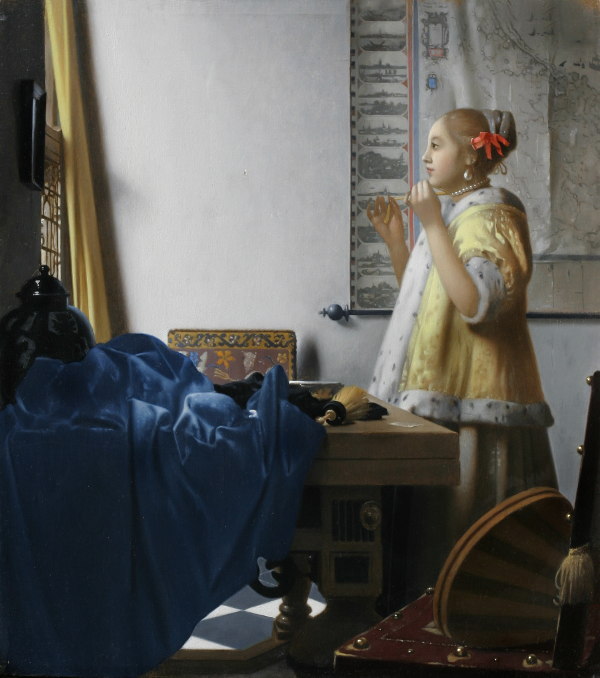
(virtual reconstruction)
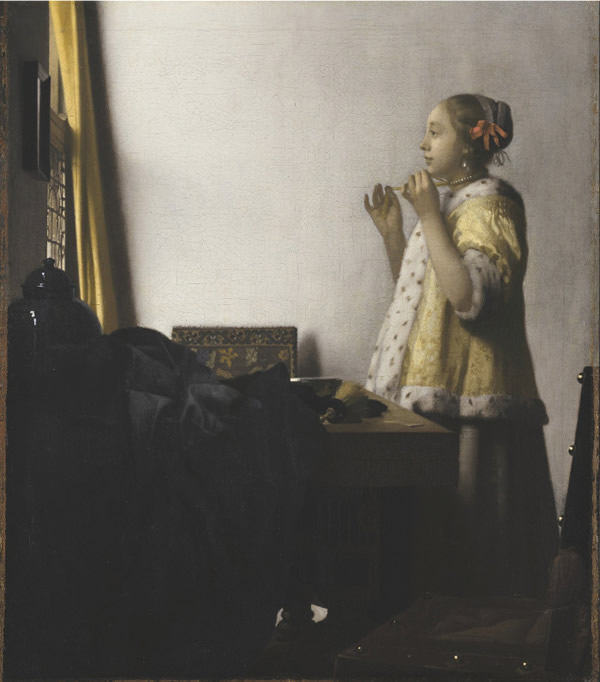
(as it appears today)
Minor alterations are also prevalent in the same group of paintings. The map in the Woman in Blue Reading a Letter was originally positioned three or four centimeters to the left and the standing young woman in the same work wore a different kind of jacket, likely similar to the fur-trimmed jacket featured in other paintings by Vermeer.
In all of the modified pearl pictures of the present study and in many of his other pictures painted before the mid 1660s, Vermeer seems to have invariably subtracted some elements which he had originally placed in the composition. This complex process of formal simplification and poetic distillation reached its pinnacle in the Woman in Blue Reading a Letter and Woman with a Pearl Necklace. In subsequent pictures there seems to be less evidence of important compositional changes. Perhaps the artist was able to anticipate compositional outcomes more clearly at the beginning of the painting process.