


Vermeer's Neighborhood
(part two)
(part two)
In 1641, on April 23, Vermeer's father, Reynier Jansz. Vos, bought the large and heavily mortgaged Mechelen inn on Market Square at the corner with the Oude Manhuissteeg (Old Men's House).Opposite this alley and bridge, the Oude Mannenhuis (Old Men's House) was located on the Voldersgracht from 1411. This institution consisted of a number of rooms or houses around a courtyard and a chapel. From the middle of the 17th century, it was used as the Sint-Lucasgildehuis (Guild of Saint Luke House). The entire complex was demolished in 1876 for the construction of a primary school, and it was reconstructed in 2007. He paid 200 guilders in cash and assumed two mortgages for the total value of 2,500 guilders. Mechelen had six fireplaces which tells us something of its size, the largest construction of the Markt. Like all the neighboring houses, the front side faced the Market Square and the backside plunged straight down into the Voldersgracht canal. The narrow Old Man's Alley ran alongside to a bridge over the canal behind (right b.). Mechelen was demolished in 1885 to make way for fire-prevention equipment.
The Mechelen Inn was the bustling heart of the town. Its location, with the town hall on one side and the Nieuwe Kerk on the other side. It was an ideal meeting place for discussions and exchanging news and archives show that many Delft artists also used to meet here for shop-talk.

On the occasion of Vermeer's wedding in 1653, the address registered was the house Mechelen where his father carried on various trades, the register also notes that his future wife, Catharina Bolnes, "lived there too." John Michael Montias maintains that it is highly unlikely that Catharina Bolnes, who, on her mothers side was from a devout Catholic family, would have actually lived with Vermeer in Mechelen before her marriage. Montias believes the clerk must have made an error. However, it has been recently advanced the idea that Catharina had gone to live with Vermeer thus forcing Catharina's mother, Maria Thins, to accept de facto of their sentimental relationship.
Judging from contemporary engravings Mechelen must have been a rather large house which certainly afforded ample space for the public-house business downstairs, for the trade in works of art and for the workshop for the "caffa" finishing. Vermeer's father was registered at the Guild of Saint Luke as an art dealer and was also known to have worked in "caffa," a fabric similar to satin which was largely used for upholstery, clothes and curtains.
Inn-keeping and art dealing often went hand in hand. In these circumstances, it is obvious that the young Vermeer was exposed to the many paintings that adorned the walls of the inn as well as a chance to encounter artists and artisans who no doubt frequented the locale. Local Delft artists Evert van Aelst, Egbert van der Poel, and Leonaert Bramer must have been familiar faces. Mechelen was also spacious enough to contain Vermeer's wife when she moved in.
Mechelen no longer exists even though there is an erroneous commemorative plaque on the side on the building which was adjacent to it. Today, the alley is wider. The only image of the facade of Mechelen dates from an engraving of the early eighteenth century by Leonard Schrenk. Sometime between 1653 and 1660 Vermeer and his wife moved out of Mechelen to his mother-in-law's larger patrician residence on the other side of the Market Square. But Mechelen was still occupied by Vermeer's widowed mother until 1670, when she died and he inherited the property. Vermeer may have helped his aged mother run the inn, a taxing chore for even the healthiest of women, before he gave it up. Payments for Mechelen were still being made when Reynier's widow tried to sell it at auction in1669. In 1672 Vermeer lets Mechelen while he was living with his mother-in-law.
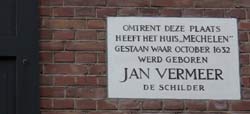
Both P.T.A. Swillens (Dutch historian and author of Vermeer: 1632–1675, 1950) and Philip Steadman believe that Vermeer painted directly from a rear window of Mechelen his Little Street.
"In 1955 a memorial tablet was placed on the wall of the adjoining house at number 52 the Markt, to mark the spot where Mechelen House once stood. The Delft sculptor Joh. Bijsterveld made the memorial tablet, which bears the following inscription: 'Here stood Mechelen House where the artist Jan Vermeer was born in 1632." This contains two mistakes. Vermeer was not born in Mechelen, as his parents moved there when he was already nine years old. The name Jan is not entirely correct either. Vermeer never used the name himself, He always signed deeds with Joannes, Joannis or Johannis. Criticism was heard on all sides in 1955, but the foundation 'Delft binnen de veste' (Delft within the ramparts) which devised the inscription, decided that the Christian name Jan had become more familiar."1
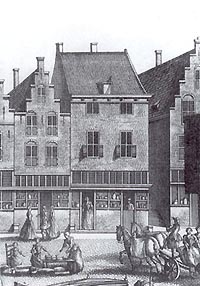 View of the Delft Market Place with Staidhuis, Oude and Nieuwe Kerk (detail showing Mechelen)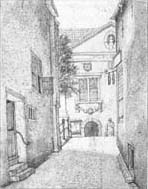
from: Johannes Vermeer, P.T.A.Swillens, Utrecht, 1950, p. 35
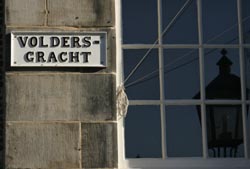
On Saint Luke's Day, October 18th, 1662, the artists of Delft chose Vermeer to be the vice-dean of their guild, which is another proof that at that time he must have been a respected and highly thought-of artist and citizen. When Johannes Vermeer took his place on the board of the Guild of Saint Luke, he stepped into a quite new guildhouse, built and furnished by the artists of Delft exclusively for themselves. It had been put up a year before 1661 on the Voldersgracht, in the immediate neighborhood of Vermeer's birth-place on the Marktveld. Undoubtedly he watched it being built and completed from his own home. The building stood on the site of "the Saint Christopher's or Old Men's House Chapel which had latterly served as a cloth-testing hall," according to the Delft chronicler Dirck van Bleyswijck. This author gives us a rather extensive description of the interior and exterior of the building. It had, according to him, "an imposing facade four, window-sills broad, under each of which a garland is festooned carved in white stone with the different tools of the four chief trades belonging to this guild, viz. Artists, Glassmakers, China-makers, and Booksellers. Above the afore-mentioned cross-windows are the city's arms, those of the Guild of Saint Luke and of Mr. Dean Dirck Meerman, Knight, Councilor and former Burgomaster as well as Chief Dike-Reeve of Delfland. In the top of the pediment appears the statue of Apelles, the most famous painter amongst the Ancients." Our illustrations (right b., c.) nearly correspond with this description of the exterior. The building was clearly erected in the classical Renaissance style. In 1879 it was pulled down to widen the alley. We still have the four festoons, they are set into the wall of the Rijksmuseum at Amsterdam.
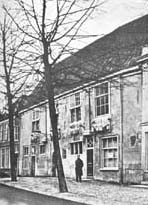
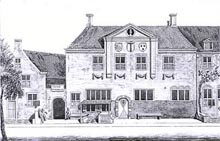 St Luke's Guildhall
 from:
John Michael Montias, Vermeer and His Milieu: A Web of Social History
The guild must have been the center of Vermeer's public life. There was little else in Delft of any conceivable interest for him. No publicly performed music, except for the playing of the organ in churches; no theater: the only Delft-born playwright, Gerrit van Santen, published his playlets in other towns but never saw them performed in Delft. The Chamber of Rhetoricians, which had once staged poetical contests and other shows, had long been inactive. Aside from a little poetry, religious for the most part, the literary scene was bleak. There was not enough intellectual ferment beyond art in Delft to keep a young artist from plying his craft.
Moreover, Vermeer had almost certainly converted to the Roman Catholic faith, which as we have seen, was repressed and intermittently persecuted. Provincial as Delft already was, belonging to the Catholic Church further narrowed a man's horizon because he was barred from all municipal functions. Election to the board of headmen of the guild was about the only civil honor to which the young artist could aspire, and that, no matter how talented he might be, he could not look forward to for several years. Election to the board of headmen did not normally come before a man was in his thirties or early forties.
It is certain that Vermeer and his family moved to live with Maria Thins (Vermeer's mother-in-law who was a devout Catholic) on the Oude Langendijk at some date between 1653 and 1600 in the so-called "Papenhoek," or Papists' Corner. The Papist Corner was not a ghetto because many families chose to live there by their own free will, and were prosperous. In Delft about a quarter of the population was Catholic. Although Catholics were not actively repressed, they were not altogether free to act as they would. It is not known for what reason the Vermeer's made this move. Perhaps the patrician home of Maria Thins was seen as a more fitting place to bring up the artist's growing family.
"With the exception of other artists in the guild with whom he had to maintain professional ties, there is little evidence to show that Vermeer entertained close contacts beyond the relatively segregated Papist's Corner, where he lived, condemned as a consequence of his Catholic marriage (and probable conversion to Catholicism) to second-class citizenship in a Protestant-dominated city."3
It is generally accepted that Vermeer, on his marriage to Catharina Bolnes converted to Catholicism and through the years seemed to have severed his ties with his own family through the years. His first born child was named Maria, after his mother-in-law and in the following years none of his many children were named after his own parents, an uncommon occurrence.
According to John Michael Montias, Maria Thins' house may be the furthest right-hand house (the highlighted area of image h. to the right) or the next house which continues off the right-hand side of the drawing.
 The Town Hall of Delft
 The town hall was designed by Hendrick de Keyser using bits from the former court of the Court of Holland that stood at this location, most notably its tower. The rest of the building, built between 1618 and 1620, is a fine example of Mannerist architecture with a richly decorated front.
The marriage bans of Vermeer and his wife Catharina Bolnes were published in the Town Hall.
If you discover a  or anything else that isn't working as it should be, I'd love to hear it! Please write me at: jonathanjanson@essentialvermeer.com