Vermeer’s Painting in the Context of the Dutch Golden Age of Painting
PART I - Cultural Backdrop: Classicism & the Hierarchy of Subject Matter
PART II - Subject Matter in Dutch Painting, Artistic Training & Technique
PART III - Vermeer’s Subject Matter
PART IV - Vermeer's Subject Matter: Women
Cultural Backdrop: Classicism & the Hierarchy of Subject Matter
The idea that subject matter could per se determine the worth of a painting is profoundly alien to today’s concept art. And yet a strict hierarchy of subject matter in painting, formulated in 16th-century Italy and later promoted by European academies, held sway with little revision until the early 19th century.1 The fact that the minor events of life, like those depicted by Vermeer, might be vehicles for great art had not yet been theoretically established. The Classicist hierarchy of subject matter was as follows:
1. History painting (istoria)
2. Portrait painting
3. Genre painting or scenes of everyday life (of sufficient decorum)
4. Landscape and cityscape
5. Animal painting
6. Still life
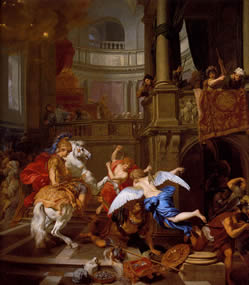 The Expulsion of Heliodorus From The Temple
Gerard de Lairesse
1674
Oil on canvas, 204 × 193 cm (80.3 × 76 in)
Private collection
This hierarchy was based on a conceptual distinction between art that was produced by an intellectual effort to "render visible the universal essence of things" (imitare in Italian) and that which merely consisted of "mechanical copying of particular appearances" (ritrarre).
The Dutch art theorist and contemporary of Vermeer, Gérard de Lairesse (Groot schilderboek [Great Book on Painting, 1707], firmly believed that only subjects possessing inherent beauty (schoonheid) and virtue (deugd) were worthy of representation for they alone allow the painter to create the kind of "antique" beauty he regards as essential to good painting.2 De Lairesse was a disciplined intellectual who was inspired by the notion that only correct theory could produce good art. For him theory meant the strict adherence to rules. The ultimate purpose of the visual arts was the improvement of mankind, and therefore art must, above all, be lofty and edifying.
The appropriate subjects that de Lairesse and all history painters had in mind were not those extracted from the artist’s imagination or personal circumstances, but from texts: the Bible and Classical literature and mythology. Allegories and scenes of great historical events of the past and near-contemporary were also acceptable if painted in a classical mode.3 Stories of street peddlers, cuckolded husbands, kitchen maids, unruly country bumpkins and buxom courtesans, from which a veritable army of enterprising Dutch painters made a passable living, would not do.
 Cleopatra Landing at Tarsus (detail)
Gerard de Lairesse
74 x 95.5 cm.
Rijksmuseum, Amsterdam
Not only subject matter, but the proper and improper modes of pictorial representation were clearly distinguished by academic prescription. When painting in the "antique" mode, the artist should refrain from excessive characterization of the figures, definition of textures, indulgence in detail and the use of color as an end unto itself. Drapery should be painted with vigor and suppleness but it was better not to define specific fabrics with any precision.
Physiognomic types, noblemen, farmers or beggars, should be immediately distinguishable but no figure should be identifiable as an individual person. All pictorial effects should be subordinated to the composition as a whole, which was not so much a matter of aesthetics as of narrative.
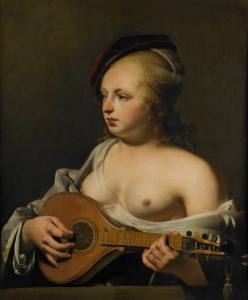 Woman Playing the Cittern
Caesar van Everdingen
1617
Rouen, Musée des Beaux Arts
Mauritshuis, The Hague
Classicist theory, however, was not dogmatically adhered to blindly in the Netherlands even by those who promoted it most strenuously. Karl van Mander (1548 - 1606), an early Dutch art writer who exhorted painters to depict "memorable histories," painted some peasant scenes. Samuel van Hoogstraten, another Dutch theorist and painter, painted genre and trompe l'œil works, the latter of which has more to do with pictorial sorcery than the search for uplifting content, even though he was awarded a medal by the Holy Roman Emperor for his efforts. Cesar van Everdingen, who was sometimes referred to as one of the Haarlem Classicists or Haarlem Academics, repeatedly depicted courtesans playing musical instruments or combing their hair (see image left).
De Lairesse, who opposed joint artistic efforts, is know to have employed Johannes Glauber to fill in landscape background in some of his works. Moreover, de Lairesse, like many figurative Dutch painters, was unable to repress his his Dutch colleagues' quintessential fascination for the depictions of specific textures, especially fine satins, practically a hallmark of Dutch painting.
"During a journey through the Netherlands in I781, Sir Joshua Reynolds paid a visit to the art collection of a certain Mr Gart in Amsterdam, owner, among others, of Gerard ter Borch's Duet. In his journal, he compared this picture with de Lairesse's Death of Cleopatra [see detail of this painting above left], which he had recently seen in the Hope Collection, also in Amsterdam:
Two fine pictures of Terburgh; the white sattin remarkebly well painted. He seldom ommited to introduce a piece of white sattin in his pictures. As I reprobated the white sattin in the picture of the death of Cleopatre by Lairesse, and make no objection here, it must be remembered that the subject of Lairesse's picture is heroick, and he has treated it in the true historical style, in every respect, except in his white sattin: but in such pictures as Terburgh painted, the individuality and naturelness of the representation makes a considerable part of the merit.
"Reynolds's remarks must be understood in the context of his general theory of art, and the issues he addresses as part of his notion of 'grand style.' Heroic subject matter demanded a heroic style, and the naturalism of the drapery in de Lairesse's work was as inappropriate as idealized figures would have been in genre painting. In this case, the Englishman's criticism was directed not at the genre painter ter Borch but rather at the history painter de Lairesse, who had broken the rules of high art with his excess of naturalness."4
From a technical point of view, history painting was considered by its proponents as the most intellectually demanding of all the categories, since the complex arrangements of multiple human figures required the artist’s secure grasp of technique, composition and of history itself. On the other hand, genre painting, in which real-life, rather than text-based situations are represented, was too limited in scope to make truly universal art. In the words of de Lairesse:
"I say then, that although modern [contemporary] things seem to have some prettiness, … they are only to be esteemed as diversions of art…I moreover maintain, that such painters as never produce more than one choice of subject, may truly be ranked among tradesmen; since such representations cannot be called an exercise of the mind, but a handicraft trade."
Specialization was not in itself condemned by de Lairesse as long as it was born from the artist's sincere inclination. However, the formulaic repetition of successful subjects or motifs was not.
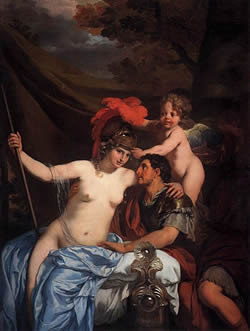 Mars and Venus as Lovers
Gerard de Lairesse
from 1676 e il 1682
Oil on canvas, 125 x 94 cm.
Rijksmuseum, Amsterdam
According to de Lairesse, the hierarchy of different categories of paintings was determined by two factors, the subject matter and the manner in which it was depicted (imitatio) which he broke down to "worse than nature," "as in nature" and "better than nature." The concepts of gentility, grace and decorum were fundamental in true painting, as de Lairesse put it, "if [they] are missing from a picture we cannot approve of it." The figures should be purged of anything incidental as well as the mundane details in both dress and physiognomy. Even the postures of the poor and destitute had to be modified to meet acceptable standards of grace.
The peasant brawls of Van Ostade (see image below) or Adriaan Brouwer were condemned out of hand both for their coarse subject matter and for the "worse than nature" manner in which they were depicted while the quite, middle-class assemblies of Van Mieris or Vermeer would have been considered depicted "as in nature," and, therefore, lacking the nobility of the "antique." Nonetheless, de Lairesse judged the burgerlyke (burger-like) subject matter far more acceptable than the "beggars, brothels, taverns, smokers, gamblers, filthy children on the potty-chair, and even dirtier and more horrible things," but still inferior to the Classical subject matter.
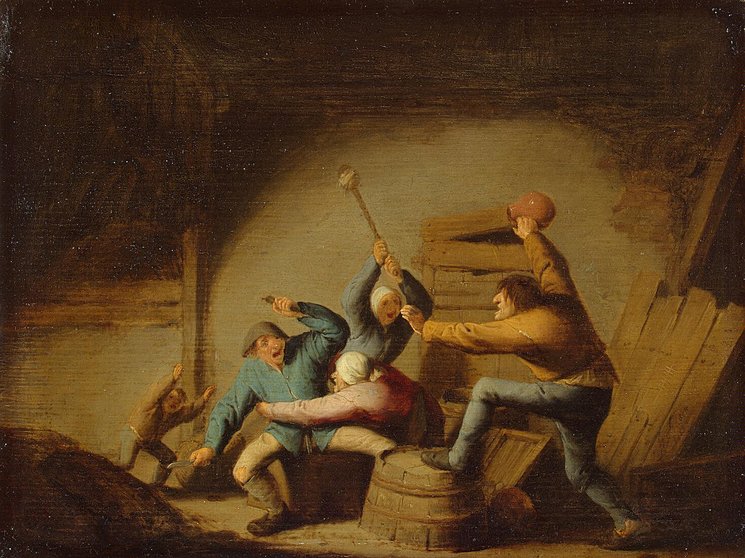 Brawl
BrawlAdriaen van Ostade
Oil on panel, 25x33.5 cm.
1637
Nonetheless, in respects to his contemporary Classicists in other parts of Europe, de Lairesse refuses to dismiss all forms of genre painting a priori. Differently from other writers on Classical painting, de Lairesse dedicated an entire chapter "Aanwyzinge om het burgerlyke of cierlyke modern wel uit te beelden" ("Method for correctly representing what is city-like or elegant modern") in his Groot Schilderboek. His aim was to demonstrate to painters of burgerlyke subjects like Gerrit ter Borch, Frans van Mieris, Vermeer and Gabriel Metsu, how classical forms can be adapted to high-life genre.
Vermeer and De Lairesse
Confronted by the formidable amount of paintings in the Netherlands of exceptional facture (and popularity) whose subject matter had nothing to do with his lofty ideals, de Lairesse felt that some sort of allowance must be made for the de facto plethora of tastes and did not reject all of them categorically: "As the genius of artists differs greatly; one leading to the sublime, another to the common, even to the meanest; so we find ourselves obliged to treat of all parts of the art, in order to be useful to every one," for,
it is … more commendable to be like a good Mieris [Frans van Mieris, Vermeer’s contemporary] in the modern manner, than a bad Raphael in the antique.
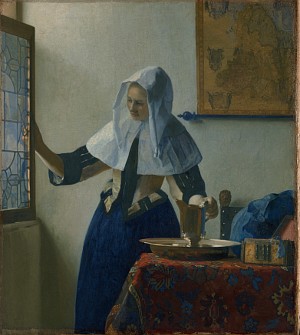 Woman Holding a Water Pitcher
Johannes Vermeer
This work is one of Vermeer's most finely balanced works, cleansed of all anecdote and distracting detail. This and other pictures of the 1660s are frequently described by art historians as "classical" in design and proportion.
From a 21st-century vantage point, the mature works of Vermeer might be taken as a plausible response to de Lairesse’s call for a reformed burgerlyke painting, "cleansed of all imperfections and improved." Indeed, the number of 20th-century writers who have trumpeted Vermeer’s measured brand of illusionism and social chronicle as "Classical," "idealized" or, at the very least, "perfectly balanced," cannot be counted. Critics point out that Vermeer always shunned the anecdotal, the picayune and the vulgar (except for the brothel scene of the early Procuress), and in this aspect at least, he stood apart from his genre colleagues. And most all knowledgeable art historians maintain that he aspired to "greater things" than they although it is not exactly clear to which lofty aims he aspired. However, today, the question of decorum and taste is no longer problematic for the art lover as it was for de Lairesse. Style and aesthetics of the past are considered equally legitimate, worthy of serious study and appreciable on their own terms.
Although Vermeer’s art may appear to respond quite well to some of the de Lairesse’s ideas of what constitutes "improved" burgerlyke motifs, it is impossible to know if Vermeer intended his art as a deliberate bridge from genre to Classicist concerns as expounded by de Lairesse. The artist's elegant, essential and muted style may have been nothing more than fruit of a deep-rooted personal inclination nad/or a natural participation in the general refinement genre painting the 1660s and 1670s cultivated especially in Delft where the artist lived and worked. Perhaps, our concepts of artistic perfection and Classicism are much wider than what de Lairesse had in mind.
As de Lairesse wrote, "The modern painting can, therefore, not be accounted art, when nature is simply followed; which is a mere imperfect imitation or defective aping her. Even when a thing represented ever so natural, well-designed, and properly ordered; the condition manners, and custom of the country well observed, and the colouring most exact, yet knowing will not think it artful; but when nature is corrected and improved by a judicious master, and the aforesaid qualities joined to it, the painting must be noble and perfect." In de Lairesse's statement one can easily see grounds both condemnation and praise of Vermeer's best canvases.
GERARD DE LAIRESSE
from: Horton A Johnson, MD, " Gerard de Lairesse: genius among the treponemes", The Journal of Royal Society of Medicine, 2004 June; 97(6): pp. 301–303
De Lairesse's misshapen face disturbed his contemporaries. One of them, Arnold Houbraken (1660-1719), wrote that when the artist first arrived in Amsterdam in 1665, two colleagues ‘gazed at him in horror because of his nauseating appearance’, but judged that since the facial deformity had been present since childhood it could not have been due to syphilis. Three recent biographers make no mention of his irregular appearance having been attributed to syphilis during his lifetime.
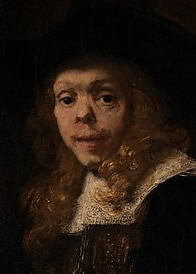
Portrait of Gerard de Lairesse
Rembrandt
mid-1660s
Oil on canvas, 112.7 x 87.6 cm.
Robert Lehman Collection, 1975
Metropolitan Museum of Art
New York
What de Lairesse lacked in physical good looks was well compensated by his attractive personality, talent, and intellect, for he was the darling of women, colleagues, wealthy patrons, and students. He first studied art in Liège, where he had been born into an artistic family. A stormy love affair forced him to leave his hometown in 1664. He eventually settled in Amsterdam with his wife and family. (His two sons, Abraham and Jan, would themselves become painters of note.) His success was almost immediate, and he was soon painting monumental historical, allegorical, and mythological works for the walls and ceilings of palaces. Known as ‘the Dutch Poussin’ for his classical French style and taste, he travelled in intellectual circles and appealed to the élite, the connoisseurs, and the aristocrats. In a sharp departure from the Dutch painters of the Golden Age, he found Apollo and Aurora more worthy subjects than the ordinary milkmaids and lace makers of Vermeer. His broad range of talent included music, poetry, and the theatre, and he designed highly successful stage sets for the Theatre of Amsterdam.
Slavish Imitation & Coloring
According to de Lairesse’s understanding of true painting, nature should not be "slavishly imitated" but consulted and subsequently idealized. The works of the great painters of the past should be admired and emulated but not to the point of stifling one’s own intellect and creative impulse. De Lairesse felt that there are "no greater abuse committed than in the use of line prints, and compositions of greater masters; for many accustom themselves so much to them, as seldom to do any thing which is not borrowed from prints, or other men’s drawings."
Perhaps too often criticized for his conservative rhetoric, de Lairesse was surprisingly modern in his approach to coloring: "If Titian and Giorgione had good colouring, let us follow their way of doing things; they took Nature for their teacher, and did not imitate other masters; and although in all other respects Nature is deficient with respect to art, she is not in so far as concerns Colouring; thus is it that, in this branch of art, no better model has been found than the life itself."
In any case, classicist warnings seemed to have had not even the slightest effect of the habits of Dutch art collectors who spent their hard-earned money according to their personal taste, and at times, with an eye on investment returns. Paintings of every subject, dimension and style imaginable were consumed in enormous numbers overshadowing in production and variety those of any country in Europe. Foreigners were often astounded by the sheer number of pictures they encountered in the Netherlands. The fierceness of the competitive market spawned stylistic evolution, new subject matter and affordability. It was common that a house might have dozens of paintings. "Name buying" was already being deprecated. Curiously, the choice of subject matter did not seem to among collectors of different economic strata. While Classical theory determined the direction of painting in many countries in Europe, in the Netherlands, it was little more than a hand in front of a bursting dike.
- Sir Joshua Reynolds defined a history-painter as one who "paints man in general."
- Kemmer, Claus, "In search of classical form: Gerard de Lairesse’s Groot schilderboek
and seventeenth-century Dutch genre-painting", Simiolus 26 (1998), p. 90 - Claus Kemmer, "In Search of Classical Form: Gerard de Lairesse's "Groot Schilderboek" and Seventeenth- Century Dutch Genre Painting", Simiolus: Netherlands Quarterly for the History of Art, Vol. 26, No. 1/2, 1998, p. 87
- Reynolds argued : "Strictly speaking, indeed, no subject can be of universal, hardly can it be of general, concern; but there are events and characters so popularly known . . . that they may be considered as sufficiently general for our purposes. Such are the great events of Greek and Roman fable and history, which early education, and the usual course of reading, have made familiar and interesting to all Europe, without being degraded by the vulgarism of ordinary life in any country. Such too are the capital subjects of scripture history, which, beside their general notoriety, become venerable by their connection with our religion."

Vermeer's World: the Wider European Context
from:
Ludwig Goldscheider, Jan Vermeer, London, 1958.
Vermeer was born at Delft, in Holland, in 1632 (in the same year as Luca Giordano and Nicolaes Maes, Spinoza, John Locke and the microbe-hunter Leeuwenhoek). Into what sort of a world was he born?
It was in the middle of the Thirty Years' War. It was the year in which Gustavus Adolphus and Tilly died on the battlefield; but in Holland there was peace. In the heart of Europe cities and pyres were burning; the armies were marching and brought with them famine, rape, murder and plague. The world was reduced to desperation, but not art. In the year of Vermeer's birth Callot was making his designs for his Misères de la Guerre; Rubens had just finished his best religious painting, the St. Ildefonso triptych, Rembrandt his The Anatomy Lesson of Professor Nicolaes Tulp; Velazquez was painting portraits of King Philip and Prince Baltasar; Bernini, the chief architect of St. Peter's, had almost completed his "Baldacchino"; Poussin was painting his mythologies in Rome; Van Dyck emigrated to England and became court painter to King Charles I.
It was the period of wars of religion; but in Holland several regions and hundreds of sects lived peaceably side by side. There were Remonstrant, Collegiants, Epicurists, Pelagians, Socinians, Rosicrucians, Pantheists, Papists, Antitrinitarians and three groups of Mennonites. Calvinism was the predominating, but not the State religion. From 1610 on, there were no more witches and magicians in Holland, and nobody in that country was burnt. The North was Protestant, the South Catholic; there were differences of opinion, but no murderous hatred. In that country and at that time, as Huizinga has pointed out, the bells tolled only for funerals; the organ was regarded with suspicion, but its voice was so beautiful that the Calvinists did not dare to silence it. Even in the synagogues, Hebrew hymns could be sung without disturbance.
It was an age of reason, with Kepler and Galilei, Descartes and Comenius its beginning and Leibniz and Newton at its end. And yet it was a period of profound and pure devoutness. For the first rime since the Middle Ages genuinely religious pictures were painted; above all by Rembrandt and Zurbaran. Milton, the "genius of Puritanism", Bunyan, the "pilgrim to spiritual eternity", Calderòn, the author of almost a hundred Corpus Christi plays, Pascal, the thinker of Port-Royal (where the task which had been set was to "restore religion in its austerity and Christianity in its purity"), Bossuet and Fénelon -all of these wrote their poems, their thoughts, plays and sermons during the two decades in which Vermeer painted his pictures. But mysticism continued to flourish; at that rime Jacob Bohrne was highly esteemed in Holland and the first collected edition of his writings was published in Amsterdam (1620 and 1682).
In the Protestant provinces of the Netherlands the painting of the younger generation of artists round about 1650 remained rationalistic and realistic. Portraits, landscapes and genre-subjects were their chief themes. The art of Vermeer was home along in the rationalistic stream of his time, and was never touched at all by the mystical influences.
