Prepared artificially since the earliest historical times and used until the nineteenth century, this warm white is very opaque, has outstanding brushing qualities and mixes well with every color on the artist's palette. As the name lead white, or white lead, suggests, it is a by-product of lead, and whatever the form of manufacture used, the purity of the color depends on the purity of the lead. Purifying processes greatly increase the cost of the product. Lead white has always been one of the most important pigments in many painting techniques.
Its importance has been immeasurable, and is the only material that has been consistently used from ancient times until the present. The monopoly in lead white production was not broken until the nineteenth century, when zinc oxide became a competitor, and in the twentieth century, it has been almost completely replaced by titanium dioxide, which is superior to lead in some properties, and unlike zinc oxide, has the strong covering ability that lead white possesses. Since white in painting is the equivalent of light in nature, it has been essential to every aspect of painting: from flesh to skies, and so on.
In the Dutch and Old German process strips of lead rolled up into spirals were placed in closed earthenware jars containing acetic acid, and then pots were hen buried under tanner's bark or dung; the heat evolved by fermentation aids in the formation of lead white through an increase of carbonic acid. Very soon a thin coat of white coating forms. The lead white is then washed of and cleaned. Lead white is extremely poisonous and must be handled with care.
Lead White in Vermeer's Painting
White has always played an important part in the art and craft of painting. The great part of pigments on a progressive scale of gray would fall into the medium dark to dark category. Only lead-tin yellow and lead-tin yellow are by themselves light pigments. In order to portray the light areas which are for indispensable to convey the sense of natural illumination, white must be added to heighten most of the darker pigments.
Vermeer, as all other painters of the time, used it extensively to lighten other colors and as the principal component used to depict white objects, such as ceramic jugs, white cloth (fig. 1) and the characteristic white-washed walls (fig. 2) seen in so many of his paintings.
In recent years, technical researchFrederik Vanmeert, Maartje Stols-Witlox, Annelies van Loon and Koen Janssens, "Vermeer’s White(s) Seventeenth-Century Methods Used to Manipulate the Working Properties of Lead White," in Closer to Vermeer: New Research on the Painter and His Art, ed. Anna Krekeler, Francesca Gabrieli, Annelies van Loon, and Ige Verslype (Amsterdam: Rijksmuseum / Veurne: Hannibal Books, 2025). has revealed that Vermeer worked with lead white in ways far more varied and deliberate than was once imagined. Seventeenth-century painters did not treat lead white as a single, uniform pigment but as a material whose handling could be tuned through specific preparations, additives and working methods, each producing a different body, opacity or drying behavior. The latest imaging and analytical techniques show that Vermeer consistently exploited these possibilities. He selected or modified different types of lead white according to the function required: a dense, sculptural white for constructing underlayers and light-bearing passages; a softer, more flowing variant when he needed subtle transitions; and mixtures adjusted with other materials when he wanted a quicker set or a more malleable surface. These findings indicate a painter who knew precisely how to manipulate his whites to support the luminosity, quiet modelling and atmospheric clarity that define his work. Lead white, for Vermeer, was not simply a neutral carrier of light but a responsive material whose properties he controlled at every stage of painting, shaping both the optical and tactile presence of his pictures.
The following was drawn from a reent essay on the use of whites in Vermeer's painting by Maartje Stols-Witlox, Annelies van Loon and Koen Janssens in Closer to Vermeer: New Research on the Painter and His ArtFrederik Vanmeert, Maartje Stols-Witlox, Annelies van Loon and Koen Janssens, "Vermeer’s White(s) Seventeenth-Century Methods Used to Manipulate the Working Properties of Lead White," in Closer to Vermeer: New Research on the Painter and His Art, ed. Anna Krekeler, Francesca Gabrieli, Annelies van Loon, and Ige Verslype (Amsterdam: Rijksmuseum / Veurne: Hannibal Books, 2025).
Close examination of Vermeer's paintings shows that he relied on several distinct forms of lead white, each chosen for a different pictorial task. In the underlayers of many works, he often employed a dense, highly covering lead white with a strong body, allowing him to set the basic light–dark architecture of a passage before any color was applied. This robust white lies beneath the drapery in Woman Holding a Balance and the wall surfaces of Woman in Blue Reading a Letter, where its firmness gave him a stable ground on which to build the characteristic soft transitions of the finished surface. By contrast, the upper modelling layers frequently contain a more finely ground or more lightly bound lead white that permitted smoother blending. The faces in Girl with a Pearl Earring and The Milkmaid demonstrate this: their highlights emerge from an extremely even, almost waxy white that allowed subtle gradations around the nose, brow, and cheek without visible drag from the brush.
Vermeer also varied the composition of his whites for optical purposes. Heat maps derived from MA-XRPD show that he shifted between different proportions of hydrocerussite and cerussite—two crystalline forms within lead white—to produce different degrees of brilliance. In the luminous accents of pearls, earrings, and points of reflected light, he consistently chose a white rich in hydrocerussite, which scatters light more strongly and gives the highlight its characteristic punch. In some works, including the flesh tones of Girl with a Pearl Earring, Vermeer reinforced these effects with small touches of nearly pure, unmodulated lead white placed on top of more colored underlayers, exploiting the pigment’s opacity to create a crisp, radiant glint.
Other materials played supporting roles. Bone black and chalk appear together beneath certain white passages, where they helped him adjust tone without dulling the surface. In places where he sought a cooler or more rapid-drying white—for instance in preparatory layers or minute corrections—technical imaging has revealed the presence of lead-tin yellow mixed in small quantities with lead white, a practice known from seventeenth-century manuals. Traces of this mixture occur in the modelling of sleeves and collars, where the slightly firmer paste allowed for sharper folds and more durable highlights. In a few cases, notably in the still-life objects on tabletops, Vermeer’s whites contain a faint presence of smalt or other low-tinting materials, which subtly cooled the mixture and helped the white recede or harmonize within blue-dominated passages.
A grainy texture can be seen on the surface of many of the lightest areas are caused by aggregates of white-lead particles. These lumpy aggregates that can "found in Vermeer's paintings have also been noted in several Frans Hal's paintings and are typical for the stack process of lead white production for which Holland was famous in the seventeenth century."Nicola Costaras, "A Study of the Materials and Techniques of Johannes Vermeer," in Vermeer Studies, ed. Ivan Gaskell (1998), 160.
Lead Isotopes and the Origins of Vermeer's Lead White
Recent Lead-isotope researchPaolo D’Imporzano and Gareth R. Davies , "Lead Isotope Studies of Vermeer’s Paintings Myths and Realities," in Closer to Vermeer: New Research on the Painter and His Art, ed. Anna Krekeler, Francesca Gabrieli, Annelies van Loon, and Ige Verslype (Amsterdam: Rijksmuseum / Veurne: Hannibal Books, 2025). confirms that the lead white Vermeer used throughout his career was remarkably consistent in origin. All securely attributed works analyzed contain lead white made from English lead—most likely from Derbyshire—which was the standard raw material used in the Dutch Republic's large-scale pigment industry in the seventeenth century. This places Vermeer firmly within the mainstream supply system of Dutch painters, relying on the same high-quality, commercially produced lead white that circulated widely in Amsterdam, Delft and beyond. The study also shows that Vermeer’s paints, grounds and underlayers often share this same isotopic profile, reinforcing the idea that he worked with stable, reliable sources of lead white and did not shift to foreign or unusual suppliers.
At the same time, the isotope data reveal subtle but meaningful variations within individual paintings. Differences between ground layers and upper paint layers in works such as Girl with a Pearl Earring suggest that Vermeer sometimes painted on canvases prepared with a slightly different lead white than the one he applied himself. Variations may also arise from mixtures with chalk or earth pigments in the ground, indicating that isotopic diversity reflects layered practice rather than changes in artistic intention. Such findings enrich our understanding of Vermeercs material habits: even when the pigment’s geological origin remained constant, the functional role of lead white—ground, underpaint, modelling layer—could involve distinct formulations.
The study by Paolo D'Imporzano and Gareth R. Davies , "Lead Isotope Studies of Vermeer's Paintings Myths and Realities", also clarifies what isotope evidence cannot reveal. Because Dutch lead white was exported across Europe, the presence of English-derived lead does not mark a painting as uniquely "Vermeer's" in any scientific sense. Paintings by many other artists, Dutch and foreign, share the same isotopic signature. What emerges instead is a picture of Vermeer as a painter who worked with the finest and most consistent white available in his milieu, and whose exploitation of lead white's optical and physical properties must be understood through technique rather than through provenance of raw materials.
The study also re-examines the controversial use of isotope data in the attribution of Saint Praxedis. Although the painting’s lead white matches the isotopic signature found in Vermeerv authenticated works, the authors demonstrate that this information cannot support or refute an attribution. Dutch lead white—made from English lead—was traded widely across Europe, and many painters, Italian and Northern alike, used pigment with essentially identical isotope ratios. Earlier claims that matching isotope values implied paint from the same batch, or a direct connection to Vermeer, are shown to rest on a misunderstanding of what the method can reveal. Lead-isotope analysis is therefore valuable for mapping pigment trade and production, but it cannot by itself determine authorship.
Taken together, recent evidence shows that Vermeer treated white not as a single pigment but as a flexible system. By varying grind, additives, crystalline composition and placement, he shaped the tone, texture and luminosity of a passage with extraordinary precision—so much so that today’s imaging techniques can reconstruct his decisions layer by layer, revealing just how deliberately he built the quiet radiance of his pictures.
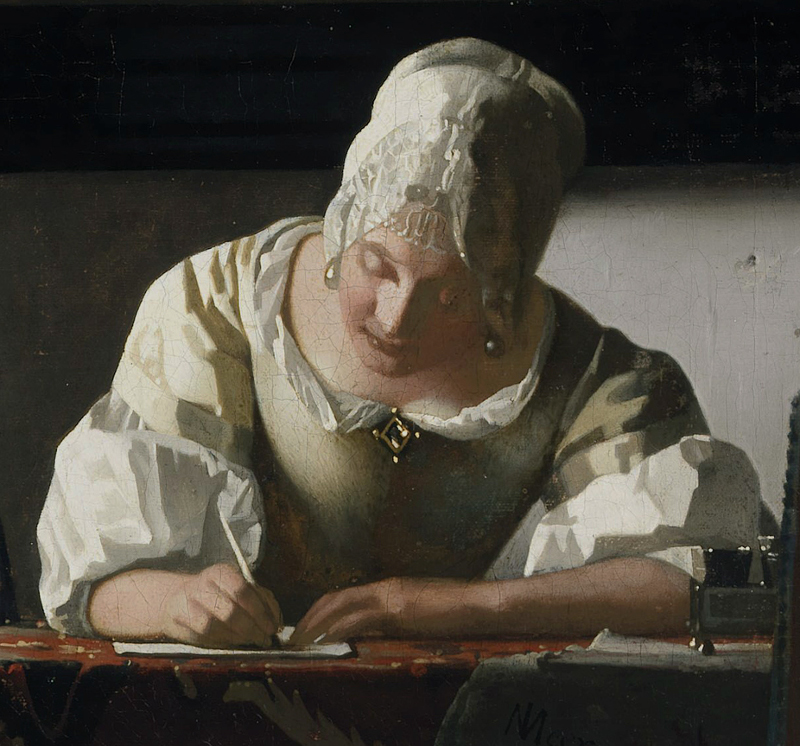
Johannes Vermeer
c. 1670–1671
Oil on canvas, 71.1 x 58.4 cm.
National Gallery of Ireland, Dublin
Lead-white was used to render the illuminated folds of the lady's sleeve and admixed with brown and black pigments to produced the sleeve's shadows and the light gray background wall.
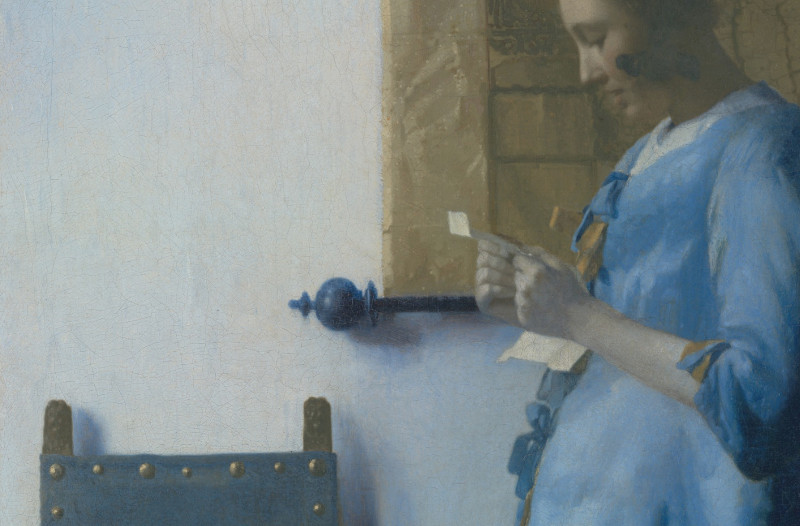
Johannes Vermeer
Oil on canvas, 46.5 x 39 cm. (18 1/4 x 15 3/8 in.)
Rijksmuseum, Amsterdam