This chronology places Vermeer's life and art within the remarkably active world in which they unfolded. Moving year by year from 1632 to 1675, it brings together what is known of the painter's personal and professional life with developments in Delft and the Dutch Republic, while following contemporary painting, architecture, music, literature, science, technology, material culture, and daily life. Rather than treating Vermeer's small surviving oeuvre in isolation, the chronology sets it alongside the artists, craftsmen, merchants, writers, scientists, institutions, objects, customs, and events that formed the historical environment in which he lived and worked.
The perspective also extends beyond the Netherlands. European art and architecture, political and military events, overseas trade and exploration, scientific discoveries, technological changes, and significant natural events are incorporated where they help convey the larger world of the seventeenth century. Some entries record precisely dated events; others describe developments that necessarily belong to a span of years rather than to a single moment. Taken together, they are intended not to establish direct connections where none can be demonstrated, but to reconstruct something of the dense and changing historical background against which Vermeer's quiet interiors, city views, figures, objects, and pictorial ideas came into being.
1668: Vermeer's Age, 36
| 1668 | Late-career artistic maturity, economic Security, but structurally dependent |
|---|---|
| VERMEER'S LIFE & ART |
VERMEER'S LIFE & ART (1668)
Johannes Vermeer 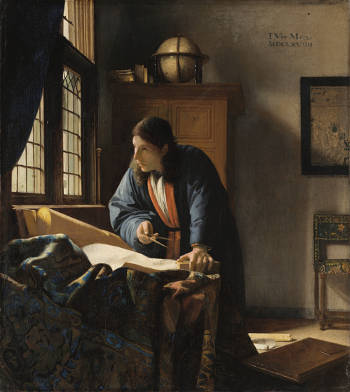
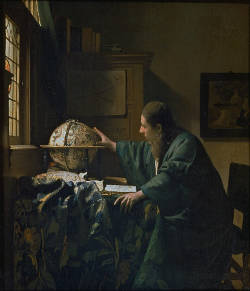
Johannes Vermeer The Astronomer bears the date 1668, providing an unusually firm point within Vermeer's largely reconstructed painting chronology. A man seated beside a window reaches toward a celestial globe, surrounded by objects associated with learned investigation. The painting and its companion, The Geographer, give sustained attention to the solitary male scholar, an uncommon subject within his surviving work. The composition makes intellectual activity visible through a physical gesture. The scholar leans forward, extending his fingers toward the globe while his other hand rests near the table's edge. The movement connects his face, the instrument, and the light entering from the window. Books and furnishings establish a place of study, but the figure's concentration gives those possessions their purpose. The scene offers no visible telescope or nighttime observation. The open volume has been identified as the 1621 edition of an astronomical and geographical manual by Adriaan Metius (1571–1635). Its discussion brings together geometry, instruments, and divine inspiration. The globe represents the heavens rather than the earth and follows a model by Jodocus Hondius (1563–1612). These objects locate the scholar within a culture where mathematical learning, navigation, and religious understanding could remain closely connected. 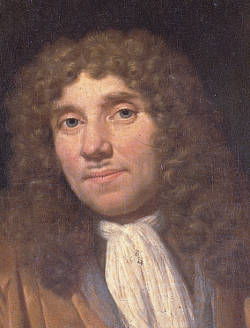
Jan Verkolje The painting on the rear wall represents the finding of Moses. Its presence adds a biblical subject to the room's scientific equipment, although its exact role in the composition remains open to interpretation. The scholar's identity is likewise uncertain. Suggestions that Antonie van Leeuwenhoek (1632–1723) served as the model have not produced a secure identification. A convincing representation of learned activity need not be a portrait of a particular practitioner. The Astronomer is closely related to The Geographer, dated 1669, through its dimensions, male model, costume, and scholarly setting. Their association allows astronomy and geography to emerge as complementary subjects across two successive years. Nevertheless, the objects should be distinguished carefully: the astronomer studies a celestial globe, whereas the globe above the cabinet in The Geographer is terrestrial. |
| DELFT |
DELFT (1668)
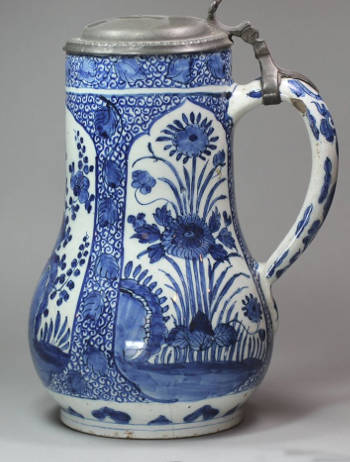
Late 17th century with pewter cover, decorated in the transitional style with panels of flowers against a scrolling background, with the mark of Adriaen Pynacker A municipal fire inspection in 1668 recorded the working equipment of several Delft potteries. De Paauw, established on the Koornmarkt, had one kiln; De Witte Ster, operating in part of a former brewery on the Oude Delft, had two. These modest numbers bring the industry down to the scale of individual businesses. Production depended on the capacity and reliability of particular kilns within a densely occupied town. Inspection records consequently provide evidence of both industrial organization and municipal concern about fire. The inspection also recorded two kilns at De Porceleyne Fles. The pottery's wider business history reveals the practical arrangements behind production: firing could require nighttime work, and the enterprise combined manufacturing with the reception of merchants and the sale of finished wares. Such evidence gives Delft's artistic trades a household and commercial setting. The attractive objects that left a pottery depended on fuel, technical knowledge, working space, and people performing several different tasks. A surviving Delft tankard bears the date May 2, 1668. Its blue decoration places musicians within framed compartments, surrounded by flowers, birds, and butterflies inspired by Chinese porcelain. The object joins European figure subjects to ornament adapted from imported ceramics. It also supplies a useful distinction in terminology: this is tin-glazed earthenware, despite its deliberate engagement with the appearance of porcelain. The maker is unidentified, but the inscription gives the vessel a precise place in the year. |
| DUTCH ART |
DUTCH ART (1668)
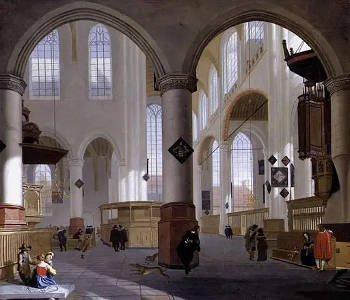
Cornelis de Man 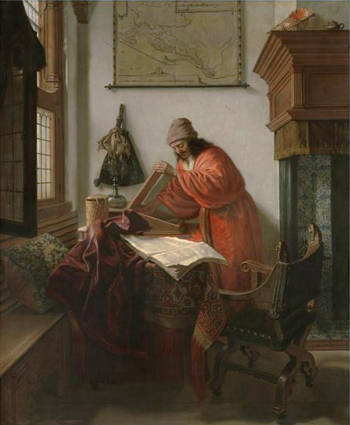
Cornelis de Man The art historian's Adriaan Waiboer detailed study of Vermeer's effect on contemporary painters makes the connection still more specific. Cornelis de De Man's (1621–1706) interiors favor strongly receding spaces, conspicuous tiled floors, oblique perspective, windows admitting light from the side, wall maps, chairs, tables covered by Oriental carpets, and carefully staged figures occupying different spatial zones. Waiboer demonstrates that De Man's Geographers at Work, c. 1670, combines elements from several different Vermeer paintings rather than merely repeating a single composition. Its scholarly subject recalls The Astronomer, while aspects of its figure arrangement and recession into depth derive from other works by Vermeer. The scholarly interiors offer one of the strongest points of comparison, but the direction of influence should not be described as entirely straightforward. De Man had already painted Portrait of the Pharmacist Dr. Ysbrand Ysbrandsz. in an Interior around 1667, before Vermeer's The Astronomer of 1668 and The Geographer of 1669. The Leiden Collection therefore treats their De Man's portrait as part of an established Dutch tradition of portraying educated professionals at work and remarks that the globe and scholarly setting connect the painting with Vermeer's slightly later works. 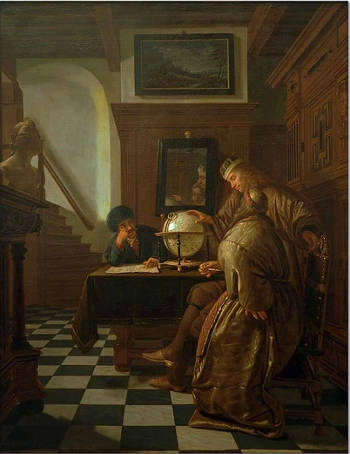
Cornelis de Man The situation changes with De Man's later scholarly pictures. Geographers at Work and A Scholar in His Study, generally dated around 1670 or shortly afterward, display much more specific affinities with Vermeer's two scholar paintings. Contemporary scholarship has explicitly identified these works as closely related to The Astronomer and The Geographer. In Geographers at Work, the globe, wall decoration, tiled floor, heavy furniture, patterned table covering, concentrated intellectual activity, and construction of space from foreground to background all recall Vermeer, although De Man's room is busier and his narrative more explicit. This relationship can be seen even in apparently minor details. Technical research published by the Journal of Historians of Netherlandish Art points out that in Geographers at Work De Man painted the lion-head finials of a Spanish chair with circular highlights resembling one of Vermeer's characteristic devices. Examination of the paint sequence, however, demonstrated that De Man produced those highlights according to his own normal working method rather than by adopting Vermeer's painting procedure. The distinction is important: visual borrowing does not necessarily imply technical awareness or imitation. 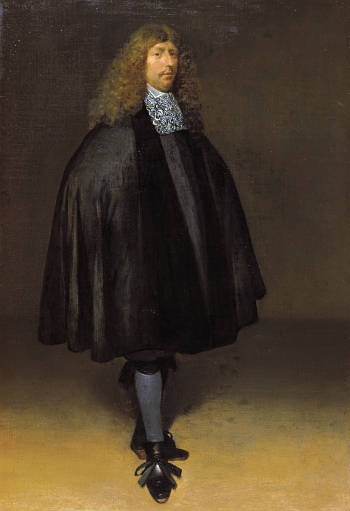
Gerrit ter Borch Gerrit ter Borch (1617–1681). Around 1668 Ter Borch painted his imposing Self-Portrait, presenting himself not primarily as a working painter but as a prosperous gentleman of the regent class, dressed in costly clothing and shown full length. The Mauritshuis connects this presentation directly with his membership in Deventer's town council. By this date the genre painter who had once traveled from city to city painting soldiers and diplomats had secured both professional and civic status while continuing to work in the intimate interior tradition that had become one of the defining achievements of Dutch painting. 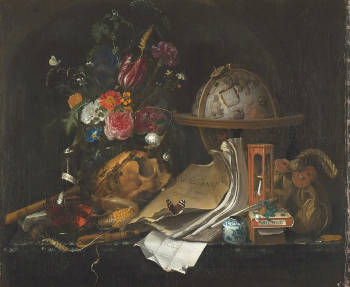
Maria van Oosterwijck Maria van Oosterwijck (1630–1693) signed and dated the Vanitas Still Life now in Vienna. Books, a skull, flowers, and scientific equipment gather several kinds of human accomplishment within a meditation on mortality. The painting's abundance complicates its warning: objects associated with learning and pleasure remain visually attractive even as their lasting value is questioned. Van Oosterwijck's command of varied surfaces also extends her place in the chronology beyond flower painting alone. Her work participates in the ambitious still-life tradition in which carefully rendered possessions carry intellectual and religious associations. Frans van Mieris the Elder (1635–1681) painted his tiny "Self-Portrait" with a Plumed Beret, signed and dated 1668. Only 11.3 x 8.2 cm, the oval panel presents the artist's recognizable face with an animated expression, fanciful headgear, and a partly concealed metal gorget. The Leiden Collection interprets it as a tronie: an exercise in character and expression using the artist as model. Its scale invited close viewing, while its costume and apparent surprise introduced a playful element. Self-representation could therefore serve purposes quite different from the formal presentation of professional dignity. 
Meindert Hobbema Meindert Hobbema (1638–1709) married and became a wine-gauger in Amsterdam in 1668. The position involved measuring imported wine and supplied an income outside painting. His subsequent production appears to have diminished, although he continued to make important landscapes. This development is significant for the economic history of Dutch art: considerable artistic ability did not necessarily make exclusive dependence on picture sales desirable. Municipal employment and painting could coexist within the same career, with changes in output reflecting household circumstances as well as artistic decisions. |
| DUTCH REPUBLIC |
DUTCH REPUBLIC (1668)
The Dutch Republic, England, and Sweden formed the Triple Alliance in 1668, seeking to restrain French expansion in the Spanish Netherlands and bring the War of Devolution to a settlement. Cooperation with England followed remarkably soon after the two maritime powers had been at war. The agreement illustrates the flexibility of diplomatic alignments when a different threat became more urgent. For Dutch statesmen, French possession of additional neighboring territory raised concerns that commercial rivalry with England could temporarily outweigh. The Treaty of Aix-la-Chapelle in May ended the War of Devolution. France returned Franche-Comté but retained a series of towns in the Spanish Netherlands, including Lille. The settlement checked the immediate campaign while leaving substantial French gains in place. From the Dutch perspective, diplomacy had limited further expansion without restoring the earlier territorial balance. The frontier remained a source of insecurity. 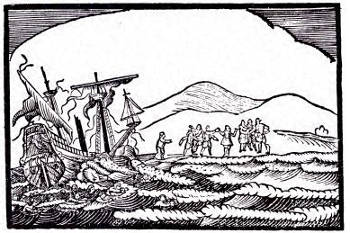
Anonymous Hendrick Hamel (1630–1692) returned to the Netherlands in 1668, and accounts of his experiences in Korea appeared in print that year. Shipwrecked there in 1653, he had spent thirteen years in the country before escaping with several companions. His narrative introduced Dutch readers to a society largely unfamiliar to them through an account shaped by involuntary residence, practical observation, and the difficulties of obtaining release. It broadens the history of overseas knowledge beyond successful voyages and commercial reports. |
| EUROPEAN PAINTING & SCULPTURE |
EUROPEAN PAINTING & SCULPTURE (1668)
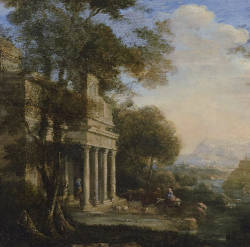
Pierre Patel Pierre Patel (1605–1676) painted his extensive view of the palace and gardens of Versailles in 1668. The elevated viewpoint makes buildings, roads, gardens, and waterworks intelligible as parts of an ordered estate. Yet the picture also alters the surrounding terrain: invented slopes strengthen the emphasis on the central garden axis. Its apparent descriptive precision therefore coexists with deliberate idealization. Patel's landscape practice becomes an instrument for presenting royal space, showing how a view can record a building campaign while shaping the viewer's understanding of its importance. 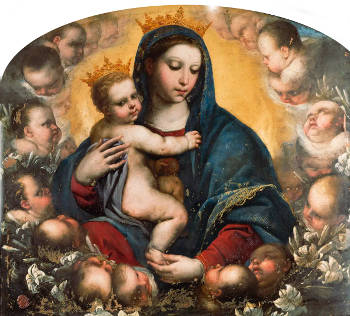
Luca Giordano Luca Giordano (1634–1705) painted four works on copper for the Deputation of the Royal Chapel of the Treasure of San Gennaro in Naples: the Madonna della Purità, Saint Joseph, Saint Anne, and Saint Joachim. Dated to 1668, they belong to the furnishing of an important religious complex rather than to an isolated market for easel pictures. Their metal supports permitted smooth, luminous surfaces, while their placement above sacristy cabinets connected painting to the room's architectural and practical arrangements. Giordano's activity demonstrates the continuing breadth of Neapolitan patronage beyond the generation most closely associated with early Caravaggism. Bartolomé Esteban Murillo (1617–1682) painted the Immaculate Conception of the Choir, often called La Niña, around 1668–1669. The youthful Virgin's upward gaze, crossed hands, and gently turning silhouette concentrate attention on devotional feeling. Murillo developed numerous versions of this subject, adjusting posture and expression within a recognizable pictorial language. Repetition here supported a sustained exploration of how an abstract theological claim could become emotionally accessible through a human figure. The painting belongs to Seville's religious culture and to the artist's mature handling of light and idealized form. |
| ARCHITECTURE |
ARCHITECTURE (1668)
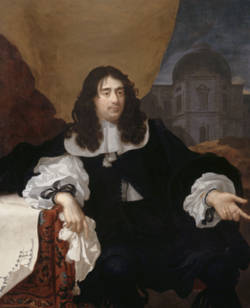
Pierre Rabon Louis Le Vau (1612–1670) undertook the major enlargement of Versailles commonly called the enveloppe. New construction surrounded the older château on its garden sides, preserving the earlier building within a substantially enlarged palace. The project demonstrates how royal architecture could grow through incorporation rather than complete replacement. Its new apartments and façades changed the relationship between residence and gardens, while the familiar Hall of Mirrors belongs to a later building campaign. Patel's view records Versailles near the threshold of this further expansion. In Turin, construction of San Lorenzo to the designs of Guarino Guarini (1624–1683) entered the phase generally dated from 1668. The church's central space and intersecting arches developed an intricate relationship between geometry, structural appearance, and light. Its celebrated dome was the result of work continuing beyond this year. Guarini's undertaking provides another example of architecture designed to direct the experience of looking upward, with the apparent complexity of the vault serving an ordered spatial scheme. |
| MUSIC |
MUSIC (1668)
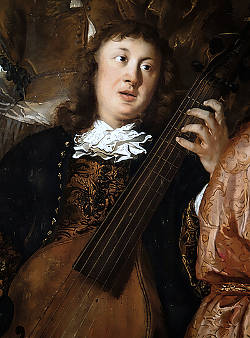
Johannes Voorhout Dieterich Buxtehude (c. 1637–1707) became organist of the Marienkirche in Lübeck in 1668. The appointment placed him within a prosperous commercial city whose principal church supported an important musical establishment. He also married the daughter of his predecessor, joining professional succession to a household relationship. The position became the foundation of his long career in organ and vocal music. Its significance lay in sustained employment, instruments, and local support—the practical conditions under which a musician could compose, perform, and teach over decades. Antonio Cesti (1623–1669) saw Il pomo d'oro performed in Vienna in July. Originally planned for imperial wedding celebrations, the enormous production was eventually presented across two evenings. Mythological action, elaborate scenery, singers, dancers, and machinery combined in a court spectacle whose scale demanded exceptional resources. The surviving designs associated with Lodovico Ottavio Burnacini (1636–1707) make its visual ambitions particularly tangible. Music belonged to a much larger coordinated undertaking, in which technical labor and theatrical illusion served the representation of imperial magnificence. |
| LITERATURE |
LITERATURE (1668)
Adriaan Koerbagh (1633–1669) published his Bloemhof, a Dutch dictionary that used explanations of words to challenge theological and intellectual authority. Writing in the vernacular was central to his purpose: readers excluded from learned Latin discourse could examine concepts usually controlled by specialists. His attempted publication of Een Ligt Schijnende in Duystere Plaatsen then brought intervention by the authorities, following denunciation by its printer. His imprisonment in 1668 exposes the limits of Dutch toleration when criticism reached fundamental religious claims and sought a broad readership. 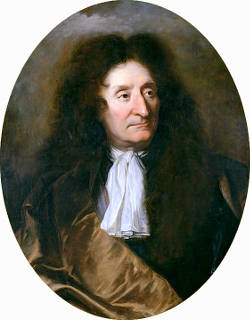
Hyacinthe Rigaud Jean de La Fontaine (1621–1695) published the first collection of his Fables, comprising six books. Animal stories and other inherited narratives became vehicles for observing power, appetite, credulity, and unequal relationships. Their apparent simplicity allowed them to move between instruction and satire. The moral was not always a comfortable assurance that virtue would prevail; worldly advantage could belong to the powerful or cunning. The collection belongs to a literary culture in which familiar stories could carry sharp observations about social conduct. Hans Jakob Christoffel von Grimmelshausen (c. 1621–1676) published Simplicissimus in 1668, with 1669 on its title page. Its wandering protagonist encounters the violence and instability of the Thirty Years' War through a succession of changing circumstances and identities. Comedy, brutality, religious reflection, and social criticism occupy the same narrative. The work gives the chronology a German literary perspective on a conflict already twenty years past but still active in memory and experience. Its publication also illustrates why the year printed on a title page does not always settle the actual date of issue. |
| SCIENCE, MATHEMATICS, & PHILOSOPHY |
SCIENCE, MATHEMATICS, & PHILOSOPHY (1668)
Francesco Redi (1626–1697) published Esperienze intorno alla generazione degl'insetti. By investigating the appearance of maggots in meat under differing conditions of access by flies, he challenged explanations that treated them as products of the decaying material itself. The importance lay in arranging comparisons that could discriminate between competing explanations. The experiments addressed particular organisms and circumstances; they did not immediately settle every contemporary claim about spontaneous generation. Redi's work joined close observation to deliberate intervention in the conditions being observed. 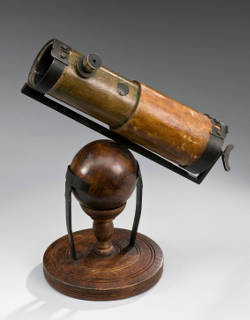
Anonymous Isaac Newton (1643–1727) constructed his first reflecting telescope in 1668. A curved mirror gathered light, offering a practical way to avoid the color fringes produced by the principal lens of a refracting telescope. Turning the proposal into an instrument required work on metal, surface preparation, and polishing. The small device therefore belongs as much to the history of skilled fabrication as to optical theory. The telescope now preserved by the Royal Society is a later model, dated 1671, and should not be confused with this first instrument. Nicolaus Mercator (c. 1620–1687) published Logarithmotechnia, presenting an infinite series for calculating logarithms. The work contributed to methods in which a quantity could be approached through the accumulation of progressively smaller terms. Such procedures expanded the resources of mathematical calculation and formed part of the developing analytical methods associated with calculus. Mercator's career also crossed national boundaries, linking teaching and mathematical work in several European settings. |
| WORLD HISTORY & POLITICS |
WORLD HISTORY & POLITICS (1668)
Spain formally recognized Portuguese independence in the Treaty of Lisbon. The agreement concluded the long struggle that had followed Portugal's separation from the Spanish monarchy in 1640. Recognition gave diplomatic form to an independence maintained through decades of warfare and foreign alliances. It also affected overseas possessions and commercial relationships, making the settlement significant beyond the Iberian Peninsula. In Sweden, the Riksens Ständers Bank, predecessor of the Riksbank, was established under the authority of the estates. It followed the failure of Stockholms Banco and represented an effort to place banking on a different institutional foundation. Its later identity as a central bank should not obscure its seventeenth-century circumstances. The immediate issues concerned lending, deposits, and confidence in financial administration, within a state whose monetary arrangements had already encountered serious difficulties. |
| DAILY LIFE |
DAILY LIFE (1668)
Beer was one of the most widely consumed beverages in the seventeenth-century Dutch Republic, forming an integral part of everyday life across nearly all social classes. Men, women, and even children drank beer regularly, although the strength and quality varied considerably. Much of the beer consumed at ordinary meals was relatively weak, containing substantially less alcohol than stronger varieties intended for taverns and special occasions. Beer was valued not only for its taste and nutritional content but also because brewing involved boiling water, which could reduce some of the health risks associated with contaminated water supplies. Nevertheless, the common assumption that Dutch people drank beer because all drinking water was unsafe is misleading: clean water from wells, rainwater cisterns, and other suitable sources was also available. Beer was particularly important among laborers, artisans, and sailors, for whom it supplied calories and accompanied the substantial quantities of bread, cheese, and salted fish that characterized their diets. Beer consumption in the Dutch Republic was exceptionally high by modern standards, although estimates vary considerably according to locality, period, and the inclusion of children. Historical estimates sometimes suggest annual consumption of several hundred liters per person, equivalent to roughly a liter or more per day in communities where beer remained the principal everyday beverage. Such figures should be treated cautiously, since they often derive from municipal production or taxation records rather than direct measurements of individual consumption. Brewing was a major urban industry, particularly in Haarlem, Delft, Gouda, and Amsterdam. Delft had possessed a flourishing brewing industry since the late Middle Ages, and its breweries had contributed substantially to the city's prosperity. By Vermeer's lifetime, however, Delft's brewing industry had declined considerably from its sixteenth-century prominence, partly because of competition from other brewing centers and changes in urban economic activity. Nevertheless, beer remained an important commodity, and excise duties on its production and sale provided municipal governments with a valuable source of revenue. The Dutch produced several varieties of beer, distinguished by their ingredients, strength, color, and price. Ordinary households generally purchased relatively inexpensive beer, while wealthier consumers could afford stronger and more carefully prepared varieties, including imported beers from German brewing centers. Hops, which had long since replaced many traditional herbal flavorings, contributed bitterness and helped preserve the beverage. Beer was commonly stored in wooden barrels and served in earthenware, stoneware, or glass drinking vessels. It was sold by brewers, beer merchants, tavern keepers, and other licensed retailers. Taverns and inns were important centers of sociability, where merchants negotiated business, artisans gathered after work, travelers exchanged news, and neighbors discussed local affairs. Drinking establishments also provided opportunities for gambling, music, and occasional disorder, prompting municipal authorities to regulate opening hours, public drunkenness, and other aspects of tavern life. Beer occupied a conspicuous place in seventeenth-century Dutch genre painting, particularly in scenes of taverns, guardrooms, and convivial gatherings. Artists such as Adriaen Brouwer (c. 1605–1638), Adriaen van Ostade (1610–1685), and Jan Steen (1626–1679) frequently depicted drinkers holding stoneware jugs, earthenware vessels, or special glasses of beer (pasglas). 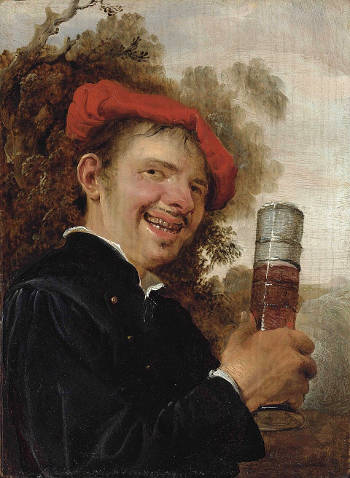
Petrus Staverenus The pasglas (plural pasglazen) was a distinctive type of tall, cylindrical drinking glass popular in the Dutch Republic during the sixteenth and seventeenth centuries, particularly for drinking beer. Its name derives from the Dutch word pas, referring to the horizontal marks or bands applied at regular intervals around the glass. These divisions indicated how much each participant should drink before passing the vessel to the next person, making the pasglas especially suitable for communal drinking games and convivial gatherings. Usually made of greenish or colorless glass, it had a relatively narrow cylindrical body, often decorated with applied glass threads that formed the measuring bands. The pasglas frequently appears in Dutch genre paintings and prints, where it evokes the sociability of taverns, festive gatherings, and drinking parties. Its characteristic form illustrates how even an ordinary activity such as drinking beer could acquire elaborate rituals and become a source of amusement in seventeenth-century Dutch society. . Such paintings could celebrate sociability and everyday pleasures while simultaneously warning against drunkenness, idleness, and moral excess. Beer also appeared in more restrained domestic settings, where its consumption was simply part of ordinary household life. During Vermeer's lifetime, however, wine, coffee, tea, and distilled spirits were becoming increasingly visible in Dutch urban culture, particularly among prosperous households. Wine carried associations of refinement and social standing, while coffee and tea gradually acquired fashionable status during the second half of the century. Beer nevertheless remained the most familiar and accessible alcoholic beverage for much of the population, linking the daily routines of ordinary Dutch households to the commercial and social life of their cities. Dom Pierre Pérignon (1639–1715) became procurator of the abbey of Hautvillers in 1668. His responsibilities encompassed the management of property and production, including the cultivation of vines and the making and sale of wine. The appointment offers a useful glimpse of a monastery as a working economic institution: religious life depended on agriculture, buildings, accounts, and dealings with purchasers. His later association with champagne should not turn this year into a sudden invention of sparkling wine. What begins here is a long period of practical supervision and attention to the quality of an important local product. |
| SIGNIFICANT BIRTHS |
SIGNIFICANT BIRTHS (1668)
Herman Boerhaave (1668–1738) would become a leading physician and teacher at Leiden, drawing students from across Europe and contributing to the international standing of its medical school. 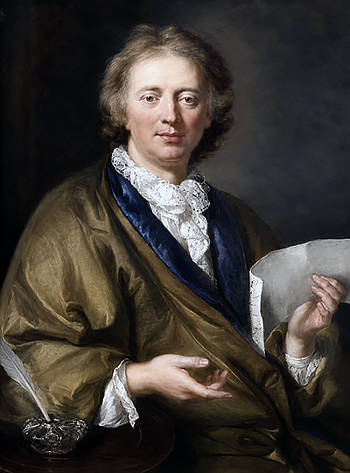
Anonymous François Couperin (1668–1733) would become a major composer of harpsichord and chamber music, combining exacting keyboard writing with distinctive approaches to musical character. Giambattista Vico (1668–1744) would develop an influential account of historical knowledge, language, myth, and the institutions made by human societies. Thomas Woolston (1668–1733) would become a controversial English theological writer, questioning literal interpretations of biblical miracles and provoking prosecution. |
| NATURAL EVENTS |
NATURAL EVENTS (1668)
A major earthquake struck Shandong in China on July 25. Centered in the Tancheng region, it caused extensive destruction and tens of thousands of deaths according to historical estimates. Accounts describe severe ground disturbance as well as the collapse of buildings. Modern estimates place its magnitude around 8.5, but this figure is a reconstruction from historical and geological evidence, not a contemporary measurement. The event ranks among the most destructive earthquakes documented in eastern China. Northern Anatolia suffered another powerful earthquake on August 17. A long section of the North Anatolian fault system ruptured, damaging numerous settlements across a broad region. Thousands of deaths were reported, although the documentary record varies considerably between places. Together, the Chinese and Anatolian events demonstrate how a single year's natural history can extend far beyond the geographical range of European observers and surviving European correspondence. |
1669: Vermeer's Age, 37
| 1669 | late-career maturity and economic deterioration |
|---|---|
| VERMEER'S LIFE & ART |
VERMEER'S LIFE & ART (1669)
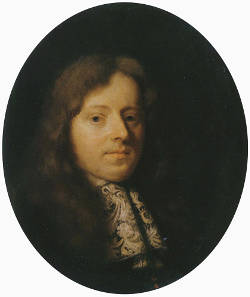
Godfried Schalcken Pieter Teding van Berckhout (1643–1713) visited Vermeer on May 14 and June 21, recording his admiration in his diary. On the second occasion, he singled out the paintings' perspective. These entries establish that Vermeer received appreciative visitors from outside Delft and had works available to show them. They also preserve a contemporary response to the construction of his pictures: the arrangement of space evidently mattered to this informed spectator. The paintings he saw cannot be securely identified. The family's documentary history includes another loss: Vermeer and Catharina Bolnes (1631–1687) buried a child in the Oude Kerk during this year. The record supplies little basis for reconstructing their response or connecting the death with a particular painting. It nevertheless belongs beside the accounts of appreciative visitors, reminding us that professional recognition and bereavement could occupy the same months.
Johannes Vermeer The Geographer bears the date 1669, providing one of the relatively rare firm chronological anchors within Vermeer's surviving work. The scholar leans over a table, holding dividers above a sheet while turning toward the window. His forward posture introduces a physical energy unusual among Vermeer's solitary figures. The loosely gathered carpet, substantial cabinet, and scattered working materials surround a moment of interrupted activity. Light draws attention to his face and hand, while the room's rectangular divisions give stability to the more animated figure. The objects specify a field of study. Maps, dividers, and a terrestrial globe connect the figure with the measurement and representation of the earth. The globe's visible surface includes the Indian Ocean, placing overseas geography within the scholar's room. These instruments do more than establish an occupation: they show knowledge taking material form in printed sheets, calibrated tools, and manufactured globes. The picture brings the physical labor of measuring into contact with the less visible activity of thought.
Johannes Vermeer Considered alongside The Astronomer of 1668, the painting extends Vermeer's sustained treatment of the learned man at work. The two pictures share a closely related setting and a similar model, but their gestures differ: one figure reaches toward a celestial globe, while the other pauses above a working surface. Their relationship supports their interpretation as companion pictures. The frequently proposed identification of the model as Antonie van Leeuwenhoek remains unproven; the paintings establish a scholarly role more securely than an individual identity. |
| DELFT |
DELFT (1669)
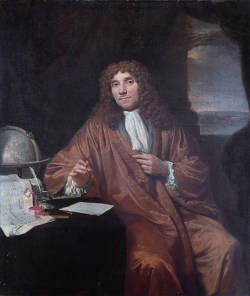
Jan Verkolje Antonie van Leeuwenhoek (1632–1723) qualified as a surveyor in 1669. His admission followed an examination in geometry, documented in a memorandum dated February 4. This qualification belongs to the practical mathematical culture of Holland, where the measurement of land served property ownership, building, and water management. It adds substance to our understanding of his abilities before his microscopic observations became internationally known. The record concerns admission to practice surveying; his appointment as a wine gauger came a decade later. Vermeer's mother, Digna Baltens (c. 1600–1670), leased Mechelen to a shoemaker for three years and went to live with her daughter on the Vlamingstraat. The transaction marks a change in the use of a building closely associated with Vermeer's upbringing. A property known through the history of an inn could accommodate another trade as family circumstances changed. Such leases reveal the adaptability of premises around Delft's market square, where residential, commercial, and artisanal activities occupied the same compact environment. |
| DUTCH ART |
DUTCH ART (1669)
Emanuel de Witte (c. 1617–1692) painted Interior of a Protestant, Gothic Church, with a Gravedigger in the Choir. Foreground columns establish an oblique passage through the building, while light directs attention toward the gravedigger in the distance. Burial becomes part of the church's ordinary activity, alongside its architectural grandeur. De Witte's earlier work in Delft had helped establish the expressive possibilities of this subject; here, in a dated painting of 1669, perspective remains inseparable from atmosphere and human presence. The interior is a place occupied and maintained by people, with the living moving above the resting places of the dead. 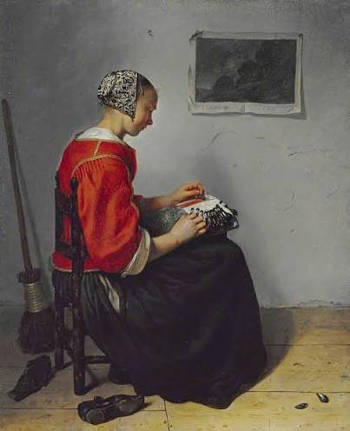
Caspar Netscher Van Berckhout's diary also brings several other painters into the year. In April he visited Cornelis Bisschop (1630–1674) in Dordrecht, praising his perspective; in December he called on Caspar Netscher (1639–1684) in The Hague and Gerrit Dou (1613–1675) in Leiden. Dou showed him several paintings. These visits place Vermeer within a wider itinerary of studio visiting, in which collectors compared different artists' accomplishments. Bisschop's inclusion is especially useful: admiration for convincing spatial effects extended beyond the painters now most closely associated with Delft. Rembrandt van Rijn (1606–1669) died this year, having continued to paint self-portraits during his final months. In Self Portrait at the Age of 63, the face emerges through variations in paint thickness, tone, and illumination. Later viewers have often interpreted such works as declarations about mortality or an accounting of the artist's life. The National Gallery cautions that they also belong to his continuing professional investigation of appearance: painting himself allowed prolonged study of aging skin, expression, and light. The work's emotional force need not depend on treating it as a deliberate farewell. 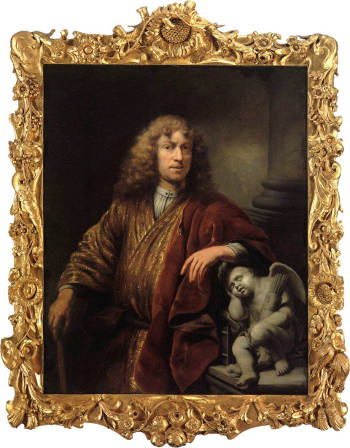
Ferdinand Bol Ferdinand Bol (1616–1680) was one of the most successful painters to emerge from the workshop of Rembrandt (1606–1669). After beginning in a strongly Rembrandtesque manner, he gradually adopted a brighter and more polished style that suited the tastes of Amsterdam’s wealthy civic and mercantile elite. By the 1650s and 1660s he had become a highly regarded portrait and history painter, receiving important commissions from regents, charitable institutions, the Amsterdam Admiralty, and prominent families. His election as a headman of the Guild of Saint Luke in 1655 and major portrait commissions of the 1660s testify to his considerable professional standing. Bol’s Self-Portrait of c. 1669 belongs to the very end of this successful career. Around the time of his marriage to the wealthy widow Anna van Erckel (1624–1680), he appears largely to have withdrawn from professional painting. The self-portrait therefore presents Bol not simply as an artist, but as a prosperous and socially established gentleman. For a chronology of Dutch painting around 1669, it is especially valuable because it marks the culmination of a career that had brought Bol substantial recognition in Amsterdam just as Vermeer was continuing his more limited and private activity in Delft. |
| DUTCH REPUBLIC |
DUTCH REPUBLIC (1669)
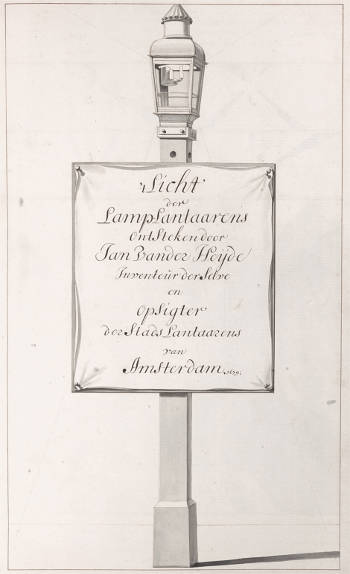
Jan van der Heyden Amsterdam approved Jan van der Heyden's (1637–1712) street-lighting plan. His contribution extended beyond designing an improved oil lantern: he worked out its placement, operating arrangements, and costs. Lighting a city required a continuing organization to supply fuel, maintain equipment, and attend to lamps. Van der Heyden's parallel activities as a painter and inventor make him particularly revealing. The streets and canals that supplied subjects for his pictures also presented practical problems demanding observation, planning, and municipal expenditure. His better-known developments in firefighting belong to a related but distinct sequence of projects. In June, Somba Opu, the principal fortified seat of Gowa near Makassar, fell to the VOC and its allies. The campaign depended heavily on regional forces, including those led by Arung Palakka (1634–1696), working with Cornelis Speelman (1628–1684). Its outcome cannot be understood simply as a contest between Europeans and Indonesians: rival political interests within Sulawesi were essential to the fighting. The destruction of the citadel severely weakened Gowa and strengthened the Company's position in eastern Indonesian commerce. Plundered goods and the subsequent reuse of building materials gave the conquest an immediate material aftermath. |
| EUROPEAN PAINTING & SCULPTURE |
EUROPEAN PAINTING & SCULPTURE (1669)
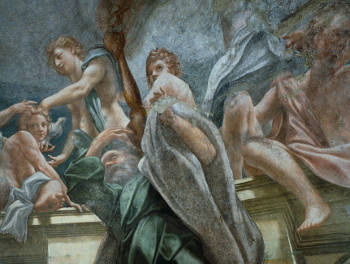
Correggio Giovanni Battista Gaulli, called Baciccio (1639–1709), traveled to Parma in 1669 to study the frescoes of Correggio (c. 1489–1534). The visit formed part of his preparation for the pendentive paintings at Sant'Agnese in Rome, a commission extending from 1666 to 1672. Gaulli's development brought together several artistic traditions: the warm color of Genoese painting, the ordered drawing of Bolognese classicism, and the bodily movement and aerial illusion of monumental decoration. His work is useful precisely because these traditions could coexist within one career. The Parma visit supplied a concrete encounter with an earlier solution to the problem of making a painted ceiling appear to open above its spectators. In Madrid, Juan Carreño de Miranda (1614–1685) became painter to the king in 1669. His appointment followed substantial experience in religious painting and collaborative decorative commissions. Court employment brought a salary and additional responsibilities, while individual paintings could be valued separately. The appointment illustrates how a painter's career might combine ambitious sacred compositions, palace decoration, portraiture, and administrative service. It should be distinguished from his promotion to pintor de cámara in 1671, when he acquired a higher position within the royal household. 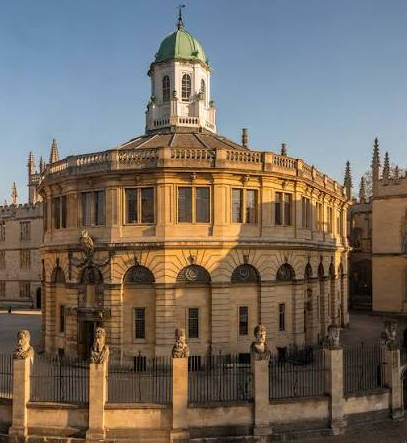
Robert Streater Robert Streater (1621–1679) completed the painted ceiling for Oxford's Sheldonian Theatre in 1668–1669. Executed in London and transported to Oxford by barge, the painting presented an elaborate allegory within an illusion of open sky. Painted drapery and cherubs worked with carved, gilded ropes to suggest the temporary covering of an ancient theater. Streater deserves attention as an English practitioner of large decorative painting, a field easily obscured by the greater familiarity of contemporary portraiture. The movement of the finished canvases also exposes the practical logistics behind an apparently unified architectural interior. |
| ARCHITECTURE |
ARCHITECTURE (1669)
The Sheldonian Theatre was completed in 1669, providing Oxford University with a purpose-built setting for its principal ceremonies. Designed by Christopher Wren (1632–1723), the building adapted the form of an ancient Roman theater to an enclosed northern European structure. Its success depended on accommodating a large assembly beneath a broad roof while retaining clear views of the proceedings. The first Encaenia held there established the building's ceremonial function. Architecture, painted allegory, and the formal recognition of learning therefore met in a single setting whose use was as important as its classical references. |
| MUSIC |
MUSIC (1669)
On June 28, Pierre Perrin (c. 1620–1675) received a royal privilege to establish an academy presenting opera in French. The privilege granted an exclusive right for twelve years and allowed admission charges, connecting royal authorization with the economics of public performance. This was an institutional foundation: the opening production followed in 1671. The arrangement helped make French opera possible as a continuing enterprise, requiring investment in performers, scenery, machinery, and premises. Its dependence on monopoly protection also shows how closely musical opportunity could be governed by access to the Crown. The Sonata representativa, traditionally attributed to Heinrich Ignaz Franz Biber (1644–1704) and generally placed around 1669, offers a very different musical experience. Its violin writing imitates birds and animals, making familiar sounds into demonstrations of instrumental ingenuity. The work belongs to a culture in which natural observation, learned curiosity, and entertainment readily overlapped. Its date and attribution warrant qualification, but its place around these years supplies a valuable example of music reaching beyond dance forms and devotional expression into the imitation of the audible world. |
| LITERATURE |
LITERATURE (1669)
Nil Volentibus Arduum was founded in Amsterdam in 1669. Associated with Lodewijk Meyer (1629–1681) and Andries Pels (1631–1681), the society sought to reform literary and theatrical practice through critical discussion and classical rules. Its members challenged a theatrical culture strongly invested in spectacle, elaborate machinery, and sensational action. Their program gives classicism a specific institutional presence in the Dutch chronology: arguments about order, probability, and appropriate expression were being pursued in organized meetings as well as in individual works. 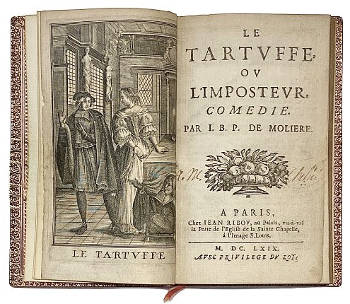
Molière Molière (1622–1673) finally brought the authorized, substantially definitive version of Tartuffe to the stage on February 5. The performance followed years of controversy and restrictions on earlier versions. A household's vulnerability to a pretended holy man made the comedy an examination of misplaced trust, self-interest, and the misuse of religious authority. Its successful return demonstrates how a play's history could depend on negotiations over permission as much as on the writing or performance itself. The anonymous Lettres portugaises appeared in Paris, presenting five passionate letters supposedly written by a Portuguese nun to a French officer. Most modern scholars attribute the work to Gabriel de Guilleragues (1628–1685); its presentation as authentic correspondence was part of its extraordinary appeal. Publishers rapidly produced competing editions, replies, and imitations, including editions associated with Dutch publishing. The book made an apparently private female voice into a highly marketable public text. Its success therefore belongs to the history of literary form, expectations about women's emotions, and commercial strategies that encouraged readers to believe they were entering an intimate correspondence. |
| SCIENCE, MATHEMATICS, & PHILOSOPHY |
SCIENCE, MATHEMATICS, & PHILOSOPHY (1669)
Nicolas Steno (1638–1686) published his Prodromus concerning solid bodies enclosed within other solids. Beginning with questions about fossils and rocks, he developed principles for interpreting the order in which sedimentary layers had formed. Lower layers normally preceded those above them, while tilted strata implied changes after deposition. Such arguments allowed the visible arrangement of material to become evidence of an earlier sequence of events. The earth could be investigated historically through relationships preserved in its structure. Jan Swammerdam (1637–1680) published Historia insectorum generalis, ofte Algemeene Verhandeling van de bloedeloose Dierkens in Utrecht. His examination of insects treated changes between larva, pupa, and adult as processes that required anatomical investigation. Careful dissection and observation challenged inherited assumptions about the apparent simplicity of small creatures. The book also illustrates the importance of vernacular scientific publication: despite its Latin opening title, the original work addressed readers in Dutch. The isolation of phosphorus by Hennig Brand (c. 1630–c. 1710) in Hamburg is conventionally dated to 1669. Working with material obtained from urine, he produced a substance whose glow and unusual behavior attracted considerable interest. The episode belongs to the experimental world of alchemy, where repeated manipulation of ordinary substances could yield unfamiliar materials. Knowledge initially circulated through personal demonstrations and guarded procedures; the discovery did not immediately arrive as a fully explained chemical result. 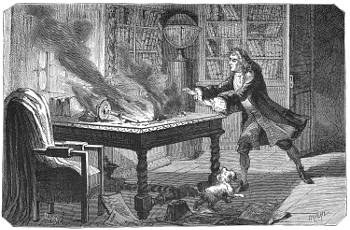
Anonymous Isaac Newton (1643–1727) became Lucasian Professor of Mathematics at Cambridge. The appointment supplied an institutional position for investigations already developing in mathematics and optics. It is a useful reminder that the chronology of scientific work includes employment and teaching alongside experiments and publications. The professorship belongs firmly to 1669, while the public communication and fuller development of several results associated with Newton came later. |
| WORLD HISTORY & POLITICS |
WORLD HISTORY & POLITICS (1669)
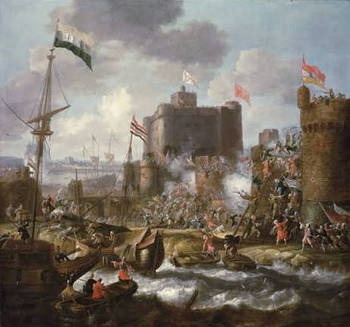
Jan Peeters the Elder Candia, now Heraklion, surrendered to the Ottomans in September, ending a siege that had lasted since 1648. The failure and withdrawal of French assistance left the Venetian defenders in an increasingly untenable position. The surrender brought most of Crete under Ottoman rule, although Venice retained several fortified offshore positions. For the inhabitants, the settlement meant departure and displacement as well as a change of sovereignty. The siege's duration had made the city's defense an international undertaking, consuming soldiers, supplies, money, and engineering expertise over more than twenty years. In the Polish–Lithuanian Commonwealth, Michał Korybut Wiśniowiecki (1640–1673) was elected king in June and crowned in September. His selection reflected support for a domestic candidate among nobles wary of foreign contenders and protective of their political liberties. The election did not resolve divisions within the Commonwealth: competing factions continued to dispute the direction of government. The episode provides a different model of monarchy from the hereditary courts of France and Spain, with royal authority dependent on an electoral political culture and powerful noble interests. |
| DAILY LIFE |
DAILY LIFE (1669)
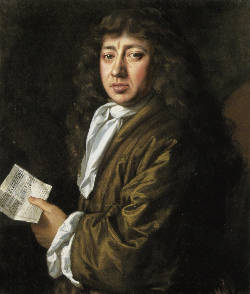
John Hayls Samuel Pepys (1633–1703) ended his principal diary on May 31, fearing that continued writing would damage his eyesight. His decision exposes the bodily conditions behind a practice that now seems chiefly literary. Reading, copying, keeping accounts, and recording private thoughts demanded prolonged close work, often under limited artificial illumination. Pepys also faced a problem of privacy: having someone else write for him would alter what he could safely record. The diary's ending therefore connects physical discomfort with the dependence of intimate writing on one person's ability to see and handle a pen. His fear of blindness should be recorded as his own understanding of the problem. |
| SIGNIFICANT BIRTHS |
SIGNIFICANT BIRTHS (1669)
Sébastien Vaillant (1669–1722): French botanist whose later investigations contributed to understanding plant reproduction and to the detailed study of the flora around Paris. His career joined collecting, observation, and work within a botanical institution. Johann Nicolaus Bach (1669–1753): German organist, composer, and instrument maker, later active in Jena. His combination of musical performance and the construction of keyboard instruments illustrates the breadth of practical skills within a professional musical family Susanna Wesley (1669–1742): English religious writer and educator whose household teaching and spiritual discipline later helped shape the environment from which Methodism emerged. Her significance extends beyond her relationship to her better-known sons to her own sustained intellectual and devotional work. |
| NATURAL EVENTS |
NATURAL EVENTS (1669)
Mount Etna erupted from March into July, sending lava across cultivated land and settlements toward Catania and the sea. Earthquakes accompanied the opening of fissures, while ash and other erupted material damaged an area beyond the lava flows themselves. The consequences continued after activity ceased: buried fields could no longer support their previous uses, settlements required rebuilding or relocation, and the physical relationship between Catania and its coastline changed. The eruption demands care in the handling of casualties. Modern research describes immense economic destruction but finds no recorded deaths or injuries directly attributable to the eruption; widely repeated claims of tens of thousands killed are unreliable. Its historical importance lies partly in that distinction: a disaster could devastate livelihoods and permanently alter a landscape without producing the enormous immediate death toll later accounts assigned to it. Contemporary reports also carried news of Etna far beyond Sicily, making the eruption an international subject of observation and discussion. |
1670: Vermeer's Age, 38
| 1670 | late-career maturity, economic Security, but structurally dependent |
|---|---|
| VERMEER'S LIFE & ART |
VERMEER'S LIFE & ART (1670)
Vermeer began another term as a headman of Delft's Guild of Saint Luke in 1670, returning to an office he had first held in 1662–1663. The appointment places him once again within the administration of the city's artistic trades. His standing rested within a professional community that included painters and producers of decorative objects, whose interests met through guild membership. This renewed responsibility provides firmer evidence of his local position than attempts to judge his contemporary reputation solely from the small number of surviving paintings. His mother, Digna Baltens (c. 1600–1670), died this year, and Mechelen passed into his possession. The inheritance preserved his connection with the market-square property where his parents had conducted their business. Ownership of a building, however, should not be equated with an immediately available sum of money: property could carry obligations while producing income through rent. The family records surrounding the inheritance belong to the practical management of assets that accompanied his work as a painter. 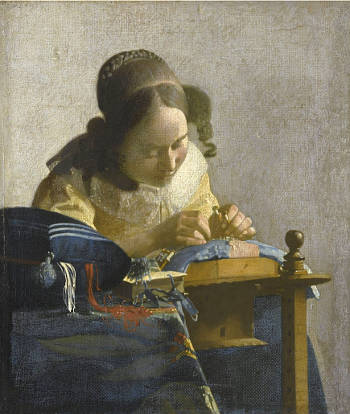
Johannes Vermeer The Lacemaker, c. 1669–1671, brings an unusually close view of concentrated manual work. The woman's lowered head and converging hands occupy most of the small composition. In the foreground, loose red and white threads appear as soft passages of color, while the finer threads at the center receive more precise definition. This difference in handling directs attention toward the task itself. Vermeer achieves intimacy through selective description: the picture does not give every object equal sharpness, despite the exacting nature of the activity represented. 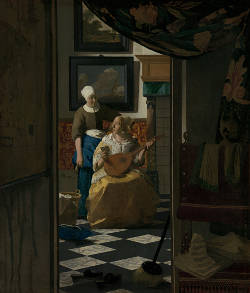
Johannes Vermeer The Love Letter, c. 1667–1670, develops the opposite spatial arrangement. We look through a dark foreground into a more brightly illuminated room, where a seated woman holding a musical instrument turns toward her maid. Their exchange suggests that the letter has interrupted another activity. The seascape behind them admits an association between love and the uncertainties of a voyage, but the contents of the message remain inaccessible. Domestic objects near the doorway make the spectator's position feel incidental, as though the encounter has been glimpsed from a service space. 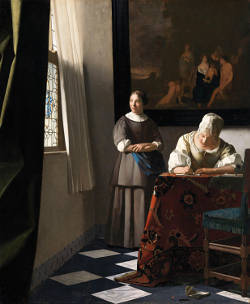
Johannes Vermeer The estimated range for Lady Writing a Letter with her Maid, c. 1670–1671, begins here. The seated writer bends over her work while the standing maid waits with folded arms, looking toward the window. Their different directions of attention introduce a relationship without making its emotional character explicit. The maid's stillness might suggest patience, distraction, or familiarity with an ordinary duty; the painting does not settle the matter. Compared with The Love Letter, the composition gives writing itself greater prominence and allows the relationship between mistress and servant to unfold through posture and spacing. 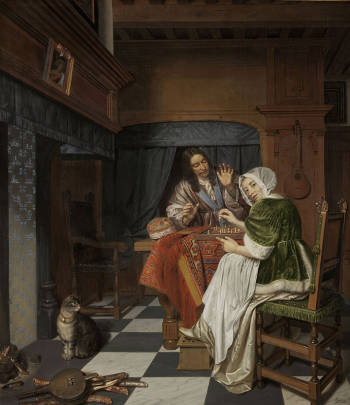
Cornelis de Man In the late 1660s and early 1670s, Vermeer and Cornelis de Man (1621–1706) were both deeply concerned with the construction of domestic space, and their closely related professional positions within the Delft Guild of Saint Luke brought them into direct contact around 1670–1671. Yet a comparison between De Man's The Chess Players (c. 1670, Szépművészeti Múzeum, Budapest) and Vermeer's The Love Letter and Allegory of Faith reveals markedly different uses of perspective. De Man treats the room as a strongly defined architectural container. The diagonally receding tiled floor, ceiling beams, fireplace, walls, and furnishings establish an emphatic sense of measurable cubic depth, recalling his earlier experience with architectural subjects and the Delft tradition represented by Gerard Houckgeest (c. 1600–1661) and Hendrick van Vliet (c. 1611/12–1675). In The Chess Players, perspective is made conspicuous: the spectator is invited to experience the room almost as a physical enclosure into which the figures, furniture, musical instruments, porcelain, and wall paintings have been carefully placed. The effect depends upon what seventeenth-century Dutch writers associated with houding—the convincing spatial relationship of forms according to their relative positions and distances.
Johannes Vermeer Vermeer, although equally systematic in his use of linear perspective, generally resists allowing architectural recession to dominate the pictorial experience. In The Love Letter, he adopts the doorkijkje, or view-through, device associated with artists such as Samuel van Hoogstraten (1627–1678) and Cornelis Bisschop (1630–1674), but turns it into a means of withholding rather than simply opening space. The spectator remains in a shadowed foreground passage while looking into the illuminated room occupied by the mistress and maid. Receding floor tiles establish depth, yet the composition is simultaneously held close to the picture surface by the doorway, wall coverings, map, fireplace, framed seascape, and other rectangular forms running parallel to the canvas. Negative spaces are likewise given unusual compositional weight. In Allegory of Faith, spatial recession is again countered by powerful surface elements: the tapestry curtain, altar-like table, foreground objects, and suspended glass sphere interrupt the perspectival movement into depth. The sphere, reflecting its surroundings in miniature, can itself be understood as an especially suggestive meditation on the painter’s ability to translate three-dimensional space into a two-dimensional image. The difference between the two painters therefore lies less in their knowledge of perspective than in the ends to which they put it. De Man's Chess Players emphasizes the intelligibility and solidity of the room as an architectural stage, populated with carefully described objects and figures engaged in recognizable social activity. Vermeer uses comparable devices—tiled floors, musical instruments, maps, wall paintings, doorways, curtains, and foreground barriers—but continually counterbalances spatial illusion with the abstract organization of the painted surface. His interiors tend to keep the spectator at a greater psychological and visual distance, while narrative remains more ambiguous and objects acquire stronger formal or symbolic roles. De Man's space encourages the eye to move into and around the represented room; Vermeer repeatedly calls attention to the tension between recession and flatness. The comparison therefore suggests two distinct responses to the same fundamental problem of Delft interior painting: how to create a convincing inhabited space while organizing every element according to the independent demands of the rectangular picture surface. |
| DELFT |
DELFT (1670)
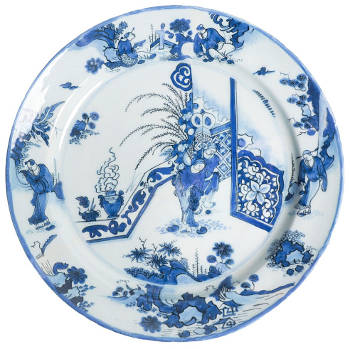
Anonymous By 1670, Delft's manufacture of tin-glazed earthenware had become one of the city's principal industries. The number of potteries had risen from only eleven in 1640 to twenty-eight in 1670, and ceramic production had become an important source of employment. The rapid expansion followed the disruption of Chinese porcelain imports during the middle decades of the century, when Delft manufacturers successfully supplied the demand for white, brightly decorated ceramics with their own tin-glazed wares. Several important factories were already established, and in 1670 the celebrated De Metaale Pot began production on the Lange Geer, occupying, like a number of Delft potteries, premises formerly associated with the city's declining brewing industry. 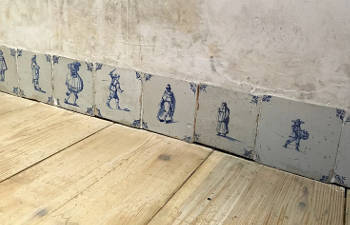
Anonymous Humble baseboard tiles formed an important branch of this expanding ceramic trade. Tin-glazed tiles were increasingly used along the lower portions of walls, around fireplaces, and in kitchens, passages, and other domestic spaces, their hard glazed surfaces providing both decoration and protection. Delft wares circulated well beyond the city and increasingly entered international markets during the later seventeenth century, although the industry's fullest artistic and technical flowering belongs to the decades after Vermeer's death: around 1700 Delft supported thirty-three potteries and had become internationally identified with finely painted Dutch faience. Thus 1670 marks not the absolute apogee but the point at which the industry was already operating on a remarkably large scale and moving toward the great export and production boom of the closing decades of the century. De Metaale Pot began operating in 1670 in premises on the Lange Geer. It was the last of four potteries established along that canal, joining neighboring businesses that included De Grieksche A and 't Fortuyn. The concentration is revealing: Delftware production occupied particular stretches of the city, where workshops, storage, transport, and residential accommodation stood close together. The new enterprise gives this year a specific local development within the broader expansion of the industry. |
| DUTCH ART |
DUTCH ART (1670)
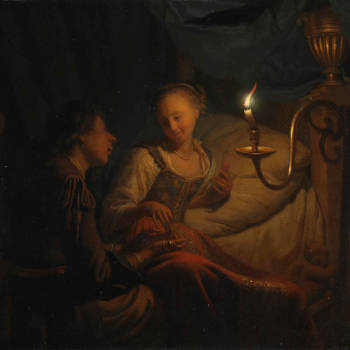
Godfried Schalcken The single Dutch painter most closely associated with candlelight, Godfried Schalcken (1643–1706). Trained by Gerrit Dou (1613–1675), Schalcken made artificial illumination something of a specialty, repeatedly exploring how a single flame could model faces, hands, fabrics, metal, and darkness. An especially effective example is A Man Offering Gold and Coins to a Girl, c. 1665–1670, in the National Gallery, London. The candle is not merely an accessory: its warm, concentrated light organizes the entire composition, emerging from surrounding darkness to illuminate the woman's flesh, the white bedding, jewelry, coins, and the man's partially concealed face. The National Gallery specifically identifies Schalcken as a painter who frequently worked with candlelit scenes, while his reputation as a specialist in such effects continued well beyond the seventeenth century. The comparison with Vermeer is striking precisely because Vermeer appears never to have been tempted by this highly successful branch of Dutch painting. Once his mature interior formula had developed, illumination normally enters through windows at the left, travels across the foreground and figures, and gradually weakens toward the right and rear of the room; the Rijksmuseum has likewise emphasized the importance of daylight entering from the left in his mature interiors. Vermeer occasionally loosened this arrangement: in works such as Girl with a Pearl Earring, Girl with a Red Hat, or The Lacemaker, the architectural source of illumination is suppressed or the light becomes more concentrated and less obviously tied to a visible window. Yet even there, the effect remains that of natural daylight, not candlelight, lamplight, firelight, or nocturnal illumination. No surviving painting shows him experimenting with the dramatic possibilities of a flame as the principal light source. This is remarkable because candlelight painting was neither obscure nor technically marginal: artists such as Dou and Schalcken demonstrated that it could provide opportunities for virtuoso effects of reflection, color, shadow, and intimacy. Vermeer instead worked within an extraordinarily narrow band of lighting conditions—usually cool or neutral daylight entering a domestic interior from one side—and investigated that restricted situation with extraordinary persistence. His originality therefore lies partly in what he refused to vary: rather than continually seeking new kinds of illumination, he repeatedly reconsidered how the same fundamental daylight could fall on a wall, a face, a satin jacket, a map, a pearl, or a sheet of paper. 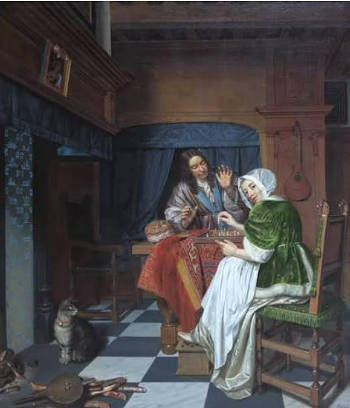
Cornelis de Man Cornelis de Man (1621–1706) painted The Chess Players around 1670. An elegantly dressed woman turns toward the spectator while her companion gestures across the board. The fireplace, bellows, logs, and cat establish a comfortable domestic setting, but the figures' responses make the room a place of social maneuvering. De Man's work belongs to the same Delft interest in convincing interiors that informed Vermeer's paintings, while giving gestures and the spectator's participation a more conspicuous role. His picture deserves attention as an independent treatment of domestic sociability, rather than simply as evidence of another painter's influence. Gerrit ter Borch (1617–1681) continued to explore refined social encounters in The Music Lesson, c. 1670, now in Chicago. The figures' angled poses suggest an interaction that may extend beyond instruction. The young woman holds a violin, an instrument more commonly associated with male performers in this setting. Ter Borch's precise treatment of clothing and restrained gestures allows social distinctions and personal intentions to emerge without an explicit narrative. His cultivated interiors offered purchasers a different balance of intimacy, elegance, and ambiguity from the more demonstrative exchanges found in De Man's work. 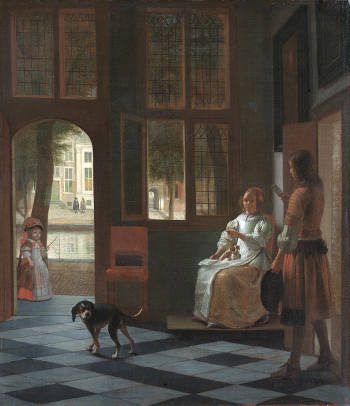
Pieter de Hooch Pieter de Hooch (1629–after 1684). De Hooch signed and dated Man Handing a Letter to a Woman in the Entrance Hall of a House in 1670. A messenger approaches a seated woman with a letter while a sequence of openings carries the viewer's gaze from the subdued interior through the doorway to a brilliant Amsterdam canal and onward toward the opposite houses. The familiar Dutch letter theme links De Hooch with Vermeer, Gabriel Metsu (1629–1667), and Gerrit ter Borch (1617–1681), but De Hooch treats correspondence primarily as an occasion for an extended architectural and luminous progression from interior darkness toward exterior daylight. Open doors and windows connect the domestic encounter with the canal outside. A dog, a child, and the sunlit buildings across the water carry the eye through successive distances. Although the delivery of a letter supplies the immediate subject, the painting's larger achievement lies in joining private and public space. De Hooch's Amsterdam interiors continued to develop spatial interests already central to his Delft work, adapting them to substantial urban houses and their outward views. |
| DUTCH REPUBLIC |
DUTCH REPUBLIC (1670)
The secret Treaty of Dover brought England and France into an agreement directed against the Dutch Republic. Concluded in June between Charles II (1630–1685) and Louis XIV (1638–1715), it linked French financial support with commitments that would contribute to the war of 1672. Its secret provisions also included Charles's undertaking to declare himself a Catholic when circumstances permitted. For the chronology, the distinction between diplomatic arrangements and public knowledge matters: the agreement altered the Republic's strategic position before its full implications were visible to Dutch society. The apparent security of the preceding peace concealed a developing threat. The publication of Baruch Spinoza's (1632–1677) Tractatus Theologico-Politicus exposed another tension within the Republic: the relationship between freedom of thought, religious authority, and civil government. Issued anonymously with a false Hamburg imprint, the book argued for the liberty to philosophize and approached Scripture through questions about language, authorship, and historical circumstances. Its concealment is part of its significance. A society capable of supporting an extensive publishing industry could also make authors and printers apprehensive about the consequences of controversial arguments. |
| EUROPEAN PAINTING & SCULPTURE |
EUROPEAN PAINTING & SCULPTURE (1670)
![Juan de Arellano, Florero [Vase of Flowers]](../timelines/timeline-thumbnnails/flora.jpg)
Florero [Vase of Flowers] Juan de Arellano (1614–1676) produced flower paintings such as the Prado's Basket of Flowers, dated c. 1670. The arrangement spreads outward from its container, balancing the different shapes and colors of individual blooms against a dark background. Spanish painting included a substantial market for such decorative subjects alongside its better-known religious commissions and royal portraits. Arellano's specialization also belongs to an international history: flower painting developed through exchanges among Spanish, Flemish, and Italian artists, with composition and decorative effect adapting to different markets. 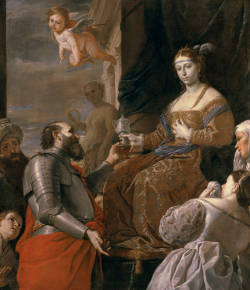
Mattia Preti Mattia Preti (1613–1699) painted The Death of Sophonisba around this period, generally placed c. 1670 or in the early 1670s. The ancient subject becomes a theatrical encounter through emphatic gestures, concentrated illumination, and the arrangement of figures around the poisoned queen. Preti is particularly useful for following the continuing consequences of Caravaggio's (1571–1610) example. Strong light and substantial human bodies remained available to later painters, but they could be incorporated into expansive historical compositions and elaborate settings. Caravaggesque naturalism persisted through adaptation, rather than through the repetition of a single manner. Gaspard Dughet (1615–1675) developed landscapes in which carefully organized distances coexist with rugged rock formations and dense vegetation. Landscape with a Natural Arch, c. 1670–1673, places small figures within a setting whose geological forms command attention. His work broadens the history of classical landscape beyond its most frequently discussed practitioners. Order could be achieved through the placement of trees, openings, and masses of rock without making nature appear uniformly gentle or domesticated. The estimated date range belongs to his final years and should not be converted into a documented completion in 1670. |
| ARCHITECTURE |
ARCHITECTURE (1670)
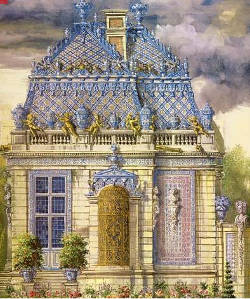
1670 The Trianon de Porcelaine was built at Versailles in 1670, providing a comparatively intimate retreat within the expanding royal estate. Designed under Louis Le Vau (1612–1670), its pavilions used blue-and-white ceramic decoration to evoke the prestige of Chinese porcelain. Despite its name, the decoration involved European glazed earthenware rather than a palace constructed from Chinese porcelain. The ensemble demonstrates how the appearance of imported objects could be translated into architecture. Its fragility and eventual replacement belong to the subsequent history of the site; in 1670, it represented an unusually ambitious application of ceramic ornament. Louis XIV also commissioned the Hôtel des Invalides, intended to accommodate and care for wounded, disabled, sick, and elderly soldiers. The project established in 1670 would take architectural form in the following years under Libéral Bruant (c. 1635–1697). Its purpose required the organization of accommodation, treatment, worship, and collective discipline on a substantial scale. The commission gives royal building a different social function from the retreat at Trianon: the monarchy's military ambitions generated continuing obligations toward men whose service had left them unable to support themselves. |
| MUSIC |
MUSIC (1670)
Jean-Baptiste Lully (1632–1687) supplied the music for Molière's (1622–1673) Le Bourgeois gentilhomme, first performed at Chambord on October 14. Spoken comedy, singing, instrumental music, and dance worked together to expose the pretensions of a prosperous man determined to acquire aristocratic accomplishments. Music is integral to the satire because instruction and performance are among the social distinctions the protagonist hopes to purchase. The mock Turkish ceremony introduces an imagined foreign world into the deception, revealing how court entertainment could turn diplomatic curiosity and cultural stereotypes into theatrical spectacle. Heinrich Ignaz Franz Biber (1644–1704) entered the service of the Salzburg court around the end of 1670, having left his previous employment without a formal release. The move brought him into the institutional setting where much of his mature career would develop. His advancement illustrates how a musician's opportunities depended on changing employers as well as on composing and performing. An ecclesiastical court could provide salaries, colleagues, instruments, and occasions for both sacred and secular music, making patronage a practical framework for sustained experimentation. |
| LITERATURE |
LITERATURE (1670)
Blaise Pascal's (1623–1662) Pensées appeared posthumously in 1670. The publication assembled material left unfinished at his death, much of it intended for a defense of Christianity. Its reflections move between human greatness and weakness, the limits of reason, habits of distraction, and the difficulty of confronting one's condition. The first edition was an editorial arrangement of surviving papers, rather than a book Pascal had completed for publication. That distinction is essential to its chronology: the work's later forms reflect changing decisions about how to order and present an unfinished intellectual project. Aphra Behn (1640–1689) began her public theatrical career with The Forc'd Marriage, performed by the Duke's Company in September. Its treatment of imposed marriage and competing claims of affection placed women's circumstances within the machinery of courtly drama. The production also marks an important professional development: Behn would earn her living through writing for the commercial stage. The opportunity depended on companies, performers, audiences, and the demand for new repertory, as well as on an individual writer's ability to secure a hearing. Jean Racine (1639–1699) premiered Bérénice in November, while Pierre Corneille (1606–1684) presented Tite et Bérénice a week later. The competing treatments allowed audiences to compare two approaches to the same ancient history. Racine concentrated the drama on the separation of lovers under the pressure of imperial duty, avoiding the accumulation of violent incidents. The encounter between the plays gives French classicism a tangible public setting: arguments about dramatic restraint, emotional intensity, and historical fidelity were also tested through performances and ticket sales. |
| SCIENCE, MATHEMATICS, & PHILOSOPHY |
SCIENCE, MATHEMATICS, & PHILOSOPHY (1670)
John Ray (1627–1705) published Catalogus plantarum Angliae, extending his botanical investigations beyond the earlier survey of plants around Cambridge. Travel, collected specimens, comparison, and correspondence supported the attempt to describe plants across a larger territory. The book belongs to a form of natural history built through cumulative observation, with names and descriptions allowing findings to be checked against those of other observers. Surviving herbarium material preserves another part of that work: the pressed specimen and the printed description supplied different kinds of evidence. Francesco Lana de Terzi (1631–1687) published his Prodromo, including a proposal for a flying vessel supported by evacuated copper spheres. The design applied reasoning about the weight of air to the possibility of flight. It remained impractical: spheres sufficiently thin to provide the intended lift could not withstand the surrounding atmospheric pressure. Nevertheless, the proposal shows experimental knowledge being extended into mechanical speculation. Its familiar boatlike body and sail also reveal how a new form of transport could initially be imagined through the equipment of an existing one. |
| WORLD HISTORY & POLITICS |
WORLD HISTORY & POLITICS (1670)
The Hudson's Bay Company received its royal charter in May 1670. The English Crown granted the company extensive commercial and territorial claims over the drainage basin of Hudson Bay, an immense region occupied by Indigenous peoples whose consent the charter did not establish. The fur trade depended on their knowledge, labor, transport networks, and decisions about exchange. The company's foundation therefore belongs both to European commercial expansion and to a history shaped by Indigenous participants. Its English maritime approach through Hudson Bay supplied an alternative to French trading routes extending inland from the St. Lawrence. 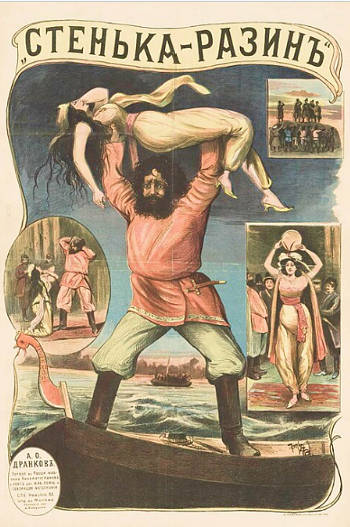
Stepan Razin (c. 1630–1671) led a major rebellion along the Volga. His forces captured important towns, including Astrakhan, and attracted people whose grievances extended beyond the original Cossack following. Their advance brought attacks on officials and property holders, while the government's response culminated in a serious rebel defeat at Simbirsk in the autumn. The uprising exposes tensions within a state attempting to consolidate authority over a socially and geographically varied population. Razin survived the defeat, and the rebellion's suppression continued into the following year. |
| DAILY LIFE |
DAILY LIFE (1670)
Ray's A Collection of English Proverbs also appeared in 1670, preserving sayings drawn from ordinary speech alongside regional expressions and proverbial verse. Such material offers access to the judgments people repeated about money, marriage, work, food, neighbors, and good fortune. Proverbs compressed experience into memorable forms, making them useful in conversation, instruction, and dispute. Their survival in print should not make them transparent statements of universal belief: sayings could contradict one another, and their meaning depended on who used them and in what circumstances. The collection nevertheless records a part of everyday verbal culture that formal political and religious documents often leave out. |
| SIGNIFICANT BIRTHS |
SIGNIFICANT BIRTHS (1670)
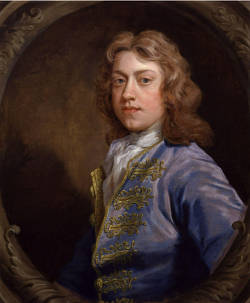
Bernard Mandeville Bernard Mandeville (1670–1733): Dutch-born physician and writer whose later Fable of the Bees would challenge conventional accounts of the relationship between private conduct and public prosperity. His career eventually connected Dutch education with English intellectual and commercial life. Maria Margaretha Winkelmann, later Kirch (1670–1720): Astronomer whose observations and calculations contributed to the production of calendars and other astronomical work. Her later career reveals both the importance of family collaboration and the barriers confronting women seeking formal scientific appointments. William Congreve (1670–1729): Playwright whose later comedies would examine courtship, property, reputation, and verbal sophistication in fashionable society. His work continued the commercial theatrical culture taking shape during these Restoration decades. Antonio Caldara (c. 1670–1736): Composer whose birth is generally placed around this year. His later career encompassed opera, oratorio, and sacred music, connecting Italian musical training with employment at several European courts. |
| NATURAL EVENTS |
NATURAL EVENTS (1670)
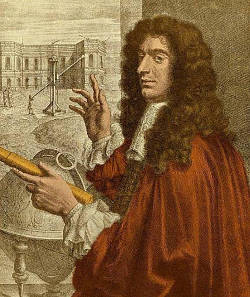
Anonymous A new star appeared in 1670 near the region then described as below the head of Cygnus. Among those who recorded it were Johannes Hevelius (1611–1687) and Giovanni Domenico Cassini (1625–1712). Visible without a telescope, the object changed in brightness and would disappear and reappear during the following years. Its behavior supplied observers with an event that could be recorded more confidently than explained. The positions and brightness estimates preserved in their accounts eventually became evidence for identifying the faint remnant. The object is now known as CK Vulpeculae. Modern research interprets the historical outburst as the aftermath of a stellar merger rather than an ordinary nova. That explanation belongs to later astronomy, drawing on observations unavailable to seventeenth-century witnesses. The event illustrates the continuing value of a carefully maintained observational record: measurements made under one system of understanding can remain useful when the physical explanation changes. |
1671: Vermeer's Age, 39
| 1671 | late-career maturity, economic Security, but structurally dependent |
|---|---|
| VERMEER'S LIFE & ART |
VERMEER'S LIFE & ART (1671)
In 1671 Vermeer again served as a hoofdman, or headman, of Delft's Guild of Saint Luke, having also held the office in 1662, 1663, and 1670. The appointment is one of the few firmly documented facts concerning his professional standing in these late years. Guild headmen participated in the administration of the organization that regulated painters, art dealers, faience makers, glassworkers, and other artistic trades. Vermeer's repeated election therefore provides concrete evidence that he continued to command respect within Delft's professional community.
Johannes Vermeer Several paintings now generally assigned to c. 1670–1672 belong to this same moment. Lady Writing a Letter with Her Maid, dated around 1670 by the National Gallery of Ireland and around 1670–1672 in other recent catalogues, is among Vermeer's most ambitious late interiors. A mistress writes rapidly while her maid waits at the window; sealing wax, a seal, and what may be a letter-writing manual lie on the floor. The unusually large composition combines the familiar subject of private correspondence with a more forceful spatial structure and stronger contrasts of light and dark than are found in many paintings of the preceding decade. At approximately the same time Vermeer painted Lady Standing at a Virginal and Lady Seated at a Virginal, both generally dated c. 1670–1672. The National Gallery has suggested that they may have been conceived in relation to one another. The standing woman is accompanied by an image of Cupid associated with faithful love, while the seated figure appears beneath a painting with more explicitly erotic associations. Musical performance, courtship, domestic refinement, and the interpretation of pictures within pictures are thus compressed into two exceptionally controlled interiors. 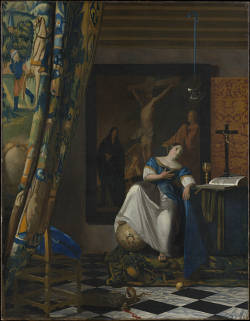
Johannes Vermeer 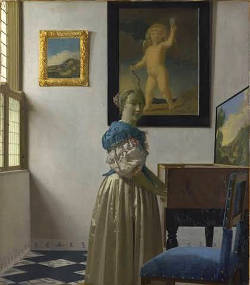
Johannes Vermeer 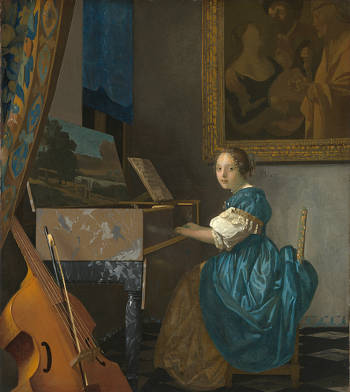
Johannes Vermeer The still more unusual Allegory of Faith, also dated c. 1670–1672, belongs to this late cluster. Here Vermeer moved away from apparently ordinary domestic life toward an explicitly religious allegory. A female personification of Faith places her foot upon a globe; a crucifix, chalice, missal, glass sphere, serpent, and cornerstone form part of a carefully constructed Catholic symbolic program. The Metropolitan Museum connects the painting with the circumstances of Catholic worship in the Dutch Republic, where the Mass could be celebrated in private or semi-private hidden churches but not as the dominant public religion. Thus 1671 finds Vermeer neither isolated nor professionally insignificant. He was helping administer his guild while producing some of the most intellectually elaborate paintings of his career. Yet the year also stands immediately before the crisis of 1672, when war and economic contraction damaged the Dutch art market and, according to later testimony from his family, severely affected his business as a dealer. In retrospect, 1671 can therefore be seen as the last full year before the economic circumstances of his household changed sharply. |
| DELFT |
DELFT (1671)
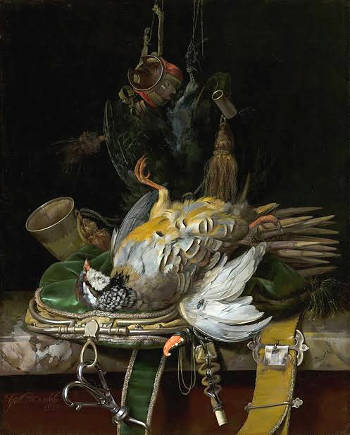
Willem van Aelst The Delft-born still-life specialist Willem van Aelst (1627–after 1683) signed and dated his magnificent Still Life with Partridges in 1671. By then Van Aelst was established in Amsterdam and had developed a particularly refined type of hunting still life in which dead game, velvet, stone, metal, feathers, and hunting equipment become exercises in texture, color, and controlled illumination. His career provides a useful reminder that Delft painters did not necessarily remain in Delft: the city fed artists into the wider Dutch market, particularly Amsterdam. Another side of Dutch painting can be seen in Jacob van der Ulft (1621–1689), whose Army Advancing among Roman Ruins is signed and dated 1671. Van der Ulft apparently never traveled to Italy; his Italianate architecture was probably assembled from prints and other visual sources. The painting demonstrates how thoroughly imagined Italy had become part of Dutch visual culture. Classical ruins, warm southern light, military processions, and distant landscapes could be constructed convincingly in a northern studio without direct experience of Rome. The coexistence of Steen's comic households, Van Aelst's luxurious dead game, Van der Ulft's imaginary antiquity, De Hooghe's political-civic allegory, and Vermeer's quiet but highly constructed interiors gives a better sense of Dutch art in 1671 than any single stylistic label. Realism remained important, but Dutch artists were equally capable of fantasy, allegory, classicism, theatricality, satire, and carefully calculated illusion. |
| DUTCH ART |
DUTCH ART (1671)
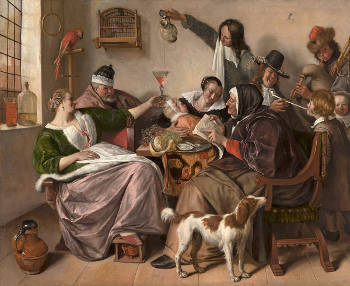
Jan Steen Dutch painting in 1671 remained extraordinarily diverse. Jan Steen (1626–1679) had returned to Leiden in 1670 after years in Haarlem and elsewhere, and in 1671 became a headman of the Leiden Guild of Saint Luke, an office he held for two years. His professional standing is worth remembering because the apparent disorder and comic misbehavior of his paintings can obscure the fact that Steen was deeply integrated into the institutional world of Dutch painting. His crowded interiors, inns, family scenes, schoolrooms, and celebrations continued the comic and moralizing branch of genre painting at the same moment that Vermeer was taking the domestic interior in a very different direction. The Delft-born still-life specialist Willem van Aelst (1627–after 1683) signed and dated his magnificent Still Life with Partridges in 1671. By then Van Aelst was established in Amsterdam and had developed a particularly refined type of hunting still life in which dead game, velvet, stone, metal, feathers, and hunting equipment become exercises in texture, color, and controlled illumination. His career provides a useful reminder that Delft painters did not necessarily remain in Delft: the city fed artists into the wider Dutch market, particularly Amsterdam. 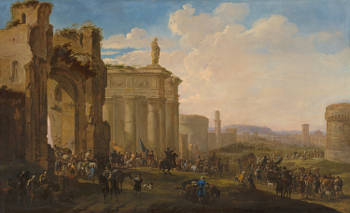
Jacob van der Ulft Another side of Dutch painting can be seen in Jacob van der Ulft (1621–1689), whose Army Advancing among Roman Ruins is signed and dated 1671. Van der Ulft apparently never traveled to Italy; his Italianate architecture was probably assembled from prints and other visual sources. The painting demonstrates how thoroughly imagined Italy had become part of Dutch visual culture. Classical ruins, warm southern light, military processions, and distant landscapes could be constructed convincingly in a northern studio without direct experience of Rome. 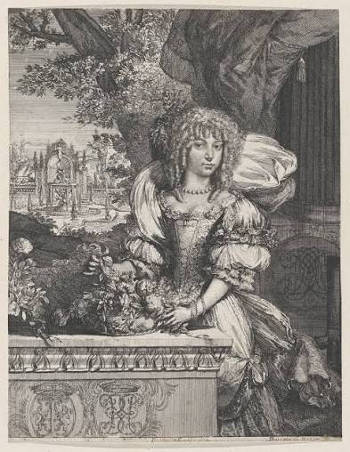
Romeyn de Hooghe Printmaking was equally important. Romeyn de Hooghe (1645–1708) produced elaborate illustrations for De Ystroom, the 1671 poem by Joannes Antonides van der Goes (1647–1684) celebrating Amsterdam and the IJ. De Hooghe filled these prints with river gods, Mercury, Neptune, personifications of navigation, fortification, dredging, the continents, and Amsterdam itself. The imagery joins commerce, engineering, maritime power, mythology, and civic pride into a single visual language. It is a useful corrective to any chronology that treats Dutch art exclusively as easel painting. |
| DUTCH REPUBLIC |
DUTCH REPUBLIC (1671)
Politically, 1671 was a year of mounting pressure rather than open war. Relations with France deteriorated sharply as commercial rivalry became entangled with diplomatic hostility. Early in the year the government of Louis XIV (1638–1715) imposed measures directed against Dutch commerce, including restrictions on Dutch involvement in the French brandy trade and duties affecting Dutch herring. The States General answered with restrictions of its own. On November 2, 1671, the Republic prohibited the importation of several French products, including wine, vinegar, canvas, paper, and chestnuts. These measures mattered because France and the Republic were important commercial partners as well as competitors. Dutch merchants carried French wine and brandy northward; French consumers purchased Dutch fish, colonial commodities, and manufactured goods. Restrictions therefore affected merchants, shipping, printers, shopkeepers, craftsmen, and consumers rather than remaining an affair of diplomats. Dutch envoy Pieter de Groot reported from France in November that the tariff dispute was producing serious anger at the French court. The military conflict that followed belonged to 1672, but the economic confrontation was plainly visible in 1671. 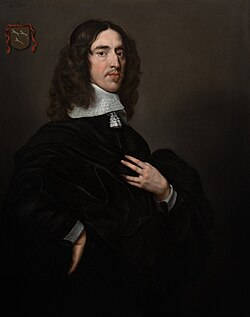
Johan de Witt, Grand Pensionary of Holland At the center of Dutch government stood Johan de Witt (1625–1672), Grand Pensionary of Holland. On July 30, 1671, he presented to the States of Holland his memorandum Waerdye van Lijfrenten naer Proportie van Losrenten, concerning the valuation of life annuities in relation to redeemable state bonds. De Witt applied mathematical reasoning to the price that the state should charge for a lifetime income, drawing upon emerging ideas about probability and mortality. It is an extraordinary intersection of mathematics and government finance: abstract numerical reasoning was being applied directly to the Republic's need to borrow money. A second political issue concerned the position of the young William III (1650–1702). The Republic had been without a stadholder in Holland since 1650, and debate continued over whether William should be given high military office. In 1671 pressure for his appointment as captain-general grew as relations with France worsened. The dispute reflected a deeper constitutional tension between supporters of the existing regent government and those who wanted the prince restored to a major military and political role. The issue remained unresolved through much of 1671 but would become decisive during the crisis of the following year. For Delft, all of this was close rather than distant politics. Delft possessed a vote in the States of Holland; its regent families participated in provincial government; its merchants and craftsmen were exposed to changes in trade; and Vermeer himself dealt in paintings at precisely the moment when international uncertainty was beginning to threaten discretionary spending. |
| EUROPEAN PAINTING & SCULPTURE |
EUROPEAN PAINTING & SCULPTURE (1671)
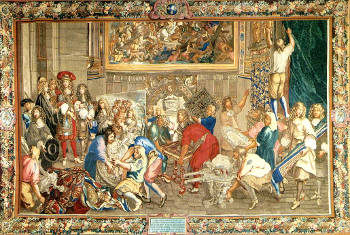
Charles Le Brun In France, artistic production was increasingly tied to the court of Louis XIV. Charles Le Brun (1619–1690) supervised vast decorative programs involving painting, sculpture, tapestry, architecture, and ornamental design. Designs associated with the History of the King tapestry series were being developed during these years, turning recent royal events into an official visual history. Such projects differed fundamentally from the relatively decentralized Dutch art market: large French commissions could mobilize teams of artists and craftsmen under court supervision. The contrast with Vermeer is striking. A Delft painter might work slowly on a small canvas destined for a private collector; the French court could organize paintings, tapestries, sculpture, gardens, architecture, costumes, and ceremonies around a coordinated image of monarchy. Both systems could produce extraordinarily sophisticated art, but the economic and institutional conditions were very different. 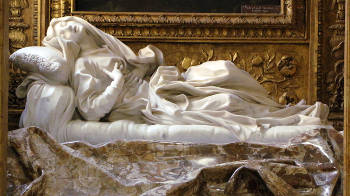
Gian Lorenzo Bernini In Rome, Gian Lorenzo Bernini (1598–1680) remained active in his seventies. His late sculptural project for the funerary chapel of Ludovica Albertoni (1473–1533) was initiated around 1671–1672. The reclining figure, eventually installed in San Francesco a Ripa, fuses sculpture, architecture, concealed illumination, colored marble, and religious theater. At nearly the same moment, Rome's Ponte Sant'Angelo displayed the series of monumental angels designed under Bernini's direction; a print published in 1671 recorded the bridge transformed into a processional approach toward St. Peter's. The effect was very different from Dutch church interiors: Catholic Rome sought emotional and spatial drama on a monumental scale. 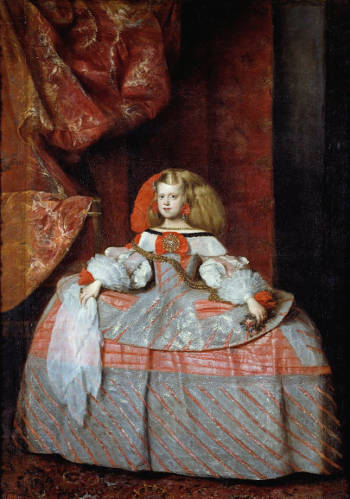
Diego Velázquez Spanish art was passing through a different transition. Sebastián de Herrera Barnuevo (1619–1671), active as painter, sculptor, and architect in Madrid, died in 1671. The generation following Diego Velázquez (1599–1660) continued to work within court and ecclesiastical systems in which portraiture, religious painting, ephemeral decoration, sculpture, and architecture frequently overlapped. Thus European art around 1671 cannot be reduced to a simple opposition between Dutch naturalism and Italian Baroque: courtly, religious, commercial, classical, theatrical, and observational traditions existed side by side. |
| ARCHITECTURE |
ARCHITECTURE (1671)
Amsterdam offers some of the most concrete architectural events of 1671. Construction began that year on both major Ashkenazi and Portuguese Jewish synagogues. The Portuguese synagogue, or Esnoga, was built between 1671 and 1675 to designs by city architect Elias Bouman (1636–1686). Amsterdam permitted Jewish congregations to erect large and conspicuous houses of worship—an exceptional degree of public visibility compared with many European cities—although Jewish residents still did not possess complete civic equality. 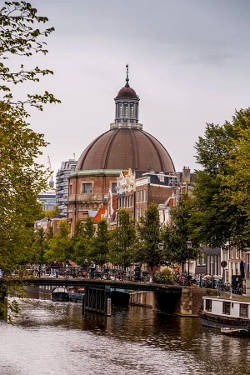
Adriaan Dortsman The Ronde Lutherse Kerk was completed in Amsterdam in 1671 under Adriaan Dortsman (1635–1682). Its circular ground plan and dome offered a distinctly classicizing solution to Protestant worship. Because towers were associated with the public privileges of the Reformed Church, the Lutheran building used a dome rather than a conventional church tower. Its restrained classical vocabulary—pilasters, regular windows, geometric organization—belongs to the mature Dutch classicism of the later seventeenth century. France was meanwhile giving architecture a new institutional framework. On December 30, 1671, the Académie royale d'architecture was established under the influence of Jean-Baptiste Colbert (1619–1683) and François Blondel (1618–1686). Architecture could now be discussed, taught, and judged within a royal academic institution comparable to those already established for painting, sculpture, and science. Questions of proportion, classical precedent, building practice, and public architecture were increasingly treated as matters of systematic theory as well as craft. The same year saw the formal beginning of the new town of Versailles. An ordinance signed by Louis XIV on May 22, 1671 offered building plots to people willing to construct houses according to prescribed conditions of symmetry. Versailles was therefore becoming not merely a palace surrounded by gardens but an organized urban environment capable of housing and servicing a growing court. The convergence of avenues upon the château made political hierarchy visible in urban form. Seen beside Delft, these developments are revealing. Delft remained a compact canal city largely defined by medieval streets, churches, guild buildings, breweries, pottery works, and seventeenth-century houses. Amsterdam and Versailles, by contrast, were producing large architectural statements that made expanding religious communities, commercial wealth, and centralized monarchy physically visible. |
| MUSIC |
MUSIC (1671)
Fontispiece The Amorous Fantasmn One of the major musical-theatrical events of 1671 occurred in Paris. On January 17, Psyché was first performed at the Tuileries. The five-act tragédie-ballet brought together Molière (1622–1673), Pierre Corneille (1606–1684), Philippe Quinault (1635–1688), and composer Jean-Baptiste Lully (1632–1687). It combined spoken drama, sung passages, instrumental music, dancing, stage machinery, costume, and spectacle. The work illustrates the increasingly close alliance of theater and music at the French court immediately before Lully established his dominance over French opera in the 1670s. The contrast with music in Dutch homes is useful. The Republic did not possess a court culture comparable in scale to Versailles, but music flourished in churches, civic institutions, taverns, theaters, and private households. Prosperous families bought lutes, viols, recorders, citterns, virginals, and harpsichords, while professional musicians supplied lessons to amateurs. The domestic musical environment represented in Dutch genre painting therefore had a genuine social basis even though individual paintings should not be read as literal documentary records. This context makes Vermeer's late virginal paintings particularly appropriate to the years around 1671. Music could signal cultivation and leisure, but in contemporary imagery it was also repeatedly connected with courtship: harmony between instruments could suggest harmony between lovers, while musical instruction provided a socially acceptable setting for interaction between men and women. The National Gallery explicitly notes that seventeenth-century Dutch musical scenes could range from decorous to openly erotic associations. The musical world of Amsterdam was also drawing musicians from abroad. Members of the Hacquart family from the Southern Netherlands established themselves there around this period, teaching instruments and participating in the city's amateur musical culture. This northern tradition of relatively intimate chamber and domestic music existed simultaneously with the immense multimedia entertainments being staged for Louis XIV. |
| LITERATURE |
LITERATURE (1671)
Dutch literature had an unusually rich year in 1671. Joost van den Vondel (1587–1679) published his Dutch translation of Ovid's Metamorphoses as Ovidius' Herscheppinge. Vondel was already in his eighties, yet remained deeply engaged with classical literature. His translation brought one of antiquity's great reservoirs of mythological subject matter into Dutch verse and reminds us how familiar educated seventeenth-century readers could be with the classical narratives that also appeared constantly in painting, prints, sculpture, and decorative art. 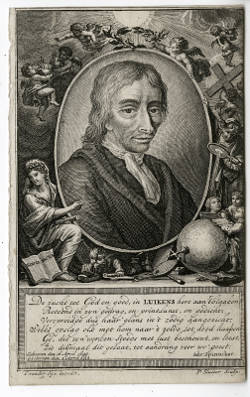
P. Sluiter after an anonymous artist The young Jan Luyken (1649–1712) published Duytse Lier in 1671. The volume belongs to a very different literary world: youthful lyric poetry centered heavily on love and desire. It appeared around the middle of the year and was dedicated to Antonides van der Goes. Luyken would later become famous for religious writings and for the extraordinarily extensive body of engravings associated with his publications, but Duytse Lier represents the secular literary culture of his youth. Antonides himself published De Ystroom in 1671, celebrating Amsterdam through the IJ, the waterway that connected the city with maritime trade. Its imagery ranged across shipping, commerce, geography, engineering, mythology, and civic history. Romeyn de Hooghe's accompanying prints populated this modern commercial environment with classical river gods and allegorical figures. The result joins contemporary Amsterdam to ancient literary traditions without treating antiquity as something remote from modern urban life. French theater was equally active. Molière's Les Fourberies de Scapin appeared in 1671 alongside the much larger court spectacle Psyché. The coexistence of farce, spoken comedy, dance, music, and lavish court entertainment illustrates how fluid theatrical genres remained. Authors could work for public theaters, court audiences, printers, and royal festivities rather than within a single literary format. This literary activity also reminds us how dense the Dutch book world had become. Amsterdam and Leiden printers supplied domestic and international markets with poetry, theology, maps, scientific works, political pamphlets, travel accounts, classical texts, and technical manuals. Paper, engraving, type, bookselling, and shipping all belonged to the same material economy. That point becomes especially important in 1671 because restrictions on French paper threatened one of the basic raw materials of this highly developed print culture. |
| SCIENCE, MATHEMATICS, & PHILOSOPHY |
SCIENCE, MATHEMATICS, & PHILOSOPHY (1671)
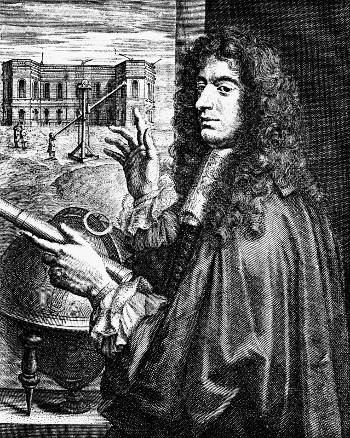
L. Coquin On October 25, 1671, Giovanni Domenico Cassini (1625–1712) discovered Iapetus, one of Saturn's moons. Cassini noticed that the object varied dramatically in visibility as it moved around Saturn, eventually reasoning that different sides of the satellite possessed very different brightness. Modern spacecraft observations have confirmed the extraordinary contrast between its dark leading hemisphere and much brighter trailing hemisphere. In England, Isaac Newton (1642–1727) constructed an improved reflecting telescope in 1671 and demonstrated it to the Royal Society. Rather than relying solely on lenses, Newton's design used a curved mirror to gather and focus light, helping to avoid some of the chromatic problems that afflicted long refracting telescopes. The surviving instrument consists of compact tubes of card and paper with metal optical components and illustrates how major advances in natural philosophy were inseparable from practical instrument making. In the Dutch Republic, Nicolaes Witsen (1641–1717) published Aeloude en Hedendaegsche Scheeps-bouw en Bestier in 1671, the first printed Dutch work devoted extensively to shipbuilding. Witsen attempted to record terminology, proportions, construction methods, tools, ship types, and working practices that had previously circulated largely through shipyards and oral craft traditions. In a maritime republic whose prosperity depended upon merchantmen, fishing vessels, naval ships, and East Indiamen, this conversion of practical shipyard knowledge into a large printed treatise was highly significant. Johan de Witt's work on life annuities belongs here as well as under politics. His 1671 memorandum brought mathematical probability into direct contact with public finance. Rather than assigning the price of a life annuity largely by convention, De Witt attempted to calculate what it should cost according to the probable duration of the recipient's life. His correspondence with mathematician Johannes Hudde (1628–1704) shows the close relationship among mathematics, mortality statistics, government borrowing, and administrative practice. In Delft itself Antonie van Leeuwenhoek (1632–1723) was already a municipal official, cloth merchant, and increasingly skilled maker of tiny lenses, although his celebrated correspondence with the Royal Society would begin only in 1673. It is worth preserving that chronology. In 1671 he was not yet internationally famous as a microscopist; he was a Delft citizen developing the observational and technical abilities that would soon make previously invisible forms of life accessible to sustained investigation. Taken together, Cassini's telescope observations, Newton's instrument, Witsen's shipbuilding manual, De Witt's mathematical finance, and Van Leeuwenhoek's developing lens craft show how broadly seventeenth-century knowledge was spreading. Astronomy, mathematics, state finance, navigation, ship construction, optics, and artisanal technique were increasingly interconnected rather than sealed into modern academic disciplines. |
| WORLD HISTORY & POLITICS |
WORLD HISTORY & POLITICS (1671)
Frederick Hendrik van Hove Far beyond the Dutch Republic, European colonial competition continued to reshape the Atlantic. In January 1671, the Welsh privateer Henry Morgan (c. 1635–1688) led a large force across the Isthmus of Panama and attacked Panama City, one of Spain's most important Pacific possessions in the Americas. The city was captured, looted, and largely destroyed by fire. Morgan's expedition illustrates the blurred boundary between piracy and state-sponsored privateering in the seventeenth-century Caribbean, where English, French, Dutch, and Spanish interests competed over shipping routes, ports, silver, enslaved labor, and colonial territory. Contemporary and near-contemporary accounts of Morgan's campaigns circulated widely in Europe. In Russia, the great uprising associated with Stenka Razin (c. 1630–1671) reached its end. Razin had led Cossacks, peasants, townspeople, and members of several ethnic communities through the Volga region in a rebellion directed against officials, landowners, and expanding Muscovite control. After military defeats in late 1670, he was captured in 1671 and taken to Moscow, where he was executed. The revolt exposed profound tensions produced by serfdom, taxation, frontier society, and the centralization of the Russian state. Central Europe also experienced political repression after the collapse of the Hungarian-Croatian magnate conspiracy against Habsburg rule. Petar Zrinski (1621–1671) and Fran Krsto Frankopan (1643–1671) were executed at Wiener Neustadt on April 30, 1671, and their estates were confiscated. The episode formed part of a wider struggle over noble privilege, religious policy, Ottoman pressure, and the authority of the Habsburg monarchy in Hungary and Croatia. Meanwhile France was moving toward confrontation with the Dutch Republic. The commercial restrictions and diplomatic disputes of 1671 formed part of the background to the French invasion of 1672. It is important, however, to preserve the chronology: the Republic and France were not yet at war in 1671. For a Delft citizen, the year could still appear outwardly prosperous and orderly even while diplomats, merchants, military planners, and governments were preparing for increasingly serious conflict. |
| DAILY LIFE |
DAILY LIFE (1671)
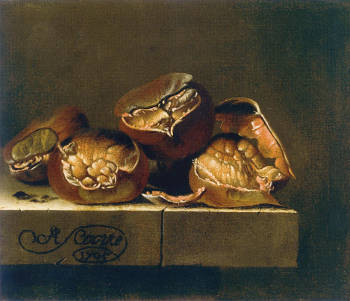
Adriaen Coorte For ordinary inhabitants of the Republic, international politics could enter daily life through surprisingly mundane objects. The Dutch prohibition of French wine, vinegar, canvas, paper, and chestnuts in November 1671 meant that diplomatic conflict could affect what appeared in shops, kitchens, warehouses, bookshops, and workshops. Paper was particularly important. Dutch printers depended substantially upon imported French paper, and restrictions therefore threatened publishers, compositors, pressmen, engravers, booksellers, writers, and the families dependent upon those trades. The example is useful because the Dutch Golden Age was not simply a society filled with locally manufactured goods. Everyday urban life depended upon complicated chains of supply. A household might consume French wine, Baltic grain, Spanish salt, Asian spices, Scandinavian timber, German metalware, locally brewed beer, Delft pottery, imported silk, and paper manufactured hundreds of kilometers away. The Republic's prosperity rested upon its ability to move such commodities cheaply and reliably. In more prosperous households, music formed part of domestic leisure. A virginal or harpsichord was expensive enough to indicate comfortable circumstances, but musical instruments were familiar objects in elite and upper-middle-class interiors. Lessons, duet playing, singing, and informal musical gatherings offered entertainment at home and opportunities for sociability. Vermeer's women at virginals therefore belong to a recognizable material environment, even if his immaculate rooms are carefully composed pictorial spaces rather than neutral records of actual Delft households. Letter writing likewise occupied a growing place in everyday urban life. Merchants, officials, relatives, lovers, scholars, and travelers depended upon correspondence. Pens, ink, paper, sealing wax, seals, and letter-writing manuals formed part of this culture. The scattered implements in Vermeer's Woman Writing a Letter, with Her Maid make visible a routine technology of communication that linked private emotion with an increasingly efficient postal and commercial world. |
| SIGNIFICANT BIRTHS |
SIGNIFICANT BIRTHS (1671)
Tomaso Albinoni (1671–1751) was born in 1671. He would become an important Venetian composer of operas, sonatas, sinfonias, and concertos, particularly associated with instrumental writing for strings and oboe. His later career belongs to the generation in which the Italian concerto became one of the most influential musical forms in Europe. Anthony Ashley-Cooper, 3rd Earl of Shaftesbury (1671–1713) was also born in 1671. His later philosophical writings addressed ethics, aesthetics, religion, sociability, and the idea of a human moral sense. His arguments concerning disinterested judgment and the relationship between moral and aesthetic perception would exercise considerable influence on eighteenth-century British and European thought. The Scottish financier John Law (1671–1729) was born the same year. His later experiments with banking, paper currency, public credit, and the Mississippi Company in France would make him one of the most controversial figures in the early history of modern finance. His career is especially interesting when placed beside Johan de Witt's mathematical treatment of public annuities in the very year of Law's birth: across Europe, money and credit were becoming increasingly sophisticated subjects of both theory and government policy. The Italian mathematician Guido Grandi (1671–1742) was another child of this year. He later worked on geometry, infinite series, hydraulics, and the dissemination in Italy of the mathematical methods associated with Newton and Gottfried Wilhelm Leibniz (1646–1716). He eventually became professor of mathematics at Pisa and a member of the Royal Society. Thus a single birth year links figures who would contribute to Baroque music, moral philosophy, banking and public credit, and infinitesimal mathematics—fields whose development would become characteristic of the early eighteenth century. |
| NATURAL EVENTS |
NATURAL EVENTS (1671)
On June 20, 1671, a substantial earthquake struck the Modena–Reggio Emilia region of northern Italy. Modern historical-seismological reconstruction assigns it an estimated magnitude of about 5.3 and an intensity of VII. Buildings were seriously damaged in Modena and Reggio Emilia; in Modena part of the town hall complex and its clock tower were damaged, and municipal authorities met that same day to organize emergency measures and clearance of debris. The shock was felt as far as Bologna and Verona. A very different natural phenomenon was recorded at Gdańsk on April 13, 1671. A correspondent of astronomer Johannes Hevelius (1611–1687) observed a brilliant fiery meteor. Hevelius forwarded a description and drawing to Henry Oldenburg (c. 1619–1677) of the Royal Society. The surviving document is valuable not simply because a meteor was seen, but because it demonstrates the developing international network through which fleeting natural phenomena could be observed locally, drawn, described in writing, transmitted abroad, and preserved for comparison with other observations. Across the Atlantic, the long eruptive sequence of San Salvador volcano was still active. The Smithsonian's Global Volcanism Program dates a confirmed eruptive episode from 1658 into August 1671, with volcanic seismicity and property damage recorded on August 16 and further ash-producing activity during the month. It provides a reminder that while European observers were beginning to record earthquakes, meteors, comets, eclipses, and eruptions with increasing systematic care, communities elsewhere were experiencing these phenomena directly as destructive events. Seen as a whole, 1671 is a remarkably rich year for the chronology. Vermeer was still a respected guild officer and was producing major late works; Dutch painting and printmaking remained extremely active; Amsterdam was erecting important new religious buildings; Dutch literature produced works by Vondel, Luyken, and Antonides; Witsen published his great shipbuilding treatise; De Witt applied mathematics to public finance; Newton demonstrated his reflecting telescope; Cassini discovered Iapetus; and Parisian court culture brought drama, ballet, poetry, music, and stage machinery together in Psyché. Yet commercial retaliation with France and mounting political tensions were already pointing toward the upheaval of 1672. The contrast between the apparent confidence of 1671 and what followed makes the year especially useful in Vermeer's chronology. |
1672: Vermeer's Age, 40
| 1672 | late-career maturity, economic deterioration & Rampjaar |
|---|---|
| VERMEER'S LIFE & ART |
VERMEER'S LIFE & ART (1672)
For Vermeer, 1672 marks the beginning of the final and financially troubled phase of his life. On January 14 he leased Mechelen, the inn on Delft's Markt that had belonged to his family, to an apothecary for six years. Whatever income the property produced, the arrangement suggests that Vermeer was treating the building as an asset rather than personally operating the inn. 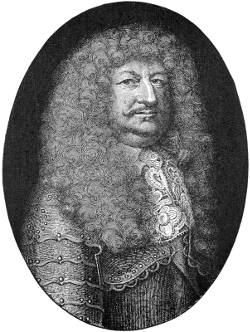
Anonymous
Johannes Vermeer More revealing of his professional reputation was an episode in May 1672, when Vermeer traveled to The Hague with the Delft painter Johannes Jordaens (c. 1616–1680) to give an expert judgment in a dispute involving a group of paintings represented as works by Italian masters. The Amsterdam dealer Gerrit van Uylenburgh had attempted to sell the pictures to Frederick William, Elector of Brandenburg (1620–1688). Vermeer and Jordaens rejected their supposed quality and authorship in unusually strong terms. The surviving documentation shows that Vermeer was regarded not simply as a painter but as a connoisseur whose judgment was respected outside Delft. Then came the Rampjaar. The French invasion, war with England, widespread commercial disruption, and collapse of confidence severely damaged the Dutch market for luxury goods, including paintings. The Rijksmuseum summarizes the effect on Vermeer directly: with the deterioration of the economy in 1672, he could no longer readily sell paintings. The National Gallery of Art likewise connects the heavy debts that burdened him at his death with the economic difficulties of the early 1670s and the decline of his art-dealing business. 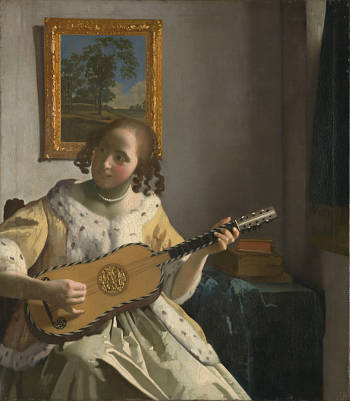
Johannes Vermeer
Johannes Vermeer
Johannes Vermeer
Johannes Vermeer This does not mean that Vermeer necessarily stopped painting in 1672. Several late works are assigned to approximately 1670–1674, although their exact sequence remains disputed: The Guitar Player, Lady Standing at a Virginal, Lady Seated at a Virginal, and Allegory of Faith. The increasingly stylized forms, sharply defined highlights, simplified folds, and cooler, more abstract treatment of space distinguish these pictures from many works of the 1660s. Their dating, however, should remain approximate rather than being forced into 1672 itself. The contrast is striking. In spring 1672 Vermeer was sufficiently respected to be summoned to The Hague as an expert on Italian painting; within months the economic system in which he sold paintings and dealt in works by other artists was being badly disrupted. |
| DELFT |
DELFT (1672)
Anonymous The Rampjaar reached Delft directly before the French armies came anywhere near the city. On April 9, 1672, Delft dispatched troops to assist in the defense of the Republic. As the French advance accelerated during June, political anxiety inside Delft increased sharply. The military crisis was accompanied by rumors of treason, hostility toward the existing regent governments, and growing popular support for William III (1650–1702). By the end of June the political conflict had moved into Delft's streets and town hall. On June 29, groups of protesters entered the city and occupied the town hall. Contemporary and later accounts associate the disturbances with people coming from nearby Maasland, Maassluis, and Schiedam, together with supporters inside Delft. The magistrates were pressured to renounce the Perpetual Edict of 1667, which had sought to separate the stadholderate from the office of captain-general, and to accept William III as stadholder. Delft was therefore one of the Holland towns in which popular pressure helped overturn the political arrangements of the First Stadtholderless Period. 
Anonhymous This cartoon was probably completed in the period following the visit of François, Duke of Anjou (brother of King Henry III of France) to Queen Elizabeth's court in 1581–82 to discuss his marriage proposal and his military support for the Anglo-Dutch alliance against the Spanish. Anjou's subsequent mission to the Netherlands met with disaster when his army was massacred by the citizens of Antwerp in early 1583. The cartoon depicts a cow which represents the Dutch provinces: King Philip II of Spain is vainly trying to ride the cow; Queen Elizabeth is feeding it; William of Orange is milking it; and the cow is defecating on the hand of the Duke of Anjou, who is holding its tail. The atmosphere remained extremely tense through the summer. A surviving letter written on August 22, 1672 describes serious disorder in Delft only days earlier. Rumors circulated that weapons discovered near a city gate were evidence of treason. A crowd attacked a house near the VOC premises, while four companies of Delft's civic militia were hurriedly called to arms to prevent looting. Stones were thrown, firearms were discharged, and several people were wounded or killed. The episode shows how national political fears could turn very quickly into neighborhood violence within Delft itself. The political reconstruction of the city followed in September. On September 10, 1672, William III intervened in Delft's municipal government and replaced approximately half of the forty-member Veertigraad with men considered supportive of the new stadholderian regime. Among those entering the council was the physician Cornelis 's Gravesande (1631–1691). The surviving Delft archives contain letters from William III, resolutions concerning this wetsverzetting, and lists of the regents dismissed in 1672. The change was therefore not simply a national shift in political leadership: it substantially altered the group of families governing Delft itself. 
Dirck van Bleyswyck Dirck van Bleyswijck (1639–1681), author of the important Beschryvinge der stad Delft of 1667, also advanced within municipal government during this period. He had entered the Veertigraad in 1671 and became a schepen in 1672. Thus the man responsible for one of the fullest seventeenth-century descriptions of Delft was simultaneously becoming involved in the administration of the city during its most unsettled political year. The crisis also affected ordinary movement and commerce, although economic life did not simply stop. The Delft–Maassluis trekschuit service had an exceptionally difficult beginning to the year: severe winter conditions prevented navigation until April. Remarkably, however, the service still finished 1672 with receipts exceeding expenses by about 745 guilders. The figure is a useful warning against imagining the Rampjaar as complete economic paralysis. Even amid invasion, political upheaval, refugees, troop movements, and commercial uncertainty, people and goods continued to circulate through Delft and its surrounding waterways. For Delft, then, 1672 was simultaneously a military, political, social, and economic shock. Troops departed the city; protesters challenged its magistrates; the town hall became a focus of political pressure; rumors of treason helped provoke street violence; the civic militia was mobilized; and half of the Veertigraad was replaced. Yet Delft's transport system, workshops, pottery businesses, markets, VOC administration, and everyday urban routines continued functioning. This was the immediate civic environment surrounding Vermeer when the art market on which both his painting and dealing depended began to contract severely. |
| DUTCH ART |
DUTCH ART (1672)
The Rampjaar had immediate consequences for Dutch art. Demand for paintings contracted as households faced taxation, disrupted trade, falling income, military uncertainty, and fears about property. The effect was particularly severe on painters and dealers dependent upon discretionary purchases by prosperous urban families. Vermeer was therefore not an isolated case: 1672 represents a serious interruption in the commercial conditions that had supported the extraordinary expansion of Dutch easel painting during the preceding decades. At the same time, the crisis generated an enormous demand for another kind of art: political prints. Romeyn de Hooghe (1645–1708) produced images responding almost immediately to military and political developments. Allegorical prints represented the Dutch Republic as a sick or threatened maiden, while reversible portrait caricatures transformed the leading political figures into animals. Other sheets reported battles, sieges, atrocities, and political upheavals. The distinction between art, journalism, propaganda, satire, and historical record became unusually porous. 
Attributed to Jan de Baen The murder of Johan de Witt (1625–1672) and Cornelis de Witt (1623–1672) on August 20 likewise became almost immediately a visual subject. Prints showed their arrest, murder, mutilation, and the display of their bodies near the Gevangenpoort in The Hague. The events were therefore being converted into reproducible images while memories of them were still fresh. Another extraordinary case is Willem van de Velde the Elder (1611–1693). During the Battle of Solebay on June 7 he accompanied the Dutch fleet and recorded the fighting from a small vessel, continuing his unusual practice of observing naval warfare at close range. Yet during the winter of 1672 he and his son Willem van de Velde the Younger (1633–1707) left the Republic for England. There they entered the service of Charles II (1630–1685), whose fleet they had recently been depicting as the enemy. The elder Van de Velde received an annual royal salary for drawing naval battles, while his son translated such observations into paintings. 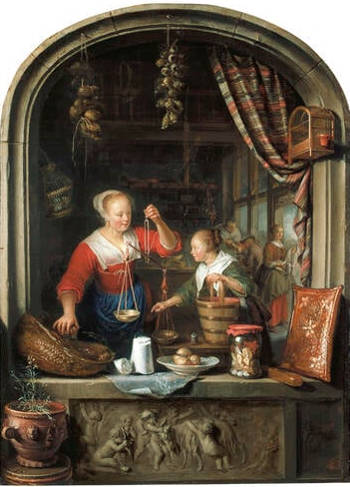
Gerrit Dou 1672 — The Grocer's Shop, Royal Collection. Signed and dated 1672, this late work by Gerrit Dou presents a remarkably well-stocked Dutch shop containing eggs, dairy products, bread, meat, lemons, imported ceramics, sponges, and other goods. The Royal Collection interprets the abundance partly as evidence of the Dutch Republic's far-reaching commercial networks. Dou stages the entire shop behind a fictive stone opening, arranging objects along the ledge so that they seem almost to project into the viewer's space. The result combines documentary richness with deliberate illusionism: an apparently natural glimpse of commerce is, at the same time, an elaborate demonstration of the painter's ability to imitate the visible world. 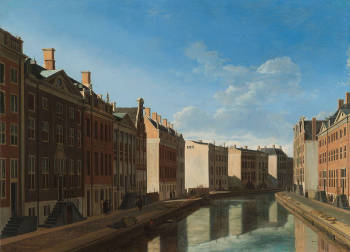
Gerrit Berckheyde Meanwhile Gerrit Berckheyde (1638–1698) signed and dated his magnificent Golden Bend in the Herengracht in 1672. It presents recently constructed mansions on the wealthiest section of Amsterdam's canal ring with measured order and remarkable clarity. The painting is an important counterpoint to the Rampjaar: even as the Republic faced military catastrophe, the immense accumulation of private wealth generated during previous decades remained physically visible in Amsterdam's new houses. Dutch art in 1672 therefore moves in two opposite directions at once: the established traditions of cityscape, genre painting, portraiture, still life, and marine painting continued, but war suddenly produced an immense appetite for news images, political allegory, satire, battle scenes, and visual polemic. |
| DUTCH REPUBLIC |
DUTCH REPUBLIC (1672)
The year became known simply as the Rampjaar—Disaster Year. The Republic was attacked by France, England, the prince-bishopric of Münster, and the electorate of Cologne. In early June a French army numbering roughly 120,000 men advanced rapidly through the eastern provinces. On June 12, forces of Louis XIV (1638–1715) crossed the Rhine near Lobith, an event that French court culture subsequently magnified into one of the celebrated military episodes of the reign. At sea, however, the Republic remained formidable. On June 7, Michiel de Ruyter (1607–1676) attacked the combined Anglo-French fleet at Solebay. The battle was indecisive tactically, but the allied fleet suffered sufficient damage that a projected landing on the Dutch coast could not proceed. The destruction of the English Royal James by Dutch fireships became one of the dramatic episodes of the engagement. 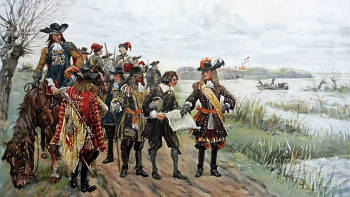
J. Hoynck van Papendrecht On land the situation was far worse. Gelderland, Overijssel, and much of Utrecht were rapidly overrun. With French forces approaching Holland, Dutch authorities resorted to inundation. Dikes and sluices were opened to place a broad belt of low-lying countryside under shallow water, producing the Hollandse Waterlinie. The water was intended to be deep enough to obstruct infantry, cavalry, and artillery but too shallow for ordinary boats. This emergency defense helped prevent the French army from advancing into the economic core of Holland. The military emergency brought a political revolution. William III (1650–1702) had been appointed captain-general early in the year and was made stadholder of Holland and Zeeland during the summer. The First Stadtholderless Period consequently came to an end. Political pressure also fell heavily upon the republican regime associated with Johan de Witt. On August 20, Johan and his brother Cornelis were killed by a crowd outside the Gevangenpoort in The Hague. Their deaths became one of the most notorious episodes of the political violence of 1672. Contemporary prints document both the killings and the subsequent public treatment of their bodies, while the enormous pamphlet literature of the year reveals fierce disagreement over responsibility for the Republic's military collapse. Not all military news was disastrous. The forces of Bernhard von Galen (1606–1678), prince-bishop of Münster, failed to capture Groningen. After weeks of bombardment, the siege was abandoned on August 28. Under Carl von Rabenhaupt (1602–1675) Dutch forces later moved onto the offensive, and Coevorden was recaptured on December 30. Delft itself was drawn directly into the political crisis. Local chronology records the dispatch of troops from the city in April, political unrest during the summer, and a substantial alteration of Delft's governing council in September as the Orangist restoration transformed municipal governments throughout Holland. Dirck van Bleyswijck (1639–1681), author of the great description of Delft, became a schepen in 1672 after entering the Veertigraad the previous year. Thus 1672 was not merely a foreign invasion. It altered the constitution of the Republic, municipal politics, military organization, taxation, trade, the art market, printed public opinion, and the everyday geography of Holland itself. |
| EUROPEAN PAINTING & SCULPTURE |
EUROPEAN PAINTING & SCULPTURE (1672)
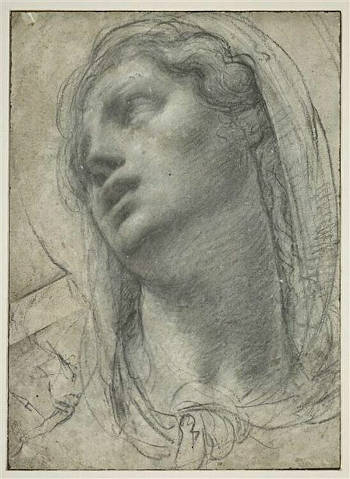
Annibale Carracci In Rome, Giovanni Pietro Bellori (1613–1696) published his Le vite de' pittori, scultori et architetti moderni in 1672. The volume contained biographies of figures including Caravaggio (1571–1610), Peter Paul Rubens (1577–1640), Anthony van Dyck (1599–1641), Nicolas Poussin (1594–1665), Annibale Carracci (1560–1609), and Alessandro Algardi (1598–1654). Bellori did much more than recount artists' lives: he promoted a classicizing theory of art centered upon selection, ideal beauty, and disciplined design. His book became one of the major seventeenth-century texts on artistic theory and biography. Giovanni Pietro Bellori (1613–1696) published Le vite de' pittori, scultori et architetti moderni, in which Carracci occupies a central place in Bellori's account of modern painting. Gian Lorenzo Bernini (1598–1680) was meanwhile working on the funerary chapel of Ludovica Albertoni (1473–1533) in San Francesco a Ripa in Rome. The marble figure dates between roughly 1671 and 1674. Bernini combined sculpture, colored marble, architectural setting, altar, and controlled illumination to present the dying Albertoni in a state poised between physical suffering and religious ecstasy. The work belongs to the sculptor's very late career and demonstrates how completely Roman religious art could integrate image and surrounding space. Carlo Maratta (1625–1713) was emerging as one of the leading painters of late seventeenth-century Rome. A monumental Madonna and Child with Saints is specifically dated 1672. Maratta's work offered an alternative to both Caravaggesque naturalism and the more turbulent forms of Baroque painting: orderly compositions, controlled emotion, idealized figures, and a close study of Raphael became central to his approach. 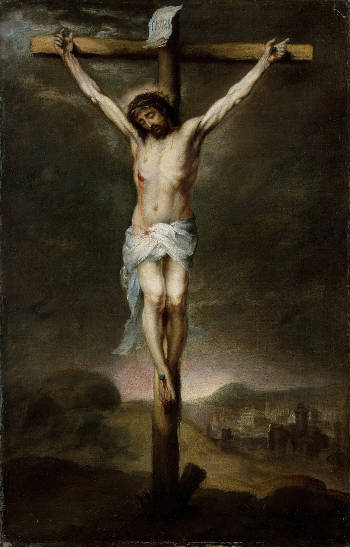
Bartolomé Esteban Murillo In Spain, Bartolomé Esteban Murillo (1617–1682) was completing the great sequence of church commissions that occupied him from the mid-1660s through about 1672. His Crucifixion, dated approximately 1670–1672, belongs to this mature period. Murillo's late works increasingly concentrate attention on a relatively small number of figures set within spacious compositions, with soft transitions of light rather than the harsh contrasts characteristic of earlier Spanish Caravaggism. The Dutch war itself also became material for French court painting. Adam Frans van der Meulen (1632–1690) accompanied the campaigns of Louis XIV and made drawings recording the conquered towns and landscapes. His compositions of the Rhine crossing and French troops before Naarden transformed recent military events into images of royal power. They provide a fascinating visual counterpart to Romeyn de Hooghe's Dutch prints: the same war generated entirely different pictorial narratives on opposite sides of the conflict. |
| ARCHITECTURE |
ARCHITECTURE (1672)
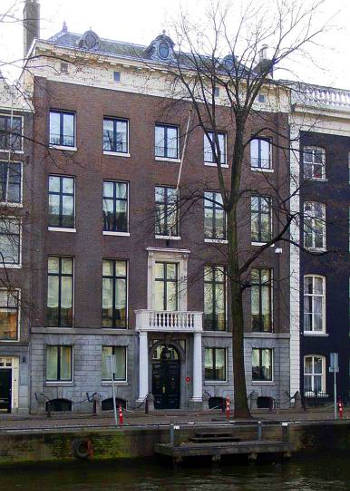
War interrupted one of Amsterdam's most ambitious religious building projects. Construction of the Portuguese Synagogue, designed by Elias Bouman (1635/36–1686), had begun in 1671. Work was interrupted during the opening phase of the Rampjaar and did not resume until May 1674; the building was finally inaugurated in 1675. An inscription preserves 1672, the year in which the congregation had originally expected the building to be completed. The interruption makes the building unusually useful for the chronology. The consequences of war can sometimes seem abstract when expressed through troop numbers and treaties; here they are literally embedded in a construction schedule. Money, labor, building materials, transport, and confidence were all vulnerable when war disrupted the economy. Yet private building did not cease everywhere. Herengracht 502 in Amsterdam, later known as the Huis met de Kolommen, was completed in 1672 for the wealthy merchant Paulus Godin. Its construction on Amsterdam's prestigious canal belt demonstrates that fortunes accumulated through international commerce continued to support large urban residences even during the national emergency. In France, Versailles continued to expand as both palace and planned town. The new settlement established under Louis XIV was organized around broad avenues converging upon the château. The urban program initiated around 1671–1672 increasingly turned Versailles from a royal hunting residence into an environment capable of accommodating court, administration, tradesmen, servants, and military personnel. Architecture in 1672 thus reveals the same contrast visible elsewhere: Amsterdam's monumental synagogue stalls because of war, rich canal houses continue to rise, and Versailles expands under the monarch whose armies have invaded the Republic. |
| MUSIC |
MUSIC (1672)
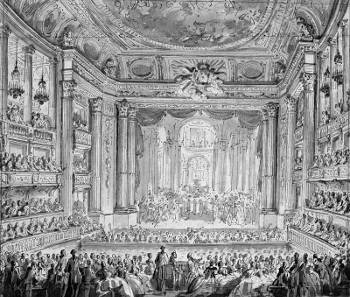
Anonymous A decisive institutional development occurred in France. In March 1672, Louis XIV transferred the privilege for establishing the Académie royale de musique to Jean-Baptiste Lully (1632–1687). A further royal privilege concerning publication of Lully's music followed in September. These privileges gave Lully extraordinary control over large-scale sung theater in France and helped establish the institutional foundation from which French opera developed during the remainder of the century. The change also affected theatrical collaboration. Lully's earlier partnership with Molière (1622–1673) broke down, while Marc-Antoine Charpentier (1643–1704) increasingly supplied music for Molière's theatrical productions. French musical theater was becoming a highly organized mixture of poetry, dance, singing, instrumental music, costume, scenery, and machinery, closely tied to royal patronage. Dutch musical life remained much less centralized. The publication at Haarlem of Het Haerlems Leeuwerckje in 1672, containing numerous songs and new tunes, demonstrates the continuing vitality of popular and domestic song culture even during the Rampjaar. One of the surviving texts addresses the king of Britain directly, showing how current politics could move rapidly into songs intended for ordinary circulation. This is an important complement to the refined musical world represented in Vermeer's late virginal paintings. Dutch music existed at many social levels: expensive keyboard instruments and private instruction in prosperous households, organ and carillon music in public space, professional musicians in civic and theatrical settings, and inexpensive printed songbooks that allowed new melodies and topical verses to circulate widely. |
| LITERATURE |
LITERATURE (1672)
Constantijn Huygens (1596–1687) published the greatly enlarged second edition of his Koren-bloemen in Amsterdam in 1672. Expanded to twenty-seven books, it gathered decades of poetry and included revised versions of earlier works prepared under Huygens' supervision. Because this was the final edition published during his lifetime, it represents an especially important statement of how he wanted much of his literary work transmitted. Joost van den Vondel (1587–1679) responded directly to the political catastrophe. In a poem associated with the image of Johan de Witt, he commemorated the murdered statesman and presented his death in the language of sacrifice to the fatherland. Vondel's reaction is one example of how rapidly writers responded to the events of August 1672. 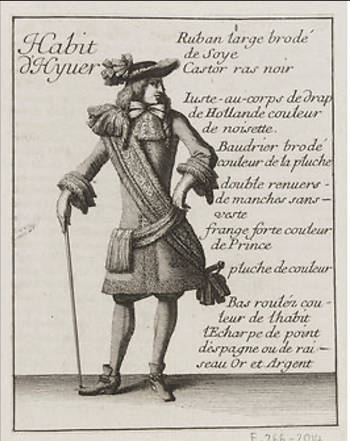
Anonymous The much larger phenomenon, however, was the explosion of pamphlet literature. Modern bibliographical research estimates that more than 1,600 pamphlet titles may have appeared in connection with the events of 1672, circulated in tens or perhaps hundreds of thousands of copies. They discussed military failure, treason, secrecy, the De Witt brothers, William III, foreign enemies, religion, municipal government, and responsibility for the crisis. Public opinion was not merely reflecting politics; printed argument was itself becoming part of political action. These pamphlets were accompanied by illustrated news sheets. Romeyn de Hooghe and others combined etched images with columns of printed explanation, allowing readers to encounter battles or political murders in a form somewhere between newspaper, broadsheet, illustrated history, and propaganda. The events at Groningen and the murder of the De Witts received this treatment almost immediately. France witnessed another development in periodical culture. Jean Donneau de Visé (1638–1710) launched the Mercure galant in 1672. It offered readers stories, literary material, court news, marriages, deaths, fashions, performances, and accounts of current events. The publication belongs to the gradual emergence of periodical reading as part of European urban culture. |
| SCIENCE, MATHEMATICS, & PHILOSOPHY |
SCIENCE, MATHEMATICS, & PHILOSOPHY (1672)
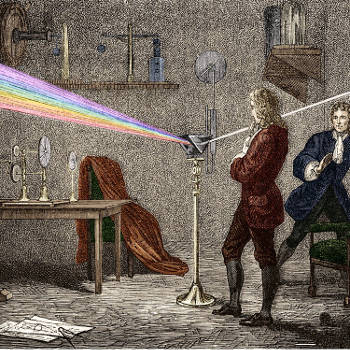
Anonymous In February Isaac Newton (1642–1727) published his new theory of light and colors in the Philosophical Transactions of the Royal Society. His prism experiments argued that white light was not transformed into colors by passing through glass; rather, white light consisted of differently refrangible rays that the prism separated. The claim immediately produced objections, replies, experiments, diagrams, and correspondence during 1672. This scientific debate is especially interesting because it was conducted through material objects as well as words: prisms, lenses, controlled beams of light, diagrams, and repeatable experimental arrangements. Newton's theory therefore depended upon both mathematical reasoning and practical manipulation of optical equipment. On December 23, 1672, Giovanni Domenico Cassini (1625–1712) discovered Rhea, the second-largest moon of Saturn. The discovery followed his identification of Iapetus the previous year and demonstrates how improvements in telescopes and sustained observation were steadily expanding the known structure of the solar system. In Delft, Antonie van Leeuwenhoek (1632–1723) was approaching the moment when his lens-making and microscopic observations would become internationally known. It is important not to move his famous Royal Society correspondence backward into 1672: Regnier de Graaf (1641–1673) introduced Leeuwenhoek's work to the Royal Society in 1673. But 1672 belongs to the immediate period in which Leeuwenhoek was developing the small single-lens microscopes and observational habits that would soon make his work remarkable. The Holland Water Line also belongs partly to the history of technology. Dutch engineers and officials deliberately manipulated dikes, sluices, canals, polders, and water levels on a regional scale to form a military barrier. Technologies originally intended to drain and regulate the landscape could therefore be reversed: rather than removing water from low land, authorities deliberately put water back onto it. The defense of Holland in 1672 depended as much upon hydraulic knowledge as upon fortresses and artillery. |
| WORLD HISTORY & POLITICS |
WORLD HISTORY & POLITICS (1672)
While western Europe concentrated upon the Franco-Dutch conflict, a major war opened on the eastern frontier of the Polish-Lithuanian Commonwealth. The Ottoman Empire under Mehmed IV (1642–1693) invaded in 1672. The great fortress of Kamianets-Podilskyi fell in August, giving the Ottomans control of a strategically important position in Podolia. The resulting Treaty of Buchach, concluded in October, required the Commonwealth to surrender Podolia and other territories and accept the payment of tribute to the Ottoman government. The Polish parliament subsequently refused to accept the settlement, and fighting resumed. The conflict helped raise the military reputation of Jan Sobieski (1629–1696), who would defeat Ottoman forces at Khotyn in 1673 and later become king of Poland. 
Anonymous In Mughal India, the reign of Aurangzeb (1618–1707) was shaken by the Satnami uprising of 1672 in the region around Narnaul. What began as a local confrontation between a Satnami cultivator and a Mughal soldier expanded into armed rebellion. Imperial forces eventually suppressed the movement. The episode belongs to a wider period of tension between the increasingly centralized Mughal state and religious, regional, and social groups within the empire. Thus the conflicts of 1672 extended across an enormous geographical arc: French armies entered the Dutch Republic; English and Dutch fleets fought in the North Sea; Münster troops bombarded Groningen; Ottoman armies moved into the Polish-Lithuanian Commonwealth; and imperial forces confronted rebellion in Mughal India. European and Asian states were simultaneously struggling with the increasingly expensive demands of armies, fortifications, taxation, and territorial government. |
| DAILY LIFE |
DAILY LIFE (1672)
Anonymous For ordinary inhabitants of the Republic, the Rampjaar meant uncertainty, movement, rumor, shortages, soldiers, refugees, flooded land, and interrupted trade. The collapse of the eastern defenses sent civilians westward toward the still-defended provinces. Roads and waterways that ordinarily moved passengers and merchandise now also carried soldiers, military supplies, displaced families, and news from the advancing front. The inundation of the Holland Water Line protected the province but imposed enormous costs upon the countryside. Agricultural land disappeared beneath water, farms became difficult or impossible to work, roads were cut, and normal communications were disrupted. The distinction between military landscape and civilian landscape effectively disappeared: a farmer's polder, ditch, bridge, sluice, and road could suddenly become part of the national defense system. Urban populations meanwhile consumed news at extraordinary speed. Pamphlets, rumors, printed proclamations, satirical verses, illustrated broadsheets, sermons, and handwritten reports all competed to explain why events were happening. With more than a thousand political pamphlet titles associated with the year, even people far removed from formal government could encounter arguments concerning generals, regents, the Prince of Orange, foreign monarchs, religion, treason, and military strategy. The crisis could also affect apparently distant luxuries. A family considering the purchase of a painting might instead retain its cash; merchants might hesitate to extend credit; rents could go unpaid; agricultural income could fall; and imported goods might become more expensive or uncertain. This is the economic environment in which Vermeer's combined occupations as painter and art dealer suddenly became far less secure. Winter introduced another danger. As water froze late in the year, the very inundations protecting Holland risked becoming roads over which troops could advance. French forces attempted to exploit frozen ground and water during the December operations around Bodegraven and Zwammerdam. A thaw frustrated the larger movement, but the episode demonstrates how closely seventeenth-century warfare could depend upon weather. For someone living in Delft, therefore, the Rampjaar was not simply news from Utrecht or the Rhine. Military mobilization, altered city government, uncertainty about trade, political pamphlets, refugees moving through Holland, and concern over the defenses of The Hague and the surrounding region would have made the crisis difficult to ignore. |
| SIGNIFICANT BIRTHS |
SIGNIFICANT BIRTHS (1672)
Peter I (1672–1725) was born in 1672. He would become tsar and later emperor of Russia, reorganizing the army and administration, developing a Baltic navy, founding St. Petersburg, and greatly increasing Russia's involvement in European political and military affairs. Joseph Addison (1672–1719) was born the same year. He later became one of the central figures of early eighteenth-century English periodical literature, particularly through his association with Richard Steele and The Spectator. His essays helped establish a form of urbane prose aimed at the expanding reading public of coffeehouses, merchants, professionals, and educated households. Johann Jakob Scheuchzer (1672–1733) would become a Swiss physician and natural historian whose interests ranged across fossils, minerals, botany, geography, meteorology, and the Alps. His later attempts to reconcile geological evidence with biblical history reveal both the rapidly accumulating evidence of natural history and the conceptual difficulties seventeenth- and early eighteenth-century scholars faced in interpreting it. 
René Frémin René Frémin (1672–1744) became a French sculptor trained in the academic tradition associated with François Girardon (1628–1715) and Antoine Coysevox (1640–1720). He later worked extensively for Philip V of Spain (1683–1746) at La Granja, carrying French court sculpture into the Spanish royal environment. The births of Peter I, Addison, Scheuchzer, and Frémin make 1672 an interesting generational marker: figures associated respectively with state reform, periodical literature, natural history, and court sculpture all entered the world during the year in which the Dutch Republic came close to political and military collapse. |
| NATURAL EVENTS |
NATURAL EVENTS (1672)
A conspicuous comet appeared in March and April 1672 and was carefully observed at Gdańsk by Johannes Hevelius (1611–1687). He published an account that same year, recording its successive positions against the stars. Such observations belonged to the increasingly systematic study of comets as astronomical bodies whose positions and paths could be compared rather than simply treated as portents. Italy experienced significant seismic activity. On April 14, 1672, a damaging earthquake struck the Rimini region. Modern historical seismology estimates its magnitude at about 5.6, with effects reaching intensity VIII in the historical record. The event forms part of an unusually active period in the seismic history of Romagna. Only weeks later, on June 8, another earthquake struck the Monti della Laga–Amatrice region of central Italy. Modern estimates place it around magnitude 5.3. Contemporary evidence reports serious damage around Amatrice, Campotosto, and Montereale, with the shock felt over a considerably wider area. The natural phenomena of 1672 are particularly interesting beside the scientific developments of the year. A comet was being measured, earthquakes recorded in contemporary reports, Saturn's moon Rhea discovered, and Newton's experiments were breaking white light into a measurable spectrum. Nature was increasingly becoming something to observe repeatedly, describe numerically, draw, compare, and communicate through international networks—even as many of its phenomena remained impossible to explain within contemporary science. |
1673: Vermeer's Age, 41
| 1673 | late- career maturity, economic deterioration & Rampjaar |
|---|---|
| VERMEER'S LIFE & ART |
VERMEER'S LIFE & ART (1673)
The surviving documents for 1673 say considerably more about Vermeer's family finances than about his painting. On June 27, another of Vermeer and Catharina Bolnes's children was buried in the family grave in Delft's Oude Kerk. The grave belonged to Maria Thins. The identity and age of the child are not recorded, but the burial is a sobering reminder of the large family living in the Oude Langendijk household during Vermeer's increasingly difficult final years. On July 21, Vermeer traveled to Amsterdam and sold two bonds with a combined value of 800 guilders. One, worth 500 guilders, had originally stood in the name of Magdalena van Ruijven, daughter of Pieter van Ruijven and Maria de Knuijt, the family closely associated with Vermeer's paintings. During the same year Vermeer also acted with or on behalf of Maria Thins in legal and inheritance matters connected with Gouda. These transactions show him actively managing family capital during the period following the economic shock of 1672. It would be dangerous, however, to interpret every financial transaction as evidence that Vermeer was already destitute. Selling bonds could be an ordinary means of converting an investment into cash. What becomes increasingly clear only from the documents of 1675–1676 is that his household eventually accumulated serious debts. In 1673, we can say securely that the economic environment in which he painted and dealt in pictures remained far less favorable than it had been during the prosperous 1660s. 
Anonymous The year 1672, remembered in Dutch history as the Rampjaar (“Year of Disaster”), brought the Dutch Republic into an acute military, political, and economic crisis. France under Louis XIV (1638–1715) invaded from the south and east, while England under Charles II (1630–1685) attacked at sea and the prince-bishoprics of Münster and Cologne advanced from the east. To prevent the French army from penetrating the province of Holland, Dutch authorities deliberately inundated large areas of countryside, forming the Hollandic Water Line. Although this strategy helped protect the principal cities of Holland, the invasion, flooding, interruption of trade, financial uncertainty, and political upheaval severely damaged economic confidence. The crisis culminated politically in the fall of the republican government associated with Johan de Witt (1625–1672) and the rise of William III (1650–1702) as stadholder. The consequences for the Dutch art market were severe, although 1672 should be understood as an acceleration of difficulties that had already appeared during the preceding decades. The Republic possessed an enormous accumulated stock of paintings, while domestic demand was becoming increasingly saturated. The Rampjaar sharply reduced discretionary spending just as bankruptcies, estate sales, and financial distress released additional paintings onto the secondary market. Living painters consequently had to compete with large numbers of inexpensive older works at a time when collectors were reluctant to spend. Prices fell, dealers found themselves holding depreciated inventories, and many artists became increasingly dependent upon supplementary occupations. Jan Steen (1626–1679), for example, received permission from the Leiden authorities in 1672 to operate an inn, although he continued to paint and remained active in the local Guild of Saint Luke. Dutch painting certainly did not cease after 1672, but the extraordinarily broad commercial market that had sustained the enormous production of the preceding decades never fully recovered. For Vermeer, the crisis was particularly damaging because his livelihood appears to have depended not only upon producing his own paintings but also upon dealing in works by other artists. His widow later explained that during the war with France he had been able to earn very little from his art and that paintings acquired for resale could be disposed of only at considerable loss. Thus the Rampjaar struck him from two directions: demand for his own costly pictures contracted while the value of his commercial stock declined. His difficulties were probably progressive rather than instantaneous, but 1672 provides the clearest starting point for the final deterioration of his financial position. Over the following three years, declining income, losses in the art trade, the expense of maintaining a large household, and diminishing financial reserves appear to have accumulated until his death in 1675 left his family heavily indebted. In this sense, the Rampjaar forms an essential economic background to the final phase of Vermeer’s career.
Johannes Vermeer
Johannes Vermeer
Johannes Vermeer
Johannes Vermeer
Johannes Vermeer Several paintings generally assigned to Vermeer's final years may have been in progress around this time, particularly The Guitar Player, Lady Standing at a Virginal, Lady Seated at a Virginal, and perhaps Allegory of Faith. Their exact sequence remains uncertain. Rather than assigning one firmly to 1673, it is safer to describe this as the period of Vermeer's increasingly simplified forms, emphatic highlights, strongly patterned drapery, and unusually abstract treatment of spatial relationships. |
| DELFT |
DELFT (1673)
John Pass after an illustration by Daniel Dodd One of the most consequential events in Delft during 1673 occurred not in politics or war but in a modest letter sent from the city. On August 15, Antonie van Leeuwenhoek (1632–1723) wrote to Henry Oldenburg (c. 1619–1677) of the Royal Society in London. The seven-page letter discussed the anatomy and sting of the bee, the structure and growth of wood, the digestion of a louse, and experiments involving compressed air. Drawings accompanied the observations. It marked the beginning of the correspondence through which the Delft tradesman and municipal official would become known throughout European scientific circles. The event deserves particular prominence in a Delft chronology. A man living and working only a short distance from Vermeer was turning extremely small, ordinary things—lice, bee stings, fibers, wood and droplets—into subjects of sustained empirical observation. Leeuwenhoek's famous investigations of microorganisms still lay ahead, but 1673 marks Delft's direct entrance into the correspondence network of the Royal Society. 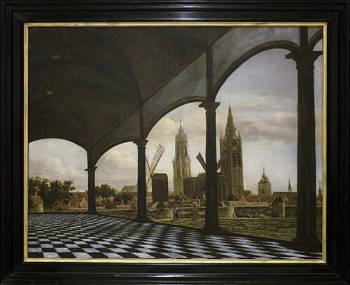
Daniel Vosmaer Delft's expanding earthenware industry also leaves a small but unusually tangible trace from this year. Archaeological finds from the site of the pottery De Porceleyne Fles, founded in 1653, include a plate dated 1673 and inscribed "Engeltie Kleijnoven." The factory then operated two kilns and produced both decorated wares and ordinary white tin-glazed objects such as bowls, candlesticks, and sconces. Such surviving pieces help place Delft pottery not simply in the category of luxury export wares but within the city's everyday manufacturing economy. Politically, Delft remained governed by the substantially altered municipal regime installed after the upheavals of 1672. The Orangist transformation of the Veertigraad had replaced roughly half of Delft's governing council the previous September. Thus the Delft in which Vermeer and Leeuwenhoek lived in 1673 was being administered by a political establishment quite different from the one that had governed the city before the Rampjaar. The city remained inside the protected heartland of Holland and escaped French occupation, but war remained an immediate concern. Taxes, military expenditure, disrupted commerce and uncertainty continued, even as Delft's markets, workshops, potteries, canals, guilds and VOC offices carried on their normal functions. The year therefore offers a useful picture of recovery under pressure rather than simple catastrophe. |
| DUTCH ART |
DUTCH ART (1673)
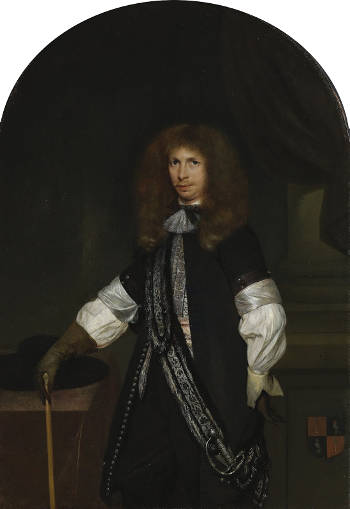
Gerrit ter Borch Dutch painters continued to work at a high level despite the contraction of the art market. Gerrit ter Borch (1617–1681) painted his portrait of Jacob de Graeff (1642–1690) in 1673. De Graeff appears in an officer's uniform, standing beside a column and table. The military costume gives the portrait particular resonance immediately after the crisis of 1672, when members of urban elites had become closely involved with civic defense and political realignment. Adriaen van Ostade (1610–1685) signed and dated The Fiddler in 1673. Rather than depicting the polished domestic world familiar from Vermeer or Ter Borch, Van Ostade shows country people gathering around itinerant musicians outside an inn. Children and adults listen while a violinist and a boy with a hurdy-gurdy perform. Such scenes remind us how much Dutch musical and social life occurred outside wealthy interiors—in streets, taverns, courtyards and village gatherings. 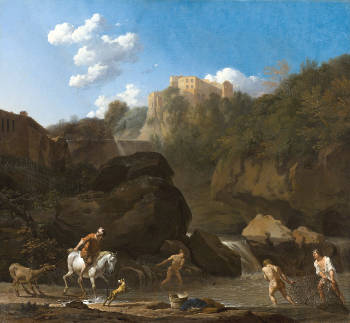
Karel Dujardin Karel Dujardin (1626–1678) produced the signed and dated Waterfalls at Tivoli in 1673. Its Italian landscape belongs to the enduring Dutch fascination with southern scenery. Dujardin had actually traveled to Italy, unlike some Dutch Italianate painters who constructed their southern worlds from drawings, prints and other paintings. His work demonstrates that pastoral Italy remained an important component of Dutch painting even while the Republic itself was at war. The conflict also continued to generate an extraordinary quantity of visual reportage. Romeyn de Hooghe (1645–1708) and artists around him represented the two naval battles of Schooneveld, the capture of Naarden and the later victories of William III. Prints combined maps, portraits, battle scenes and explanatory text. The image became a means of consuming current events almost as quickly as events could be reported. This gives the art of 1673 an unusual range: refined portraiture, peasant genre painting, Italianate landscape and rapidly produced illustrated news all existed simultaneously. The Dutch visual culture of these years was far broader than the easel paintings now most familiar in museums. |
| DUTCH REPUBLIC |
DUTCH REPUBLIC (1673)
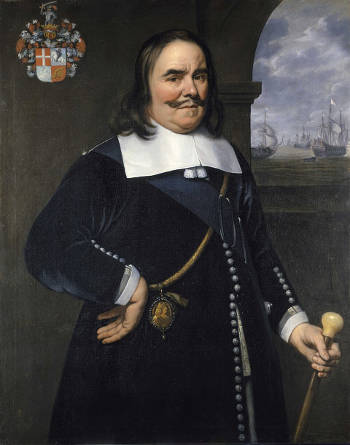
Ferdinand Bol If 1672 was the year in which the Republic nearly collapsed, 1673 was the year in which its military position began to recover. At sea, Michiel de Ruyter (1607–1676) again prevented the combined English and French fleets from establishing superiority. The Dutch fought the allies twice off Schooneveld on June 7 and June 14, frustrating attempts to approach the Dutch coast and supporting the defense against invasion. The struggle culminated in the Battle of Texel in August 1673. De Ruyter again faced a larger Anglo-French fleet. No major ship was captured on either side, but the allies failed in their objective of destroying the Dutch fleet and opening the coast to invasion. The battle became the last great fleet action of the Third Anglo-Dutch War. On land, however, France could still strike hard. Louis XIV (1638–1715) personally accompanied the campaign against Maastricht. Assisted by the siege methods of Sébastien Le Prestre de Vauban (1633–1707), French forces forced the heavily fortified city to capitulate after only thirteen days. The capture of Maastricht became an important episode in French royal imagery and was repeatedly represented as a demonstration of the king's military authority. Yet the strategic direction of the war was changing. William III (1650–1702) captured Naarden on September 12, removing an important French position close to Holland. Contemporary prints immediately celebrated the event as his first conquest of the campaign. More consequential still was the campaign into Germany. William III joined Imperial and Spanish forces and captured Bonn on November 13. Its fall weakened the French position on the Rhine and helped sever communications between France and its allies in Cologne and Münster. By the end of 1673 the conflict had widened from an attempt to crush the Dutch Republic into a broader European war against French expansion. The political meaning was equally important. William III, elevated during the panic of 1672, was now demonstrating his position through active military leadership. The Republic remained financially and socially strained, but by the close of 1673 its survival was no longer in the immediate doubt that had prevailed the previous summer. |
| EUROPEAN PAINTING & SCULPTURE |
EUROPEAN PAINTING & SCULPTURE (1673)
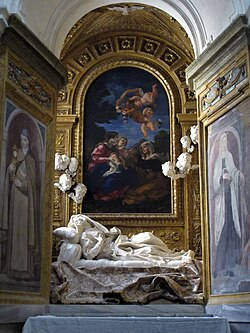
Gian Lorenzo Bernini In Rome, Gian Lorenzo Bernini (1598–1680) was completing one of the extraordinary works of his old age, the Blessed Ludovica Albertoni, begun after 1671 and finished by 1674. The reclining marble figure appears in a chapel setting in San Francesco a Ripa, surrounded by colored marble and illuminated in a manner calculated to make sculpture, architecture and light work together. The subject hovers between physical suffering, death and mystical experience. In France, war itself provided subject matter. Pierre Mignard (1612–1695) developed the image of Louis XIV before Maastricht, dressed in Roman armor and crowned by Victory. Rather than showing the confusion and physical destruction of siege warfare, the composition turns the 1673 campaign into an image of controlled royal command. The actual painting was commissioned shortly afterward, but its subject belongs directly to the events of this year. 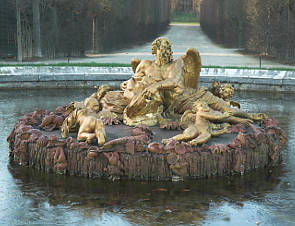
François Girardon At Versailles, François Girardon (1628–1715) was working on sculptural programs for the gardens, including the Bassin de Saturne, undertaken between 1672 and 1677. Such projects joined sculpture, fountains, garden planning, mythology and royal symbolism within a single designed environment. The contrast with Dutch art is revealing. The Republic still depended heavily upon a dispersed commercial market of private buyers, while French and Roman artists could work within enormous programs financed by monarchs, cardinals, churches and courts. The differences affected not only scale but subject matter: portraits, tavern scenes and domestic interiors flourished alongside monumental religious sculpture and royal allegory. |
| ARCHITECTURE |
ARCHITECTURE (1673)
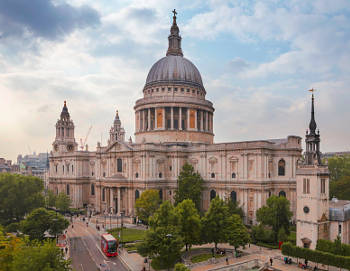
Christopher Wren In London, Christopher Wren (1632–1723) spent much of 1673 developing his enormous proposed model for the rebuilding of St. Paul's Cathedral. Work on the design ran from December 1672 through September 1673, after which the large wooden model itself was built. Wren's scheme centered on a great dome and geometrically organized interior derived from his earlier Greek-cross proposal. Although this exact design was later rejected, it was a decisive stage in the long process leading to the present cathedral. On November 13, 1673, Charles II (1630–1685) formally appointed Wren architect of St. Paul's. At Amsterdam, the war could be seen in unfinished architecture. Construction of the great Portuguese Synagogue, begun in 1671 under Elias Bouman (1635/36–1686), had stopped early in the Rampjaar and remained suspended throughout 1673. Work would not resume until May 1674. The interruption shows how shortages of money, labor and building materials could translate national emergency directly into the physical fabric of a city. 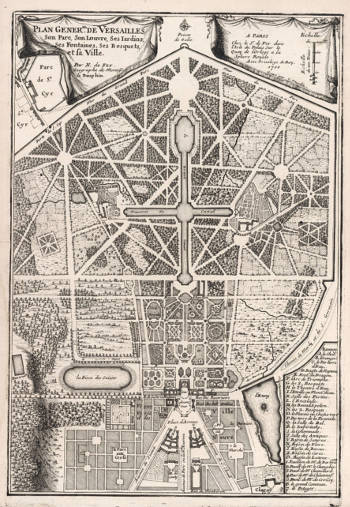
Chez N. de Fer, Paris Versailles offers the opposite image. In 1673 the old village was cleared as Louis XIV's planned new town expanded around the royal residence. The geometrically organized settlement was intended to accommodate the growing population required by court life and royal administration. The transformation of Versailles was therefore no longer limited to enlarging a château: an entire urban setting was being rearranged in relation to royal power. |
| MUSIC |
MUSIC (1673)
On April 27, 1673, Cadmus et Hermione, with music by Jean-Baptiste Lully (1632–1687) and a libretto by Philippe Quinault (1635–1688), received its first performance in Paris. Generally regarded as the first fully developed French tragédie en musique, it brought together sung drama, chorus, dance, orchestral writing and stage machinery in a form that Lully and Quinault would develop repeatedly over the following decade. The work arose directly from Lully's new control of the Académie royale de musique. French opera was thus becoming an institution as well as a musical genre, with royal privileges governing who could stage large musical productions and under what conditions. 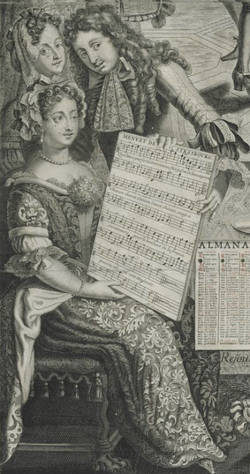
Almanach royal gravé par Landry en 1682 A very different theatrical event occurred in February. Marc-Antoine Charpentier (1643–1704) supplied the music for Le Malade imaginaire, the final comedy-ballet of Molière (1622–1673). It premiered on February 10. During the fourth performance on February 17, Molière became seriously ill while playing Argan and died at home later that evening. Thus two works produced within weeks of one another mark a changing French musical world: Lully was establishing the model of royal French opera, while Charpentier's collaboration with Molière represented the continuation of the older mixed tradition of spoken theater, songs, dances and instrumental interludes. |
| LITERATURE |
LITERATURE (1673)
Molière's Le Malade imaginaire belongs as much to literary history as to music. Its central character, convinced that he is perpetually ill, becomes the vehicle for an extended satire on doctors, prescriptions, medical language and professional pretension. The circumstances of Molière's death only days after its premiere gave the comedy an association with mortality that could hardly have been anticipated when it was written. In England, John Milton (1608–1674) published Of True Religion, Heresy, Schism, Toleration in 1673, entering continuing English arguments over Protestant unity and religious toleration. Milton was now near the end of his life, blind and internationally known principally for Paradise Lost, but he remained actively engaged in religious and political writing. In the Dutch Republic, Baruch Spinoza (1632–1677) received an extraordinary professional offer. On February 16, 1673, Johann Ludwig Fabritius wrote on behalf of the Elector Palatine inviting Spinoza to accept a professorship of philosophy at Heidelberg, promising considerable freedom to philosophize provided that he did not disturb the publicly established religion. Spinoza declined. The correspondence is revealing precisely because of the condition attached to the offer: intellectual freedom could be extensive, but its relationship with confessional authority remained difficult. The war also sustained the Dutch appetite for inexpensive printed news. Battle reports, poems, proclamations, illustrated sheets and pamphlets continued the print culture that had exploded during the Rampjaar. The victories at Schooneveld, Naarden and Bonn could become printed images almost immediately, allowing warfare to enter domestic reading culture far from the battlefield. |
| SCIENCE, MATHEMATICS, & PHILOSOPHY |
SCIENCE, MATHEMATICS, & PHILOSOPHY (1673)
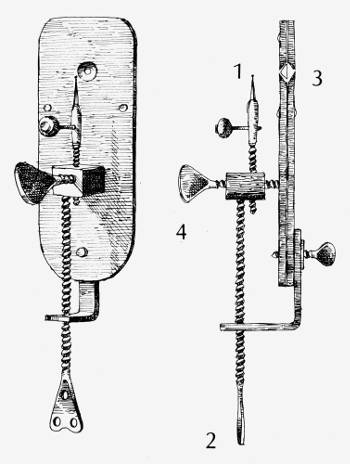
Anonymous The most important Delft scientific event of the year was Leeuwenhoek's August 15 letter to the Royal Society. His topics are revealing: bee anatomy, wood structure, the digestive system of a louse and compressed air. There was no single narrow discipline governing these investigations. Animal anatomy, plants, mechanics and optics could all belong to natural inquiry, provided that they could be subjected to careful observation and experiment. Gottfried Wilhelm Leibniz (1646–1716) visited London and was elected a Fellow of the Royal Society on April 9, 1673. His contacts with the Society included discussions of mathematics and his calculating machine, a mechanical device intended to perform arithmetic operations. Leibniz's career illustrates the increasing overlap among mathematics, practical calculation, mechanical engineering, administration and philosophy. Christiaan Huygens (1629–1695) remained deeply involved with problems of pendulum motion and accurate timekeeping. His correspondence with Oldenburg in June 1673 discussed the isochronism of the cycloid, circular pendulums and methods for improving pendulum clocks, including their possible use at sea. Finding longitude accurately remained one of the great practical problems linking astronomy, mathematics, clockmaking and navigation. 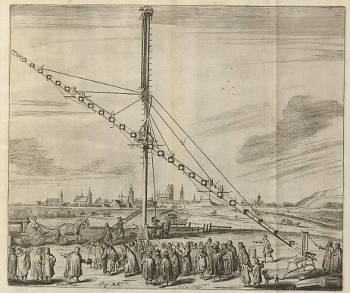
Anonymous The astronomer Johannes Hevelius (1611–1687) was also constructing increasingly enormous instruments. An engraving dated 1673 shows his extraordinary 150-foot refracting telescope, whose long open framework was suspended from a tall mast and operated using ropes and pulleys. Such instruments reveal both the ambition and the practical difficulties of seventeenth-century observational astronomy before the development of compact high-performance telescopes. These developments place Leeuwenhoek's tiny hand-held lenses in an interesting contrast with Hevelius's immense telescope: seventeenth-century investigators were simultaneously extending vision toward the extremely small and the enormously distant. |
| WORLD HISTORY & POLITICS |
WORLD HISTORY & POLITICS (1673)
The Franco-Dutch War was becoming a general European conflict. France remained capable of taking Maastricht, but by late 1673 Spain and the Habsburg emperor were cooperating militarily with the Dutch Republic. The combined campaign that culminated in the capture of Bonn forced France to abandon much of its exposed position in the Dutch Republic and shifted the geographical center of the war toward the Spanish Netherlands and the Rhine. Farther east, the Polish-Lithuanian Commonwealth remained at war with the Ottoman Empire. On November 11, Jan Sobieski (1629–1696) defeated the Ottoman army under Hüseyin Pasha at the Battle of Khotyn. The victory greatly strengthened Sobieski's political standing; after the death of King Michael Korybut the preceding day, Sobieski would be elected king in 1674. The coincidence is striking. Dutch armies were fighting France and its allies around the Rhine while Polish armies were confronting Ottoman forces farther east. Across Europe, governments were attempting to maintain increasingly large standing armies, fortified cities, artillery trains and supply systems. Warfare placed growing demands upon taxation, administration, credit and civilian populations. |
| DAILY LIFE |
DAILY LIFE (1673)
The consequences of war continued to enter ordinary Dutch households in 1673. Military expenditure had to be financed through taxation and public borrowing, while disruptions to inland transport and foreign trade affected employment and prices. Families who had treated paintings, expensive furniture or imported goods as reasonable purchases during prosperous years could become much more cautious about spending. 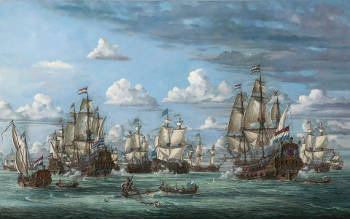
Anonymous At the same time, the recovery of Dutch naval power helped restore confidence. Battles at Schooneveld and Texel were not remote events for inhabitants of maritime towns. Sailors, shipbuilders, rope makers, victuallers, dock laborers, merchants and their families depended directly on the fleet. Illustrated news prints allowed inhabitants of Delft, Leiden or Haarlem to examine battle formations and portraits of commanders while reading accounts of what had happened. Delft itself continued to manufacture household goods in quantity. The 1673 plate from De Porceleyne Fles is a useful reminder that the celebrated Delft pottery industry also produced relatively ordinary plates, bowls, candlesticks and other objects that entered houses at many economic levels. Letter writing, music making and domestic sociability also continued despite wartime uncertainty. Paper, sealing wax, pens, musical instruments and printed songbooks belonged to an expanding material culture of communication and leisure. The intimate activities represented in Dutch genre painting were therefore taking place against a background of war news, military taxation and political uncertainty rather than in an isolated private world. |
| SIGNIFICANT BIRTHS |
SIGNIFICANT BIRTHS (1673)
Dimitrie Cantemir (1673–1723) was born in 1673. He would become prince of Moldavia as well as a historian, philosopher, music theorist and composer. Educated within both Ottoman and European intellectual traditions, he later wrote an influential history of the Ottoman Empire and works on Moldavian history and culture. 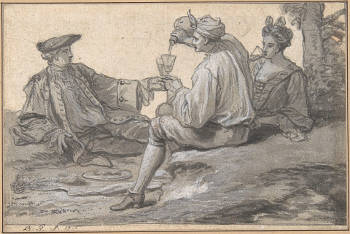
Bernard Picart Bernard Picart (1673–1733) was born the same year. A draftsman, engraver and print dealer, he later settled in Amsterdam and became closely associated with the enormous illustrated project Cérémonies et coutumes religieuses de tous les peuples du monde, which attempted to represent and compare religious practices across many cultures. Jacques-Martin Hotteterre (1673–1763) became one of the most important French woodwind players and teachers of the following generation. A flutist and composer associated with the royal musical establishment, he later published influential instructional works for transverse flute, recorder and oboe. Johann Konrad Dippel (1673–1734) was born in 1673. He became a theologian, physician and alchemical experimenter whose restless career crossed the boundaries that later generations would separate into religion, medicine and chemistry. |
| NATURAL EVENTS |
NATURAL EVENTS (1673)
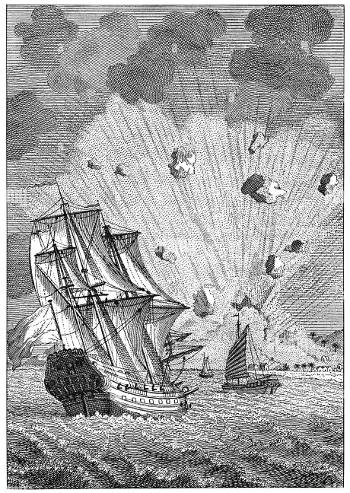
French Anonymous One of the most destructive natural events of the year occurred far from Europe. Gamkonora volcano on Halmahera in present-day Indonesia began a confirmed eruption on May 20, 1673. The Smithsonian Global Volcanism Program identifies it as the largest historically recorded eruption of Gamkonora and reports that it was accompanied by tsunamis that inundated coastal villages. A severe earthquake was also recorded in the region on August 12. Older accounts sometimes associated it with an eruption of nearby Gamalama on Ternate, but modern volcanic catalogues reject that eruption attribution and distinguish the earthquake from the Gamkonora event. Astronomers were meanwhile following a comet visible in 1673. Correspondence preserved by the Royal Society records observations by Hevelius and Giovanni Domenico Cassini (1625–1712) being circulated internationally in April. The event illustrates how observations of transient celestial phenomena could now be compared rapidly among astronomers working hundreds of kilometers apart. So 1673 has a quite different character from 1672. The Dutch Republic is still under enormous pressure, but the year moves from defense toward recovery: De Ruyter blocks the allied fleets, William III retakes Naarden and helps capture Bonn, and France's attempt to destroy the Republic is turning into a wider European war. At the same time, Delft produces two exceptionally intimate records of another kind: Vermeer burying a child and managing family investments, and Leeuwenhoek sending his first scientific letter from Delft to the Royal Society. Those two events alone give 1673 a remarkably human scale within the larger chronology. |
1674: Vermeer's Age, 42
| 1674 | late-career maturity, economic deterioration & Rampjaar |
|---|---|
| VERMEER'S LIFE & ART |
VERMEER'S LIFE & ART (1674)
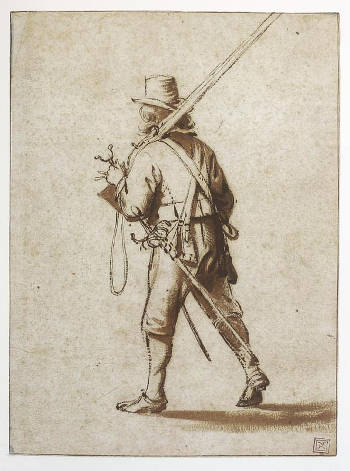
Anthonie Palamdesz. In 1674 Vermeer appears in the register of the Delft civic militia, or schutterij. He is listed as a schutter in the first squad of the third company, the company recruited from the quarter in which he lived. Membership was not universal: a Delft ordinance described suitable guardsmen as established, peaceful, qualified burghers or sons of burghers. The entry therefore adds an important dimension to Vermeer's civic identity. Alongside his repeated service as a headman of the Guild of Saint Luke, it places him within the organized institutions through which respectable male citizens participated in the governance and defense of Delft. The militia entry acquires additional significance when set against the events of the previous two years. During the emergency of 1672 Delft's civic militia had been mobilized amid fears of invasion, political disorder, and street violence. By 1674 the immediate danger to Holland had receded, but the war against France continued. Vermeer's enrollment therefore belonged to a living military institution rather than to a merely ceremonial civic organization. The initial financial collapse of Vemeer begins with the French invasion that halts art sales, ruins dealer stock value, and floods Maria Thins's income-producing farmlands. There is a deterioration and necessary asset sales for 800 guilders in bonds. Vermeer's paron Pieter van Ruijven dies and household debts (bread, cloth) have dramatically accumulated. 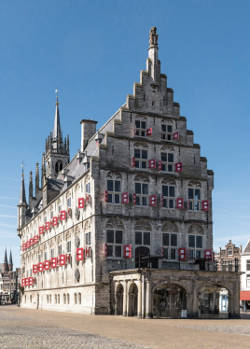
On May 4, 1674, Vermeer traveled to Gouda to help settle affairs following the death of his father-in-law. Then, on June 10, his eldest daughter Maria (c. 1654–after 1713) married a Delft merchant. These small family events are important because they bring us unusually close to Vermeer's domestic life during his final years: legal and financial responsibilities in Gouda continued to connect his household with the Bolnes family, while his children were beginning to reach adulthood and establish households of their own. Another important death occurred in August. Pieter van Ruijven (1624–1674), a member of the Delft collecting household closely associated with Vermeer's paintings, died in 1674. The later estate of his daughter Magdalena would contain an extraordinary group of Vermeer paintings, providing some of the strongest evidence for sustained collecting of Vermeer's work within this family circle. It is better, however, not to impose upon 1674 the later assumption that Van Ruijven alone was responsible for acquiring all of these works; recent research has drawn increased attention to the role of his wife Maria de Knuijt (c. 1623–1681).
Johannes Vermeer
Johannes Vermeer Exactly what Vermeer was painting in 1674 remains uncertain. Some chronologies extend Allegory of Faith as late as c. 1672–1674, while other scholars place it earlier. Comparable uncertainty surrounds the final virginal paintings and The Guitar Player. The safest conclusion is that Vermeer's late manner—simplified modeling, strongly patterned folds, emphatic highlights, relatively hard contours, and increasingly abstract spatial relationships—belongs to the period immediately surrounding 1674 without requiring us to assign a particular surviving picture firmly to that year. |
| DELFT |
DELFT (1674)
One of the most remarkable events anywhere in Delft in 1674 occurred when Antonie van Leeuwenhoek (1632–1723) took a small bottle of water from the Berkelse Meer, a shallow lake a few miles from the city. Examining the sample through one of his tiny single-lens microscopes in August, he saw numerous minute moving organisms. In his letter of September 7, 1674, to Henry Oldenburg (c. 1619–1677) of the Royal Society, he described extraordinarily small "little animals" moving rapidly upward, downward, and in circles. The Royal Society catalogue identifies the letter as containing observations of protozoa in stagnant water. The importance of the event is difficult to overstate, but it is worth describing precisely. Leeuwenhoek had already used lenses to investigate blood, hair, skin, teeth, muscle, bone, insects, and plant material. In the Berkelse Meer water, however, he encountered an unsuspected abundance of living organisms invisible to ordinary sight. Later investigators have identified elements of his description with rotifers, ciliates, algae, and other microscopic forms. The microscopic world that would dominate his later career was beginning to reveal itself in water collected just outside Delft. Nor was this an isolated observation. During 1674 Leeuwenhoek sent a succession of letters from Delft. On June 1 he discussed blood, skin, plant growth, tissues, and capillary action; on July 6 he described an improved glass tube for studying the movement of blood; in September came the Berkelse Meer observations; and in October he wrote about animal tissues, metals, skin, the bladder, and taste. Delft was thus becoming a point in an international scientific correspondence network linking a self-trained local investigator with London's Royal Society. 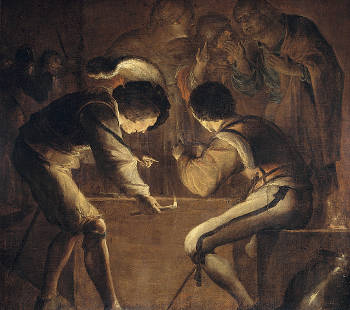
Leonaert Bramer The city also lost one of the most distinctive painters of its older generation. Leonaert Bramer (1596–1674) died in 1674. On May 7, a large quantity of paintings, drawings, works on copper, and albums left by him was offered for sale in the chamber of Delft's Guild of Saint Luke. Bramer had been active in the city for decades and had close connections with Vermeer's family—most famously appearing as a witness connected with the arrangements surrounding Vermeer's marriage. The sale of his studio material in the guild building must have been a conspicuous event within Delft's relatively compact artistic community. The 1674–1675 Groot Familiegeld, an extraordinary wealth-tax register compiled after the financial pressures of the war, gives us another unusually sharp view of Delft society. It assessed a levy of one-half percent on substantial capital holdings. Vermeer's mother-in-law Maria Thins (c. 1593–1680) was assessed on capital of 26,000 guilders, placing her among roughly the wealthiest five percent of Delft inhabitants recorded in the levy. The figure helps explain how the large Vermeer household could retain access to substantial property and investment income even while Vermeer's own painting and dealing activities were encountering difficulties. These records reveal a Delft of striking contrasts. Within the same relatively small city lived a painter whose finances were deteriorating, a wealthy Catholic widow living largely from investments, an internationally respected older painter whose estate was being dispersed, and a cloth merchant and municipal official peering through tiny lenses at forms of life that no human being had previously described with comparable detail. |
| DUTCH ART |
DUTCH ART (1674)
Gerrit ter Borch (1617–1681). Documents record Ter Borch again in Amsterdam in 1674 and in The Hague and Haarlem in 1675, although Deventer remained his permanent home. Thus, during the final two years of Vermeer's life, Ter Borch was still traveling among major Dutch artistic centers and maintaining a long-established career. The contrast is useful chronologically: while Vermeer's production appears to have slowed severely under worsening economic conditions, Ter Borch remained professionally mobile and socially well established. 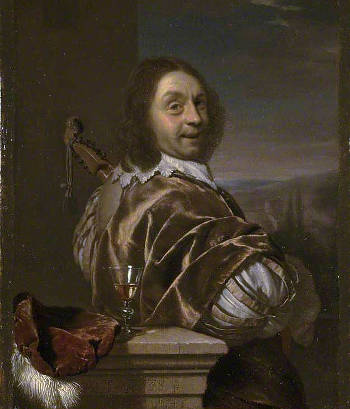
Frans van Mieris Frans van Mieris (1635–1681). Three days before his thirty-ninth birthday in 1674, Van Mieris painted the tiny Self Portrait of the Artist, with a Cittern. He presents himself not simply as a craftsman but as a cultivated gentleman and musician, reflecting the elevated social identity he had acquired through international patronage and extraordinary commercial success. By this late stage of Vermeer's career, Van Mieris remained one of the clearest examples of how a Dutch genre specialist could command aristocratic collectors and very high prices through a combination of refined subject matter and technically immaculate execution Jan Steen (1626–1679) remained professionally prominent despite the difficult conditions of the art market. Having returned to Leiden in 1670, he had already served three years as a headman of the Guild of Saint Luke when he was elected its dean in 1674. His guild career is useful evidence against taking the disorderly households, drunken celebrations, taverns, and comic misbehavior of his paintings as straightforward autobiography. Steen was thoroughly integrated into the professional institutions of Dutch painting. 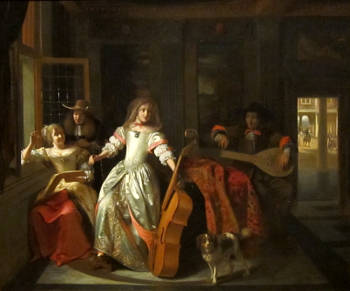
Pieter de Hooch The later work of Pieter de Hooch (1629–1684 or later) shows how far his painting had moved from the quiet brick courtyards and modest Delft interiors of the 1650s. His Musical Conversation, dated 1674, belongs to the Amsterdam phase in which rooms become grander, costumes richer, floors more luxurious, and domestic entertainment more explicitly associated with prosperous urban society. The comparison with his Delft work is revealing: the same artist who once concentrated on women, children, courtyards, and household work had adapted his art to a wealthier Amsterdam clientele. Emanuel de Witte (c. 1617–1692) continued the architectural-interior tradition that had developed so strongly in Delft during the early 1650s. Although long resident in Amsterdam by 1674, he continued to construct church interiors through dramatic contrasts of light, deep spatial recession, figures, open graves, monuments, and architectural elements sometimes rearranged for pictorial effect. Unlike Pieter Saenredam (1597–1665), whose church views tend toward architectural precision and measured clarity, De Witte treated church space as a lived environment in which worship, conversation, burial, dogs, children, and everyday activity coexist. 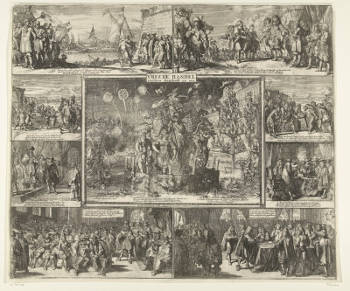
Romeyn de Hooghe The events of the war continued to feed the print market. Romeyn de Hooghe (1645–1708) produced an elaborate print devoted to the Peace of Westminster, surrounding an image of the bonfires and fireworks held at The Hague with smaller episodes tracing the Anglo-Dutch conflict from the declaration of war through the negotiations of 1674. The sheet demonstrates how swiftly political history could be turned into a commodity combining journalism, cartography, allegory, portraiture, and spectacle. Thus Dutch visual culture in 1674 ranged from Steen's comic narratives and De Hooch's affluent interiors to De Witte's churches and De Hooghe's political news prints. The contraction of the traditional painting market after 1672 did not bring Dutch art to an abrupt end, but it altered the commercial conditions within which artists worked and made cheaper, topical printed imagery particularly visible. |
| DUTCH REPUBLIC |
DUTCH REPUBLIC (1674)
The most important diplomatic event of the year was the Treaty of Westminster, signed on February 19, 1674, which ended the Third Anglo-Dutch War. England withdrew from the coalition that had attacked the Republic in 1672. The peace was publicly proclaimed at The Hague on March 6 and celebrated there with bonfires and fireworks on March 14, festivities recorded in contemporary prints by Romeyn de Hooghe and others. The Republic also reached settlements with two of its German enemies. The prince-bishop of Münster concluded peace with the States General at Cologne on April 22, and the elector of Cologne followed with a treaty on May 11. Surviving treaty and ratification documents in the Nationaal Archief provide unusually precise evidence for the dismantling of the four-power coalition that had confronted the Republic two years earlier. The war with France, however, continued. The Republic increasingly fought within a broader coalition involving Spain, the emperor, Brandenburg, and several German princes. A treaty of mutual defense involving the Republic, the emperor, Spain, and the dukes of Brunswick-Lüneburg was concluded in June. The struggle that had begun in 1672 as a direct invasion of the Dutch Republic was becoming a larger European conflict over French territorial expansion. On August 11, the allied army commanded by William III (1650–1702) met the French army under Louis II de Bourbon, Prince de Condé (1621–1686) at Seneffe in the Spanish Netherlands. The engagement developed into an exceptionally long and bloody battle, and contemporary prints on both sides interpreted its confused outcome according to their own political purposes. For the chronology it is more useful to emphasize that Dutch troops were now fighting well outside the territory that had seemed on the verge of collapse only two years earlier. Meanwhile the French-held fortress of Grave remained under siege for months and capitulated to forces under William III in late October. The recovery of Grave removed one of the remaining French positions within the Republic. By the end of 1674 the immediate military geography had therefore changed fundamentally from that of June 1672, even though the Franco-Dutch War itself would continue until 1678. The political order created during the Rampjaar also remained in place. William III was now firmly established as stadholder and captain-general, while the municipal governments altered during the Orangist political changes of 1672—including Delft's—continued to administer the cities. The constitutional change brought about under the pressure of invasion had outlasted the immediate emergency. |
| EUROPEAN PAINTING & SCULPTURE |
EUROPEAN PAINTING & SCULPTURE (1674)
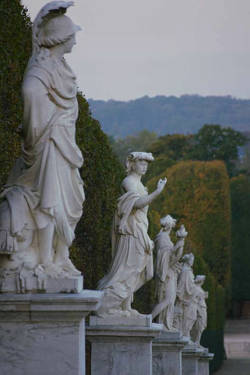
Charles Le Brun At Versailles, Charles Le Brun (1619–1690) devised one of the largest sculptural programs of the reign of Louis XIV (1638–1715): the Grande Commande of 1674. The project called for monumental marble groups representing the four elements together with twenty-four allegorical statues organized around the continents, seasons, times of day, elements, human temperaments, and forms of poetry. Many of France's leading sculptors worked on the program over the following two decades. It amounted to an attempt to organize the natural and human world into a vast allegorical system surrounding the royal residence. In Rome, Carlo Maratta (1625–1713) received a major commission in 1674 from Pope Clement X (1590–1676) for the principal audience room of Palazzo Altieri. Maratta planned an extensive allegorical program involving Peace, Religion, Faith, Divine Wisdom, Evangelical Truth, and other virtues. Only part of the scheme was ultimately executed, but the surviving drawings reveal the continuing importance of large coordinated decorative programs in Roman elite interiors. 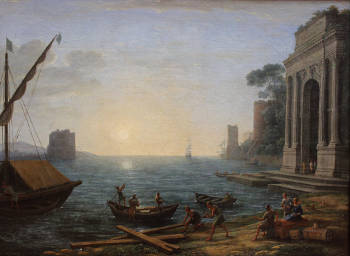
Claude Lorrain The aged Claude Lorrain (c. 1604–1682) was still producing major landscapes. His Seaport at Sunrise is dated 1674. Rather than recording an actual harbor, Claude constructed an imaginary antique maritime world: boats are loaded beneath glowing early light while classical architecture evokes ancient Rome. The painting belongs to a group commissioned by Bavarian privy councillor Franz von Mayer and demonstrates that Claude's idealized fusion of antiquity, landscape, sea, architecture, and atmospheric light continued to attract patrons late in his career. 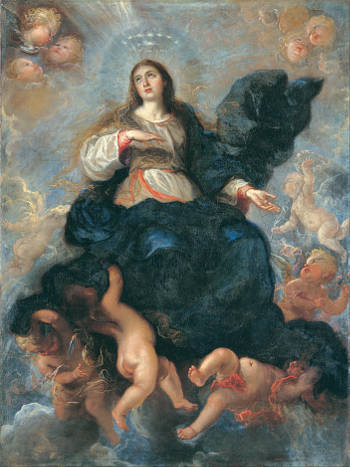
Juan Carreño de Miranda In Spain, Juan Carreño de Miranda (1614–1685) occupied a very different artistic environment, working principally for court and church. His paintings of the 1670s continued the Spanish tradition of strongly individualized royal portraiture and large devotional compositions. The persistence of such court-centered careers contrasts sharply with the decentralized Dutch market in which artists such as Vermeer, Steen, De Hooch, and De Witte largely depended upon urban collectors rather than monarchs or great ecclesiastical institutions. Across Europe in 1674, therefore, artistic production ranged from privately traded Dutch cabinet pictures to enormous royal sculptural programs at Versailles, papal decorative schemes in Rome, ideal landscapes commissioned by foreign aristocrats, and Spanish court painting. The institutional conditions of art were every bit as diverse as its styles. |
| ARCHITECTURE |
ARCHITECTURE (1674)
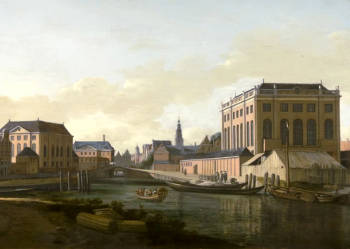
Gerrit Berckheyde Amsterdam's Portuguese Synagogue provides one of the clearest architectural signs of recovery from the Rampjaar. Construction had begun in 1671 but was suspended after the outbreak of war in 1672. Work resumed on May 27, 1674, under architect Elias Bouman (c. 1636–1686). New contracts followed for the surrounding buildings and masonry. The synagogue would be completed and inaugurated in 1675. Thus the resumption of work itself becomes evidence that Amsterdam's Sephardic community again felt able to commit substantial resources to a monumental public building. The violent storm of August 1 complicated matters: the unfinished synagogue suffered damage, but construction continued. The building's enormous rectangular interior, tall round-headed windows, galleries, timber roof, and restrained classical exterior would eventually make it one of the most imposing Jewish religious structures in seventeenth-century Europe. 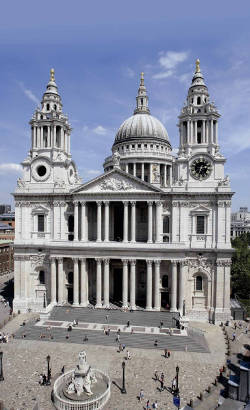
Christopher Wren In London, Christopher Wren (1632–1723) reached an important turning point in designing the new St. Paul's Cathedral. His enormous wooden Great Model was being completed in 1674, and in May the cathedral commissioners initially proceeded on the assumption that construction would follow it. Carpenters began measuring and marking the site. During the latter part of the year, however, the design was set aside, probably because its centralized arrangement and circular choir were considered insufficiently suited to cathedral worship. Wren consequently began the sequence of revisions that led toward the design approved in 1675. Versailles continued simultaneously to develop as a planned town as well as a palace. Streets and squares were increasingly coordinated with the axes leading toward the château, while new housing accommodated officials, craftsmen, servants, soldiers, merchants, and members of the expanding court. The contrast with older cities such as Delft is worth emphasizing: Delft retained the inherited fabric of canals, medieval streets, churches, guild houses, and converted industrial buildings, whereas Versailles was being reorganized in direct relation to the residence and authority of a monarch. |
| MUSIC |
MUSIC (1674)
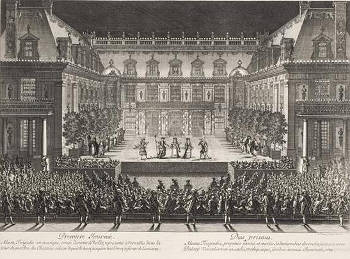
Jean Le Pautre On January 19, 1674, Alceste, with music by Jean-Baptiste Lully (1632–1687) and a libretto by Philippe Quinault (1635–1688), was first performed at the Palais-Royal in Paris. Structured as a prologue and five acts, it continued the new French form of tragédie en musique established with Cadmus et Hermione the previous year. Sung drama, dance, chorus, orchestral music, mythological spectacle, and stage machinery were fused into a form closely linked to the institutions and ceremonial world of the French monarchy. In the Dutch Republic, Carolus Hacquart (c. 1640–c. 1701) published his Cantiones Sacrae in Amsterdam in 1674. The collection contained ten Latin sacred pieces for varying combinations of voices and instruments. Hacquart had settled in Amsterdam around 1670, attracted by the city's flourishing culture of amateur music making, and worked as a teacher of lute and viol as well as a composer. His publication provides a useful Dutch counterpart to the large theatrical productions of Lully: music in the Republic depended heavily upon churches, private households, wealthy amateurs, teachers, small ensembles, and printed music rather than upon a permanent royal opera establishment. The dedication of Hacquart's collection to William III also reminds us how readily culture and politics overlapped. Musical publications could advertise patronage, social connections, loyalty, and status while circulating compositions among performers. The Dutch musical world was less centralized than the French one, but it was thoroughly connected to printing, teaching, instrument making, private sociability, and elite networks. |
| LITERATURE |
LITERATURE (1674)
Nicolas Boileau (1636–1711) published his L'Art poétique in 1674, a didactic poem in four cantos setting out principles for poetry and literary composition. Boileau stressed clarity, discipline, proportion, decorum, and the study of classical models. The work became one of the central statements of French literary classicism and belongs to the same intellectual environment in which academies increasingly attempted to formulate rules governing language, literature, painting, architecture, and theater. At Versailles on August 18, Jean Racine (1639–1699) presented Iphigénie before the court. The five-act tragedy reworked the ancient story of Iphigenia and the Greek expedition to Troy. Its first performance formed part of the elaborate festivities at Versailles that combined theater, music, banquets, fountains, illuminations, and royal ceremony. The play reached the Paris stage shortly afterward and was published the following year. 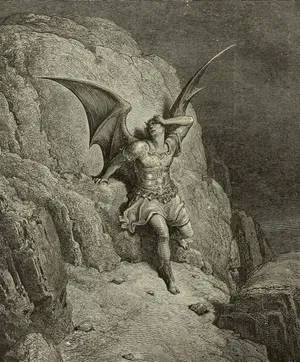
John Milton In England, John Milton (1608–1674) issued the second, revised edition of Paradise Lost in 1674. The epic was reorganized from ten books into twelve, bringing its formal arrangement closer to classical epic models. This is the form in which Paradise Lost has generally been known ever since. Milton died later that year, making the 1674 edition the final version published during his lifetime. These three publications are wonderfully revealing together. Boileau codified poetic practice; Racine demonstrated the concentrated dramatic power of French classicism; and Milton revised a vast Protestant Christian epic modeled partly upon classical precedent. Antiquity remained an active resource rather than a dead inheritance, continuously translated and reworked for very different religious, political, and literary cultures. |
| SCIENCE, MATHEMATICS, & PHILOSOPHY |
SCIENCE, MATHEMATICS, & PHILOSOPHY (1674)
Leeuwenhoek's work in Delft belongs at the center of the scientific history of 1674. His September letter on microscopic organisms in Berkelse Meer water substantially widened the range of living things accessible to human observation. Equally important was the practical character of his method: small lenses, handmade mounts, capillary tubes, carefully prepared specimens, repeated observations, and written descriptions were the material foundation of the discoveries. Robert Hooke (1635–1703) published An Attempt to Prove the Motion of the Earth from Observations in London in 1674. Hooke sought observational evidence for the Earth's movement, particularly through stellar parallax—the apparent displacement of a star as the observer's position changes. The work illustrates a central difficulty of seventeenth-century astronomy: Copernican planetary motion could be mathematically persuasive while the tiny observational effects expected from the Earth's movement remained extremely difficult to measure with contemporary instruments. Mathematician John Wallis (1616–1703) presented his Discourse of Gravity and Gravitation Grounded on Experimental Observations to the Royal Society on November 12, 1674. The title itself captures a major intellectual tendency of the period: problems traditionally treated philosophically were increasingly subjected to mathematical treatment and experimental observation. 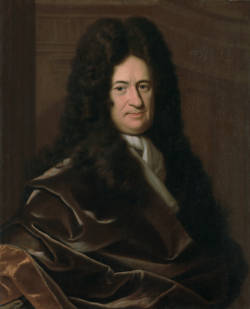
Christoph Bernhard Francke Meanwhile Gottfried Wilhelm Leibniz (1646–1716) was developing new methods in mathematics while working in Paris and communicating with Christiaan Huygens (1629–1695) and the Royal Society network. During this period he worked out the alternating infinite series later commonly associated with Gregory and Leibniz for calculating π. Such work formed part of the intense mathematical activity from which the differential and integral calculus would soon emerge in more systematic form. |
| WORLD HISTORY & POLITICS |
WORLD HISTORY & POLITICS (1674)
The Treaty of Westminster had consequences across the Atlantic. The Dutch had retaken New Netherland from England in 1673, temporarily restoring Dutch authority over New York and surrounding territory. Under the 1674 peace settlement, however, the colony was returned to English control. The episode demonstrated how European treaties could determine sovereignty over settlements thousands of miles away and how the Anglo-Dutch struggle remained tied to trade routes and colonial possessions as well as to European waters. 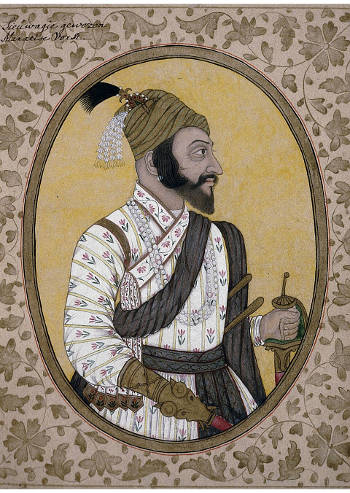
Anonymous In western India, Shivaji (1630–1680) underwent a formal coronation at Raigad on June 6, 1674. The ceremony publicly asserted his position as an independent sovereign and provided a formal dynastic and ritual framework for Maratha rule. Contemporary English observers were present, and accounts describe the throne, ministers, ceremonial insignia, ritual bathing, and elaborate court observances. In the Polish-Lithuanian Commonwealth, John III Sobieski (1629–1696) was elected king on May 21, 1674, following the death of Michael Korybut Wiśniowiecki and Sobieski's major military success against Ottoman forces at Khotyn the previous year. His election occurred while the Commonwealth remained engaged in conflict with the Ottoman Empire and its allies. 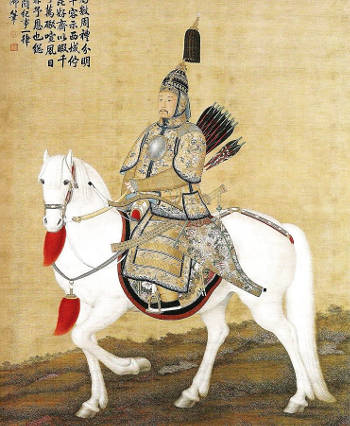
Anonymous In East Asia, the reign of the Kangxi Emperor (1654–1722) was confronted by the expanding Revolt of the Three Feudatories, which had begun late in 1673. During 1674 the rebellion spread across parts of southern China as powerful regional military governors challenged Qing central authority. The conflict would continue for several years before imperial forces reestablished control. Thus the political world of 1674 stretched well beyond the continuing Franco-Dutch War: colonial sovereignty changed hands in North America, Maratha kingship received formal ceremonial expression in India, an elective monarchy selected a new ruler in Poland-Lithuania, and the Qing empire faced a major internal rebellion. |
| DAILY LIFE |
DAILY LIFE (1674)
|
| SIGNIFICANT BIRTHS |
SIGNIFICANT BIRTHS (1674)
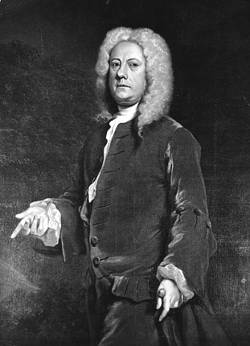
Anonymous Jethro Tull (1674–1741) was born in 1674. He would become an English agricultural writer and experimenter associated especially with the development and promotion of mechanical seed drilling and more systematic cultivation. His later Horse-Hoeing Husbandry became an important text in the history of agricultural improvement. Isaac Watts (1674–1748) was also born in 1674. A Nonconformist minister, theologian, educator, and prolific hymn writer, he would play a major role in reshaping English Protestant congregational singing. Many of his hymns continued to be sung centuries after his death. Philippe II, Duke of Orléans (1674–1723) was born the same year. A nephew of Louis XIV, he would later become regent of France during the minority of Louis XV, from 1715 until 1723, placing him at the center of French government during the transition following Louis XIV's long reign. He also assembled an important collection of European painting. Painter Alexis-Simon Belle (1674–1734) belongs to the same generation. He later became particularly associated with portraiture among the exiled Jacobite court and French aristocracy, demonstrating how painters could build careers across the interconnected courts of early eighteenth-century Europe. The birth year therefore brings together figures later associated with agriculture, Protestant hymnody, French government, and court portraiture—a generation whose mature careers would belong primarily to the early eighteenth century. |
| NATURAL EVENTS |
NATURAL EVENTS (1674)
On August 1, 1674, an extraordinary line of severe thunderstorms crossed the Low Countries. Modern reconstruction by the Royal Netherlands Meteorological Institute indicates an exceptionally powerful squall line accompanied by violent downbursts and localized rotating wind phenomena. Damage stretched from northern France through Belgium and the Netherlands toward northern Germany. 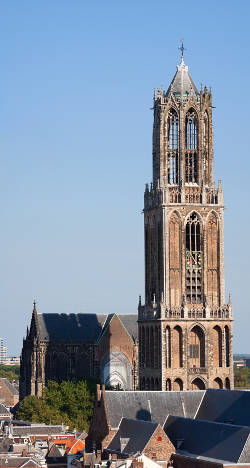
Utrecht Utrecht was struck especially hard. The nave of the great medieval Dom Church collapsed, while remarkably the massive Dom Tower survived. Other church towers, mills, roofs, trees, and buildings throughout the city were damaged or destroyed. The ruined gap between tower and surviving choir permanently altered the physical form of central Utrecht and remains visible today. Amsterdam also suffered severely: trees were uprooted, ships broke from their moorings, roofs and gables were damaged, and windows and tiles were shattered across the city. The unfinished Portuguese Synagogue, whose construction had only recently resumed after the wartime interruption, was among the buildings damaged. Contemporary observers struggled to describe the violence of what became known as the Schrickelik Tempeest—the "terrible tempest." Modern meteorological reconstruction suggests that some gusts may have reached extraordinary velocities. An even more catastrophic natural disaster occurred on Ambon in the Dutch East Indies. In 1674 a major earthquake was followed by a devastating tsunami. The naturalist Georg Eberhard Rumphius (1627–1702) later recorded the disaster in exceptional detail. Modern research based upon his account estimates that the tsunami reached an extraordinary local run-up of approximately 100 meters on Ambon's northern coast and caused more than 2,300 deaths. Current modeling indicates that an earthquake-triggered coastal landslide probably produced the extreme local wave rather than tectonic displacement alone. This is a particularly valuable event for the chronology because it connects Dutch natural history, colonial expansion, and environmental disaster. Rumphius was not observing a distant event reported secondhand: he lived within the Dutch colonial world of the Moluccas and recorded a catastrophe experienced directly by local communities. Taken together, 1674 feels much less like the abyss of 1672 and more like a year of readjustment. England, Münster, and Cologne leave the coalition against the Republic, although war with France continues; construction resumes in Amsterdam; Dutch civic institutions settle into the post-1672 political order; and Delft once again offers an unusually intimate view of seventeenth-century life. Vermeer joins the civic militia, deals with family affairs, and sees his eldest daughter marry; Bramer's studio is dispersed after his death; and only a short distance away Leeuwenhoek looks into a bottle of lake water and finds an entire living world that had previously been invisible. For a chronology centered on Vermeer, that last juxtaposition is especially worth preserving. |
1675: Vermeer's Age, 43
| 1675 | late-career maturity, economic deterioration, Rampjaar, and death |
|---|---|
| VERMEER'S LIFE & ART |
VERMEER'S LIFE & ART (1675)
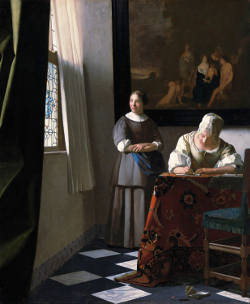
Johannes Vermeer The financial pressures surrounding Vermeer become unusually visible during his final year. On March 5 he received power of attorney from his mother-in-law Maria Thins (c. 1593–1680) to represent her in an inheritance matter, and later that month he traveled to Gouda in connection with land she owned near Wilnis. The surviving document records that the tenants were unable to pay rents for 1673 and 1674 because of the war, and Vermeer agreed that those arrears could be remitted. Here the Franco-Dutch War can be seen reaching directly into the finances of the household in which Vermeer lived. In July Vermeer traveled to Amsterdam and borrowed 1,000 guilders, using as security an obligation worth 2,900 guilders from which Maria Thins received the income. This is the last surviving document in which Vermeer is known to have acted while alive. A loan of this size does not by itself prove insolvency, but in conjunction with the later bankruptcy records it indicates a pressing need for ready money during his final months. 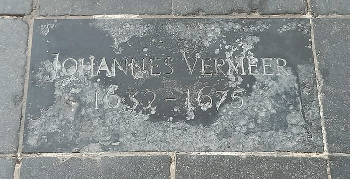
Vermeer died in the second week of December 1675, aged forty-three, following an illness that his widow later described as lasting only about a day and a half. The burial records place his interment in the family grave in Delft's Oude Kerk in mid-December. His funeral was substantial: fourteen pallbearers carried the coffin and the church bell was rung, signs that his family still arranged a respectable public burial despite its financial difficulties. He left his wife Catharina Bolnes (c. 1631–1687) and eleven surviving children, ten of them minors.
Johannes Vermeer
Johannes Vermeer
Johannes Vermeer The documents drawn up after his death make the consequences of the economic crisis clearer than anything written during his lifetime. Catharina later explained that the war with France had caused such a collapse in Vermeer's business as an art dealer that he had been unable to sell either his own paintings or works by other artists. The family owed the baker more than 600 guilders, eventually pledging The Guitar Player and Lady Writing a Letter with Her Maid toward settlement of that debt.
Johannes Vermeer
Johannes Vermeer No surviving painting can securely be assigned to 1675 itself although the dark Lady Seated at a Virginal is often seen as one of the very latest works, citing it preumably inferior facture. |
| DELFT |
DELFT (1675)
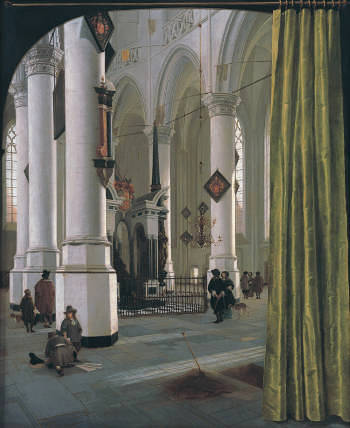
Hendrick Cornelisz. van Vliet Vermeer was not the only significant Delft painter to die in 1675. Hendrick Cornelisz. van Vliet (c. 1611–1675), one of the principal painters of Delft church interiors, was buried in the Oude Kerk on October 28. Van Vliet had begun as a portrait painter but around 1651 turned increasingly toward architectural interiors. His repeated views of the Oude and Nieuwe Kerken transformed familiar Delft buildings into carefully ordered fields of perspective, pale masonry, tiled floors, tombs, figures, dogs, children, and shafts of cool daylight. His death is particularly meaningful in a Delft chronology. The architectural school associated with Gerard Houckgeest (c. 1600–1661), Van Vliet, and Emanuel de Witte (c. 1617–1692) had been one of the city's major artistic developments around the time Vermeer emerged as a painter. By 1675 both Houckgeest and Van Vliet were dead, De Witte had long since moved to Amsterdam, and Vermeer himself would die only weeks after Van Vliet. 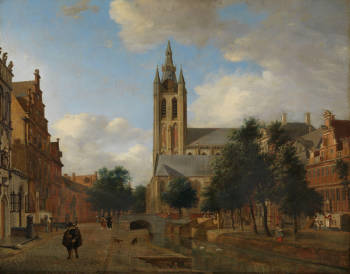
Jan van der Heyden 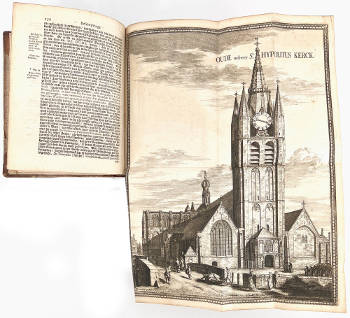
Dirck can Bleyswijck Yet Delft itself was still attracting painters from elsewhere. Jan van der Heyden (1637–1712) painted The Oude Delft Canal and the Oude Kerk, Delft in 1675, providing a remarkably lucid view of one of the city's principal canals and the great leaning tower of the Oude Kerk. The painting is especially appropriate to Vermeer's final year: while Vermeer's surviving cityscape belongs to an earlier phase of his career, Van der Heyden gives us another meticulously ordered image of the same compact urban environment as Vermeer's life came to its close. The inventory of the Amsterdam art dealer Johannes de Renialme (c. 1600–1657), drawn up on June 27, 1657, lists a painting described as een graft besoeckende van der Meer, valued at twenty guilders. Traditionally identified as Vermeer’s lost Visit to the Tomb, the work has generally been interpreted as a biblical history painting depicting the Holy Women visiting Christ’s sepulcher following the Crucifixion. However, the original Dutch description neither identifies the tomb as Christ’s nor specifies the figures involved. This ambiguity leaves open another, admittedly speculative interpretation: that the painting represented visitors to a funerary monument, possibly the celebrated tomb of William the Silent (1533–1584) in Delft’s Nieuwe Kerk. Such an interpretation acquires a degree of plausibility when considered against the remarkable popularity of church-interior painting in Delft during the early and middle 1650s. Gerard Houckgeest (c. 1600–1661), Emanuel de Witte (c. 1617–1692), and Hendrick Cornelisz. van Vliet (c. 1611–1675) repeatedly depicted the city's principal churches, frequently giving particular prominence to the imposing marble monument of William the Silent. Completed in 1622, the tomb was among the most celebrated monuments in the Dutch Republic and attracted considerable numbers of visitors. Houckgeest's paintings of 1651 and De Witte's compositions of the following years established a recognizable pictorial formula in which visitors contemplate the monument within an elaborate architectural setting. The combination of carefully constructed perspective, natural illumination, monumental architecture, and small groups of figures provided a particularly appealing subject for collectors. As an artist working in Delft during the height of this fashion, Vermeer would undoubtedly have been familiar with such paintings, and it is conceivable that he briefly experimented with the genre before concentrating on domestic interiors. Nevertheless, the hypothesis remains entirely conjectural. Nothing in the surviving documentation establishes that the lost painting represented William's tomb or, indeed, any recognizable church interior. Moreover, the conventional biblical interpretation accords comfortably with Vermeer's earliest surviving paintings, particularly Christ in the House of Martha and Mary and Diana and Her Companions, which demonstrate his initial engagement with religious and mythological subjects. Yet the possibility of an architectural composition should not be dismissed altogether. If the painting did represent a contemporary visit to a tomb, rather than an episode from sacred history, it would suggest that Vermeer's early artistic interests were broader than his surviving works indicate, potentially extending to the architectural perspective and carefully observed illumination that distinguished the Delft school of church-interior painting. Delft's political identity also entered its art. Around 1675 Cornelis de Man (1621–1706) painted a portrait of the former stadholder William II (1626–1650) after a model by Gerard van Honthorst (1592–1656). De Man was closely involved with Delft's Guild of Saint Luke and had served repeatedly in its government. Such retrospective Orange portraits acquired renewed relevance after the restoration of the stadholderate under William III (1650–1702) during the crisis of 1672. 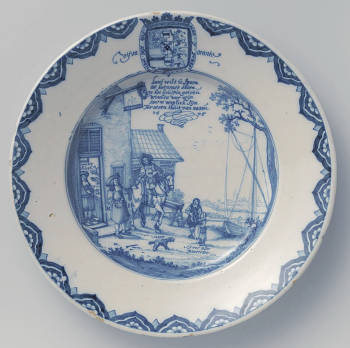
Anonymous The same political culture appears in Delft pottery. A large tin-glazed earthenware dish dated 1675, now in the Rijksmuseum, depicts the Kruipin inn together with an equestrian image of William III and the motto of the Order of the Garter. The museum classifies its subject explicitly under Orangist political history. Delft faience was therefore capable of carrying topical political imagery as readily as floral, Chinese-inspired, heraldic, or domestic decoration. Delft's international commercial connections also continued. The VOC vessel Stad Grave was built in 1675 for the Delft Chamber at its Delfshaven shipyard. The 474-ton ship departed the Maas on November 8 with approximately 140 people aboard, bound for Batavia. While Vermeer's household was struggling financially on the Oude Langendijk, the institutional machinery connecting Delft with Asian trade remained very much in operation. |
| DUTCH ART |
DUTCH ART (1675)
Dutch painting lost another major figure early in the year. Gerrit Dou (1613–1675) was buried in Leiden's Pieterskerk on February 9. His estate was valued at approximately 20,000 guilders, testimony to the extraordinary commercial success he had achieved. Dou had established the Leiden tradition of fijnschilderij—highly finished cabinet painting characterized by minute detail, polished surfaces, controlled illumination, and painstaking technique. His influence extended through painters such as Frans van Mieris and Godfried Schalcken and well into the eighteenth century. 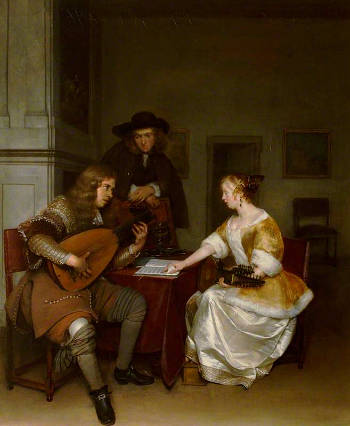
Gerrit ter Borch 1675 — The Duet, Waddesdon Manor. Dated 1675, The Duet is Gerrit ter Borch's last securely dated painting. He returned here to a subject that had occupied him for decades: elegant figures joined by music within a refined domestic interior. Its late date is especially useful because it demonstrates the persistence of the musical courtship theme through the final years of Vermeer's lifetime. Vermeer's late Lady Standing at a Virginal and Lady Seated at a Virginal similarly return to music, but with the characteristic difference that Ter Borch retains interpersonal exchange and implied social narrative, while Vermeer reduces the situation to an almost motionless encounter between a woman, an instrument, and the surrounding room. The comparison shows two very different conclusions drawn from one of the central subjects of Dutch high-life genre painting. Frans van Mieris (1635–1681). Van Mieris painted The Family Concert in 1675, continuing his long engagement with music and fashionable domestic society. In the same year Joachim von Sandrart (1606–1688) praised Van Mieris's astonishing ability to reproduce different textiles, singling out The Cloth Shop and its convincing representation of fabrics. The comparison with Vermeer at the end of his life is especially instructive: both had made music, costly fabrics, and prosperous interiors central to their art, but Van Mieris's international reputation rested upon laborious finish and dazzling material description, whereas Vermeer developed an increasingly economical visual language in which objects are subordinated to light, color, space, and human concentration. 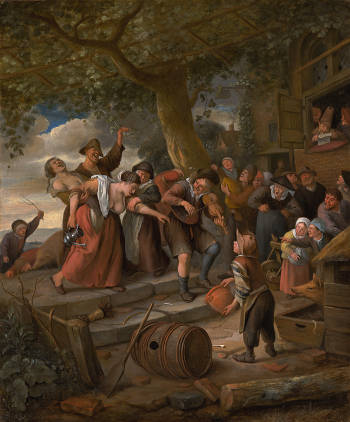
Jan Steen Jan Steen (1626–1679) was meanwhile still producing vigorously comic paintings. A Pig Belongs in the Sty, generally dated c. 1673–1675, returns to a peasant milieu of drinking, disorder, and coarse behavior. Steen makes the proverbial comparison between drunken human conduct and animal behavior explicit by having a pig wander among the revelers. The picture is far removed from Vermeer's silent interiors, yet both belonged to the same broad Dutch tradition of using recognizable domestic or social situations to invite interpretation. Edwaert Collier (c. 1640–1708) signed and dated a compact Vanitas Still Life in 1675. Such pictures assembled books, documents, musical instruments, skulls, timepieces, extinguished candles, and other objects associated with learning, pleasure, wealth, time, and death. In the year of Vermeer's death, this well-established Dutch pictorial language of impermanence continued to find buyers. 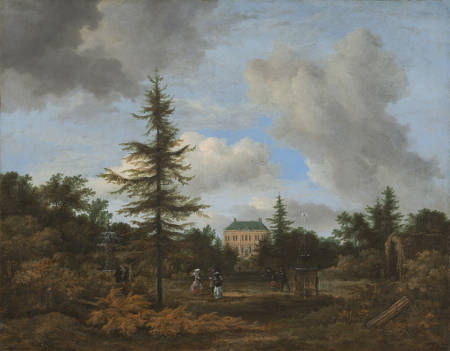
Jacob van Ruisdael Landscape painting was equally active. Jacob van Ruisdael (c. 1628–1682) painted Country House in a Park around 1675, showing an elegant residence amid elaborate fountains, exotic spruce trees, garden structures, and strolling figures. Country houses had become increasingly fashionable as prosperous urban merchants established estates outside the cities, especially along waterways such as the Vecht. Ruisdael probably did not depict a single identifiable property; instead he constructed an ideal of cultivated country leisure while introducing fallen architectural and natural forms that suggest the passage of time. Thus the deaths of Vermeer and Dou in 1675 should not be mistaken for an abrupt ending of Dutch painting. Steen, Ruisdael, De Witte, De Hooch, Van der Heyden, De Man, Collier, and many others remained active. What was changing was the extraordinary economic environment that had supported the exceptionally large number of professional painters earlier in the century. |
| DUTCH REPUBLIC |
DUTCH REPUBLIC (1675)
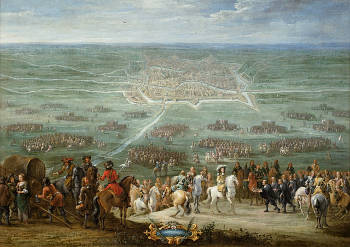
Lambert de Hondt (II) The Dutch Republic was still engaged in the Franco-Dutch War, but the strategic situation was completely different from the catastrophe of 1672. England, Münster, and Cologne had already left the original anti-Dutch coalition. Dutch policy now depended increasingly upon a wider alliance against France involving Spain, the Holy Roman emperor, Brandenburg, and several German states. On January 26, 1675, the States General concluded a treaty of "confederation, assistance and defense" at The Hague with the Holy Roman emperor, Spain, and the bishop of Osnabrück. In October a further defensive agreement was concluded among the Republic, Spain, and the bishop of Münster—the same Münster that had invaded the Republic only three years earlier. The rapid alteration of alliances demonstrates how thoroughly the original Dutch emergency had developed into a wider European struggle over the power of France. Relations with England, meanwhile, were being normalized after the Treaty of Westminster of 1674. On March 8, 1675, England and the States General concluded a specific agreement intended to prevent or settle disputes between the English East India Company and the VOC. Commercial rivalry therefore continued even after naval hostilities had ended, but it was increasingly being handled through negotiation rather than fleet action. 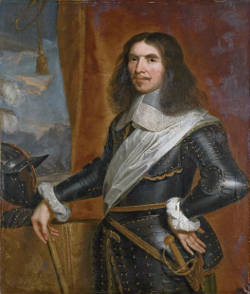
Circle of Philippe de Champaigne The land war remained severe. Henri de La Tour d'Auvergne, Vicomte de Turenne (1611–1675), one of France's most important commanders, was killed by artillery fire near Salzbach on July 27 during operations against Imperial forces. His death deprived Louis XIV (1638–1715) of a highly experienced general while the war continued along the Rhine and in the Spanish Netherlands. For the Dutch population, the important fact was that the war had ceased to threaten the immediate survival of Holland but continued to consume taxes, credit, soldiers, supplies, and diplomatic attention. This helps explain why economic recovery did not instantly restore the buoyant art market of the 1650s and 1660s. Vermeer's final financial difficulties belong to this longer aftershock rather than merely to the panic of the Rampjaar itself. |
| EUROPEAN PAINTING & SCULPTURE |
EUROPEAN PAINTING & SCULPTURE (1675)
At Versailles, the enormous sculptural program known as the Grande Commande, devised in 1674 under Charles Le Brun (1619–1690), was gathering momentum. It called for eight sculptural groups associated with the four elements and twenty-four statues representing such concepts as the continents, seasons, hours of the day, human temperaments, and poetic forms. Teams of leading French sculptors would work on these marbles for nearly two decades. The program reveals how differently art could function under Louis XIV from the private market in the Dutch Republic. Sculpture, architecture, waterworks, gardens, mythology, royal ceremony, and political symbolism were being coordinated across an immense site. The individual statue belonged to a much larger system intended to organize nature, antiquity, and allegory around the person of the monarch. Rome lost one of its leading landscape painters when Gaspard Dughet (1615–1675) died on May 25. Closely connected with his brother-in-law Nicolas Poussin (1594–1665), Dughet developed an idealized but vigorous form of landscape painting built from wooded slopes, rocky terrain, storms, distant valleys, and small human figures. His work helped establish landscape as a major field of Italian and international collecting rather than merely a setting for history painting. |
| ARCHITECTURE |
ARCHITECTURE (1675)
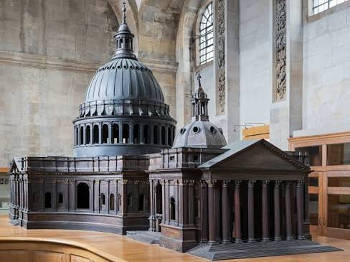
Christopher Wren In London, one of the century's greatest architectural undertakings moved from planning into construction. After the rejection of his earlier Great Model, Christopher Wren (1632–1723) prepared a cruciform design for the new St. Paul's Cathedral. Charles II (1630–1685) approved it by royal warrant on May 14, 1675, and five days later the building committee ordered work to begin on the foundations. The first major masonry contracts followed in June. Wren did not simply execute a completely predetermined design. Surviving drawings and building records show that he revised proportions and structural arrangements as construction proceeded. The cathedral that eventually emerged was therefore the result of a prolonged process of architectural adjustment extending far beyond 1675. Another extraordinarily important building began the same year at Greenwich. On March 4, 1675, John Flamsteed (1646–1719) was appointed the king's "astronomical observator." On June 22 Charles II authorized construction of an observatory in Greenwich Park, expressly linking its purpose with astronomy and the determination of longitude for navigation. The foundation stone was laid on August 10. Wren supplied the design, while Robert Hooke (1635–1703) supervised construction. Amsterdam, meanwhile, completed one of the most impressive religious buildings of the Dutch seventeenth century. The great Portuguese Synagogue, designed principally by Elias Bouman (1636–1686), was inaugurated in August 1675 after construction interrupted by the Rampjaar had resumed the previous year. A large print by Romeyn de Hooghe (1645–1708) records the crowded dedication ceremony, Torah scrolls being carried toward the ark, and allegorical figures representing Amsterdam and liberty of conscience. 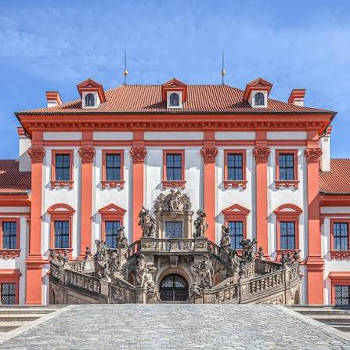
Jean-Baptiste Mathey Farther east, the French architect Jean-Baptiste Mathey (c. 1630–1695) arrived in Prague in 1675, bringing with him a combination of French classicism and Roman architectural experience. He began work on the archiepiscopal palace and would spend nearly twenty years in Bohemia, contributing significantly to the diffusion of western European architectural ideas into central Europe. |
| MUSIC |
MUSIC (1675)
On January 11, 1675, Thésée, with music by Jean-Baptiste Lully (1632–1687) and a libretto by Philippe Quinault (1635–1688), received its first performance at Saint-Germain-en-Laye. Organized as a prologue and five acts, it continued the tragédie en musique that Lully and Quinault had been developing since Cadmus et Hermione. Chorus, solo singing, instrumental music, dancing, mythological narrative, and stage spectacle were brought together within the institutional framework of the Académie royale de musique. The prologue itself referred to contemporary warfare, allowing classical mythology and royal politics to overlap. French opera under Lully was therefore not simply musical entertainment: its subjects, prologues, staging, and institutional privileges formed part of the ceremonial culture surrounding Louis XIV. 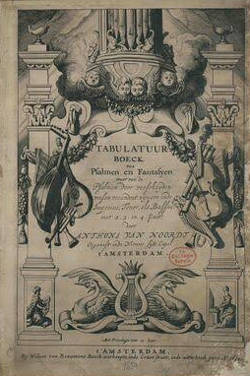
Anthoni van Noordt Dutch musical life remained far less centralized. One significant loss was Anthoni van Noordt (c. 1619–1675), the Amsterdam organist and composer who was buried on March 23. Van Noordt's Tabulatuur-boeck van psalmen en fantasyen had represented one of the major surviving bodies of Dutch keyboard music after Jan Pieterszoon Sweelinck (1562–1621). His contrapuntal psalm variations and fantasias belonged to a strong northern European organ tradition linking Dutch churches with German keyboard culture. The contrast with France remained substantial. Paris and the royal court could support highly organized theatrical productions with orchestras, dancers, singers, scenery, and machinery; Dutch music remained more dispersed among churches, city organists, private teachers, amateur performers, chambers, taverns, and prosperous households. |
| LITERATURE |
LITERATURE (1675)
In England, William Wycherley (1640–1716) published The Country Wife in 1675, following its performance at the Theatre Royal. The comedy borrows elements from works by Molière (1622–1673) but transforms them into the fast-moving, socially aggressive world of Restoration London. Sexual deception, marriage, reputation, urban sophistication, and hypocrisy are treated with a frankness very different from the moralizing domestic literature circulating in the Dutch Republic. In France, Jean de La Fontaine (1621–1695) published Nouveaux contes in 1675. These verse tales belonged to the worldly and often erotic side of La Fontaine's writing rather than the moral fables for which he later became most universally known. The volume reminds us that seventeenth-century literary culture embraced bawdy narrative, satire, classical imitation, courtly poetry, religious writing, drama, scientific prose, and political pamphleteering simultaneously. The Dutch philosopher Baruch Spinoza (1632–1677) was meanwhile contemplating publication of his Ethics. Correspondence with Henry Oldenburg (c. 1619–1677) in July 1675 refers explicitly to Spinoza's intention to publish a five-part treatise. Faced with growing controversy surrounding his ideas, however, Spinoza withheld the book. The Ethics would appear only posthumously in 1677. Amsterdam also produced an extraordinary book at the boundary between literature, science, and religion. Jan Swammerdam (1637–1680) published Ephemeri vita, of Afbeeldingh van 's menschen leven in 1675, a detailed study of the mayfly. Swammerdam used the insect's extraordinarily brief adult life both as an object of exact anatomical investigation and as a meditation upon human existence. The book's engraved illustrations documented stages of development with remarkable precision while its text repeatedly connected natural observation with religious reflection. |
| SCIENCE, MATHEMATICS, & PHILOSOPHY |
SCIENCE, MATHEMATICS, & PHILOSOPHY (1675)
In Delft, Antonie van Leeuwenhoek (1632–1723) continued the extraordinary sequence of observations begun the preceding year. On January 22, 1675, he wrote from Delft to Henry Oldenburg describing improved methods for observing blood corpuscles and brain tissue, investigations of the optic nerve, tobacco and tobacco smoke, experiments involving saltpeter and gunpowder, and the sting and poison of scorpions. A letter of February 11 ranged just as widely: crystallization of salts, vinegar, soap, acids, pepper, mustard, fish bile, cod roe, and the optic nerves of animals. On March 26 he discussed marrow, peas, blood, transparency, circulation in leaves, and the structure of a louse's leg. In August he returned to blood corpuscles but also investigated plant sap, taste, sugar, salt, digestion, and poisons. What is especially striking is the material ordinariness of his subjects. Leeuwenhoek did not require rare astronomical instruments or exotic specimens. Soap, mustard, pepper, tobacco, blood, leaves, fish eggs, insects, water, and crystals became objects of natural philosophy once placed before sufficiently powerful lenses and examined with sustained attention. Delft's workshops, kitchens, bodies, canals, shops, and surrounding countryside supplied his laboratory. Swammerdam's Ephemeri vita offers a parallel form of close observation. His illustrations trace the mayfly through its aquatic and adult stages, showing anatomical structures and metamorphosis in detail. Together, Swammerdam and Leeuwenhoek demonstrate how insects and other small organisms were becoming central evidence in debates over generation, anatomy, development, and the organization of living matter. 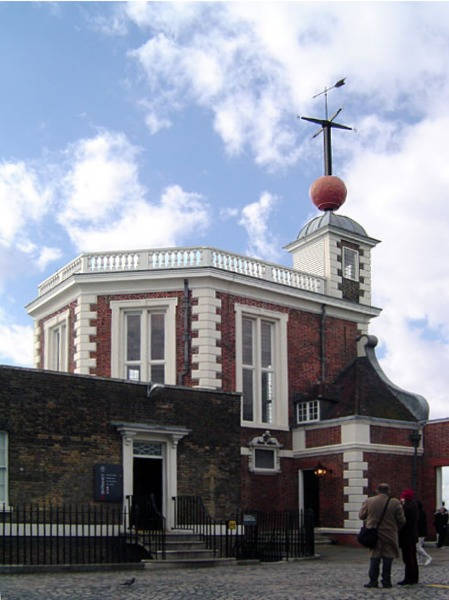
The founding of the Royal Observatory at Greenwich supplied the opposite scale of investigation. Its warrant explicitly connected astronomical measurement with the practical problem of finding longitude at sea. Astronomy, maritime trade, navigation, state patronage, mathematics, clockmaking, and instrument construction were therefore being drawn together within a permanent scientific institution. The contrast could scarcely be greater: Leeuwenhoek looked into blood and pond organisms through a lens scarcely larger than a pinhead while Flamsteed prepared to measure the heavens from a purpose-built observatory. Both belonged to the same rapidly developing culture of exact observation. |
| WORLD HISTORY & POLITICS |
WORLD HISTORY & POLITICS (1675)
The Franco-Dutch conflict continued to widen geographically. France's Swedish allies invaded Brandenburg, bringing Frederick William, Elector of Brandenburg (1620–1688) rapidly northward with his army. At the Battle of Fehrbellin on June 28, 1675, Brandenburg forces defeated the Swedish army. The battle acquired considerable importance in later Brandenburg-Prussian political memory and opened a northern theater connected with the broader European coalition war against France. Across the Atlantic, King Philip's War began in New England in June 1675 following mounting conflict between English colonists and Indigenous communities, particularly the Wampanoag led by Metacom (c. 1638–1676), known to the English as King Philip. Land loss, political jurisdiction, colonial expansion, and a series of violent incidents all contributed to the outbreak. The conflict rapidly spread beyond Plymouth Colony. The Narragansett initially sought to remain neutral and sheltered Wampanoag noncombatants. In December colonial forces attacked the Narragansett winter settlement in what became known as the Great Swamp Fight, killing large numbers of inhabitants and drawing the Narragansett directly into the war. King Philip's War became one of the most destructive conflicts, proportionate to population, in seventeenth-century northeastern North America. These events underline the global reach of warfare in Vermeer's final year. European dynastic and commercial rivalry stretched from the Rhine to the Baltic and overseas colonies, while Indigenous resistance to territorial expansion produced wars whose causes and consequences were very different from those of European state conflict. |
| DAILY LIFE |
DAILY LIFE (1675)
The effects of the long war were still being felt in household finances. Vermeer's documents provide a particularly intimate example: tenants on land belonging to Maria Thins were unable to meet rents because of wartime conditions, while Vermeer himself borrowed 1,000 guilders only months before his death. The economic consequences of warfare could therefore pass from international politics through agricultural rents and investments into the finances of an individual Delft household. Leeuwenhoek's letters offer a completely different inventory of daily material culture. Soap, vinegar, pepper, mustard, tobacco, salt, sugar, fish, plants, blood, and drinking water all appear as experimental substances. These were ordinary things purchased, consumed, prepared, cleaned with, smoked, tasted, or encountered in everyday life. Microscopy was making the commonplace visually unfamiliar. 
After Romeyn de Hooghe Late in the year, however, water became threatening on an entirely different scale. A violent northwesterly storm on November 5 broke major dikes in North Holland. At Scharwoude the Omringdijk failed around 2:30 in the morning, flooding the region between Heerhugowaard, Hoorn, Enkhuizen, and Medemblik with salt water. Although no human deaths are recorded there, large numbers of livestock drowned and churches were hastily converted into temporary stables for surviving animals. The storm also breached the Spaarndammerdijk east of Halfweg, opening a gap approximately 140 meters wide and ten meters deep. Together with other failures, this caused extensive flooding from the dunes eastward toward Naarden. The event demonstrates the precariousness beneath the famous Dutch mastery of water: dikes, sluices, mills, canals, and drainage boards could control the landscape only through continuous maintenance, collective taxation, labor, and vigilance. |
| SIGNIFICANT BIRTHS |
SIGNIFICANT BIRTHS (1675)
Evaristo Felice Dall'Abaco (1675–1742) was born in 1675. He became an Italian violinist, cellist, and composer whose sonatas and concertos combined Italian instrumental traditions with musical influences encountered during his career north of the Alps. Several of his later works were published in Amsterdam, demonstrating the continuing importance of Dutch music printing to an international market. Samuel Clarke (1675–1729) was born the same year. He became an English theologian and philosopher closely engaged with Newtonian natural philosophy, questions of divine attributes, morality, metaphysics, and the relationship between reason and religion. His later writings would place him at the center of major intellectual controversies in early eighteenth-century Britain. Tadeusz Jan Krusiński (1675–1757) became a Polish Jesuit missionary and orientalist. He later spent years in Safavid Persia and became an important European source for the Afghan invasion and collapse of the Safavid state in the early eighteenth century. He wrote in Latin and also worked with Persian texts. William Jones (1675–1749) became a Welsh mathematician, teacher, and Fellow of the Royal Society. He is particularly remembered for using the Greek letter π in 1706 for the ratio of a circle's circumference to its diameter, a notation later made standard through the work of Leonhard Euler (1707–1783). Jones also worked extensively on navigation and maintained close contacts with the Newtonian mathematical circle. |
| NATURAL EVENTS |
NATURAL EVENTS (1675)
The most consequential natural disaster affecting the Dutch Republic in 1675 was the great November storm and flood. During the night of November 4–5 a severe northwesterly storm drove water against the defenses of North Holland. Multiple dikes failed, including the Omringdijk at Scharwoude and the Spaarndammerdijk near Halfweg. Large areas of cultivated land were submerged, livestock drowned, and transport and agriculture were seriously disrupted. The disaster did not end when the first storm passed. At Scharwoude the breached dike was provisionally closed on November 29, only for another storm to destroy the repair a few days later; the opening was not finally secured until January 1676. Such episodes remind us that seventeenth-century Dutch hydraulic engineering depended not upon a single technological achievement but upon continual inspection, rebuilding, organization, and expenditure. Far away in Japan, Aso volcano experienced a confirmed eruption beginning on February 16, 1675. The Smithsonian Global Volcanism Program records explosive activity at Naka-dake, including explosions and the ejection of blocks, with a Volcanic Explosivity Index of 2. 1675 consequently brings the chronology to a fitting but complex close. In Delft, Vermeer borrows money, conducts family business, and dies suddenly in December; Van Vliet dies only weeks earlier; De Man paints images associated with Orange political memory; Delft potteries continue working; a new VOC ship leaves for Asia; and Leeuwenhoek repeatedly sends microscopic observations from Delft to the Royal Society. Elsewhere, Dou dies in Leiden, Lully stages Thésée, Spinoza prepares but withholds the Ethics, Swammerdam publishes his extraordinary study of the mayfly, the Portuguese Synagogue opens in Amsterdam, construction begins on St. Paul's and the Greenwich Observatory, and a catastrophic flood again exposes Holland's dependence upon its dikes. |