Art is filled with specialized language that can often puzzle the lay reader. Many terms used by artists, historians, and critics carry meanings that differ significantly from their everyday use, while others are so particular to the field that they remain virtually unknown outside it. This online glossary aims to clarify these distinctions, offering clear definitions enriched by historical and visual context.
Each entry begins by examining the term within the broader history of art—tracing its development, significance, and changing interpretations across time and cultures. When relevant, the discussion shifts to the term’s role in the Dutch Golden Age, a period of extraordinary artistic innovation, technical refinement, and market-driven production. Here, the glossary highlights how concepts were understood and applied by Dutch painters, collectors, and theorists, situating them within the intellectual and social fabric of the seventeenth century.
Given the focus of this website, many entries also include a dedicated section marked with Vermeer’s distinctive monogram. These sections examine how each concept relates specifically to Vermeer’s work—his use of perspective, light, and material texture, or his place within broader Dutch artistic practices. In doing so, the glossary functions not only as a reference tool, but as a framework for understanding Vermeer’s enduring contribution to the history of art.
With more than 800 carefully curated terms and a network of over 30,000 internal links, the glossary allows users to navigate across multiple facets of art, revealing unexpected connections and deeper layers of meaning. Designed to function as both a structured reference and an open-ended journey, it encourages readers to move beyond isolated definitions—tracing the evolution of artistic ideas across disciplines and centuries. Whether used by scholars or by curious enthusiasts, this glossary offers an extensive, interconnected resource for anyone wishing to deepen their understanding of visual art.
Aanleggen
Aanleggen is a Dutch term for the painting technique called "maniera lavata," that describes a method of dead-coloring (underpainting) in which each specific area of the painting is first approximated in a flat tint—a relatively light wash—before creating the final nuances of form, hue, and light.
In the 17th century, underpainting appeared in various forms, and it is clear that the defunct term was somewhat flexible. Sometimes the underpainting was executed in strict monochrome, or grisaille, and at others as an assembly of evenly blocked-out areas of dull colors that anticipated the final color with a flat tint (localized underpainting). For most painters, the underpainting was not so much a transitional stage, but a provisionally completed whole.
In an English manuscript—the Commonplace-Book (c. 1640–50) compiled by Thomas Marshall (c. 1621–1685) —there is a text cited in Dutch that can be linked to the Flemish master Anthony van Dyck (1599–1641). It describes a method of dead-coloring in which the final color for each individual area is approximated with a flat tint: "'Dead-coloring' is called the maniera lavata, that is to say, the washed manner, because it fills in the area within the outline with only one color."
In an earlier passage in the same manuscript, bearing the title "dead-coloring" in the margin, it appears that a "light-applied color"—most likely the "one color" referred to in the quotation above—was applied over what was termed the "scheme," in Dutch stelsel. The Dutch words stellen (to place) and ordineren (to arrange) were used to describe the organizing of the composition, which, according to the manuscript, occurred before the dead-coloring.
Abrasion
Abrasion, in the context of art and painting, refers to the physical wearing away or erosion of a surface due to friction, handling, or environmental factors. This can occur naturally over time or be the result of intentional interventions, such as cleaning or restoration efforts. In paintings, abrasion often affects the uppermost layers of pigment and varnish, leading to a loss of detail, softening of forms, or exposure of the underlying ground or preparatory layers. This issue is particularly relevant in oil painting, where delicate glazes and fine brushwork can be compromised through excessive or improper cleaning methods. Throughout history, works of art have suffered from abrasion due to a combination of factors, including overzealous restorations, repeated rolling or folding of canvases, or the rubbing of framed works against their surroundings.
In the 17th-century Netherlands, abrasion was a known concern among painters and collectors, though the terminology for it may not have been as explicit as it is today. The widespread use of thin oil glazes in Dutch painting, particularly in works that employed a refined sfumato technique or delicate transitions of light, made certain areas of paintings vulnerable to surface wear. Artists such as Gerrit Dou (1613–1675) and Frans van Mieris (1635–1681), who specialized in fine, meticulously detailed genre scenes, relied heavily on thin layers of translucent paint. If these layers were subjected to repeated cleanings, they could lose their depth and subtlety. Vermeer's works, which often feature soft tonal gradations and precisely rendered surfaces, have also been affected by abrasion over time, particularly in passages of shadow or where delicate glazes were used to create luminosity. In some cases, areas of paintings by Dutch masters exhibit a dull or chalky appearance due to the loss of original glazes, a direct consequence of historical cleaning practices that did not yet account for the long-term effects of abrasive methods.
Art dealers and collectors in the Dutch Republic were acutely aware of issues related to surface damage, as paintings were frequently bought, sold, and transported across cities and international markets. The rise of connoisseurship during this period meant that discerning buyersscrutinized works for their state of preservation, and excessive wear could diminish a painting's desirability. The presence of abrasion in 17th-century Dutch paintings today often provides insight into the painting's history, revealing not only the artist's original technique but also the interventions and misfortunes that the work has endured over centuries.
Abrasion is a major issue in several of Vermeer's paintings, affecting both their aesthetic quality and our ability to fully appreciate his original technique. Some works, such as Diana and Her Companion , have suffered particularly severe damage, while others, like Woman with a Lute, have nearly been lost due to excessive cleaning or mishandling over time. The state of preservation varies widely among his works—A Lady Seated at a Virginal retains certain passages in near-pristine condition, such as the face and the foreground bass viol, while the frame of the large picture-within-a-picture in the background is heavily abraded. In Woman in Blue Reading a Letter, the raised edges of the paint surface have been slightly worn, a typical sign of repeated cleaning.
One of the most telling examples of abrasion is found in A Maid Asleep, where the remnants of a large Dutch roemer (a drinking glass) lying on its side, just in front of the white ceramic jug, have been largely worn away. This loss affects not only the physical state of the painting but also its compositional meaning, as Vermeer likely included the overturned glass as a subtle narrative element. The Concert, a mid-career work, also shows signs of damage, particularly in the delicate glazes Vermeer employed to achieve his signature luminosity. The wear in these areas diminishes the full effect of the light modulations that were once more pronounced.

Johannes Vermeer
c. 1653–1656
Oil on canvas, 98.5 x 105 cm.
Mauritshuis, The Hague
One of the most debated cases of abrasion in Vermeer's oeuvre concerns Saint Praxedis, a work whose attribution remains contested. Conservator Jørgen Wadum has argued that the signature on the painting is not integral to the work, pointing out that it remains visible despite the heavy abrasion of the surrounding paint. He further notes that the knobs of the canvas weave are partly visible beneath the signature, suggesting that the paint layer was worn down before the inscription was added. The presence of the signature, rather than confirming Vermeer's authorship, has instead fueled skepticism about the painting's authenticity. The lower right inscription, reading something like "Meer N R[..]o[.]o," is so rudimentary that any definitive interpretation would be speculative.
The effects of abrasion in Vermeer's paintings illustrate how conservation history can shape our perception of an artist's work. In many cases, overzealous cleaning has compromised Vermeer's carefully constructed surfaces, leaving behind a record of past restoration practices rather than the artist's original intentions. Some of his paintings, however, have fared better than others, allowing us to glimpse the extraordinary subtlety of his technique where the paint surface remains relatively unaltered.
Abstract / Abstraction
The abstract qualities in art are those which are independent of a artwork's resemblance to external reality. The arrangement of lines, forms, tone and color, even in a painting depicting an aspect of the known world, can be viewed as a series of non-representational relationships. Such patterning has often been appreciated for its own sake; music without vocal narrative elements tends to be enjoyed in a similar manner.
From the late-19th century onwards, visual abstract or formal qualities were increasingly emphasized, analyzed and finally isolated by painters.
Visual abstraction is not merely an aesthetic quest; it is a biological necessity. By reducing visual complexity abstraction increases perceptual efficiency allowing us to recognize objects, evaluate movement, and orient ourselves in space with great rapidity. Without abstraction, the brain would be enslaved to the particular because it would have to recall every detail in order to make sense of the contents of the visible world. In daily life, most visual information is redundant. In the case of photographic images, it has been calculated that this redundancy may be as high as 90%. The ability of the human mind to abstract may also be linked to the limitations of its memory system.
Throughout the 20th century, the term "abstraction" was regularly summoned to describe certain aspects of Vermeer's style. However, abstraction, which we inevitably associate with 20th-century abstract painting, has no exact correspondence in 17th-century art discussion. The closest concept is that of idealization, by which Classically oriented painters sought to divest the world of imperfections and transmit fundamental religious and ethical truths that were considered the only worthy objectives of the art of painting. The fundamental difference between the two concepts is that abstraction seeks to extract an underlying "truth" of reality on a general level, such that it can be true of many cases, while idealization involves a premise, which can skew reality to a predetermined result making it potentially misleading.

Johannes Vermeer
c. 1667–1670
Oil on canvas, 44 x 38.5 cm.
Rijksmuseum, Amsterdam
In Vermeer's paintings, shapes are abstracted, on a few occasions to the point of becoming unrecognizable. Volumes are reduced to their simplest geometric components. Complicated folds of drapery are untangled. For example, the block-like gown of the seated mistress of The Love Letter is defined with only a few essential planes, while the carpet-covered table in The Music Lesson has been transformed into nothing less than a geometrical fortress, which may have entailed considerable manipulation given that such carpets were probably not stiff enough to produce such simple, structural folds by themselves. Props and figures are often set perpendicular or at 45 degrees to the picture plane. The limp contours of real satin, which remind the viewer of the fragility of luxury, are "ironed out" into crisp, angular folds with sharp chiaroscural contrasts that can be more easily assimilated by the visual system. The dark blue gown of Young Woman with a Water Pitcher, whose inner creases and folds are barely indicated, is transmuted into a pure, bell-like shape which is understood only through its two graceful external contours. The surfaces of objects are sometimes so abstracted that they are cleansed of their natural texture, for instance, the reflections that would be expected to be observed.
Vermeer's abstraction may have in part been inspired by the generalized image of a camera obscura. Moreover, history painters had long simplified modeling, form and texture in order to create more universal visuals, and in almost every painting and drawing manual of the time painters were warned against getting lost in distracting detail. However, the true broadness in Vermeer's rendering is adequately appreciable only when his paintings are compared to analogous works of his contemporaries. It may have resulted from a confluence of external influences, some of which just mentioned above, but the type of unsparing geometrically based abstraction that so deeply characterizes his method mode of rendering must have sprung from the artist's deepest personal inclinations, as there is no real comparable rendering in painting of the time in neither the Netherlands nor the rest of Europe.
The abstract quality of Vermeer's painting may be so appreciated today not only because it is consistent with contemporary taste, but because, perhaps, abstraction reveals something of the mechanics of vision and renders assimilation more efficient, and therefore more pleasurable. Just as the brain searches for constancies and essentials, so does the artist. In fact, a growing number of perceptual scientists hold that aesthetics are neurobiologically based, and that the artistic process shares vital similarities with physiological processes. Neuroaesthetics is a term that has been coined to refer to the project of studying art using the methods of neuroscience.
Academy / Academic Art

Raphael
1511
Fresco, 550 x 770 cm.
Vatican Museums, Vatican City
An academy, in general terms, is an institution dedicated to the advancement of learning, often focusing on the arts, sciences, or both. Originating from Plato's Academy in ancient Greece, the concept evolved significantly in Europe during the Renaissance and Baroque periods. Academies provided a structured environment for education, fostering discussions on artistic theory, philosophy, and the refinement of skills through systematic training. For guild, academies offered an alternative to the traditional guild-based apprenticeships, emphasizing anatomy, perspective, and life drawing based on Classical ideals. The curriculum often included lectures on aesthetics, history, and literature, aiming to elevate the status of artists from craftsmen to intellectuals.
The first academy of art was founded in Florence on 13th January 1563 by Cosimo I de' Medici (1519–1574) at the suggestion of Giorgio Vasari, (1511–1574) named as Accademia delle Arti e del Disegno (Academy and Company of the Arts of Drawing). Another academy, the Accademia di San Luca (named after the patron saint of painters, Saint Luke), was founded in 1577 in Rome. The Roman Accademia reflects the modern notions of an artistic academy rather than a perpetuation of the medieval guild system. Although not initially in direct competition with the local guilds, the academies eclipsed and eventually supplanted the guilds.
"The curriculum of the Accademia di San Luca was, as least as far as technique is concerned, designed to combat the abhorrent practices followed by Caravaggio (1571–1610) and the Bamboccianti,Group of relatively small, often anecdotal, paintings of everyday life, made in Rome in the mid-17th century. The word derives from the nickname "Il Bamboccio" ("Large Baby"), applied to the physically malformed Dutch painter Pieter van Laer (1592/95–1642). Generally regarded as the originator of the style and its most important exponent, Van Laer arrived in Rome from Haarlem about 1625 and was soon well known for paintings in which his Netherlandish interest in the picturesque was combined with the pictorial cohesiveness of Caravaggio's dramatic tenebrist lighting. Because van Laer and his followers depicted scenes of the Roman lower classes in a humorous or even grotesque fashion, their works were condemned by both court critics and the leading painters of the classicist-idealist school as indecorous and ridiculous. The painter Salvator Rosa was particularly savage in his comments about the later followers of the style, whom he criticized for painting "baggy pants, beggars in rags, and abject filthy things." The Bamboccianti (painters of Bambocciati) influenced such Dutch genre painters as Adriaen Brouwer and Adriaen van Ostade. (from the excellent online art resource the Web Gallery of Art. a group of Dutch painters who depicted low-life subjects in alla prima painting technique. The academy's training programme included instruction in perspective, foreshortening and anatomy, and it stressed imitation of the Antique, by way of drawing from ancient sculpture or plaster casts."Arie Wallert and Willem de Ridder, "The Materials and Methods of Michael Sweerts," in Michael Sweerts (1618–1664), ed. Guido Jansen and Peter C. Sutton (Zwolle: Waanders Books, 2000), 373. The Academia di San Luca later served as the model for the Royal Academy of Painting and Sculpture founded in France in 1648. The French Academy very probably adopted the term "'arti del disegno," which is translated into "beaux arts," from which is derived the English term " Fine Arts."Christopher L. C. E. Witcombe, "Art & Artists: The Renaissance and the Rise of the Artist
Nevertheless, there was an academic influence in the Netherlands, especially in cities like Utrecht, where the exposure to Italian art and the influence of the Utrecht Caravaggists reflected a more systematic approach to composition, chiaroscuro, and narrative. In Amsterdam, art theorists such as Samuel van Hoogstraten (1627–1678), who had studied in Italy, advocated for a balance between scholarly theory and painterly practice, blending academic ideals with local traditions Although the Dutch Republic did not embrace academies in the same institutionalized manner as its southern and Catholic neighbors, the exchange of ideas and informal networks of artists served a similar function in cultivating a high level of artistic discourse and innovation.
Academics held that since art was a scientific and intellectual pursuit and not a craft, art instruction should be systematic. Drawing was considered to be the essential requirement for painting. Thus, the manipulation of the so-called porte-crayon was more important than that of the brush.
In the mid-1660s, the guilds of Saint Luke, which had been in charge with regulating the commerce of artists and artisans on a local level, and to a certain degree the education of their members, had already had begun to lose hold on painters. Instead, brotherhoods, whose membership was restricted to master painters, began to spring up in various parts of the Netherlands: Dordrecht in 1642, Hoorn in 1651, Amsterdam in 1653 and The Hague in 1656. The Saint Luke Guild in Delft (where Vermeer was born and spent his entire career) was one of the few guilds in Holland that comprised the same trades (with the exception of the scabbard makers) in 1550 as in 1750.John Michael Montias, "The Guild of Saint Luke in 17th-century Delft and the economic status of artists and artisans," Simiolus: Netherlands Quarterly for the History of Art 9, no. 2 (1977)104.
Vermeer probably began his artistic training in the late 1640s. It is not known, however, either where or with whom he studied. In this period there are no records that testify to his whereabouts. Various cities and masters have been proposed. Since his earliest works show certain affinities with the paintings of two established painters, Jacob van Loo (1614–1670) and Jan-Erasmus Quellinus (1634–1715), both of whom worked in Amsterdam, it is possible he was sent there to study by his father, himself a member of the Delft guild. Carel Fabritius (1622–1654), considered Rembrandt's (1606–1669) finest student, resided in Delft but at the time Vermeer would have begun to study when Fabritius was not yet a registered guild member. Newly accepted guild members had to wait two years before they were allowed to accept apprentices. Leonard Bramer (1596–1674), a family friend of the Vermeers and one of the most esteemed painters in Delft, has been cited as a possible candidate but the elder artist's eccentric Italianate history paintings share very little with anything in Vermeer's work.
One thing seems to be certain; Vermeer's master must have been versed in classical painting since his early works indicate an awareness of Classical art theory and practice.
Accelerated Perspective

Carlo Crivelli
1486
Egg and oil on canvas, 207 x 146.7 cm.
National Gallery, London
Accelerated perspective is an intentional exaggeration of perspective often in a stage set to permit a shallower than appears actual stage depth. Accelerated perspective was developed in stage scenery in 16th-century theater productions. It shows objects as if they were farther away than they really are by diminishing their size or by elevating the visual horizon so that the stage appears sloped upwards to accelerate effects of perspective diminution. The term is also used to describe a non-mathematically derived perspective that creates an exaggerated sense of spatial depth, drawing the spectator violently in the space of the painting.
Accent
In general terms, the word accent refers to a feature that draws attention or provides emphasis within a larger whole. It can apply across many fields: in speech, an accent might highlight a particular syllable or reflect regional pronunciation; in music, an accent stresses a particular note or beat; in design and the visual arts, an accent typically denotes an element that stands out through color, light, form, or placement. The idea of accent is tied closely to the broader concept of composition—it helps guide the viewer's eye, adds rhythm, and can balance or activate a scene. Historically, the use of accents in visual art can be traced back to antiquity, where artists and craftsmen used contrasting colors, precious materials, or dynamic poses to draw attention to key parts of an image or object. During the Renaissance, the understanding of compositional balance matured, and the strategic use of accents became a conscious tool for leading the viewer through a painting or sculpture.

Johannes Vermeer
c. 1666–1668
Oil on canvas, 90.2 x 78.7 cm.
Frick Collection, New York
In 17th-century Dutch culture and painting, the notion of accent took on particularly refined and varied expressions. Dutch artists, working within a culture that prized realism, subtlety, and close observation, used accents sparingly but decisively. An accent could be a glint of light on a wine glass, a vivid patch of fabric in an otherwise muted room, a shimmer on a pearl earring, or a sudden dash of red among browns and grays. In the quiet domestic interiors painted by Vermeer, accents are often created through masterful touches of reflected light or carefully chosen bursts of saturated color, such as a brilliant blue jacket or the sharp white of a letter. Pieter de Hooch (1629–c.1684) made strategic use of accents through doorways and window frames, where light floods into darker spaces and creates points of emphasis that structure the entire composition. In the genre scenes of Gabriel Metsu (1629–1667), accents often come in the form of small luxurious objects—fur-lined jackets, glistening metallic vessels, or richly patterned carpets—that punctuate the narrative and infuse a quiet scene with vitality.
Accession Number
Accession number control number unique to an object used to identify it among the other objects in that collection. It is part of the numbering system encompassing the permanent collection of an individual or an institution and reflects the transaction making an object a part of that collection. An accession number is assigned based on the order in which it was acquired, not on its kind, and typically consists of the year of accession and the serial number within that year.
Acrylic
Acrylics are a class of fast-drying synthetic paints first developed in the 20th century, fundamentally different from traditional oil or tempera paints in both chemistry and behavior. The key innovation behind acrylic paint is the use of an acrylic polymer emulsion as the binder, rather than oil or egg yolk. When water is added, the emulsion holds the pigment in suspension, and as the water evaporates, the polymer particles coalesce into a stable, flexible film. This allows for rapid drying times—typically minutes to a few hours depending on thickness and ambient conditions—while still providing a durable surface.
Acrylic paints were introduced commercially in the 1950s and quickly gained popularity among modern artists for their versatility, ease of use, rapid drying time and compatibility with a wide variety of surfaces. They can be applied thickly like oils or thinned with water for watercolor-like effects, and they do not yellow or crack with age the way oil paints sometimes do. Their rapid drying makes them especially suited to techniques involving layering, glazing, and mixed media, where time is a constraint.
Acrylics did not exist during the 17th century, so they have no direct connection to Dutch Golden Age painting.
In terms of visual and material character, acrylic paint lacks the depth, translucency, and subtle luster that traditional oil painting can achieve through glazes and layered effects. For 17th-century Dutch artists, who often used glazing to achieve rich luminosity and depth in shadows, acrylics would likely have seemed limited in comparison. Yet for underpainting or rapid decorative work, or for artists like Adriaen Brouwer (1605–1638), whose loose and expressive brushwork carried an emotional immediacy, acrylics might have offered a different but potentially appealing mode of expression.
Aerial Perspective
See also: Spatial Depth.

Leonardo da Vinci
1474
Oil on panel, 37 x 42.7 cm.
National Gallery of Art, Washington D.C.
Aerial perspective is a pictorial convention that enables the painter to create a forceful illusion of distance in a landscape by using paler colors (generally tinged with light blue), less pronounced tonal variation and vaguer rendering forms to define those objects that are farthest from the viewer, especially near the horizon. The painterly technique replicates a natural phenomenon that depends on the quantity of moisture in the air between the viewer and the objects. In order to enhance the effect of aerial perspective, painters depicted foreground objects with sharp outlines, brilliant or warm colors that contrast with those reserved for the background. Aerial perspective had been firmly established as a mimetic device by the 15th century, and explanations of its effects were written by polymaths such as Leon Battista Alberti (1404–1472) and Leonardo da Vinci (1452–1519). The landscape in the background of da Vinci's portrait of Ginevra de Benci provides an early example of aerial perspective. Samuel van Hoogstraten (1627–1678), a 17th-century Dutch painter and art theoretician, took aerial perspective further and remarked that "it appears that [in nature] the air forms a body even over a short distance, and clothes itself in the color of the heavens." Ernst van der Wetering, (Rembrandt: The Painter at Work, 2000) hypothesized that Rembrandt (1606–1669) had applied Van Hoogstraten's insight to the figures in his Anatomy Lesson of Dr. Nicolas Tulp, even though aerial perspective is normally only associated with the great distances typical of landscape painting.
Vermeer did not make use of aerial perspective in his interiors, although he was aware that warm colors appear to advance toward the viewer while cool colors seem to recede. In three pictures, the artist used a strong red for the figures in the foreground (Officer and Laughing Girl, The Girl with a Wine Glass and Girl Interrupted in her Music), which make them appear closer to the spectator. The only painting in which one might have expected to find evidence of aerial perspective is the View of Delft, but it does not occur.
Aesthetic
Aesthetics (also written "æsthetics") is a branch of philosophy dealing with the nature of art, beauty and taste, with the creation and appreciation of beauty. It is more scientifically defined as the study of sensory or sensorial-emotional values, sometimes called judgments of sentiment and taste. More broadly, scholars in the field define aesthetics as "critical reflection on art, culture and nature."
Originally, that which pertains to the beautiful, as conceived variously by artists and, especially, philosophers with reference to noble aspects of experience beyond superficial appearance or mere prettiness. Beauty is a profound quality that evokes admiration and a sense of the sublime, often tied to harmony, proportion, and deeper meanings that resonate intellectually and emotionally. Prettiness, on the other hand, is a more superficial and pleasing appearance, marked by charm and delicacy but lacking the depth and complexity that characterizes true beauty. The theme preoccupied philosophers in ancient Greece, but the term "beauty" itself first appeared in the 18th century. It is sometimes still used to indicate a certain imprecise distinction between art and life, or as a rough synonym for "artistic."
"The concept of the aesthetic descends from the concept of taste. Why the concept of taste commanded so much philosophical attention during the 18th century is a complicated matter, but this much is clear: the 18th-century theory of taste emerged, in part, as a corrective to the rise of rationalism, particularly as applied to beauty. Against rationalism about beauty, the 18th-century theory of taste held the judgment of beauty to be immediate."James Shelley, "The Concept of the Aesthetic," in The Stanford Encyclopedia of Philosophy, Spring 2012 ed., ed. Edward N. Zalta.
After
When used in relation to an artwork, after means that artwork was modeled on the work of another artist. It may be either nearly identical to the other's work or differ to some degree from it.
Algemeen Licht
The term algemeen licht (common light) in 17th-century Dutch art refers to diffuse, neutral daylight—typically the soft northern light entering a studio from high windows on the left—that does not imply a specific time of day or visible source. The painter and influential art theorist Gerard de Lairesse (1640–1711) recommended this kind of lighting for portraits, landscapes with clear skies, low-horizon scenes, and large interior paintings fixed to architecture (zaal- en kamerstukken). In such lighting, transitions between light and shadow are subtle, shadows lack sharp contours, and the loss of color through aerial perspective is minimal.
De Lairesse stressed that in settings where light sources are present—such as interiors with windows or doors—light should correspond logically to the depicted setting and not behave as though a wall had been removed. For life-sized figures, he preferred gemeen kamerlicht (ordinary room light) over theatrical lighting, advising the use of frontal light from above to enhance three-dimensionality, especially against dark backgrounds. He pointed to Leonardo da Vinci (1452–1519), not Rembrandt (1606–1669), as a model in this context, likely because sitters generally disliked the dramatic shadows characteristic of Rembrandt's portraits.
Align / Alignment
In design, to align is to line up type and other graphic elements on the same vertical, horizontal, or diagonal line. Alignment is the positioning of the characters in a line of type in exact juxtaposition with each other and with accompanying lines.
In 17th-century Dutch painting , alignment played a crucial role in structuring compositions, particularly in genre scenes and domestic interiors. Artists like Pieter de Hooch (1629–1684) and Vermeer carefully aligned architectural elements, such as floor tiles, window frames, and ceiling beams, to establish depth and spatial recession . This practice, often influenced by linear perspective, was not only a technical exercise but also a means of reinforcing narrative clarity and spatial coherence. In history painting, alignment helped direct focus to the central figures, while in still life, it controlled how objects were arranged on a tabletop to create a convincing illusion of space. Painters like Willem Claesz. Heda (1594–1680) and Pieter Claesz (1597–1660) used diagonal alignments of plates, knives, and overturned cups to introduce movement and subtle tension in otherwise quiet compositions. In portraiture, alignment often followed an established hierarchy, ensuring that a sitter's face and hands received the most prominence. Whether subtly guiding the eye or creating an illusionistic space, alignment in Dutch art of this period reflected the broader emphasis on precision, order, and optical realism.
All-Over Painting

Jackson Pollock
1948
Oil and enamel paint on canvas, 172.7 x 264.2 cm.
Museum of Modern Art, New York
All-over painting is when a surface is treated as a continuous and indivisible surface, paint applied so that every portion receives equal attention. The first painter to use the described method was Jackson Pollock (1912–1956), an Abstract Expressionist who, by distributing paint in a significantly uniform way, dripping and spattering it onto canvas spread on his floor, abandoned traditional means of composition. Contrary to this technique, 16th- and 17th-century paintings were worked up using sequential layers and in a largely piecemeal fashion.
Alla Prima

Jean Onoré Fragonard
c. 1769
Oil on canvas, 81.1 x 64.8 cm.
National Gallery of Art, Washington D.C.
Alla prima is an Italian term meaning "at first attempt." It indicates a method of painting in which a picture is completed by painting on the entire surface of the canvas all-over at once, rather than by the traditional method that required a methodical building-up of the image in piecemeal fashion with successive layers of paint. Alla prima painting is generally referred to as direct painting, as opposed to indirect painting. In French it is called premier coup.
The curriculum of the Italian Accademia di San Luca, (founded in Florence in Italy in 1577) was, as least as far as technique is concerned, designed to combat the "abhorrent" practices followed by Caravaggio (1571–1610) and the Bamboccianti of painting low-life subjects done in the direct alla prima mode.
Some artists of Vermeer's time practiced alla prima painting. The direct method was just the same deprecated by the history painter Gérard de Lairesse (1641–1711), a painter-gone-blind and one of the most influential art theorists of the time: he referred to the technique as "smudging" and "rummaging." According to the Dutch painter and art theoretician, it took "someone with a steady hand and a quick brush to complete his concept at one go…" but still, he described them as "clever characters who to get some recognition by novelties."
Samuel van Hoogstraten (1627–1678) another Dutch painter and art writer, lamented that those artists who turned to ras schilderen ("rapid painting") did so for profit and much as fame as much as for the love of art. Evidently, economic and artistic preoccupations were inextricably linked.
Among the many Baroque painters who practiced the alla prima technique was Diego Velázquez (1599–1660). In the Rococo era, connoisseurs appreciated bold alla prima painting, as exemplified in the works of artists such as Jean-Honoré Fragonard (1732–1806), Francesco Guardi (1712–1793) and Thomas Gainsborough (1727–1788). Both Frans Hals (c. 1582–1666) and Rembrandt (1606–1669) occasionally painted alla prima, although technically their works are more complex and stand at a midway point between traditional multi-step methods and true alla prima. Among the most able practitioners of the alla prima method in the Netherlands were Jan Porcellis (1580/8–1632), and Jan van Goyen (1596–1656), who were exceptionally successful in attaining high artistic standing in little time. While the paintings of these two artists were not expensive, they still commanded relatively high prices proportionate to their scant production costs. Van Goyen is known to have painted more than 1,000 pictures in his life.
In the case of the Great Masters, we should always remember that we are dealing with a preconceived, clearly thought-out pictorial project, where every phase of the painting process executed according to a schedule. Seventeenth-century Dutch painters, especially "fine painters" like Vermeer, generally divided the painting process into four distinct steps: "inventing" or drawing, "dead-coloring"(underpainting), "working-up" and "finishing" and lastly, "retouching."
Paint was applied in layers, each of which varied in consistency, density and transparency. The final optical result depends on the combined effect of these layers and different paint qualities. The rationale behind this system was that, unlike today, the problems of composition, form and color were addressed separately. Far from stifling artistic inspiration, the step-by-step system allowed the most talented painters to "program" masterworks of exceptional artistic level in considerable numbers and sometimes vast dimensions while less talented artists fashioned dignified, well-crafted paintings. As the Dutch art historian Ernst van de Wetering pointed out, the work of art of a Great Master may be likened to a game of chess, in which many moves have to be considered in advance and for which a remarkable combination of calculation and creativity is required if the final outcome is to be a success.
Allegory
An allegory is the description of a subject in the guise of another subject. An allegorical painting might include figures emblematic of different emotional states of mind, for example, envy, love or personifying other abstract concepts, such as sight, glory, or beauty. These are called allegorical figures. The interpretation of an allegory, therefore, depends first on the identification of such figures, but even then the meaning can remain elusive.

Domenico Guidobono
c. 1710–1720
Oil on canvas, 144.1 x 234.3 cm.
Metropolitan Museum of Art, New York
Allegorical subjects were frequently painted from the Renaissance until around 1800, although they were probably most often used in engraved frontispieces for books and in medals. Still-life paintings, particularly before 1700, often contained religious and allegorical symbolism relating to the objects depicted. In 17th-century Dutch painting, allegories were frequently used to communicate complex ideas about virtues, vices, religion, or the fleeting nature of life through carefully arranged objects, figures, and settings, often requiring the viewer's knowledge of emblematic literature and symbolism to decode their messages.
Although allegorical subject matter had been one of the principal vehicles of history painters, by the late 1700s the use of allegory had already received critical attention. Roger De Piles (1635–1709), an influential French art theoretician of the late 17th century, criticized some painters for their improper use of allegory.
"The allegorical consists in selecting objects to represent in a painting ...something else than what they are...The ancient authors...cite numerous examples of allegories; and since the revival of Painting, Painters had used them rather frequently; if some of them had done so too often, it is because, ignoring that the allegory is the kind of language which must be common to several people and which is based on an established usage,...they preferred...to imagine a particular allegory which, though clever, could only be understood by themselves."
"Underlying the essential realism of Dutch art, thus, is an allegorical view of nature that provided a means for conveying various messages to contemporary viewers. The Dutch, with their ingrained Calvinist beliefs, were a moralizing people. While they thoroughly enjoyed the sensual pleasures of life, they were aware of the consequences of wrong behavior. Paintings, even those representing everyday objects and events, often provide reminders about the brevity of life (see: vanitas) )and the need for moderation and temperance in one's conduct. Subjects drawn from the Bible, mythology, and ancient history, likewise, were often chosen for their moralizing messages or for establishing parallels between the Dutch experience and great historical, literary and political events of the past.""Dutch and Flemish Painting of the 16th and 17 Centuries," National Gallery of Art, (webpage no longer available).
It is generally held that Vermeer painted three allegorical works: The Art of Painting (where the standing model is presumed to be Clio, the muse of fame), the Allegory of Faith, and the Woman Holding a Balance, whose allegorical meaning has been somewhat more vexing to decipher than the first two. In the Allegory of Faith, the "idealized figure is the Catholic Faith adores heaven in the form of a glass sphere and dominates the globe (its mundane nature seems suggested by realistic description). In the foreground, the cornerstone of the church (Christ) crushes a serpent (the Devil) near the apple of original sin, which required the Savior's sacrifice. On the table, a crucifix, a chalice, a long silk cloth (perhaps a priest's stole), a large book (presumably the Missale Romanum), and a crown of thorns refer to the sacrament of the Eucharist, which was especially denigrated by Protestant critics of the time. The setting resembles a small chapel set up in a private house, as Catholic hidden churches' were in the Dutch Republic."
According to the art writer Daniel Arasse, the Allegory of Faith "is an allegory explicitly declared as such, and the woman's gesture, the furniture and especially the serpent of heresy crushed in the foreground indicate; it is a 'public allegory' in response to a specific commission Vermeer had been given.""Vermeer's Private Allegories," in Vermeer Studies, ed. Ivan Gaskell and Michiel Jonker (National Gallery of Art Washington D.C.; New Haven and London: Yale University Press, 1998).
We know that The Art of Painting was intended as an allegory since Vermeer's wife described the painting as De Schilderconst (The Art of Painting). Vermeer and his wife, Catharina, must have been particularly attached to this work since it is was kept in the artist's studio until his death and that his wife afterward went to great lengths to save it from her creditors.
Vermeer's Woman Holding a Balance (c. 1662–1664) may be read as a carefully constructed allegory in which the outward simplicity of a domestic scene conceals a meditation on judgment, moral equilibrium, and the tension between temporal and eternal values. Rather than depicting a woman engaged in the practical weighing of gold or pearls, Vermeer presents an image in which the scales—significantly empty—become the central metaphor for the weighing of the soul.
The allegorical structure of the painting is anchored by the large picture-within-a-picture of the Last Judgment on the rear wall. Christ, enthroned above, raises his arms in a gesture that finds a visual counterpart in the horizontal beam of the balance held by the woman below. This formal echo establishes a direct link between divine judgment and human action. Positioned beneath Christ, the woman occupies the place traditionally assigned to the archangel Michael, who weighs souls at the end of time. In assuming this role, she becomes an emblem of individual responsibility: the act of judgment is no longer deferred to a distant, apocalyptic future but is enacted in the present, within the quiet interior of daily life.
The surrounding objects function as allegorical attributes that articulate this moral condition. The open jewelry box, with its pearls and gold chains, represents worldly wealth and the fleeting nature of material existence, recalling the visual language of vanitas imagery. Yet these objects remain untouched, suggesting that they are not the subject of the weighing but rather the stakes of the judgment. The mirror on the wall introduces a complementary theme of self-knowledge, a traditional symbol urging introspection and the examination of one's inner state. Together, these elements frame the woman's gesture as an act of conscious moral evaluation, in which external riches are set against the invisible measure of the soul.
The empty scales are crucial to this allegory. Their lack of contents shifts the meaning from material assessment to a state of equilibrium, implying a suspension between opposing values—earthly desire and spiritual duty, action and reflection, time and eternity. The woman's calm and introspective demeanor reinforces this reading: she does not act decisively but instead inhabits a moment of poised consideration, embodying the ideal of temperance.
Vermeer's formal organization intensifies the allegorical meaning. The perspective converges on the woman's hand, placing the act of weighing at the structural center of the composition, while the light entering from the left softly unifies figure, objects, and background. This illumination does not merely describe forms but establishes a correspondence between the visible and the invisible, suggesting that the physical world participates in a higher moral order. The stillness of the scene, its measured geometry, and its restrained palette all contribute to a sense of contemplative suspension, appropriate to an image concerned with judgment.
In this light, Woman Holding a Balance transcends the conventions of genre painting and approaches the condition of a modern allegory. Without overt symbolism or narrative elaboration, Vermeer constructs a visual meditation in which the ordinary becomes a vehicle for reflection on the most fundamental questions of human existence: how to weigh one's life, how to judge one's actions, and how to maintain balance between the claims of the world and those of eternity.
Allusion
Allusion is a subtle or indirect reference within a work of art to another work, idea, person, or event. Unlike direct citation or illustration, an allusion relies on the viewer's familiarity with the source being referenced and often gains its effect through suggestion rather than declaration. The term comes from the Latin alludere, meaning "to play with" or "to refer to indirectly." In literature, allusion often appears as a fleeting mentions of a classical myth or biblical episode. In visual art, it can manifest through a pose, a motif, a background detail, or the structure of a composition, quietly echoing an earlier source while maintaining the illusion of independence.
Throughout art history, allusion has served multiple purposes. It can flatter the viewer's knowledge, layer a work with historical or moral significance, or position the artist within a lineage of admired predecessors. During the Renaissance, allusion was often used to demonstrate learning and link the present to the ancient world. In the Baroque period, it continued to be a mark of sophistication, but it also allowed artists to shape how their work was understood—sometimes ironically, sometimes reverently.
In 17th-century Dutch painting, where overt religious themes were less dominant than in neighboring Catholic regions, allusion became an especially valuable tool for conveying layered meanings in domestic or secular settings. A seemingly ordinary scene might allude to a well-known emblem or proverb, to a biblical episode reimagined in contemporary clothing, or to another work of art. These references were often subtle, intended for an audience that prized visual wit and cultural literacy.
For example, a painting of a woman reading a letter might allude not just to private communication but to stories of fidelity, longing, or betrayal drawn from classical literature or moral emblem books. Gerrit ter Borch (1617–1681) often infused his quiet interior scenes with gestures or glances that seem to carry echoes of larger narratives. Pieter de Hooch (1629–c.1684), in his compositions of women standing in sunlit doorways, sometimes inserted pictorial allusions to earlier architectural or religious imagery. The effect is often one of familiarity laced with ambiguity: the viewer senses a deeper meaning without always being able to articulate it fully.
Vermeer employed allusion in his own way, often through compositional reference or symbolic suggestion. In The Art of Painting, the figure of Clio, muse of history, is based on Cesare Ripa's Iconologia, a widely used emblem book. The map on the back wall may refer not only to Dutch territorial pride but also to historical reflection. Even a painting like Woman Holding a Balance, which appears serene and balanced in its surface composition, contains in the background a depiction of the Last Judgment, creating a quiet but profound moral allusion to the weighing of one's soul.
Allusion and symbolism are both methods of indirect communication in art, but they operate differently and serve distinct purposes, even though they often coexist within the same image.
Allusion refers to an external reference—something outside the artwork itself. It points beyond the immediate content to something that the viewer is expected to recognize: a famous painting, a mythological figure, a historical event, a line from the Bible, or even a work by another artist. Allusions rely on the viewer's prior knowledge. They are not self-contained; their meaning is activated by what lies outside the picture. For example, a Dutch painting of a woman writing a letter may allude to classical images of Penelope awaiting Ulysses, or to a specific poem about love and longing. These allusions remain hidden unless the viewer is able to detect the connection.
Symbolism, on the other hand, involves objects, figures, or settings that carry meaning within the context of the image itself. A symbol is not necessarily a reference to something outside the painting but is instead a sign that stands for an idea—virtue, transience, temptation, wealth, or redemption. Symbols can be conventional or culturally specific, and their meaning can shift depending on how they are used. A skull, a snuffed-out candle, and a wilting flower in a vanitas still life are not allusions to other works; they are symbols of mortality and the passage of time.
In 17th-century Dutch painting, both strategies were widely used, sometimes even simultaneously. A domestic interior might include a mirror (symbol of vanity or self-knowledge), a dog (symbol of fidelity), and a musical instrument (which could symbolize harmony or erotic desire). These are symbols. But if the pose of the central figure is based on a famous classical sculpture or a prior painting by another artist, it would be considered an allusion.
Vermeer frequently used both. In Woman Holding a Balance, the scales are symbolic—they suggest judgment, balance, and moral reflection. The Last Judgment painting in the background is an allusion, a reference to a larger theological framework that enhances the scene's symbolic meaning. The viewer's interpretation is enriched by recognizing both the internal language of symbols and the external references brought in through allusion.
In short, a symbol means something in and of itself within the image; an allusion points to something outside the image that informs or deepens the meaning. Symbols speak their own language; allusions whisper someone else's.
Altarpiece
An altarpiece is an artwork such as a painting, sculpture or relief representing religious subject matter made for placing behind the altar of a Christian church. Though most commonly used for a single work of art such as a painting or sculpture, or a set of them, the word can also be used of the whole ensemble behind an altar, otherwise known as a reredos, including what is often an elaborate frame for the central image or images. Altarpieces were one of the most important products of Christian art especially from the late Middle Ages to the era of the Counter-Reformation.

Workshop of Robert Campin
c. 1430
Oil on oak panel, center panel, 64.1 x 63.2 cm
each wing: 64.5 x 27.3 cm., Metropolitan Museum of Art, New York, The Cloisters Collection
An altarpiece is a picture or relief representing a religious subject and suspended in a frame behind the altar of a church. The altarpiece is often made up of two or more panels, which can be hinged together. It can be constructed from various materials, including wood, metal, and ivory, and can be sculpted, painted, or a combination of both.
There are various types of altarpieces, including:
- Triptych: This is an altarpiece of three panels. The center one is usually the largest, and the two on either side can often be folded inwards.
- Diptych: An altarpiece consisting of two panels, hinged together.
- Polyptych: An altarpiece composed of more than three sections.
- Retable: An altarpiece placed on a shelf or raised structure behind the altar.
- Reredos: A decorative screen or partition wall behind the altar, which can stretch from the altar to the ceiling.
A large number of altarpieces are now removed from their church settings, and often their elaborate sculpted frameworks, and displayed as more simply framed paintings in museums and other places.
Alterstil
The Dutch term alterstil used to describe a style of an older artist who no longer conforms to any current or prevailing style. Such a style is often seen as visionary, for example, the late style of Rembrandt (1606–1669) or Titian (c. 1488/1490–1576), or Beethoven's late string quartets.
Amateur
See also: Dilettante.
An amateur (French from Classical Latin amator, lover from past participle of amare, to love) who engages in an art, science, study or athletic activity as a pastime rather than as a profession, who generally is lacking the skill of a professional, as in an art. In the context of art, an amateur artist may or may not have formal training in art. His skill level may vary widely, from those just starting out to those with considerable talent and expertise.The primary distinction between amateur and professional artists is often motivation. Amateurs create art for the love of it, personal satisfaction, or as a form of artwork as a primary source of income, in contrast to professional artists.While professional artists often seek and achieve broader public recognition or pursue art as a career, amateur artists generally not actively seek such acknowledgment.
It is essential to note that the term "amateur" does not necessarily denote a lack of skill or quality in the work of art . Many amateur artists produce works of high quality, comparable to those of professionals. The distinction is more about intent, motivation, and professional engagement rather than talent or skill level.
In recent years, two Dutch painters previously deemed amateurs, Jacobus Vrel (c. 1630–c. 1667) and Adriaan Coorte (c. 1665–c. 1707), have been re-evaluated. They are no longer viewed as obscure provincial artists but are now recognized as competent artists in their own right. The exact dates of birth and death for Vrel are uncertain although he is believed to have been active between 1654 and 1662 based on the dates found on his paintings. A recent exhibition has been dedicated to Vrel linking his sparse interior scenes to those of Vermeer. Coort was active mainly between the late 1670s and 1707. His exact birth and death dates are not definitively known, but he is believed to have lived from around 1665 to after 1707.

Jacobus Vrel, Between
1654
and 1662, sOil on panel, 55.9 x 40.6 cm.
Detroit Institute of Arts, Detroit
Vermeer and Vrel not only portrayed similar subjects but also shared the initials "JV". Due to these similarities, some artworks by Vrel were mistakenly attributed to Vermeer in the past. There have been instances where Vrel's full signatures were fraudulently altered to appear as Vermeer's. Vrel's Street Scene with a Bakery by the Town Wall, probably Waterstraat in Zwolle, and Old Woman Reading, with a Boy behind the Window from a private collection, were acquired in 1888 under the belief they were by Vermeer's hand.
Ambient Light
Ambient light means the light that is already present in a scene before any additional lighting is added. It usually refers to natural light, either outdoors or coming through windows or other sources. It can also mean artificial lights such as normal room lights. Ambient light, in both photography and general terms, can be thought of as the general illumination that fills an environment, as opposed to specific sources of light such as spotlights, flashlights or other targeted lighting instruments.
In the visual arts, it is a term also used to describe general, even illumination of a scene from no apparent direction, as opposed to directional or localized lighting.
Ambiguity
Ambiguity is something which admits of interpretation in two or more possible senses. In logical and critical texts, ambiguity is usually something to be avoided, but many creative works capitalize on it effectively. In art, ambiguity generally refers to the deliberate use of unclear or multiple meanings within a work of art , inviting diverse interpretations and engaging the viewer's imagination and intellect. In 17th-century Dutch painting, artists like Vermeer often employed ambiguity through subtle gestures, expressions, and spatial definition.
Since the rediscovery of Vermeer in the mid-1860s by Thoré-Bürger (1807–1869), his painting has inspired an impressive number of interpretations. Although Bürger himself had dubbed Vermeer "the Sphinx of Delft" (for the different styles the artist seemed to have worked in). Lawrence Gowing (Vermeer, 1952) was the first critic to stress what he viewed as a pervading sense of ambivalence in Vermeer's art, so much, that the artist's presumed "reticence" became the focal point of his penetrating examination of the artist's oeuvre. Almost every interpretation that followed, in one way or another, has taken into account Gowing's observations even though they are ultimately subjective. In Gowing's words:
However definite and recognizable the weave of paint in the style of Vermeer, inside it is something hidden and compressed. There is a curious note in many of his pictures. It is to be seen in the vocabulary of representation that he applies to the simplest form, the fold of a bodice or a finger. It is a note of ambiguity, a personal uncertainty that one cannot help feel about the painter. His detachment is so complete, his observation of tone so impersonal, yet so efficient. The description is always exactly adequate, always completely and effortlessly in terms of light. Vermeer seems almost not to care, or even to know, what it is he is painting. What do men call this wedge of light? A nose? A finger? What do we know of its shape? All should be well. Such might be the constitution of the simplest painters. Yet something keeps us wondering. What kind of man was Vermeer? Here is the ambiguity. We may examine the pictures from corner to corner and still be uncertain.
And again, "There is in his thought the paradoxical accompaniment of its clarity, a deep character of evasiveness, a perpetual withdrawal."
After the 1950s, perhaps in reaction to the Hans van Meegeren (1889–1947) debacle of forged Vermeer paintings, critics began to search for more objective ways of explaining the intricacies of Vermeer's art. His pared-down oeuvre was reexamined within the context of contemporary Dutch painting and in particular in relation to genre painters such as Gerrit ter Borch (1617–1681), Nicolaes Maes (1634–1693), Gabriel Metsu (1629–1667) and Pieter de Hooch (1629–1684) (see Albert Blankert, Vermeer, 1976). A number of iconographical studies that followed attempted to unlock presumed hidden meaning in the artist's seemingly straightforward scenes of daily life.
Symbolic and emblematic readings, in theory, should be a more objective tool for understanding Vermeer's (and Dutch painting of the period as well) in that, in order to be comprehensible, symbols must be common to many people and based on an established usage. However, after years of research, no single key for unlocking hidden meaning in Vermeer's paintings was found.
In the last decades, some Vermeer experts have attempted to come to grips with the presumed ambivalence in Vermeer's oeuvre in another way. In 1984, Jan Bialostocki was among the first to suggest that 17th-century artists had been deliberately ambiguous in their use of symbol. A number of Vermeer scholars have followed his lead. Art historian Arthur K. Wheelock Jr. states, "The range of interpretation possible for Vermeer's paintings is part of their poetic qualities." Daniel Arasse later stated that "the uncertainty of meaning is deliberate in Vermeer."
In 1998, Eddy de Jongh, the leading figure of the iconographical school as applied to Dutch art, offered a finely balanced analysis ("On Balance," in Vermeer Studies, 1998) of the progress and the problems that lay open in the field of iconographical interpretation of Vermeer's painting. He has noted that even though there is still great debate as to exactly what meaning Vermeer may have invested in his work, there has been "a remarkable agreement about Vermeer's artistic stature. Many authors have done their best to capture Vermeer's exceptional subtleties in words. 'Done their best,' because there is a high 'je ne sais quoi' and many critics have strove tirelessly to capture in words the exceptional subtlety of his works. The closer one gets to the artistic essence (if such a thing exists) the more one thinks one is fathoming that strange fusion of immobility of and movement, of poised animation and frozen action, the more one finds oneself stammering. Finally, the ineffable secret remains thus ineffable." De Jongh came to the conclusion that the iconographical vein of interpretation of Vermeer's painting has run its course even though in his opinion much has been learned from this approach.
The ambiguity in Vermeer's work lay not only in symbolic and allegorical reading of the painting but in the dichotomy between the illusionist image and the means by which the image is realized. Looking at Vermeer's The Art of Painting we have an example of the miraculous duality of painting: at the very same instant we perceive an illusion of reality and the material evidence that we are in front of a painted illusion.
Anamorphic Art
Anamorphic works of art are a distorted or monstrous projection or representation of an image on a plane or curved surface, which, when viewed from a certain point, or as reflected from a curved mirror or through a polyhedron, appears regular and in proportion; a deformation of an image.
In one common form of anamorphosis—usually termed "oblique"—the unconventionality arises from the fact that the image must be viewed from a position that is very far from the usual in-front and straight-ahead position from which we normally expect images to be looked at.
In another common form—sometimes termed "catoptric"—the image must be seen reflected in a distorting mirror (typical shapes being cylindrical, conical and pyramidal). Leonardo's Eye (Leonardo da Vinci (1452–1519) is the earliest known definitive example of perspective anamorphosis in modern times. The prehistoric cave paintings at Lascaux may also use this technique because the oblique angles of the cave would otherwise result in distorted figures from a viewer's perspective.
Hans Holbein the Younger (c. 1497 –1543) is well known for incorporating an oblique anamorphic transformation into his painting The Ambassadors. In this artwork, a distorted shape lies diagonally across the bottom of the frame. Viewing this from an acute angle transforms it into the plastic image of a human skull, a symbolic memento mori. During the 17th century, Baroque trompe l'oeil murals often used anamorphism to combine actual architectural elements with illusory painted elements. When a visitor views the artwork from a specific location, the architecture blends with the decorative painting. The dome and vault of the Church of St. Ignazio in Rome, painted by Andrea Pozzo (1642–1709), represented the pinnacle of representational illusionism. Due to neighboring monks complaining about blocked light, Pozzo was commissioned to paint the ceiling to look like the inside of a dome, instead of building a real dome. As the ceiling is flat, there is only one spot where the illusion is perfect and the dome appears undistorted.

Hans Holbein the Younger
1533
Oil on oak, 207 x 209.5 cm.
National Gallery, London(Right: Detail of the skull when viewed from the correct angle.)
According to Philip Steadman, "the landscapes on the lids of Vermeer's A Lady Standing at a Virginal and A Lady Seated at a Virginal appear quite normal as regards their perspective geometry. In truth, they are most unusual. We see the lids in both instances at very shallow angles. If we reconstruct what the two landscapes would look like when seen frontally, we find that the scenes become excessively stretched out. These are anamorphic landscapes that only look realistic when seen very obliquely." Steadman believes that "the explanation for these anamorphoses might be that Vermeer traced the outlines of the virginals in both cases, or studied their camera obscura images, and found that the appearance of the actual painted decoration on the lid—in reality perhaps unlike either of the landscapes—was quite disturbingly foreshortened and distorted. Therefore, he decided to fill in the quadrilateral within the outline of the lid in each case with a composition suited to the surface of his painting, ignoring the steep perspective of the real surface of the instrument itself. We are not visually disturbed by this mild deception—indeed no Vermeer scholar seems ever to have remarked on it."
Anatomical Proportion

Leonardo da Vinci
c. 1490
Pen, brown ink, and watercolor over metalpoint on paper, 34.4 × 24.5 cm.
Gallerie dell'Accademia, Venice
Anatomical proportion refers to the relative measurements and relationships between different parts of the human body. Since antiquity, artists have sought to understand and represent these proportions to create figures that appear natural and harmonious. The concept was codified in classical sculpture, particularly in works from ancient Greece and Rome, where idealized ratios were established to reflect beauty and symmetry. During the Renaissance, figures such as Leonardo da Vinci (1452–1519) and Albrecht Dürer (1471–1528) systematically studied human proportions, producing treatises and diagrams that influenced generations of artists. These studies often relied on mathematical formulas and ratios to determine ideal measurements, reinforcing the belief that the human body adhered to a rational order.
In the context of 17th-century Dutch painting, anatomical proportion played a crucial role, though not always in the way it was approached by Italian Renaissance masters. Dutch artists, particularly those working in portraiture and genre painting, emphasized observational accuracy over idealized proportions. Rembrandt van Rijn (1606–1669), for example, was more concerned with conveying human expression and psychological depth than with strict adherence to classical ideals. His figures often exhibit naturalistic variations in proportion, sometimes appearing robust or elongated in a way that enhances their individuality. In a different approach, Gerrit Dou (1613–1675) and other fijnschilders, or "fine painters," maintained an almost microscopic precision in their renderings of figures, ensuring that hands, faces, and limbs were minutely detailed and proportionally sound. Artists engaged in anatomical studies, particularly those influenced by scientific advancements, such as the work of Andreas Vesalius (1514–1564), whose anatomical drawings provided artists with an empirical basis for depicting the human body. This knowledge was especially relevant in the depiction of medical scenes, such as Rembrandt's The Anatomy Lesson of Dr. Nicolaes Tulp, where an understanding of skeletal and muscular structures added to the painting's realism. While some Dutch artists embraced proportional accuracy in their religious and historical paintings, in everyday genre scenes, a looser approach prevailed, prioritizing realism and narrative clarity over mathematical precision.
The question of Vermeer's draftsmanship—particularly his handling of anatomy—has occasionally occupied critics and art historians, with some arguing that his approach reflects a fundamentally optical rather than structural understanding of the human figure. In a notable early assessment, Philip L. Hale (1865–1931) maintained that Vermeer "did not draw structurally at all," suggesting that the painter lacked a firm grasp of anatomical construction and instead relied on acute visual perception. According to this view, Vermeer did not build forms from an underlying knowledge of bone and muscle, but rendered them as they appeared under specific conditions of light, allowing tonal transitions to define shape.
This issue is often illustrated by the hand of the painter in The Art of Painting. The hand has been described as unusually rounded or "bulbous," with a softness that seems to obscure the articulation of joints. Some observers have remarked that it appears almost swollen, lacking the clear structural divisions expected in academic figure drawing. Even Hale, who otherwise praised the painting's technical achievement, singled out this hand—and that of the model holding the trumpet—as elements that invite closer scrutiny. The effect is not one of incompetence so much as a departure from conventional anatomical clarity, in which form dissolves slightly under the influence of light.
Comparable observations have been made in other works. In Study of a Young Woman, the relationship between the hand and the foreshortened arm has been judged somewhat uncertain, while in The Concert the wrist and hand have been described as lacking firmness of construction. Vermeer's early Diana and Her Companions presents further irregularities, with figures that appear elongated or awkwardly proportioned, especially in more complex poses. Even in works of disputed attribution, such as Girl with a Flute, the handling of hand and arms has been cited as evidence in debates over authorship.
Yet these observations must be understood within the broader context of Vermeer's pictorial aims. Rather than indicating a simple deficiency, the acclaimed Vermeer critic Lawrence Gowing argued eloquently argued, they point to a different conception of representation. Vermeer appears to have prioritized the recording of visual experience—how light falls across a surface, how form emerges through tonal modulation—over the articulation of anatomical structure as an independent system. In this sense, he did not "correct" or clarify forms according to learned conventions, but allowed them to remain contingent on perception. The joints of a hand, the bridge of a nose, or the flexion of a wrist are often subdued or even obscured if they do not assert themselves clearly within the light.
This approach aligns with what has often been described as an "optical" method, in which the painter responds to the immediate appearance of things rather than to an abstract knowledge of their construction. Whether or not one accepts Hale's more critical formulation, it is evident that Vermeer's art places less emphasis on tactile structure than on visual coherence. Forms are unified not by anatomical logic but by light, color, and atmosphere. What may appear as anatomical uncertainty is thus inseparable from the very qualities that define his work: the subtle transitions, the quiet surfaces, and the sense that the visible world is apprehended as a field of light rather than as a system of solid forms.
Anecdote
An anecdote refers to a small, often personal or historical narrative embedded within a work of art, either through the subject matter itself or the context in which the artwork was created. Anecdotal elements can appear in genre painting, historical compositions, portraiture, and even still life, offering glimpses into daily life, specific events, or the personalities of the figures depicted. Artists have long used anecdotal details to add layers of meaning, engage the viewer, or convey moral, humorous, or sentimental messages.
The difference between anecdote and symbol in art lies in their function and scope within a composition. While both can add layers of meaning, an anecdote is a narrative element that suggests a small, often personal or historical story, while a symbol is a visual sign that conveys a broader, more abstract concept or idea.
An anecdote in art refers to a momentary, often incidental detail that enriches a scene by providing insight into the lives, emotions, or actions of the figures depicted. It is often tied to a specific event, experience, or story, inviting the viewer to speculate on the underlying narrative. For example, in Jan Steen's (1626–1679) genre paintings, small details like a discarded lute, an overturned jug, or a mischievous child contribute to the storytelling, often suggesting humor, moral lessons, or human folly. Similarly, in Vermeer's (1632–1675) The Love Letter, the slight smirk on the woman's face and the distant look of the maid add anecdotal elements that hint at the nature of the letter's contents.
A symbol, on the other hand, is a universally or culturally recognized sign that conveys an idea beyond its literal appearance. Unlike anecdotes, which are usually specific to a particular scene, symbols carry broader, often abstract meanings that transcend the immediate context. For example, in Christian art, a lamb often symbolizes Christ's sacrifice, while an hourglass in Dutch still-life paintings represents the passage of time and mortality (vanitas themes). In Rembrandt's (1606–1669) portraits, a skull or candle might symbolize the transience of life.
During the Dutch Golden Age (17th century), anecdotal storytelling flourished in genre painting, where artists such as Vermeer, Jan Steen (1626–1679), and Gerrit ter Borch (1617–1681) depicted everyday domestic scenes filled with subtle narratives. Vermeer's Love Letter, for instance, is not just an image of a woman receiving a letter—it invites the viewer to speculate on the sender's identity, the woman's emotions, and the deeper social context behind the interaction. Jan Steen's often humorous and chaotic household scenes are filled with anecdotal details that suggest moral lessons about excess, indulgence, and human folly.

Hans Holbein the Younger
1532
Oil on panel, 97.5 x 86.2 cm.
Gemäldegalerie, Berlin
Portraiture has also been a vehicle for anecdotal elements, where artists include objects, gestures, or background details to hint at the sitter's life or personality. Rembrandt (1606–1669), in his self portraits and commissioned works, frequently incorporated anecdotal touches—whether through expressive facial details, the play of light on aging skin, or the presence of symbolic items that hinted at his profession or financial struggle . Similarly, Hans Holbein the Younger (c. 1497–1543) painted intricate details in his portraits of the Tudor court, embedding visual clues about the ambitions, power, and status of his subjects.
Historical and religious paintings have often used anecdote to humanize grand narratives. In Caravaggio's (1571–1610) The Calling of Saint Matthew, for example, the moment Christ gestures toward Matthew is filled with small, vivid details that bring the biblical story to life: the confusion on the tax collectors' faces, the dimly lit interior, and the anachronistic costumes that make the scene feel immediate and real. Similarly, Jacques-Louis David (1748–1825), in works like The Death of Marat, introduced personal and political anecdotes into history painting, using carefully placed details—a letter, a bloodied bathtub—to turn revolutionary martyrdom into a powerful, intimate scene.
Animal Painting
Animal painting, as an independent artistic category, developed gradually in European art and was not widely practiced or appreciated before the 17th century. In earlier centuries, animals appeared regularly in biblical, mythological, and allegorical compositions—think of lions in martyrdom scenes, horses in battle paintings, or symbolic animals in depictions of the Evangelists—but they were usually subordinate to human narratives. However, from the late 15th century onward, individual artists in various parts of Europe began to observe and depict animals with increasing realism and sensitivity, foreshadowing the full emergence of animal painting as a distinct genre.

Pisanello
1430–1440
Watercolor on paper, 14 x 21.4 cm.
Musée du Louvre, Paris
In Italy, one of the earliest and most devoted observers of animals was Pisanello (c. 1395–c. 1455), whose detailed studies of horses, dogs, and birds suggest a genuine fascination with the natural world. His drawings, now dispersed in collections such as the Codex Vallardi, were admired by humanists and courtly patrons alike. These were not paintings in the conventional sense, but they reflect an early impulse to treat animals as worthy subjects in their own right. In Flanders, Jan Brueghel the Elder (1568–1625) painted lush Paradise landscapes, menageries, and scenes of Noah's Ark, filled with scores of species rendered with striking specificity. While these works usually had a religious or allegorical framework, the sheer number and variety of animals—many of them exotic—indicate not just decorative intent but also an empirical interest in nature and classification. His frequent collaborations with Peter Paul Rubens (1577–1640) included many dramatic and carefully observed animals, such as lions, horses, and elephants.
Other painters, such as Joachim Beuckelaer (c. 1533–c. 1574), incorporated animals into bustling market scenes and kitchens. Chickens, fish, game, and livestock appear not as moral emblems, but as the bounty of daily life, rendered with the clarity and immediacy of direct observation. In Spain, Juan Sánchez Cotán (1560–1627) placed dead birds and game in stark, meticulously arranged still lifes, and Diego Velázquez (1599–1660) portrayed hunting dogs and horses with remarkable sensitivity, especially in royal hunting scenes and equestrian portraits. In the German-speaking world, Hans Hoffmann (c. 1530–1591), associated with the tradition of natural history illustration, painted squirrels, monkeys, and birds with a level of care that aligns more with scientific illustration than decorative art. These examples show that even before the rise of animal painting as a self-contained genre, individual artists across Europe were already testing the expressive and descriptive possibilities of animals in visual art.

Juan Sánchez Cotán
1600–1603
Oil on canvas, 67.8 x 88.7 cm.
Art Institute of Chicago, Chicago
It was in the 17th-century Netherlands that animal painting became a recognized and popular category, shaped by the country's agricultural affluence, global trade networks, and empirical culture. Dutch painters increasingly treated animals not as props or emblems, but as primary subjects. Cows, horses, sheep, birds, dogs, and more exotic creatures were depicted with careful attention to anatomy, posture, and environment. This mirrored the growing pride in rural productivity, the fascination with nature inspired by scientific developments, and the taste for collecting rare animals and natural curiosities among the wealthy.
Jan Asselijn (c. 1610–1652), know for the famous Threatened Swan, was a Dutch artist active during the first half of the 17th century. He was born in Dieppe to a French Huguenot family but became part of the Dutch artistic community, particularly known for his Italianate landscapes and animal paintings. The painting shows a life-sized swan defending its nest, wings raised and beak open, as if preparing to strike an unseen enemy. The bird is placed against a sparse background with a strip of land and water, emphasizing its powerful silhouette and aggressive stance. What makes the work especially notable is that it was later inscribed with political overtones, identifying the swan as a symbol of Johan de Witt (1625–1672), the Dutch statesman, defending the Republic from its enemies. These inscriptions were probably added after Asselijn's death and reflect how the painting came to be interpreted as an allegory of political resistance, though there is no evidence that Asselijn intended this meaning.
Asselijn had spent time in Italy as part of the so-called Bentvueghels, a group of Dutch and Flemish artists who worked and socialized in Rome. His nickname in that group was "Crabbetje," due to a deformed hand. In Italy, he absorbed the influence of classical landscapes and southern light, which later informed his Dutch views and pastoral scenes. In The Threatened Swan, however, his focus turns from the picturesque to the monumental and dramatic, showing how even a single animal, carefully rendered, could hold symbolic and emotional weight.
Though not prolific, Asselijn helped establish animal painting as a serious subject in Dutch art, and The Threatened Swan became one of the earliest paintings acquired by what would later become the Rijksmuseum in Amsterdam.

Jan Asselijn
c. 1650
Oil on canvas, 144 x 171 cm.
Rijksmuseum, Amsterdam
Paulus Potter (1625–1654) stands out as one of the first artists to treat animals with the same visual dignity as human figures. His large-scale painting The Young Bull presents a life-sized cow as a monumental subject, set against a bright landscape with accompanying human and animal figures. The painting may appear eccentric by later standards, but in its time, it suggested a new way of seeing rural life as both noble and emblematic of Dutch values. Karel Dujardin (1626–1678), working both in the Netherlands and Italy, often painted goats, sheep, and donkeys in idealized pastoral settings that blended animal study with Arcadian nostalgia. Melchior d'Hondecoeter (1636–1695) specialized in bird painting—both domestic and exotic species—composing them in elaborate garden settings with theatrical flair. His paintings, frequently owned by the upper classes, testify to a taste for spectacle as well as a curiosity about the diversity of global fauna.
These artists worked within a broader cultural framework that valued observation, classification, and naturalism. Scientific thinkers like Jan Swammerdam (1637–1680) and collectors of naturalia helped shape a world in which painters and viewers alike found meaning in the close study of living creatures. Animal painting in the Dutch Republic thus reflected more than just affection for the countryside or the exotic; it formed part of a visual culture that celebrated realism, exploration, and a deep engagement with the natural world. While it may not have carried the intellectual prestige of history painting, it held a respected place in the art market and in the homes of those who saw in it a mirror of their environment, values, and aspirations.
Although Vermeer is known never to have painted animals as independent subjects, there are several instances in which animals appear in his work, either as living presences or decorative motifs. A small hound is present in the early Diana and Her Companion, and the same dog originally appeared in the open doorway of A Maid Asleep, though Vermeer later painted it out (pentimento). In the late Allegory of Faith, a serpent is shown crushed beneath a large stone. The snake, symbolizing Satan, hell, and death, spits blood onto the floor as it is pinned beneath a marble slab. This stone refers to the cornerstone upon which Christ instructed Simon Peter to build His Church, thus alluding to the foundation of the papacy. In the foreground, Vermeer follows Cesare Ripa’s Iconologia by depicting the Devil in the form of a snake, defeated beneath the Church’s cornerstone—Christ himself—echoing scriptural references found in Matthew 21:42, Mark 12:10, and Luke 20:17, all drawn from Psalm 118:22. Nearby, a bitten apple signifies original sin. In the same composition, what appears to be a stylized camel led by a man on foot is visible on the repoussoir curtain to the left.
Antique
From: National Gallery website.

Filippo Brunelleschi
c. 1442–1470
Architecture with glazed terracotta decoration, (dimensions unavailable)
Basilica of Santa Croce, Florence
Antique is an Italian term meaning "in the manner of the ancients;" used for works of art, architecture and literature that sought to revive the style and principles of the Classical past, especially those of Ancient Rome. The origins of this style can be seen as early as the 14th century, but it became especially widespread in the 15th century. In architecture, the style is distinguished by its use of antique ornament, particularly the Classical Orders, and symmetry. It was based upon the study of antique buildings and upon the only surviving Ancient Roman architectural manual, On Architecture by Vitruvius. Prominent early examples include the buildings of Filippo Brunelleschi (1377–1446), including the Pazzi Chapel and the Loggia degli Innocenti.
In the Groot Schilderboek, the Dutch painter and art theorist Gérard de Lairesse (1640–1711) distinguished between the two modes of painting which he termed "the Antique" and "the Modern." According to de Lairesse, "the Antique" persists through all periods while "the Modern constantly changes with fashion." Therefore, the most appropriate subject matter for great painting should be drawn the Bible, historical, mythological or allegorical literature. Pictures should represent appropriate dress and settings and not "modern" scenes such as those of Vermeer. De Lairesse believed that viewers would become eventually estranged by contemporary dress owing to continual changes in fashion.
In the 1740 edition of de Lairesse's treatise, Vermeer was cited among other modern Dutch masters whose art was destined to perish along with "the old Mieris" (Frans van Mieris) and "Metzu" (Gabriel Metsu (1629–1667).
Antiquity
Antiquity is a broadly applied term that refers to the history and culture of a period of Western civilization. It is primarily used in an art-historical context to describe Greco-Roman life and art in Europe prior to the decline of the Roman empire.

Design attributed to Pheidias
438–432 BC
Marble, 123 x 233 cm.
British Museum, London
The literary, cultural and architectural remains surviving from antiquity were particularly valued during the Renaissance. Artists might depict Roman ruins in the background or use Classical inscriptions and Roman lettering within a picture. They also sought archaeological exactness in dress.
It is generally believed that from the onset of his career, unlike many Dutch contemporary painters who considered themselves little more than artisans, Vermeer seemed to have conceived the role of the artist in its most lofty sense. His first pictures were large-scale history paintings of religious or mythological subjects. These subjects were considered most suitable for expressing the noble goal of art: the elevation of the human spirit. For an unknown reason, soon after the first history paintings, Vermeer abruptly began to depict contemporary interiors which, according to art theorists of the time, belonged to the "modern" mode, considered inferior because only transitory values were expressed.
However, for modern art historians, only Vermeer among Dutch "modern" genre interior painters was able to imbue paintings of daily life with a sense of timelessness, and express the moral seriousness associated with history painting.
The most explicit testimony of Vermeer's elevated concept of art is announced in his ambitious The Art of Painting. Whether the allegorical message of the painting refers to the nobility of art or its capacity to bestow fame upon its creator is uncertain, it is clear that the work displays a knowledge of Classical ideals which dominated European art theory, but which in the Netherlands had lost their hold on the great part of painters.
Apprentice
An apprentice is someone who learns a trade or craft by working under the guidance of an experienced master, typically for a fixed period. This system of training was fundamental to the transmission of skills and knowledge in various professions, including painting, during the Renaissance and Baroque periods. Apprenticeship agreements usually involved a formal contract where the apprentice would live with the master, assist with routine tasks, and gradually acquire the techniques and secrets of the craft, often in exchange for a modest fee or the promise of future employment.

Jan Miense Molenaer
1631
Oil on canvas, 86 x 127 cm.
Staatliche Museen, Berlin
The history of apprenticeship dates back to Classical Antiquity, with roots in ancient Egypt, Greece, and Rome, where young artisans were trained through informal systems of mentorship within workshops. However, the structured form of apprenticeship that became widespread in medieval Europe emerged with the rise of craft guilds around the 12th century. These guilds, which regulated trades such as masonry, metalwork, and painting, formalized the apprenticeship system to ensure the transmission of skills, maintain quality standards, and protect the economic interests of their members. Typically, apprenticeships began in early adolescence and lasted for several years, during which time the apprentice would live in the master's household, assist with daily tasks, and gradually learn the craft's intricacies through hands-on experience and observation.
By the late Middle Ages and the Renaissance, the apprenticeship model was well established in European cities, particularly in Italy and the Low Countries, where it played a crucial role in the artistic and economic life of urban centers. Workshops of renowned artists like Andrea del Verrocchio (c. 1435–1488) in Florence and Rogier van der Weyden (c. 1399–1464) in Brussels became famous for producing skilled apprentices who would go on to establish their own workshops. The contracts binding apprentices to their masters often outlined not only the skills to be taught but also moral conduct and living arrangements, emphasizing loyalty and discipline. This system not only facilitated the spread of stylistic and technical innovations but also ensured a steady supply of skilled artisans to meet the growing demand for art and craftsmanship in both religious and secular contexts.
As John Walsh pointed out (Jan Steen: The Drawing Lesson, 1996) most 20th-century ideas of art education are based on the modern assumptions that the painter's job is to communicate his subjective states of mind rather than to transmit traditional values, or that the artist ought to be independent, choosing a financially risky life on the fringe of society if necessary. These ideas would have seemed strange ideas to Vermeer and his contemporaries, because "in our time painting has become primarily an intellectual or spiritual activity that is no longer constrained by the labor and discipline of imitating nature or expected to embody learning. Painting in the 17th century, by contrast, was practiced entirely within the social and economic boundaries of the system that supported it."
There seems to have been no rigid limitation on the time apprentices spent in the botegga. Cennino Cennini (c. 1370–c. 1440) recommended at least six years. The relationship between master and apprentices was very flexible, geared to the economics of the art market. Once the apprentice had become a master he could set up a shop for himself and take on his own apprentice or apprentices. The number of apprentices in a master's studio appears to have been directly related to his popularity, although guilds sometimes limited the number of apprentices he might hold. There is strong evidence that Rembrandt (1606–1669) took on an unusually large number of pupils during his career, especially in the 1630s and early 1640s, which some contemporaries and later commentators viewed critically. Although there was no official guild rule limiting how many apprentices a master could take, the practice raised eyebrows, particularly among Rembrandt's peers in Amsterdam, who may have felt that his studio operated more like a commercial enterprise than a proper place of artistic training.
The system of apprenticeship first developed in the later Middle Ages and came to be supervised by craft guilds and town governments. A master craftsman was entitled to employ young people as an inexpensive form of labor in exchange for providing food, lodging and formal training in the craft. Most apprentices were males, but female apprentices were found in crafts such as seamstress, tailor, cordwainer, baker and stationer. Apprentices usually began at ten to fifteen years of age, and would live in the master craftsman's household. Most apprentices aspired to become master craftsmen themselves on completion of their contract, but some would spend time as a journeyman and a significant proportion would never acquire their own workshop.

Jan Steen
c. 1665–1666
Oil on panel, 23.8 x 20.3 cm.
Museum of Fine Arts, Boston
In the Netherlands, boys customarily began their apprenticeship at the age of ten or twelve through the signing of a detailed contract by the father of the apprentice, who paid specified fees to the master to whose studio the boy was to be attached. Although some female Dutch painters are known, they received training from their fathers or husbands. Training was sometimes harsh: the adolescent apprentice learned his craft, literally, from the ground up. He swept floors, ran errands and cleaned brushes each evening. He was obliged to keep regular hours, which made for a long day, dawn to dusk at a minimum. He learned how to grind paint, purify drying oils, handle dangerous substances, stretch canvases and make panels because most of the artist's material had to be produced by the painter himself. This made painting more time-consuming and physically taxing than it is today. Paint, for example, was not sold in convenient off-the-shelf, ready-to-use tubes. Each morning, the artist had to hand grind paints necessary for the day's work and no more. This practice, however, allowed him to create the optimum texture and viscosity for each paint and avoid wasting precious raw materials. Today, instead, artists use paints manufactured by specialized firms who strive for a uniform behavior across all paints. Among the other chores, during the Renaissance apprentices posed for both male and female figures; the use of women models was extremely rare and probably limited to the master's own wife or daughters.
The apprentice sat for long hours drawing, and only once he had proved his mettle was he allowed to take a brush in hand other than to clean it. And even then, it was probably to fill in anonymous background foliage, secondary draperies of his master's current labor or to make a copy of another master's work. On the other hand, the master was obligated by contract to "provide instruction, to the best of his ability and as he himself practices it, in the art of painting and all that goes with it," or words to that effect, "without concealing anything" is sometimes added. It was a recognized custom for the pupil's work to be sold as the master's. Sometimes the master signed his pupil's work with his own name. Even though the initial years of training taxed the apprentice's physical and creative energies, he acquired an intimate, hands-on knowledge of his craft with the additional advantage of being exposed to a solid business model.
Training with a recognized master was expensive. On average, the family of a young apprentice, who continued to live with his parents, paid between twenty and fifty guilders per year. Without board or lodging, the apprentice could disburse fifty to one hundred guilders in order to study with a famous artist such as Rembrandt or Gerrit Dou (1613–1675), although highly productive pupils might be exempted from paying fees. Some even received wages. If we consider that school education in the Netherlands generally cost two to six guilders a year and that apprenticeship generally lasted between four and six years, the financial burden of educating a young artist was considerable. The parents had to do without their son's potential earnings because everything he made was the property of his master. Evidently, the allure of social advancement and future earnings must have been significant for many families.
Architectural Painting
Architectural painting is a form of genre painting where the predominant focus lies on architecture, both outdoors views and interiors. While architecture was present in many of the earliest paintings and illuminations, it was mainly used as background. In the Renaissance, architecture was used to emphasize perspective and create a sense of depth, like in Masaccio's (1401–1428) Holy Trinity from the 1420s.
In Western art, architectural painting as an independent genre developed in the 16th century in Flanders and the Netherlands, and reached its peak in 16th- and 17th-century Dutch painting. Later, it developed into a tool for Romantic paintings, with, a for example, views of ruins becoming very popular. Closely related genres are architectural fantasies and trompe-l'oeil, especially illusionistic ceiling painting, and cityscapes.
In the 17th century, architectural painting became one of the leading genres in the Dutch Golden Age, together with portrait painting, Pieter Jansz. Saendredam (1597–1665), Gerard Houckgeest (1600–1661), Dirck van Delen (1605–1671), Hendrick Cornelisz. van Vliet (1612–1675, Emanuel de Witte (1617–1692), Jan van der Heyden (1637–1712), Gerrit Adriaenszoon Berckheyde (1638–1698) and Caspar van Wittel (1652 or 1653–1736) became among the most sought-after artists.

Dirck van Delen
1633
Oil on panel, 128 × 196 cm.
Private Collection
During the first years of the 1650s, a small group of Delft church painters began to emphasize visual experience over fantasy. In a few years, they brought the art of church painting to its apogee. Although Saenredam had no pupils or close followers, some art historians believe his works may have been a common source of inspiration for Houckgeest and de Witte, Delft's most accomplished practitioners of the specialization. Their close-up portrayals of Delft's two venerable churches, the Nieuwe and Oude Kerk, are flooded with a cool, crystal clear daylight suggested by delicately modeled patches of diaphanous grays. Huge columns are placed off-center in the very forefront of the painting, partially obscuring the viewer's access to the rest of the church. The spectator is no longer overwhelmed by the vacuous space of the earlier church scenes but feels as if he were able to move comfortably in and around these monumental man-made constructions, the vaunt of Delft's citizenry.
For the first time, figures, which had been previously employed as decorative filler (staffage), become an integral part of the composition. The Dutch men, women and children who inhabit the churches appear dignified and self-possessed, not stylized dolls. The reduced dimensions of the Delft church views—the architectural paintings of the nearby Hague were generally much larger to suit the exigencies of the princely patronage—may have been determined by the desire to create more intimate scenery, by specific demands of the art-buying public in Delft or by both.

Emanuel de Witte
c. 1650
Oil on wood, 48.3 x 34.6 cm.
Metropolitan Museum of Art, New York
De Witte and Houckgeest revolutionized the spatial construction of their church interiors by employing two-vanishing points which form a corner at the nearest foreground column, from which the perspectival orthogonals recede to both sides of the composition. Both lateral vanishing points are located outside the composition. This innovation creates a natural, and intriguing spatial recession that appears to expand "behind" the picture frame creating the sense of spatial breadth as well as spatial depth. By lowering the height of the vanishing point, which had been placed higher in earlier church paintings in order to create a wide panoramic view of the scene, the viewer of De Witte's and Houckgeest's works feel as if he is located "in" the picture, with his feet firmly on the church's pavement rather than suspended at an undetermined height somewhere above the ground.
In various Delft church interiors, De Witte, Houckgeest and Van c, the latter a Delft painter of minor talent, placed hanging curtains, sometimes brilliantly colored, to the side of the composition in order to increase the sense of spatial illusion. Sometimes the curtain's hanging rod is also represented creating the illusion that the curtain does not belong to the space of the church itself, but is located in front of the painting, imitating curtains that were hung over precious paintings to prevent them from collecting dust. The luxuriously colored green curtain which appears on the right-hand side of Vermeer's Girl Reading a Letter at an Open Window was almost certainly inspired by the church painter's trompe-l'oeil motif. The art historian Sergiusz Michalski traced this motif to Rembrandt (1606 –1669), who had used it occasionally in representations of mythological or biblical scenes.
Due to the unquestionable naturalness of their works, most critics agree that de Witte and Houckgeest worked from life, although most likely in the form of drawing. Painters of the time rarely set up their easels to paint in oils outdoors while records of painters drawing outdoors are relatively abundant. The exact sequence of church paintings created by Houckgeest and De Witte in the crucial first years of 1650–1654 is still open to argument. The so-called "Delft-type" of church interior painting had a significant impact on the development of the artistic types in the Gouden Eeuw, the Golden Age of Dutch painting.
Vermeer painted two architectural landscapes which have survived, or more precisely, one cityscape, View of Delft and one cityscape, The Little Street. A surviving document informs us another cityscape existed.
The View of Delft is Vermeer's largest and most time-consuming work of his oeuvre, except perhaps, the elaborate Art of Painting. Since nothing has come down to us concerning the artist's intentions in regards to this—or for that matter, any other work—art historians have felt obliged to somehow fill the gap. Walter Liedtke believes that the view could have been commissioned by Vermeer's patrons, Maria de Knuijt (c. 1625–1681) and her husband Pieter van Ruijven (1624–1674) who had collected more than half of the artist's artistic production including The View of Delft. Furthermore, the art historian point out that Van Ruijvens' collection had two ( already mentioned) small-scale cityscapes as well as three architectural paintings by de Witte, including a patriotic view of William the Silent's tomb in the Nieuwe Kerk which Vermeer spectacularly highlighted in his View of Delft. Van Ruijven would have also been aware of the historically proclaimed relation between an artist's reputation and the fame bestowed on his city. Dutch citizens strongly identified not only with their republic but with their city of birth as well. Their civic pride is testified by innumerable Dutch cityscapes many of which are so similar to one another that they are virtually indistinguishable except for a few characteristic church towers or large civic buildings.
Curiously, even the earliest reference to The Little Street describes it as a "house" rather than a "street." As in few other Dutch townscapes, the intimacy of domestic life prevails over mere architectural features. In those times, Vermeer's house was not the kind of luxurious townhouse that was going up on the fashionable Oude Delft but a modest house from a distant past which had somehow resisted the misfortunes of the city, old but not dilapidated. To any 17th-century Dutchman who gazed upon the Little Streett, the now-unfamiliar term, schilderachtig, would have come to mind. Schilderachtig, which means roughly "picture worthy" or "worthy of painting" corresponds fairly well to today's "picturesque." However, in the 17th century, Italian concepts of art, one of which was that the worth of a painting was indivisible from the value of its subject, continued to weigh heavily upon European painting. Accordingly, an old woman, a dilapidated farmhouse, a village peasant scene or Vermeer's humble house would have drawn sneers since only grand Biblical or historical narratives were truly worthy of great art.
Ars
The Latin word ars—meaning skill, craft, or technique—forms the root of our modern word "art," but its original significance was both broader and deeper. In Classical Antiquity, ars referred not only to the creation of beauty but to any disciplined and teachable method of doing something well—whether medicine, rhetoric, architecture, or painting. It was grounded in structure, learning, and refinement. The fine arts, as we now call them, inherited not just the name but the moral and philosophical weight of this concept.
A number of Latin maxims centered on ars had profound consequences for how artists and intellectuals in the West understood the value, purpose, and practice of art. These sayings were passed down through medieval manuscript culture and reasserted with full force during the Renaissance and early modern periods.
- Ars longa, vita brevis
Art is long, life is short.
—Adapted from a Greek aphorism by Hippocrates (c. 460–c. 370 BCE), it entered Latin philosophical discourse via translations and paraphrases in late antiquity. This expression asserts that true mastery of any art form outlives the artist. In the context of Western painting, it helped elevate the artist's vocation above mere craftsmanship, implying that artistic creation aimed at permanence and universal value. The brevity of human life contrasted with the enduring legacy of an artist's work provided moral justification for lifelong dedication and discipline. In Renaissance Italy and the Dutch Republic alike, it underpinned the artist's pursuit of immortality through mastery and excellence. - Ut pictura poesis
As is painting, so is poetry.
—From Ars Poetica by Horace (65–8 BCE).
This comparison between painting and poetry was central to Renaissance and Baroque art theory. By equating the visual and literary arts, Horace offered a framework in which painting could be seen as a liberal art rather than a mechanical one. The phrase encouraged painters to think narratively and symbolically, just as poets did, and it gave rise to a long-standing tradition of interpreting paintings as texts—full of allegory, metaphor, and layered meaning. In the 17th century, the idea supported the growing status of history painting, which aspired to moral seriousness and intellectual depth on par with classical epic. - Ars est celare artem
True art is to conceal art.
—A saying commonly attributed to Ovid (43 BCE–c. 17 CE), though not found verbatim in his works. This maxim articulated a key aesthetic ideal from antiquity through the Enlightenment: that true artistic mastery hides its own effort. The artist who could make the artificial seem natural was praised above one who called attention to their technique. In Western painting, this had two major implications. First, it fostered the pursuit of illusionism—techniques like linear perspective and subtle modeling were refined to render visible brushwork invisible. Second, it aligned painting with Classical rhetoric, in which persuasive speech avoided drawing attention to its own devices. Dutch painters of the 17th century often practiced such restraint, aiming for an art that concealed its own labor behind seamless realism. - Nulla dies sine linea
Not a day without a line.
—Attributed to the ancient Greek painter Apelles by Pliny the Elder (23–79 CE), and popularized in Latin among Renaissance theorists.
This phrase underscored the importance of daily, disciplined work. Far from the modern myth of the artist as a spontaneous genius, this principle affirmed the role of habit, repetition, and humility in the development of artistic skill. In Western art philosophy, it placed the emphasis on constancy and perseverance. In the studios of early modern Europe, where apprentices copied and refined endlessly, the idea helped justify long years of training and positioned art as a learned pursuit. It also gave moral weight to the artist's labor—each line was a form of progress toward mastery.
Together, these sayings shaped Western attitudes toward painting, sculpture, and the graphic arts by grounding them in the ideals of permanence, analogy, discipline, and restraint. They offered both a philosophical foundation and a daily ethic for artistic life. Through them, ars became not only a matter of making, but of thinking, striving, and enduring.
Art Academy
The evolution of art academies across Europe marked a significant shift in how artists were trained, evaluated, and perceived, particularly in relation to the older system of guilds. During the Middle Ages and well into the Renaissance, the visual arts were governed by craft guilds—local associations that regulated training, quality, and market access. Painters were grouped alongside other manual trades such as house painters, glaziers or saddlemakers, and their status was defined by technical competence and workshop affiliation. To become a master, who take on apprentices, an artist typically had to complete an apprenticeship, pass a test, and pay a fee to the guild. This model prevailed across the Dutch Republic, where institutions like the Guild of Saint Luke oversaw the affairs of painters in cities such as Delft, Haarlem, and Utrecht. The guild ensured economic regulation and professional credibility, but it did not concern itself with artistic theory, historical knowledge, or philosophical ambition.
Beginning in the late 16th century in Italy and France, a new idea emerged: that painting and sculpture were not just mechanical crafts but liberal arts requiring formal education, intellectual engagement, and classical grounding. This idea led to the founding of art academies, beginning with the Accademia del Disegno in Florence and the French Royal Academy in the 17th century. These institutions emphasized drawing from the antique, life study, and the hierarchy of genres, placing history painting at the pinnacle. The academy model spread to other countries and slowly began to displace or coexist with guild structures. In the Dutch Republic, however, the integration of academies into artistic life was more tentative. Some cities founded small drawing schools or informal academies, such as the Leiden academy associated with Jan van Goyen (1596–1656) and others, but these remained limited in scope. The guilds still held authority over who could sell or teach, and their economic role endured well into the 18th century.
The development of Italian art academies in the late Renaissance and Baroque periods reflected a growing ambition to redefine painting, sculpture, and architecture as intellectual disciplines governed by principles and theory, rather than as mechanical trades. Each of the major Italian academies had its own structure, emphasis, and ideological orientation, reflecting regional identities and shifting cultural priorities.
The Accademia del Disegno in Florence, founded in 1563 under the patronage of Cosimo I de' Medici and led initially by Giorgio Vasari (1511–1574), is generally regarded as the first true art academy in Europe. Its creation marked a decisive effort to professionalize the training of artists, emphasizing disegno—not merely drawing, but the mental conception behind it—as the foundation of all visual arts. The academy promoted classical ideals, life drawing, and architectural studies, and it functioned both as a teaching institution and a body that regulated artistic practice in Florence. It maintained close ties with the Medici court and became a model for later academies in its effort to integrate art with learned discourse and civic prestige.
In Rome, the Accademia di San Luca, formally organized in 1593 with papal approval, served as both a teaching institution and a cultural authority. Named after Saint Luke, the traditional patron of painters, the academy sought to establish painting and sculpture on equal footing with poetry and philosophy. Its founding members included prominent artists such as Federico Zuccari (c. 1540–1609), who helped shape its intellectual mission. The Roman academy emphasized the study of antiquity, anatomy, and ideal beauty, drawing from the classical tradition and the Renaissance heritage of Raphael (1483–1520) and Michelangelo (1475–1564). It also hosted lectures, exhibitions, and competitions, which helped to institutionalize critical discourse about art. Rome's role as the spiritual and artistic capital of Italy gave the Accademia di San Luca an enduring influence on European academic art.
The Accademia Carrara in Bergamo, founded in the late 18th century by Count Giacomo Carrara (c. 1714–1796), represents a later stage in the evolution of Italian academies but continued the tradition of combining artistic instruction with collecting and connoisseurship. It functioned as both a school and a museum, and its holdings, especially of Venetian and Lombard painting, were intended to provide students with direct access to models of excellence. Other notable academies included the Accademia Clementina in Bologna, associated with the Carracci family and their reformist emphasis on nature, observation, and classical balance; and the Accademia di Belle Arti di Venezia, founded in 1750, which became central to Venetian artistic education and the professionalization of painters and architects in the Republic.
The French and Dutch art academies evolved along different lines, shaped by their political systems, cultural priorities, and relationships to the existing guild structures. While both types of institutions shared the goal of elevating the visual arts beyond mere craftsmanship, their forms and functions reflected distinct national temperaments and ambitions.
In France, the most influential institution was the Académie Royale de Peinture et de Sculpture, founded in 1648 under the auspices of Cardinal Mazarin and officially sanctioned by King Louis XIV (1638–1715). Its purpose was to assert royal control over the arts, centralize artistic training, and define academic standards for taste and technique. The French academy rejected the authority of the medieval guilds and sought to professionalize artists through a hierarchical curriculum that placed history painting at the top. Students were trained in drawing from the antique, anatomy, perspective, and composition, with rigorous standards and public competitions. The academy also codified artistic discourse through lectures and theoretical texts, notably those by André Félibien (1619–1695), who articulated the hierarchy of genres, and later by Charles Le Brun (1619–1690), who developed a system for expressing emotion through facial expression and gesture. French academic theory emphasized ideal beauty, decorum, and clarity, and it shaped the international norms for art education well into the 19th century. The academy was also closely linked to the Salon, an annual public exhibition that defined official taste and granted visibility and status to selected artists.

Nicolas Langlois
1700
Etching and engraving, (dimensions unavailable)
Galerie Terrades, Paris
In the Dutch Republic, by contrast, no single national academy ever emerged during the 17th century. The decentralized, urban-based political structure of the Republic meant that each city developed its own mechanisms for training and regulating artists, primarily through the Guilds of Saint Luke. While some cities established drawing schools or informal academies, these institutions typically operated in conjunction with the guild system rather than replacing it. In Amsterdam, for example, the Tekenacademie (drawing academy) provided life drawing classes and occasional lectures, but it had limited institutional power. Similarly, in Haarlem, a small academy was active during the second half of the century, involving figures like Cornelis van Haarlem (1562–1638) and Salomon de Bray (c. 1597–1664), but its function remained pedagogical rather than regulatory. The closest approximation to an academic theorist in the Dutch context was Samuel van Hoogstraten (1627–1678), whose Inleyding tot de Hooge Schoole der Schilderkonst combined practice, classical theory, and philosophical reflection. However, his work remained personal and literary rather than institutional.
Although there was an art academy in Leiden during the 17th century, it was not a formal academy in the grand sense of the French or Italian institutions. Rather, it was an informal and intermittent drawing school, often associated with local artists and supported by the city magistrates or artistic societies. Leiden, while known primarily for its university and intellectual life, had a strong tradition of painting, especially during the early decades of the 17th century, with figures such as Jan van Goyen (1596–1656), Jan Lievens (1607–1674), and Rembrandt van Rijn (1606–1669) active there in their formative years. The most concrete reference to a drawing academy in Leiden dates to the 1640s, when a small group of artists began organizing life drawing sessions. These gatherings were loosely structured and allowed artists and advanced pupils to study from nude models from life —an opportunity that could not be provided through the standard guild apprenticeship system. This kind of initiative reflected a broader trend across Dutch cities, where informal academies or tekenkamers (drawing rooms) sprang up to supplement practical training with more theoretically oriented study. The influence of academic ideals was also felt through the university culture of Leiden, where painters had access to scholars, collectors, and humanist discourse. This intellectual environment may have shaped the careers of more theoretically inclined artists such as Gerrit Dou (1613–1675), whose meticulous technique and refined genre scenes often suggested a kind of pictorial erudition.
In practice, guilds and academies often represented two different ideals. The guild embodied local regulation and practical mastery, while the academy aspired to elevate the status of the artist through theory, classical learning, and alignment with courtly taste. Artists like Samuel van Hoogstraten (1627–1678), who advocated for the painter as a man of reason and cultivated mind, bridged these two worlds. In Dutch culture, where the market valued technical skill and innovation over grand academic ambition, the guild system continued to play a dominant role throughout the 17th century. Painters such as Gerrit ter Borch (1617–1681) or Pieter de Hooch (1629–c. 1679) found success not through academic patronage but by appealing directly to private collectors. Vermeer himself was a member of the Guild of Saint Luke in Delft and even served as one of its headmen, indicating that the guild remained a central institution in his professional life. The academy's influence in the Netherlands would grow in the following century, but during the 1600s, the guild remained the principal structure through which Dutch painters worked, taught, and maintained their place in society.
Dutch artists in the 17th century largely found success by responding to market demand rather than through court patronage or academic approval. Painters such as Jan Steen (1626–1679), Pieter de Hooch (1629–c. 1679), and Vermeer thrived in a climate that valued technical mastery, variety, and innovation over adherence to a formal hierarchy of genres. Unlike their French counterparts, painters were not expected to justify their work through classical narrative or theoretical authority. The academy in the Netherlands gained greater prominence only in the 18th century, when the influence of French academic models began to take hold, and painters increasingly sought recognition through institutional channels.
Together, the Italian academies fostered an environment where art was theorized, systematized, and debated. They contrasted sharply with the guild-based approach of the Northern Netherlands, where artistic training remained workshop-centered and responsive to market forces. While Dutch painters may have engaged with Italian academic ideas through prints, travel, or treatises, they generally worked outside such institutional frameworks. The Italian academies, by contrast, laid the groundwork for the codification of art education across Europe, establishing hierarchies of genres, canons of taste, and formal methods of critique that would shape artistic production and teaching well into the 19th century.
Art and Literature
The reciprocal influence of art and literature describes a long-standing exchange in which visual images and written texts shape one another's themes, forms, and ways of meaning. From antiquity onward, artists and writers have shared subjects, metaphors, and compositional strategies, often responding to the same cultural questions through different media. Classical authors such as Horace (65–8 BCE) framed this relationship memorably in the phrase ut pictura poesis("as is painting, so is poetry"), suggesting that poetry and painting operate through comparable principles of selection, balance, and persuasion. Later theorists, including Aristotle than a learned elite. Writers such as the Dutch painter Karel van Mander (1548–1606) provided artists with biographies, critical ideas, and moral expectations, while also addressing readers who might never paint but knew how to look. Emblem books combined short poems with images and mottos, teaching viewers to read pictures as layered texts. The immensely popular works of Jacob Cats (1577–1660) offered moral reflections through everyday situations, reinforcing habits of interpretation that painters could rely on without spelling them out.
Dutch painters absorbed these literary habits and responded in kind. Genre scenes by artists such as Jan Steen (1626–1679) often echo the structure of comic literature and moral anecdote, presenting moments that feel like paused narratives, rich with implied before-and-after. The humor and disorder in such scenes align closely with contemporary plays and verse that mocked human weakness through humor while inviting recognition rather than condemnation. Other painters, such as Gerrit ter Borch (1617–1681), adopted a quieter, more restrained tone, closer to the reflective poetry and conduct literature of the period, where meaning emerges through subtle gesture and silence rather than overt action.
Even architectural interiors and domestic scenes participate in this exchange. The calm rooms of Pieter de Hooch (1629–c.1684) resonate with contemporary prose and poetry that praised order, cleanliness, and measured behavior as civic virtues. Such paintings do not illustrate specific texts, yet they depend on a shared literary culture that taught viewers how to read space, light, and human interaction as carriers of ethical meaning.
Dutch drama and poetry also learned from painting. Playwrights such as Joost van den Vondel (1587–1679) used visual clarity, staging, and symbolic props in ways that mirror pictorial composition, while descriptive passages in verse often rely on painterly attention to light effects, surface, and spatial arrangement. The arts met in a common language of signs: a letter, a musical instrument, a window, or a map could function simultaneously as a visual motif and a literary idea.
In this context, the reciprocal influence of art and literature in the Dutch 17th century is less about direct borrowing than about shared habits of thought. Painters and writers addressed the same audience, assumed similar moral knowledge, and trusted viewers and readers to complete meaning through reflection. Images could be read, and texts could be seen. The result is a culture in which painting and literature move together, each quietly shaping how the other communicates experience, behavior, and the texture of everyday life.
Art and Science
Art and science have long been intertwined, influencing one another in ways that extend beyond mere representation. Science has provided artists with a deeper understanding of perspective, optical phenomenons, color theory, and anatomy, while artistic observation has, in turn, contributed to scientific advancements in fields such as botany, physics, and human anatomy. The Renaissance saw the emergence of a systematic approach to perspective and proportion, with artists such as Leonardo da Vinci (1452–1519) applying scientific principles to achieve natural appearances and painting and sculpture. With the rise of empirical observation in the 17th century, art and science became even more closely aligned, as both disciplines relied on careful study, experimentation, and precise documentation of the world.
In the Dutch Republic of the 17th century, the relationship between art and science was particularly strong. The era was marked by a flourishing of scientific inquiry, often referred to as the Dutch Golden Age of science, which coincided with a period of extraordinary artistic achievement. Optical studies, cartography, microscopy, and developments in natural philosophy all found their way into Dutch painting. The microscope, pioneered by Antoni van Leeuwenhoek (1632–1723), opened up new ways of perceiving the natural world, while advances in lens grinding and optics contributed to more accurate depictions of light and reflection in painting. Artists became fascinated with how light behaved as it passed through glass, water, and atmospheric haze, leading to an increasing realism in their work.

Cornelis de Man
c. 1670
Oil on canvas, 81 x 68 cm.
Hamburger Kunsthalle, Hamburg
Cartography, another scientific field in which the Dutch excelled, played an important role in art as well. The precision with which mapmakers charted coastlines and landmasses paralleled the careful attention to detail in Dutch landscape painting. Vermeer, whose interiors often included large, detailed maps hanging on the walls, incorporated these scientific artifacts into their compositions, reflecting both the intellectual curiosity of the time and the increasing global awareness brought about by Dutch trade and exploration.
Still-life painting, particularly the works of artists such as Rachel Ruysch (1664–1750) and Jan Davidsz. de Heem (1606–1684), also demonstrates the intersection of art and science. These painters exhibited an almost botanical precision in their depiction of flowers, insects, and fruits, reflecting contemporary advancements in natural history. Ruysch, whose father was a renowned anatomist and botanist, had access to scientific collections that informed her highly detailed floral arrangements, which were often composed with an understanding of both aesthetic balance and botanical accuracy.
Anatomy and the study of the human body also found expression in Dutch art. Rembrandt van Rijn's The Anatomy Lesson of Dr. Nicolaes Tulp (1632) captures the merging of artistic skill with medical science, as it depicts a public dissection conducted by a leading physician. Such works not only commemorated the practice of medicine but also demonstrated the artist's ability to observe and render the human form with precision.
The Dutch fascination with optics extended to trompe-l'oeil painting, a genre that played on the viewer's perception by creating illusions of three-dimensionality . Trompe-l'oeil paintings were created through a combination of empirical observation and mathematical principles.
While many of the effects relied on the artist's keen eye for detail and an intuitive understanding of how light and shadow create depth, there was also a strong theoretical foundation in linear perspective and foreshortening. Artists such as Samuel van Hoogstraten (1627–1678) experimented with perspective and foreshortening to create effects that blurred the boundaries between painted space and reality. These experiments were closely related to contemporary discussions in optics and visual perception, which sought to understand how the eye perceives depth and form.
Vermeer's paintings provide a striking example of this synthesis between art and science. His fascination with light and optics suggests that he may have been aware of the camera obscura, an optical device that projected an image onto a translucent surface, allowing for the study of composition, perspective, and tonal gradations. While no direct evidence confirms that he used one as a tool for painting, the soft focus and diffused highlights that dissolve into the so-called disks of confusion in his works suggest an understanding of how light was refracted and intensified through lenses. His meticulous rendering of reflections on metallic surfaces, glassware, and pearls further demonstrates a painterly approach informed by scientific observation.
Vermeer's Astronomer (1668) and Geographer (1669) occupy a distinctive place within his oeuvre as his only known paintings devoted exclusively to male protagonists and to the intellectual culture of the Dutch Republic. Often understood as pendants, the two works articulate a complementary vision of knowledge—one directed toward the heavens, the other toward the earth—at a moment when scientific inquiry was closely bound to navigation, commerce, and the global ambitions of the Republic.
A frequently cited figure in connection with these paintings is Van Leeuwenhoek, who was born in the same year as Vermeer and later served as executor of his estate. This documented link has encouraged speculation that Van Leeuwenhoek may have acted as patron or even model for the two works, an idea supported by certain perceived resemblances to his features in later portraits. While this hypothesis remains unproven, the association is suggestive on a broader level. Both men were engaged, in different ways, with the observation of the natural world, and both shared an interest in optical phenomena. Vermeer's use of small highlights of light—often described as pointillé—has occasionally been compared to Van Leeuwenhoek's microscopic observations, though such parallels remain metaphorical rather than demonstrable.
The scientific instruments depicted in the paintings have been rendered with notable precision, allowing modern scholars to identify them with specific 17th-century models. Both works include globes associated with the Hondius family of cartographers: a celestial globe in The Astronomer, displaying constellations such as Ursa Major and Lyra, and a terrestrial globe in The Geographer, oriented toward the Indian Ocean, a region central to Dutch maritime trade. The open book in The Astronomer has been identified as a 1621 edition of Adriaen Metius's Institutiones Astronomicae et Geographicae, a widely used manual that combines practical instruction with theoretical knowledge. Other instruments—the cross-staff, dividers, set square, and charts—further situate the figures within an environment of active inquiry, where measurement and observation are the means by which the world is understood.
At the same time, these paintings cannot be reduced to scientific illustration. In the 17th century, the study of nature was often conceived as a path toward understanding divine order, and Vermeer's compositions reflect this intellectual framework. In The Astronomer, a painting of the Finding of Moses appears in the background, introducing a biblical dimension that links the pursuit of knowledge to sacred history. The juxtaposition suggests that the investigation of the heavens was not opposed to religious belief but could be seen as continuous with it. The two figures themselves embody different modes of engagement: the astronomer leans forward in an active gesture, turning his globe as if testing a hypothesis, while the geographer pauses, momentarily suspended, as if struck by insight. In both cases, light entering from the left functions not only as a naturalistic device but also as a sign of intellectual illumination.
Vermeer's treatment of space and light in these works further reinforces their conceptual unity. The compositions are constructed with great precision, their perspective systems organized around carefully placed vanishing points that guide the viewer's attention toward the central act of inquiry. At the same time, subtle optical effects—soft transitions of focus, highlights that dissolve into luminous points—suggest an engagement with the visual phenomena associated with the camera obscura. Rather than imposing a rigid geometric order, Vermeer allows light to mediate between objects, creating a sense that knowledge itself emerges through observation.
Taken together, The Astronomer and The Geographer can be understood as allegories of human inquiry. The paired figures represent complementary domains—the celestial and the terrestrial—but also two aspects of intellectual activity: action and reflection, measurement and insight. Their setting within a domestic interior, characteristic of Vermeer's art, brings these elevated concerns into the sphere of everyday life. In this way, the paintings do not merely depict scientists at work; they offer a meditation on the nature of knowledge itself, grounded in the belief that the visible world, when carefully observed, reveals an underlying order that is at once natural and, in a broader sense, meaningful.
Art and Visual Perception
Rudolf Arnheim's Art and Visual Perception: A Psychology of the Creative Eye (1974) is a foundational text that seeks to explain how perception—the process of seeing and understanding what we see—shapes the making and viewing of art. Arnheim argued that vision is not passive but an active form of thinking. His central thesis is that every act of visual perception is a form of reasoning, and that the formal elements of art (shape, balance, direction, weight, movement, and structure) are rooted in psychological principles that also govern how we experience the world.
In general terms, Arnheim proposed that the mind perceives the world not as isolated pieces of data but as wholes—what the Gestalt psychologists called Gestalten, or organized structures. These wholes are perceived through dynamic relationships: we do not merely register the presence of a circle on a square field, but sense whether it is balanced or off-kilter, central or peripheral, stable or restless. For Arnheim, these visual forces are as real as color and line. In art, the formal structure of a composition arises from how these forces are distributed and reconciled within the pictorial field. His experiments and observations show that the viewer responds to these structures intuitively: a disk placed off-center in a square, for example, creates tensions that can feel unresolved or unstable unless counterbalanced. These tensions are not symbolic; they are intrinsic to how the mind organizes perception.
Historically, Arnheim's work stems from the Gestalt school of psychology, especially the thinking of Max Wertheimer (1880–1943), Wolfgang Köhler (1887–1967), and Kurt Koffka (1886–1941), who emphasized the mind's tendency to seek order and form. Arnheim adopted their principles and applied them to the visual arts, arguing that the formal aspects of a painting—the layout, weight, symmetry, orientation—are not decorative or secondary but are essential to its meaning. This approach was a challenge to the idea that form and content could be separated. Instead, he insisted that form is content, and that the structure of an image reveals the psychological and expressive intention behind it.
Arnheim's theory helps explain why these paintings feel not only composed but resolved, and why even scenes of everyday life or stillness carry a weight of c. The visual structure itself—not just the depicted content—communicates thought. For the Dutch painters, this kind of clarity and visual logic aligned with broader cultural values: order, intelligibility, and the quiet dignity of the observable world. Arnheim thus offers a way to understand the Dutch Golden Age not merely as a stylistic period, but as a moment in which vision, structure, and thought were deeply intertwined.
Art Appreciation

Art appreciation, in general terms, refers to the understanding and enjoyment of visual art. It involves not only recognizing what is depicted in a painting, sculpture, or other artwork, but also grasping the techniques, ideas, and emotions that inform it. This appreciation may develop through study or simply through attentive viewing, and it often deepens as the viewer becomes more familiar with different styles, historical contexts, and artistic intentions. Art appreciation is not limited to experts—it can be experienced by anyone willing to look closely and respond thoughtfully to what they see.
Historically, the way people have appreciated art has changed significantly over time. In Classical Antiquity, appreciation was often tied to ideals of proportion and harmony. During the Renaissance, viewers began to value individual expression and innovation, while in later centuries, new movements such as Romanticism and Impressionism introduced a more emotional or sensory kind of engagement with art. The 19th and 20th centuries brought museums to the forefront, turning art appreciation into a more public and often more formalized activity.
In the Renaissance, art appreciation took on a new intensity and complexity, reshaping the relationship between artist, patron, and viewer. This period marked a turning point in how art was valued and understood—not only as decorative or devotional but as a humanist expression of intellect, individuality, and culture. As classical texts were rediscovered and interest in antiquity flourished, a new class of educated elites emerged who saw in art a mirror of their philosophical ideals, social status, and worldly knowledge.
At the heart of Renaissance art appreciation was the connoisseur—the discerning viewer who had the education and sensitivity to judge quality, style, and meaning. Connoisseurs were often patrons themselves or closely tied to those who were. Their taste could shape artistic production, encouraging painters to push boundaries in both technique and subject matter. Patrons such as the Medici family in Florence or Isabella d'Este (1474–1539) in Mantua did not merely commission works; they cultivated relationships with artists, supported their development, and helped elevate their social status. Artists were no longer anonymous craftsmen; figures like Leonardo da Vinci (1452–1519), Raphael (1483–1520), and Titian (c.1488–1576) became celebrities in their own right, known for their intellect as much as their manual skill.
This system of mutual reinforcement—where artists gained prestige through elite patronage, patrons gained cultural capital through their collections, and connoisseurs added layers of interpretation and refinement—formed the backbone of a broader cultural milieu that increasingly celebrated artistic achievement as a pillar of civilization. Art appreciation in this context was cultivated and performative, a sign of one's education and refinement.
In contrast, art appreciation today operates within a more fragmented and commercialized landscape. Museums, collectors, critics, curators, and social media influencers all play roles in shaping what is appreciated and why. Art fairs, biennials, and auctions have become stages where value is established not only aesthetically but financially, and this commerce exerts a powerful influence on artistic trends. Institutions like the Tate, the Museum of Modern Art, or the Venice Biennale set standards, but so too do galleries, celebrity endorsements, and viral online images. Artists can achieve sudden fame through platforms like Instagram, while collectors and investors may drive demand based on market potential rather than aesthetic conviction.
Yet, as in the Renaissance, appreciation is not evenly distributed. A significant portion of the public remains distanced from formal art discourse. For many, the experience of art remains deeply personal and immediate, shaped less by theory than by instinct. The often-quoted phrase, "I don't know much about art, but I know what I like," expresses this sentiment: a resistance to intellectual authority paired with a sincere, if subjective, engagement. This perspective has its own validity—it affirms that art still speaks directly to emotion and memory, even outside formal education.
At the same time, others actively seek a more informed engagement, attending lectures, taking museum tours, or reading about art history to deepen their understanding. Technology has made such access easier than ever, yet it has also accelerated the pace and breadth of what people are exposed to, sometimes at the cost of reflection.
Ultimately, while the conditions of art appreciation have changed dramatically since the Renaissance, certain dynamics remain: the importance of informed spectatorship, the interplay of money and taste, and the enduring tension between personal reaction and public consensus. Whether through a princely court in Florence or an online feed in 2025, the value of art continues to be negotiated among those who make it, those who present it, and those who look.
In the 17th-century Dutch Republic, art appreciation was widespread and deeply embedded in daily life. Unlike the more hierarchical systems in Italy or France, where art was often confined to the church or aristocracy, Dutch art reached a broad middle class. Paintings hung not only in civic buildings and churches but also in private homes, taverns, and town halls. Buyer were educated enough to recognize references, symbols, and painterly techniques, and they often selected paintings based on personal taste, moral values, or social aspirations.
Art appreciation in this setting could take many forms. A Leiden collector might admire the astonishing detail of a still life by Willem Claesz. Heda (1594–c.1680), recognizing the virtuosity required to paint a glass half-filled with beer. A Delft merchant might appreciate the quiet dignity of a household scene by Vermeer, not only for its visual beauty but also for its reflection of domestic virtue. In some cases, paintings were appreciated as conversation pieces, capable of prompting reflection or amusement among guests.
Thus, in the Dutch Golden Age, art appreciation was part of a broader cultural literacy. It reflected a society that took pride in observation, interpretation, and the pleasures of looking—qualities that continue to shape how we engage with art today.
In their own time, the appreciation of Vermeer, Rembrandt van Rijn (1606–1669), and Gerrit Dou (1613–1675) followed markedly different paths, shaped by the cultural expectations of the Dutch Republic and the particular art markets in which they worked.
Gerrit Dou , Rembrandt's most successful apprentice, of , was one of the most admired and highly paid painters of the 17th century. He specialized in fijnschilderij—"fine painting"—a style characterized by extraordinary technical precision, smooth surfaces, and meticulous attention to light and texture. His small-scale genre scenes, often painted on copper or wood, were praised for their jewel-like quality and were collected eagerly by elite patrons, including foreign royalty. In Leiden, where he worked, Dou commanded prices far above those of many of his contemporaries, and he was a founding figure of the Leiden school of fine painters. His paintings were considered paragons of technical mastery and virtuous content, reflecting the high value placed at the time on refinement and control.
Rembrandt, by contrast, had a far more tumultuous relationship with public opinion. He was celebrated in his youth for his dramatic history paintings and portraits, full of vitality and rich psychological insight. He achieved great fame in Amsterdam, attracting prominent commissions and teaching a large number of pupils. But as his style evolved—becoming looser, darker, and more introspective—he fell out of step with prevailing tastes. By the time of his death, he was no longer considered fashionable and had suffered personal and financial ruin. His work was admired by some, especially those who appreciated his expressive power, but it did not hold the consistent prestige that Dou's did during the same years.
Vermeer, working in Delft, occupied a different space entirely. He painted few works and sold them mostly to a small circle of local collectors. His meticulous handling of light, space, and everyday subjects echoed some of Dou's values, but without the same finish or widespread recognition. Vermeer was respected by some connoisseurs, such as the theorist and painter Samuel van Hoogstraten (1627–1678), but he was not a major figure in the larger Dutch art market. He died in debt, with no known pupils and little influence beyond his immediate surroundings. His name faded into obscurity soon after his death.
Today, the reputations of these three painters have shifted dramatically. Vermeer is now regarded as one of the supreme artists of the Dutch Golden Age. The quiet radiance of his interiors, the psychological presence of his figures, and the subtle calibration of space and light are seen as uniquely poetic achievements. His limited oeuvre adds to the sense of rarity and mystery, and his paintings attract intense admiration from scholars and the general public alike.
Rembrandt, likewise, has become one of the most universally revered figures in Western art. His self-portraits, biblical scenes, and group portraits are studied for their human depth and technical innovation. Where his contemporaries might have prized polish and external harmony, today's viewers often value Rembrandt for his exploration of imperfection, aging, emotion, and spiritual gravity. He is now considered more profound than many of his more polished peers.
Dou, however, has experienced a relative decline in stature. Though his technical skill is still admired, his paintings are often seen as overly precious or artificial by modern standards. The very smoothness and exactitude that won him acclaim in the 17th century now strike some viewers as cold or lacking emotional depth. While he remains a key figure in the study of fijnschilders and 17th-century taste, his fame has been eclipsed by the very artists whose broader visions were underappreciated in his day.
In sum, the arc of appreciation has reversed. Dou, once the star, is now a specialized interest; Rembrandt, once admired and later dismissed, has risen to near-universal acclaim; and Vermeer, once nearly forgotten, is now cherished as a master of light and intimacy. Their shifting fortunes reveal not only changes in aesthetic taste but also the evolving priorities of art history itself—what we value in art, and why.
Art Center
In general terms, an art center refers to a place dedicated to the production, study, exhibition, or promotion of the arts. These institutions vary widely, from museums and academies to informal workshops and artist collectives. Some focus on fostering artistic education, while others serve as cultural hubs where artists, patrons, and the public engage with the arts. The significance of an art center is not only in its physical space but also in the intellectual and social networks it facilitates, shaping artistic movements and trends.
In Classical Antiquity, artistic centers were closely tied to political and religious power. Athens, in the 5th century BCE, was one of the most significant art centers of the ancient world. Under Pericles' leadership, monumental projects such as the Parthenon, designed by Phidias (c. 480–430 BCE), showcased the role of art in reinforcing civic identity and divine order. Artistic production was largely state-sponsored, with sculpture, architecture, and vase painting serving both public and religious functions. In contrast, Rome, as the center of the Roman Empire, absorbed and adapted Greek artistic traditions, using art primarily as an instrument of imperial propaganda. Roman patrons commissioned grand frescoes, mosaics, and statues to glorify military victories and assert political legitimacy. Workshops operated under an atelier system, where artists remained largely anonymous, with the emphasis placed on craft and execution rather than individual creativity.
During the Renaissance, art centers shifted toward a system of elite and institutional patronage, with cities such as Florence, Rome, and Venice dominating artistic production. Florence, under the Medici family, became the heart of Renaissance innovation, with artists like Leonardo da Vinci (1452–1519) and Michelangelo (1475–1564) benefiting from a flourishing intellectual climate that valued humanism, scientific inquiry, and artistic mastery. Here, the bottega (workshop) model structured artistic training, with younger apprentices learning from established masters. The formation of the Accademia del Disegno in 1563 by Giorgio Vasari (1511–1574) marked a shift towards formalized art education, reinforcing the idea that artists were not just craftsmen but intellectuals.
Rome, as the seat of the papacy, functioned as another dominant art center. The Vatican's patronage led to some of the most ambitious artistic commissions in history, such as Michelangelo's frescoes in the Sistine Chapel and Raphael's (1483–1520) Vatican Stanze. Unlike Florence, where private families played a central role in fostering the arts, Rome's artistic agenda was largely dictated by the church, with popes using monumental projects to assert religious authority and respond to Protestant critiques during the Counter-Reformation.
Venice, by contrast, developed a unique artistic character shaped by its maritime empire and commercial wealth. Artists like Titian (c. 1488–1576) and Tintoretto (1518–1594) excelled in oil painting, pioneering new techniques in color and light. The Venetian School differed from the more linear and sculptural Florentine approach, favoring expressive brushwork and atmospheric effects, anticipating later developments in Baroque painting.

Hendrik de Leth
1736–1737
Engraving, (dimensions unknown)
Private collection
In the 17th-century Dutch Republic, art centers played a crucial role in the development and dissemination of painting, printmaking, and other visual arts. Unlike the centralized academies of Italy or France, the Dutch artistic landscape was decentralized, with different cities emerging as key centers of artistic production. Amsterdam, Leiden, Utrecht, Haarlem, and Delft each had thriving artistic communities, supported by local guilds, collectors, and an expanding art market.
By the 17th century, the Dutch Republic's art centers emerged within a fundamentally different social and economic context. Unlike classical Athens or Renaissance Florence, where artistic production was centralized and largely controlled by elite patrons, Dutch cities such as Amsterdam, Haarlem, Utrecht, Leiden, and Delft operated within a competitive and decentralized market. The absence of a dominant monarchy or religious authority dictating artistic taste meant that artists catered to a diverse clientele, from wealthy merchants and civic institutions to middle-class collectors. This shift in patronage resulted in the proliferation of genres such as portraiture, still life, and domestic interiors, which reflected the values of a prosperous and increasingly secular society.
Amsterdam, the commercial capital, was the most dynamic center, attracting artists such as Rembrandt van Rijn (1606–1669), who ran a highly productive studio there. The city's wealth and international trade networks created a demand for portraiture, large-scale history paintings, and refined still lifes, catering to both local and foreign buyers. The influence of Italian and Flemish art was also strong in Amsterdam, where painters like Gerard de Lairesse (1641–1711) promoted classicizing styles inspired by French and Italian traditions.
Haarlem, another major artistic hub, was known for its innovative approach to portraiture and genre scenes. The city was home to painters such as Frans Hals (c. 1582–1666), whose lively, spontaneous brushwork distinguished him from his contemporaries. Haarlem also played a significant role in the early development of Dutch landscape painting, with artists like Jacob van Ruisdael (c. 1629–1682) contributing to a tradition that emphasized dramatic skies, vast open spaces, and symbolic references to national identity.
In Utrecht, a group of painters, Utrecht Caravaggisti, who adopted the dramatic lighting and naturalism of Caravaggio (1571–1610)—was another important center. Painters such as Hendrick ter Brugghen (1588–1629) and Gerrit van Honthorst (1592–1656) brought a more theatrical and dynamic quality to Dutch painting, influencing artists across the Republic.
Delft, while smaller in population, became renowned for its refined, atmospheric interior scenes, particularly those of Vermeer. The city's art production was also shaped by its ties to the court in The Hague and by the presence of sophisticated patrons, including the Jesuits, who played a role in commissioning religious works despite the dominance of Protestantism.
Leiden developed a distinctive school of fine, meticulously detailed painting, exemplified by artists such as Gerrit Dou (1613–1675), a pupil of Rembrandt, who specialized in small-scale, highly polished works. This so-called Leiden fijnschilders tradition emphasized precision and minute detail, appealing to elite collectors who prized technical perfection.
These centers were not isolated but interconnected through artists, commissions, and the expanding art market. The Dutch Republic's wealth and social mobility encouraged a culture in which art was accessible beyond the aristocracy, leading to an unprecedented demand for paintings. Unlike the patronage systems of Italy or Spain, where royal courts and the church dictated artistic production, Dutch art centers thrived in a competitive market, with artists tailoring their work to meet the tastes of a broad clientele.
The concept of an art center in the Dutch Golden Age thus differed from that of a centralized academy or royal court. Instead, multiple cities functioned as artistic hubs, each with its own character and strengths, contributing to the diversity and richness of Dutch painting. The decentralized nature of these centers, combined with economic prosperity and cultural openness, helped make the 17th-century Dutch Republic one of the most prolific and innovative artistic landscapes in European history.
The influence of earlier artistic centers on Dutch painting was indirect but significant. The tradition of Classical idealization, championed by artists like Raphael (1483–1520), resurfaced in the Dutch Golden Age in the works of Gerard de Lairesse (1641–1711), who advocated for a more classicizing, academic approach. The Venetian emphasis on color and atmosphere (colorito) can be seen in the luminous interiors of Vermeer, whose masterful use of light evokes the painterly richness of Titian and Giorgione (c. 1477–1510). Meanwhile, the Utrecht Caravaggisti, led by Hendrick ter Brugghen (1588–1629), imported the dramatic chiaroscuro of Caravaggio (1571–1610), adapting it to Dutch tastes in genre scenes and religious imagery.
Despite these connections, the Dutch model of multiple, competing art centers represented a fundamental departure from the hierarchical systems of Classical Antiquity and the Renaissance. Whereas Athenian sculptors or Roman fresco painters worked within rigid patronage frameworks, and Renaissance artists navigated elite commissions, Dutch painters operated within a freer, though often more precarious, market system. The resulting diversity in artistic production—from grand history paintings to small-scale domestic scenes—was a direct reflection of the unique social and economic structure of the Dutch Republic.
Collection / Art Collection
A collection, in general terms, refers to an assemblage of objects gathered for their value, whether artistic, historical, scientific, or personal. In the context of art, a collection typically denotes a curated group of paintings, sculptures, drawings, prints, or decorative objects acquired by an individual, institution, or ruling body. The practice of collecting art has existed since antiquity, with rulers and elites amassing works to demonstrate power, taste, and intellectual refinement. Over time, collections evolved from private holdings to the foundations of public museums, shaping how art is preserved, studied, and appreciated.
In the 17th-century Dutch Republic, collecting was a widespread practice, driven by economic prosperity, global trade, and a thriving art market. Unlike in Italy or France, where art collections were often dominated by royal or ecclesiastical patronage, the Dutch collecting tradition was more decentralized, reflecting the Republic's mercantile and bourgeois character. Wealthy merchants, civic leaders, and scholars amassed paintings, prints, and rarities, often displaying them in kunstkamers (art chambers) alongside scientific instruments, exotic objects, and natural specimens. These collections were expressions of intellect, curiosity, and social status, serving as both private treasures and spaces for learned discussion.
Dutch collectors varied in their preferences. Some sought prestigious history paintings, favoring works by Rembrandt van Rijn (1606–1669) or the classicizing compositions of Gerard de Lairesse (1641–1711). Others collected more intimate domestic interiors and genre scenes, purchasing works by artists like Vermeer or Pieter de Hooch (1629–c. 1684). Still-life paintings, such as those by Willem Kalf (1619–1693), were particularly appealing to collectors who valued their technical brilliance and the luxurious objects they depicted. Landscape painting, too, was highly sought after, with works by Jacob van Ruisdael (c. 1629–1682) or Aelbert Cuyp (1620–1691) gracing the walls of prosperous Dutch homes.
One of the most renowned collectors of the period was Constantijn Huygens (1596–1687), a diplomat and polymath who played a key role in shaping Dutch artistic taste. His refined collection included works by leading painters of his time and reflected his engagement with both Dutch and international artistic trends. Another notable figure was Johan de Bye, a Leiden collector who specialized in the fijnschilders (fine painters), acquiring numerous works by Gerrit Dou (1613–1675), the most sought-after fine painter of the time.
While private collections were dominant, civic institutions and guilds also acquired paintings for public spaces. Town halls and civic guard chambers commissioned and displayed group portraits and history paintings, turning municipal buildings into early forms of public art galleries. Amsterdam's Stadhuis (now the Royal Palace) housed major works by artists like Rembrandt van Rijn (1606–1669) and Govert Flinck (1615–1660), illustrating how collecting was not only a private endeavor but also a civic one.
Beyond the Dutch Republic, art collecting was central to the culture of European courts. In Flanders, Peter Paul Rubens (1577–1640) was both a painter and an avid collector, acquiring Classical sculptures and Renaissance paintings that influenced his own artistic production. In England, King Charles I amassed an extraordinary collection, including works by Titian (c. 1488–1576), Raphael (1483–1520), and Anthony van Dyck (1599–1641), though much of it was dispersed after his execution in 1649. In France, Cardinal Richelieu (1585–1642) and later Louis XIV (1638–1715) built collections that laid the foundation for the Louvre.
By the late 17th century, the concept of the public museum began to take shape, though most collections remained private or restricted to elite audiences. The Dutch collecting tradition, however, played a key role in shifting art from being primarily an aristocratic possession to an object of broader cultural engagement. The sheer volume of art produced in the Republic, combined with the sophistication of its collectors, contributed to a culture in which paintings were not just symbols of status but also objects of intellectual and aesthetic appreciation.
The legacy of Dutch collecting continues today, as many of the masterpieces now housed in institutions such as the Rijksmuseum, Mauritshuis, and Louvre originated in 17th-century private collections. The practice of acquiring and displaying art, whether in a kunstkamer or a museum, remains deeply connected to the Dutch Golden Age, when collecting flourished as an essential part of cultural and intellectual life.
Collector / Art Collector
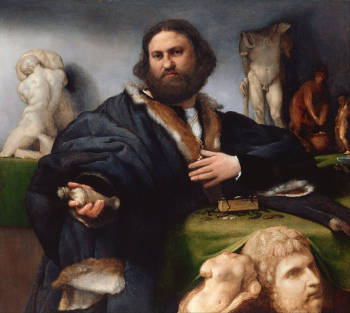
Lorenzo Lotto
1527
Oil on canvas, 104.3 x 116.8 cm.
Royal Collection, London
A collector, in the context of art, is someone who acquires and assembles works of art, whether out of personal passion, intellectual curiosity, financial investment, or social prestige. Art collecting has existed for centuries, with motivations ranging from a desire to support artists and preserve cultural heritage to the pursuit of status, fame, and wealth. Collectors often shape the art market, influencing trends and determining which artists and styles gain recognition. Some maintain private collections, while others donate or bequeath their holdings to institutions, leaving a lasting impact on the cultural landscape.
The distinction between a patron and a collector or buyer is fundamental in understanding the economic and social conditions of painting in the 17th-century Dutch Republic. A patron is not simply someone who purchases works, but someone who maintains a sustained, often personal and financially supportive relationship with an artist. This relationship may include advance payments, loans, commissions, or even long-term acquisition of an artist's output, thereby providing a degree of economic stability. By contrast, a collector or occasional buyer acquires works more sporadically, usually through the open market or individual transactions, without necessarily maintaining an ongoing relationship with the artist. The collector's role is primarily acquisitive, while the patron's role may shape the conditions under which the artist works.
The practice of collecting art dates back to Classical Antiquity, when rulers, aristocrats, and scholars amassed objects not only for aesthetic enjoyment but also as symbols of power, education, and cultural prestige. In the ancient world, art was closely tied to religion, politics, and status, and collections often consisted of sculptures, frescoes, mosaics, metalwork, and other luxury items that demonstrated wealth and refinement.
The Mesopotamians, particularly the Assyrians and Babylonians, collected works of earlier civilizations, preserving and copying inscriptions, sculptures, and architectural elements from conquered lands. The famed Library of Ashurbanipal, assembled in the 7th century BCE by the Assyrian king Ashurbanipal (c. 685–c. 627 BCE), was an early example of the impulse to preserve knowledge and artistic achievements.
In Greece, art collecting took on a more intellectual character, particularly among the elite who admired works for their craftsmanship and association with famous sculptors and painters. The philosopher Aristotle (384–322 BCE) is said to have assembled a collection of natural specimens and objects of artistic significance, while statesmen and rulers began amassing artworks as symbols of civic pride and personal distinction. The city of Athens housed numerous collections of statues and painted panels, many dedicated to the gods in temples and public spaces. As Greek art gained renown, collectors from other regions sought to acquire masterpieces, often as trophies of war or diplomatic gifts.
The Romans elevated the practice of art collecting to an unprecedented level. Conquering generals looted artworks from Greece and other territories, bringing back vast quantities of sculpture, painting, and decorative objects to adorn their homes and public buildings. Wealthy patricians filled their villas with copies of famous Greek statues, frescoes, and mosaics, sometimes employing skilled artisans to reproduce lost works of antiquity. The emperors, particularly Augustus (63 BCE–14 CE) and Hadrian (76–138), played a key role in institutionalizing art collecting, not just as a private indulgence but as a means of solidifying imperial authority. Hadrian, an admirer of Greek culture, assembled one of the most famous collections of Classical sculptures, displayed throughout his grand villa at Tivoli. Collecting in Rome also extended to luxury items such as engraved gems, gold and silver vessels, and finely crafted furniture, reinforcing the idea that art could be both an intellectual pursuit and a demonstration of status.
The fall of the Roman Empire led to a decline in art collecting as a structured activity, but many works were preserved within religious institutions or repurposed in later medieval art. The impulse to amass and preserve art would resurface during the Renaissance, when rulers and scholars rediscovered the treasures of antiquity, leading to the foundation of some of the first modern collections.
In the 17th-century Dutch Republic, the influence of Classical collecting practices was evident in the way scholars, merchants, and connoisseurs sought out artworks with historical significance, technical brilliance, or intellectual depth. While Dutch collectors did not have access to the same volume of ancient art as their Italian counterparts, they acquired antiquities when possible, particularly engraved gems, coins, and classical busts. More commonly, they embraced a similar spirit of discernment and prestige in assembling paintings, favoring works that demonstrated refinement, learning, and mastery of technique. The kunstkamer tradition, which originated in Renaissance Europe, remained influential, with collectors organizing their acquisitions in carefully arranged rooms designed to showcase knowledge and taste.

Caspar Netscher
1672
Oil on panel, 27 x 23 cm.
Huygens Museum Hofwijck
The passion for collecting extended beyond paintings to include prints, scientific instruments, and natural curiosities, reflecting a broader intellectual engagement with the world. Collectors in the Dutch Republic, much like their ancient predecessors, saw art as a means of cultural enrichment, a mark of status, and a way to connect with the artistic achievements of the past. The commercial success of Dutch artists in the international market, particularly painters like Rembrandt (1606–1669) and Dou (1613–1675), was in part due to this enduring desire to acquire and display works that embodied both technical brilliance and intellectual sophistication.
In the 17th-century Dutch Republic, art collecting was a widespread and deeply ingrained practice, reflecting the economic prosperity and cultural sophistication of the period. Unlike earlier traditions, in which art patronage was largely confined to the nobility, the Dutch art market was remarkably open, with collectors emerging from various social classes, including wealthy merchants, government officials, scholars, and even skilled craftsmen. The unprecedented rise of the middle class, fueled by global trade and financial innovation, allowed individuals outside the aristocracy to amass significant collections. Collecting was often a mark of refinement and education, with many collectors priding themselves on their knowledge of painting, history, and connoisseurship.
Some of the most prominent collectors of the period were deeply involved in the intellectual and artistic circles of their time. Constantijn Huygens (1596–1687), a statesman, poet, and secretary to the House of Orange, was an early supporter of Dutch artists, including Rembrandt van Rijn (1606–1669) and Gerrit Dou (1613–1675). His writings reveal a keen appreciation for artistic technique and composition, and he played a role in fostering the careers of painters who later became renowned figures. Another notable collector was Johan de Bye (1622–after 1670), a Leiden-based patron who owned multiple works by Dou and actively promoted the fijnschilder tradition, which emphasized meticulous detail and refined surfaces.
The most influential collectors often had strong ties to the booming Dutch art market, acquiring paintings directly from artists' studios, dealers, or auctions. Some, such as Pieter Spiering (c. 1595–1652), the Swedish ambassador in The Hague, built impressive collections of fine paintings, commissioning works by leading artists and sending Dutch art abroad, thus contributing to its international recognition. Other collectors focused on specific themes or styles, assembling rooms filled with landscapes, still lifes, or history paintings, reflecting personal taste as well as contemporary trends.
Many collectors were guided by principles of connoisseurship, carefully selecting works based on quality, subject matter, and technical execution. This was especially true in cities like Amsterdam, Leiden, and The Hague, where networks of artists and collectors exchanged ideas, advice, and recommendations. The demand for art encouraged a level of specialization among painters, leading to the rise of highly skilled artists who catered to the tastes of particular clients or patrons. At the same time, collecting was not solely an elite pursuit. A broad range of individuals, including prosperous tradesmen and skilled artisans, participated in the market, purchasing paintings to adorn their homes, often selecting works that reflected their values, professions, or aspirations.
In the case of Vermeer, the evidence points to a single central patronal relationship, though even this remains debated in its precise form. The well-to-do Protestants Maria de Knuijt (1623–1681) and her husband Pieter Claesz. van Ruijven (1624–1674) stand at the center of this discussion. Together, they appear to have acquired a very large portion of Vermeer's output—possibly half or more of his total production—and maintained a relationship that extended beyond ordinary transactions. This included financial assistance: Van Ruijven lent Vermeer money, likely in connection with future paintings, and de Knuijt left him a substantial bequest of 500 guilders in her will, an unusual gesture for someone outside the family. Such evidence suggests a relationship that goes beyond that of buyer and seller, approaching what can reasonably be termed true patronage, even if no formal contract survives.
Recent scholarship has shifted emphasis toward de Knuijt as the more active figure in this relationship, suggesting that she may have been the principal force behind the acquisition of Vermeer's works and his sustained support. The couple's collection passed to their daughter Magdalena and subsequently to Jacob Dissius (1653–1695), whose estate included a large number of Vermeer paintings later dispersed in the 1696 auction. This continuity indicates that the Van Ruijven–De Knuijt household functioned not merely as collectors but as long-term custodians of Vermeer's production, reinforcing their status as patrons in a structural sense.
At the same time, Vermeer did not work exclusively for a single patron. Evidence indicates that he occasionally sold works to other buyers, though these transactions appear to have been limited in number and scope. Individuals such as the Amsterdam dealer Johannes de Renialme (c. 1600–1657), whose inventory includes a Vermeer, represent this broader category of collectors or clients. These figures participated in the art market but did not sustain a continuous relationship with the artist. Similarly, visitors such as Balthasar de Monconys (1611–1665), who sought out Vermeer in Delft, testify to a modest but real circulation of his work beyond a single household, even if his reputation remained largely local during his lifetime.
The overall pattern suggests that Vermeer's career operated within a hybrid system: he appears to have relied heavily on one principal patronal network—centered on van Ruijven and de Knuijt—while maintaining occasional contact with the open market. This arrangement may help explain both the limited number of works he produced and their exceptional degree of finish. As the American economist turned Vermeer biographer John Michael Montias (1928–2005) argued, painters working for a steady patron could afford to devote more time to individual works, rather than producing larger quantities for speculative sale.
In summary, Vermeer's "true patrons " are best identified as Van Ruijven and, perhaps more decisively, de Knuijt, whose sustained financial and personal support distinguishes them from ordinary buyers. Other figures—dealers, collectors, and incidental clients—played a secondary role, contributing to the limited circulation of his paintings but not shaping his career in the same extent or degree.
The individuals below can be distilled as occasional buyers, clients, or collectors—that is, people who are documented to have owned or acquired one or more of Vermeer's paintings, but who do not qualify as active patrons in the strict sense of sustained support.
- Nicholas van Assendelft (1630–1692)
- Hendrick van Buyten (1632–1701)
- Willem van Berckel
- Jacob Dissius (1653–1695)
- Abraham Dissius (d. 1694)
- Diego Duarte (1612–1691)
- Cornelis de Helt (?–1661)
- Johan, Jean, or Johannes Larson (?–1664)
- Johannes de Renialme (c. 1600–1657)
- Magdalena van Ruijven (1655–1682)
- Herman van Swoll (1632–1698)
Critic / Art Critic
Notman and Sandham
1880
Wet-collodion negative, silver salts on glass, 25.4 x 20.3 cm.
McCord Stewart Museum, Montreal
A critic, or art critic, is who analyzes, evaluates or expresses an opinion on a work of art, from a cluster of Greek words meaning to decide, to discern, to judge. Academic scholars and art historians, primarily engaged in the historical study of visual arts, have generally seemed to maintain a tacit distinction between themselves and critics, whom they see as engaged in journalistic art appreciation, subjective "impressionism ," and other types of unreflective criticism.
The written critiques or reviews of art critics contribute to understanding and are published in newspapers, magazines, books, exhibition brochures and catalogues and on websites. Some of today's art critics use art blogs and other online platforms to connect with a wider audience and expand debate about art.
Differently from art history, there is not an institutionalized training for art critics (with only a few exceptions); art critics come from different backgrounds and they may or may not be university trained. Professional art critics are expected to have a keen eye for art and a thorough knowledge of art history. Typically the art critic views art at exhibitions, galleries, museums or artists' studios and they can be members of the International Association of Art Critics which has national sections. Very rarely art critics earn their living from writing criticism.
The opinions of art critics have the potential to stir debate on art-related topics. Due to this the viewpoints of art critics writing for art publications and newspapers adds to public discourse concerning art and culture. Art collectors and patrons often rely on the advice of such critics as a way to enhance their appreciation of the art they are viewing. Many now-famous and celebrated artists were not recognized by the art critics of their time, often because their art was in a style not yet understood or favored. Conversely, some critics, have become particularly important helping to explain and promote new art movements—Roger Fry with the Post-Impressionist movement, Lawrence Alloway with Pop Art as examples.
Criticism / Art Criticism
Art criticism is the analysis, evaluation, interpretation and study of works of art. Although it is true that disapproving remarks are sometimes made, it is a common mistake to assume that "criticism" simply means negative commentary and that to be critical means to be cynical, derogatory and insulting.
Art history and art criticism are intellectual activities aiming at the study, comprehension and interpretation of works of art. Their basic difference concerns not only the recentness of their objects but also their objectives: the art historian studies the works of the past and constructs contemporary art, which he analyzes and interprets with the aim of evaluating it critically. More simply, while art historians are interested in the meaning of a work of art within its cultural and historical context, the job of the art critic is to evaluate if a particular piece of art is "good" or "successful," often taking on the additional role of philosopher or theorist of art. The critic must make judgments because the art he deals with is generally new and unfamiliar—unless the critic is trying to reevaluate an old art with a fresh understanding of it—and thus of uncertain aesthetic and cultural value. The critic is often faced with a choice: to defend old standards, values and hierarchies against new ones or to defend the new against the old. Generally, critics view art at galleries and museums, or in private collections, and they write their personal opinions about the art they see. On the other hand, the research art historian generally has a scientific character, aiming at objectively valid formulations.
The following, which briefly traces the birth of the modern art criticism, is drawn from:
Gerrit Verhoeven. "Mastering the Connoisseur's Eye: Paintings, Criticism, and the Canon in Dutch and Flemish Travel Culture, 1600–1750." Eighteenth-Century Studies 46.1 (2012): pp. 29–56. Project MUSE. Web. 3 January 2013.
In the late 17th-century books on art criticism and aesthetic theory had flooded the market, ranging from Roger de Piles's Dissertation sur les ouvrages des plus fameux peintres (Paris 1681), Gerard de Lairesse's (1641–1711) Groot Schilder-boeck (Amsterdam 1707), and Dubois de Saint-Gelais's descriptions of Parisian art treasures, to reprints of older manuals by Giorgio Vasari (1511–1574) and Karel van Mander (1548–1606).

Jonathan Richardson
1729
Oil on canvas, 73.7 × 62.9 cm.
National Portrait Gallery, London
In 1728, the English painter, collector and writer Jonathan Richardson Sr. (1667–1745) and his son, wrote Le traité de la peinture, a manual which discussed the theory of art criticism and connoisseurship, along with a detailed probate inventory of the most outstanding paintings, sculptures and architecture in Europe, as drawn up by Richardson Jr. during his Grand Tour to Italy in the early 1720s. Looking with a trained eye, Richardson Jr. had listed hundreds of masterpieces worth seeing and meticulously weighed pros and cons in design, composition, brush techniques , and chiaroscuro. Although Richardson's traité was far from unique, it soon became the benchmark criteria for assessing the quality of paintings (balanced composition, lofty style, powerful brushstrokes, lively coloring) well underway by the 18th century, but a clearly defined canon of favorite masters, schools, subjects and periods had also begun to take shape.
What was novel and trail-blazing in Richardson's work, however, was his idea that the stanza of art criticism, rather than being restricted to erudite painters, royal collectors, and aesthetic quibblers, could in fact be mastered by lay connoisseurs and bourgeois art lovers. Written in a comprehensible style, his book offered training for this growing multitude of do-it-yourself experts.
Richardson's textbook thus marks a broader social phenomenon, in which dilettanti and dabblers slowly but surely entered the domain of art criticism, thereby founding a public opinion based upon the most exceptional masterpieces and (re)shaping the highbrow canon to "popular" bourgeois taste. During the 18th century this new ideal of the amateur-connoisseur resonated in a boom of auction rooms and art galleries, concert halls, music magazines, painting and literature, and private fine arts societies.
Art Dealer
An art dealer is a professional who buys, sells, and promotes artworks, often acting as an intermediary between artists and collectors. The role of the art dealer emerged prominently during the Renaissance, when increased patronage and a growing market for paintings transformed art into a profitable commodity. The beginnings of art dealing can be traced back to the late Middle Ages and early Renaissance in Italy, where the rise of wealthy merchant classes and a flourishing urban culture created a demand for artworks beyond religious commissions. Initially, artworks were sold directly by artists or through intermediaries such as guilds, but by the 15th century, specialized merchants began to emerge, managing transactions between artists and patrons. In cities like Florence and Venice, these early art dealers often combined the sale of paintings with other luxury goods, capitalizing on the growing appreciation for art as a status symbol. They played a crucial role in shaping tastes, advising patrons, and sometimes even directing artists to produce works that catered to the market's preferences. This early evolution of art dealing laid the groundwork for a more structured and professional art market that would later flourish in the Dutch Republic and other parts of Europe during the 17th century.

Frans Francken the Younger
Early 1600s
Oil on copper, 29 x 40.5 cm.
Hallwyl Museum, Stockholm
Art has been traded ever since art was made. The Phoenicians were already active traders, and ancient Rome imported large amounts of Greek art. Auctions were held in imperial Rome and art dealers carried on their trade in well-known quarters. The structure of the demand and the social position of the artist in the Middle Ages was such that there was no space for an art trade outside relics and luxury items such as ivory combs and chessboards.
New forms of art trade arose only at the end of the Middle Ages owing to social changes and an increasing demand for art. The growing bourgeoisie class began to buy and collect art by the end of the 16th century joining the church and the aristocracy, although they were unable to finance major works of art as the patrons had done before. In addition to religious painting, portraiture and profane art, often more marketable than religious art, created a new market, easier to appreciate. The creative status of the visual artist began to supplant the role of the painter as a mere workman although it did not disappear entirely. These accumulated factors facilitated the position of an intermediary between artist and buyer and spawned new forms of art trade in the works of living artists.
The birthplace of the art trade as we know it today was in the 17th-century Netherlands. While commissions by nobility and the church stagnated, members of the increasingly wealthy bourgeoisie were able to afford oil paintings for the first time. Following the demands of the new market, the motifs and techniques changed, lowering costs and producing new motifs. Lofty history paintings and mythological scenes were replaced by more down- to-earth still lifes, landscapes and genre images. Prices ranged from a few guilders to vast sums. The explosive rise of art production in the Netherlands made it the leader of European art trade in the 17th and 18th centuries.
The first art dealers often were the painters themselves—almost every one of them in fact—supplementing the income of their own works with the sales of artworks of their colleagues. Even Rembrandt (1606–1669) and Vermeer acted as dealers. Apart from artists, book traders, printers and general merchants traded with art. Despite the fact that guild tried to protect local production by prohibiting the sale of artworks from non-member paintings, there were many ways to get around this limitation, such as public raffles. Interested clients visited the dealer's studio. Some paintings were commissioned but the overwhelming of paintings were produced in response to market demand and sold on spec. Professional art dealers, including Vermeer's father, Reynier Jansz. (c. 1591–1652), and Abraham de Cooge (c. 1630–1683), another dealer located in Delft, dealt not only in their hometown but the latter, presumably as far away as Antwerp and Amsterdam. The dealer had an advantage over the artist/dealer in that he could furnish a range of styles and subject matter much wider than what was available at an individual artist's workshop. He could also sell the work of artists who did bot belong to the Guild of Saint Luke.
A successful art dealer had to know which paintings were the most desired during a certain period. If he were also an artist he could either paint such works himself or arranged for them to be copied in his studio. As there existed no copyright protection for creative artworks, particularly salable paintings and subjects were copied time and time again by an army of young painters, who worked from dawn to dusk. In Antwerp, one of the most important art markets in Europe, paintings were made to order in great quantities, and sometimes pictures were sold by weight.
Today, many art dealers own their own galleries in order to exhibit and sell art in a setting that encourages comparison and open discussion, but the reputation of the category has been and remains equivocal. The role of an art dealer has been said to be a mix of nursemaid, fixer, connoisseur and capitalist. Eugène Delacroix (1798–1863), called them "financiers du mystère." Marcel Duchamp (1887–1968) said they were "lice on the backs of the artists."
It is known that just like many other Dutch painters Vermeer dealt in the works of his colleagues. In a probate inventory of his living quarters, various paintings by his colleagues are listed, including those of Carel Fabritius (1622–1654). In his time Hendrick Gerritsz van Uylenburgh (c. 1587–1661) was an influential art dealer who helped launch the careers of Rembrandt and other painters. In 1671, Van Uylenburgh organized an auction of Gerrit Reynst's art collection and offered thirteen paintings and some sculptures from among those which had not sold at the auction to Frederick William, Elector of Brandenburg. However, Frederick accused them of being counterfeits and sent them back. Van Uylenburg then organized a counter-assessment, asking a total of 35 painters to pronounce on their authenticity, including Vermeer. In 1675, Van Uylenburgh had financial problems, as a result of the war with France, falling art prices, and possibly due to the damage to his reputation from the Brandenburg affair. His business went bankrupt and he moved to London, where Peter Lely (1618–1680) exerted his influence at court and secured him the post of Surveyor of the King's Pictures. In general, art dealers had to become guild members to work legally.
There is solid evidence that Vermeer worked not only as a painter but also as an art dealer, a common practice for artists of his time, especially in Delft, where the market was relatively small. The clearest statement about his difficulties as a dealer comes from his widow, Catharina Bolnes (c. 1631–after 1687), in a petition she submitted after Vermeer's death. She wrote that during the Franco-Dutch war (beginning in 1672), the art market collapsed so dramatically that "he was unable to sell any of his own works or even the paintings he dealt in." This crisis, she explained, left Vermeer so distressed that he fell into a deep depression and died within a day or two.
This statement is significant for two reasons. First, it confirms that Vermeer was actively engaged in the art trade beyond his own paintings. Second, it highlights the broader economic collapse of the early 1670s, when the invasion of the Dutch Republic triggered a severe contraction in luxury spending, including the purchase of paintings. For an artist with a slow production rate like Vermeer, this collapse would have been especially ruinous.
Vermeer had some family connections to the art world that likely facilitated his dealing. His father was both an art dealer and an innkeeper, and Vermeer likely inherited both the business contacts and the commercial instincts associated with this trade. After his father's death, Vermeer took over the operation of the inn Mechelen , which may have doubled as a site for showing and selling paintings. While we lack detailed inventories of what he sold, it is plausible that he dealt in works by other contemporary Dutch painters, and perhaps even Italian or Flemish pictures, which were in demand among Delft's wealthier clients. The fact that Vermeer left behind debts and no record of ownership of many paintings suggests that his commercial dealings, like his career as a painter, were tightly bound to a modest and ultimately vulnerable market.
Art Exhibition
See also: Blockbuster Exhibition and Exhibition Catalogue
An art exhibition is the space in which art objects meet an audience that includes art lovers and the general public, universally understood to be for a temporary period, making it fundamentally different from an art collection. In American English, exhibitions may be called "exhibit," "exposition" (the French word) or "show." In UK English, they are always called "exhibitions" or "shows" and an individual item in the show is an "exhibit." Art expositions may present paintings, drawings, video, sound, installation, performance, interactive art, new media art or sculptures by individual artists, schools of artists or collections of a specific form of art.
The work of arts may be presented in museums, art halls, art clubs or private art galleries, or at some place the principal business of which is not the display or sale of art, such as a coffeehouse. An important distinction is noted between those exhibits where some or all of the works are for sale, normally in private art galleries, and those where they are not, such as public museums. Sometimes the event is organized on a specific occasion, like a birthday, anniversary or commemoration, but often important exhibitions are almost always organized around a historic period, geographical location, artist, group of artists, art movement, theme or a combination of these features. Sometimes exhibitions are simply works from drawn from a private collection or public institution.
Exhibitions often present the occasion to assemble works together that are dispersed throughout the globe and have never been shown together, allowing curators and the public to make more meaningful comparisons between them. Interpretive exhibitions require carefully managed context. They are often accompanied by explanatory panels, illustrated catalogues and, occasionally, interactive displays to aid the visitor's understanding of background and concepts. Major exhibitions are overseen by a curator who, along with other specialists, write illustrated exhibition catalogues, both of which may require considerable expense and years of research and planning.
In ancient Greece and Rome, it is known that artists exhibited their works prior to being installed in public buildings, although the works shown were considered offerings to deities rather than for public enjoyment or education. Later, in the Middle Ages the situation remained the same but by the 17th century, artists began to stage rudimentary exhibitions in artistic capitals such as Rome, Venice and Florence in conjunction with religious celebrations, and it was during this time that artists realized they could use these exhibitions to help establish their own reputations. However, the art exhibition as we know it began to play a crucial part in the market for new art since the 18th and 19th centuries.

L'Acadèmie de Peinture et de Sculpture in Paris was responsible for the state's educational program in the fine arts held its first exhibition in 1667 for the court society only, but by 1725 the exhibition moved to the Louvre and was open to the general public where it became known simply as the Salon, It rapidly became the key factor in determining the reputation, and so the price, of the works of French artists. The Royal Academy of London soon established a similar influence on the market, and in both countries artists strove to produce artworks that would meet approval, often changing the direction of their style to meet popular or critical taste. The British Institution was added to the London scene in 1805, holding two annual exhibitions, one of new British art for sale. These exhibitions received lengthy and detailed reviews in the press, which were the main vehicle for the art criticism of the day. Among the most important exhibitions are; Paris Salon, 1824, The Salon des Refusés, 1863, The first "Impressionists" show, 1874, The first Salon d'Automne, 1903, the Armory Show, 1913, Degenerate Art, 1937 and The 9th Street Art Exhibition, 1951.
Following Vermeer's rediscovery in the mid-1850s over 320 exhibitions have been staged with one or more of his paintings, the earliest recorded being 1838. Most of these exhibitions featured works of other painters although a few only works by Vermeer. The 1995–1996 exhibit in Washington/The Hague (see image above-left) with 21 paintings by Vermeer remains among the most ambitious—it is highly probable that even during Vermeer's lifetime so many paintings were never on view in the same environment—and visited art exhibitions ever staged (attendance, 327,551). The exhibition drew extraordinary crowds, and free passes were required for admission at all times. Lines for daily passes grew longer each morning. Beginning on November 24, hours were extended until 7 p.m. every Friday, Saturday and Sunday, and from February 1, until 9 p.m. each night.
In 2023, the Rijksmuseum in Amsterdam hosted a landmark retrospective of Vermeer, marking the most comprehensive exhibition of the Dutch master's work to date. Running from February 10 to June 4, the exhibition featured 28 of Vermeer's approximately 35 known paintings, an unprecedented assembly that drew art enthusiasts from around the globe. Notably, it included works never before displayed in the Netherlands, like the newly restored Girl Reading a Letter at an Open Window from the Gemäldegalerie Alte Meister in Dresden.
The retrospective was organized in collaboration with the Mauritshuis and involved extensive research into Vermeer's artistry, techniques, and creative process. This scholarly effort provided fresh insights into his work, enhancing the exhibition's depth and educational value.
The exhibition attracted approximately 650,000 visitors, setting a new attendance record for the Rijksmuseum. To accommodate the overwhelming demand, the museum extended its opening hours and offered additional tickets, underscoring Vermeer's enduring appeal and the exhibition's significance in the art world.
Art for Art's Sake
Art for art's sake refers to number of positions related to the possibility of art being autonomous. The term is usually used by artists and art writers of the second half of the 19th century: in France, the prime promoters of art for art's sake were Charles Baudelaire (1821–1867) and Théophile Gautier (1811–1872); in England, James Abbott McNeill Whistler (1834–1903) and Oscar Wilde (1854–1900); in the United States, Edgar Allan Poe (1809–1849). Among others, in the 20th century, the notion has been sharply critiqued by Walter Benjamin (1892–1940).
As the 19th century progressed, the exercise of artistic freedom became fundamental to progressive modernism. Artists began to seek freedom not just from established artistic conventions the rules of academic art, but from the demands of the public. Soon it was claimed that art should be produced not for the public's sake, but for art's sake.
In its heyday, art for art's sake is basically a call for release from what was perceived as the tyranny of meaning and purpose. It was also a ploy, another deliberate affront to a bourgeois sensibility which demanded art with meaning or that had some purpose such as to instruct, or delight, or to moralize, and generally to reflect in some way their own purposeful and purpose-filled world.
In his 1891 essay The Soul of Man Under Socialism, Oscar Wilde wrote:
A work of art is the unique result of a unique temperament. Its beauty comes from the fact that the author is what he is. It has nothing to do with the fact that other people want what they want. Indeed, the moment that an artist takes notice of what other people want, and tries to supply the demand, he ceases to be an artist, and becomes a dull or an amusing craftsman, an honest or dishonest tradesman. He has no further claim to be considered as an artist.
In the late-19th century, we find art beginning to be discussed by critics and art historians largely in formal terms which effectively removed the question of meaning and purpose from consideration. From then on, art was to be discussed in terms of style—color, line, shape, space, composition—ignoring or playing down whatever social, political, or progressive statements the artist had hoped to make in his or her work.
Thoré-Bürger (1807–1869), who is generally credited for having recovered Vermeer's painting in the mid-1800s, deeply conditioned the perception of Vermeer's art for the decades that followed. As a leftist politician, Thoré believed that the primary function and value of Dutch art was to reflect the daily experience of the life of common people. The Dutch made, in Thoré's eyes, art for a people of common virtues; "l'art pour l'homme" (art for the people).
However, with the rise of the modernist school of painting in the early 1900s Vermeer's art began to be appreciated for its formal qualities which seemed to reflect the revolutionary concerns of avante-garde contemporary painting. Wilhelm Valentiner (1880–1958), an expert of Dutch painting, maintained that Vermeer focused primarily on the "purely aesthetic."
Philip Leslie Hale (1865–1931), Boston painter and art teacher, was the first American to write a monograph on Vermeer in 1913. Hale was deeply struck by what he perceived as "Vermeer's modernity." According to Hale, "if ever a man believed in art for art's sake it was he. He anticipated the modern idea of impersonality in art...he does not comment on the picture. One does not see by his composition what he thought of it all."
Some years later, P. T. A. Swillens (1890–1967), a Dutch art historian whose monograph on Vermeer was published in 1950, was to have an important impact on the study of Vermeer. He shared Hales' opinions and wrote that the artist had no interest in the "inner life" of his sitters and that he "reveals only what is of value to him as a painter." Vermeer, thus, was not interested in what intrigued him as a human being or thinker but as a painter.
However, Swillen's overriding emphasis on the aesthetic content of a picture, which typifies the concept of art for art's sake, may miss one of the most compelling aspects of Vermeer's work: the emotional intensity of his figures. Lawrence Gowing (1918–1991) only two years after the publication of Swillens' monograph, exposed a new point of view. While recognizing Vermeer's extraordinary capacity of pictorial organization—Gowing was a painter himself—he held that when the artist's perfect style is understood, his paintings "yield their strangely emotional content."
Art Gallery
A private gallery is a commercial art space owned and operated by individuals, collectors, or businesses, rather than by public institutions, museums, or governments. Unlike public museums, which focus on education, conservation, and scholarship, private galleries primarily serve as venues for exhibiting and selling works of art, often representing a selection of contemporary artists, estates, or historical pieces. These galleries function as intermediaries between artists and collectors, fostering relationships that contribute to the commercial and critical success of artists.
The idea of a private art gallery, distinct from religious, civic, or princely collections, began to take shape in the Renaissance, when wealthy patrons started displaying their art in dedicated spaces within their residences. Before this period, artworks were primarily found in churches, public buildings, or the homes of the elite, where they served devotional, political, or decorative functions. The transition toward private viewing spaces reflected the growing status of art as a collectible commodity and an expression of personal taste rather than merely an instrument of religious or civic identity.
One of the earliest examples of a private collection organized as a gallery was that of Isabella d'Este (1474–1539), the Marchesa of Mantua, who assembled a studiolo, a small, private room filled with paintings, sculptures, and rare objects. Her collection included works by Andrea Mantegna (c. 1431–1506) and Giovanni Bellini (c. 1430–1516) and set a precedent for later aristocrats and intellectuals who sought to create intimate spaces for contemplation and display.
In Florence, the Medici family established some of the first true private art galleries, distinct from their political and civic patronage. Cosimo I de' Medici (1519–1574) arranged his collections in the Palazzo Pitti and the Uffizi, with the latter eventually becoming one of the world's first public museums. However, in its early form, the Uffizi served as a private gallery for Medici guests, scholars, and diplomats, showcasing the family's extensive art holdings.
In the Dutch Republic, the 17th century saw an expansion of private art collecting among the wealthy merchant class. Unlike aristocratic collections, which emphasized grand historical and mythological paintings, Dutch collectors often favored smaller-scale works, including still lifes, landscapes, and genre scenes. Art dealers and connoisseurs began displaying their collections in private homes, sometimes allowing select visitors to view and purchase works. This was an important step toward the modern concept of the private gallery, where art was arranged for viewing rather than solely for decoration or status.
By the 18th century, the concept of a dedicated space for viewing art had spread across Europe. In England, the Grand Tour fueled a demand for galleries where connoisseurs could view and discuss works of art in a controlled environment. The Dulwich Picture Gallery, founded in 1811, was one of the first buildings specifically designed as a public gallery, but it was built upon the tradition of private collecting. Meanwhile, in France, the salon culture provided an alternative space for private exhibitions, often held in aristocratic residences before shifting to public institutions.

The 19th century marked the true expansion of private galleries as commercial enterprises. Dealers such as Paul Durand-Ruel (1831–1922) in Paris and Joseph Duveen (1869–1939) in London helped transform private galleries into professional exhibition spaces, where artists, collectors, and buyers could interact. These galleries played a crucial role in promoting modern art, with Durand-Ruel championing the Impressionists and Duveen shaping American collections that would later become the core of major museums.
By the early 20th century, the rise of commercial galleries, such as those of Ambroise Vollard (1866–1939) and Daniel-Henry Kahnweiler (1884–1979) further solidified the private gallery as a central institution in the art world. Today, private galleries serve both as spaces for selling art and as curated environments where collectors and the public can engage with artistic trends, bridging the historical divide between private collecting and public exhibition. The 20th century saw the rise of influential private galleries such as Leo Castelli's in New York, which helped establish the careers of artists like Jasper Johns (b. 1930) and Andy Warhol (1928–1987).
Art Historian

Anton Raphael Mengs
c. 1777
Oil on canvas, 63.5 × 49.2 cm.
Metropolitan Museum of Art, New York
An art historian is a scholar who studies the visual arts within their historical, cultural, social, and material contexts. This includes the analysis of paintings, sculpture, architecture, prints, and other forms of visual expression, considering not only how they were made and by whom, but also how they were viewed, interpreted, and valued over time. Art historians examine style, technique, iconography, patronage, and the circulation of artworks, often combining visual analysis with archival research, theory, and interdisciplinary methods. Their work may involve attributing authorship, dating works, uncovering meanings, or situating art within larger movements, ideologies, or social structures. Whether working in academia, museums, libraries, or cultural institutions, the art historian contributes to the understanding and preservation of visual culture and offers insights into how images reflect and shape human experience across time.
The earliest surviving writing on art that can be classified as art history are the passages in Pliny the Elder's Natural History (c. A.D. 77–79), concerning the development of Greek sculpture and painting. However, the beginnings of art history as a distinct intellectual pursuit lie in the humanist culture of the Renaissance, when writers began to treat painting, sculpture, and architecture not simply as manual crafts but as forms of intellectual and cultural expression. Giorgio Vasari (1511–1574), often considered the first true art historian, set the tone with his Lives of the Most Excellent Painters, Sculptors, and Architects. In that collection, he chronicled artists' biographies and promoted the idea of a developmental arc in art, from primitive beginnings to what he saw as perfection in the work of Michelangelo. This biographical and progress-oriented approach defined much of the field for centuries, framing art in terms of stylistic innovation, influence, and individual genius. Vasari's model, however, was focused on central Italy and suffused with his own cultural and aesthetic judgments, leaving much of northern Europe's artistic development outside his scope.
In the 17th and 18th centuries, art collecting and connoisseurship began to play a central role in shaping the foundations of art history. Patrons, dealers, and collectors sought expert opinions to assess attribution and value, giving rise to a form of visual expertise that emphasized the artist's hand—the so-called maniera. Figures such as Filippo Baldinucci (1625–1696) in Florence and Roger de Piles (1635–1709) in France began to write about artistic taste, style, and national character. These writings were often colored by personal or political preferences, but they also contributed to the classification and comparative analysis of art. By the 18th century, with Johann Joachim Winckelmann's (1717–1768) the discipline took a more philosophical and historicizing turn and is widely regarded as the father of modern art history. His History of the Art of Antiquity (1764) established a systematic, chronological approach to the study of classical art and introduced the idea that artistic styles reflect the spirit of their time. Winckelmann idealized ancient Greek art, especially the sculpture of the classical period, which he praised for its "noble simplicity and quiet grandeur." His writings deeply influenced European taste, encouraging a turn toward neoclassicism in the late 18th century. More than just a stylistic historian, Winckelmann proposed that art was shaped by cultural and moral forces, and he was among the first to suggest that beauty in art was not merely an aesthetic category but a philosophical and historical one. Though focused almost exclusively on antiquity, his influence extended far beyond, establishing principles that would guide the writing of art history for generations.
The modern role of the art historian emerged in the 19th century, alongside the institutionalization of museums, academies, and universities. In this period, art historians like Jacob Burckhardt (1818–1897) treated art as an integral part of cultural history, bound to broader forces such as politics, religion, and economics. Connoisseurship also became more specialized, with scholars such as Giovanni Morelli (1816–1891) developing forensic methods for attribution based on minor details—like the rendering of ears or hands—to distinguish one master from another. These methods shaped the work of early Dutch art historians, who sought to identify and catalogue the many unsigned or misattributed paintings circulating in Europe's collections. In this environment, figures like Thoré Bürger (1807–1869) played a decisive role in restoring Vermeer to visibility by assembling dispersed works, comparing them, and attributing them to a forgotten master.
Thoré, who was a French journalist, critic, and political exile who played a decisive role in the 19th-century rediscovery of Vermeer. Deeply engaged with the liberal politics of his time, Thoré wrote extensively under the pseudonym "Bürger" burger or citizen) after fleeing France in the wake of the 1848 revolution. During his years in the Low Countries, he visited collections and became captivated by a then largely forgotten painting in The Hague's Mauritshuis, View of Delft, which he later identified as the work of Vermeer. Through careful study and comparison, he began to reassemble Vermeer's oeuvre, attributing to him works scattered across European collections, many of which had been assigned to more famous artists. His publications were passionate and evocative, shaped as much by Romantic idealism as by scholarly rigor. While his attributions were not always accurate, his efforts brought Vermeer back into public and academic awareness, laying the foundation for all subsequent Vermeer scholarship. Thoré Bürger's approach also helped shift the focus of art history from grand historical narratives to the quiet poetry of everyday life captured in genre painting.
In the late 19th and early 20th centuries, the discipline was expanded and transformed by figures such as Heinrich Wölfflin (1864–1945), Erwin Panofsky (1892–1968), and Aby Warburg (1866–1929). Wölfflin introduced formal analysis as a foundational method in art history, emphasizing shifts in visual language rather than iconography. His comparison of Renaissance and Baroque styles, expressed through oppositions like linear versus painterly or closed versus open form, created a vocabulary for describing visual style independently of subject. Panofsky developed iconology, a method that interprets images in layers—formal, symbolic, and cultural—arguing that artworks are structured like texts and must be read accordingly. His work on Renaissance art and its philosophical underpinnings brought intellectual depth to the study of iconography. Warburg, working somewhat outside the academic mainstream, pioneered a cultural-historical approach to images, emphasizing the survival and transformation of ancient motifs across time. His vast and idiosyncratic archive of visual material, the Mnemosyne Atlas, sought to trace the transmission of expressive gestures and symbols from antiquity into Renaissance and modern imagery. Together, these thinkers shaped the intellectual backbone of 20th-century art history, balancing visual scrutiny with historical, philosophical, and psychological insight.
In the context of 17th-century Dutch painting, the art historian plays a uniquely reconstructive role. Much of the surviving evidence—inventories, guild records, sales catalogues, and contemporary treatises—is fragmentary and often silent on individual painters. The historian must navigate these silences using visual analysis, technical examination, and cultural context. Painters such as Carel Fabritius (1622–1654), Jan van der Heyden (1637–1712), and Pieter Janssens Elinga (1623–after 1682) have all required careful reassessment, as their reputations were either eclipsed or entangled with better-known figures. The work of the art historian, then, is not just to describe or admire, but to question, verify, and situate. Art history becomes an active form of cultural memory, one that mediates between past objects and present understanding.
The role of the art historian is complex, partly because few contemporary sources provide direct commentary on artists like Vermeer. Much of what is now considered Dutch art history was assembled retrospectively, through early biographers such as Arnold Houbraken (1660–1719), who worked in the early 18th century, relying on anecdotes and judgments shaped by his own artistic values. Later, in the 19th century, scholars like Thoré Bürger (1807–1869) rediscovered painters who had fallen into obscurity, including Vermeer, whose work Bürger identified and championed. Art history in this context became not just a scholarly endeavor but a form of cultural recovery, reshaping the canon and public taste.
Arnold Houbraken (1660–1719) and Karel van Mander (1548–1606) stand as two of the most important early writers on Dutch art, each shaping how artists of their own time and earlier generations were understood. Van Mander, often called the "Dutch Vasari," wrote Het Schilder-boeck in 1604, a combination of artists' biographies, moral instruction, and poetic meditations on painting. His work was deeply indebted to classical rhetoric and humanist ideals, drawing on ancient sources such as Pliny the Elder, Horace, and Ovid. He viewed the painter not merely as a craftsman but as a learned figure capable of expressing complex allegories, elevating the status of painting as a liberal art. Van Mander's accounts of northern artists, including Jan van Eyck (c. 1390–1441) and Lucas van Leyden (c. 1494–1533), are mixed with references to mythological and historical topoi, revealing his conviction that artistic greatness involved both technical mastery and moral refinement. Although Vermeer is not mentioned—likely due to his youth at the time—Van Mander laid the intellectual groundwork for the genre and narrative painting that would flourish later in the century.
Arnold Houbraken continued and expanded Van Mander's project with his De Groote Schouburgh, published in three volumes between 1718 and 1721. Like Van Mander, Houbraken borrowed from classical models and rhetorical tropes, often portraying artists through the lens of virtue, diligence, or tragic downfall. His tone is more anecdotal and sometimes moralizing, as he sought not only to inform but to edify. Houbraken evaluated many of his contemporaries and near-contemporaries, often favoring artists with fine draughtsmanship and academic ambition over those who worked in quieter or more tonal modes. He had little to say about Vermeer and entirely omitted some now celebrated painters such as Carel Fabritius, whose reputations have risen sharply in modern scholarship. Houbraken's preferences reflect the values of his time: emphasis on history painting, technical skill, and visible labor. Today's art historians, by contrast, are more likely to value understatement, optical innovation, and cultural resonance, qualities often overlooked in early critical accounts. The distance between Houbraken's judgments and current evaluations reminds us that art history itself evolves, shaped by shifting aesthetic criteria, new archival discoveries, and changing conceptions of what constitutes artistic value.
Art historians studying Dutch painting have also explored how images functioned within their social and moral worlds. Still lifes, genre scenes, and domestic interiors were once seen as mere records of daily life, but are now read for their symbolic resonances, class messages, and religious undercurrents. Painters such as Jan Steen (1626–1679), Pieter de Hooch (1629–c. 1679), and Gerrit Dou (1613–1675) have all benefitted from this deeper interpretive approach. In Vermeer's case, the challenges are even greater. His small oeuvre, lack of documented pupils, and scarce archival references force scholars to rely on style, technique, and material clues. The art historian's task is therefore not just to describe or attribute, but to build meaning around the work—to understand what the paintings reveal about their time, their makers, and their afterlives. Art history, in this sense, is as much about intellectual curiosity and historical recovery as it is about appreciation.
In the 17th and 18th centuries, the accumulation of artworks in princely collections and the growth of connoisseurship gave rise to new forms of visual expertise. Scholars and amateurs alike began to identify, classify, and attribute paintings, often by comparing minute details believed to reveal an artist's hand. This early form of art historical thinking was motivated by taste and market value as much as scholarship. Figures like Roger de Piles (1635–1709) in France and Filippo Baldinucci (1625–1696) in Italy contributed to emerging vocabularies of style and national schools, while Johann Joachim Winckelmann (1717–1768) introduced a more philosophical and historicist perspective. For Winckelmann, art expressed the moral climate of an age, and its evolution reflected the broader development of civilization. This marked a turning point, shifting art history from a record of artistic personalities to a history of cultural expression.
By the 19th century, the discipline had begun to take on its modern shape, closely tied to the growth of museums, universities, and academic publishing. Scholars like Jacob Burckhardt (1818–1897) approached art as part of a wider history of ideas and society, while Giovanni Morelli (1816–1891) developed forensic methods of attribution based on unconscious habits in an artist's brushwork or draftsmanship. In the context of Dutch painting, this was a period of rediscovery and reclassification. Thoré Bürger (1807–1869), a French critic and political exile, played a pivotal role in recovering the reputation of Vermeer, whose works had been scattered, misattributed, or simply ignored. Art historians working on 17th-century Dutch art must piece together fragmentary records—guild documents, inventories, sales catalogues—and interpret them in light of the paintings themselves. Because Dutch artists rarely theorized their own work and often left few personal writings, the historian's role becomes partly reconstructive, blending visual analysis with contextual reading.
Today, the training and education of art historians is rooted in university study, typically beginning with a bachelor's degree in art history or a related field such as history, literature, or archaeology. Undergraduate programs emphasize visual literacy, historical analysis, and writing, while introducing students to a broad chronological and geographical range of art—from ancient to contemporary, Western and non-Western traditions alike. Students are taught to analyze images not only formally, in terms of composition, color, and technique, but also contextually, considering social, religious, political, and economic factors that shape both the creation and reception of artworks. Courses often include museum visits and exposure to primary sources, fostering a close engagement with objects and their historical settings.
Graduate study, at the master's or doctoral level, deepens this foundation through specialization. Students select a specific area—such as Italian Renaissance painting, Islamic manuscript culture, or Dutch Golden Age art—and develop expertise through coursework, language study, and independent research. Doctoral training involves years of focused inquiry culminating in a dissertation based on original analysis, often supported by archival research, technical examination, or theoretical critique. Art historians today are also trained to consider materiality, conservation, collecting histories, and the politics of display. Increasingly, digital tools, such as image databases, virtual reconstructions, and GIS mapping, are part of the scholarly toolkit. Beyond academia, many art historians work in museums, galleries, libraries, and cultural institutions, where their training supports curatorial work, conservation planning, public education, and the stewardship of cultural heritage. The field has become both broader in scope and more interdisciplinary, engaging with anthropology, philosophy, and visual studies to interpret the role of art in human experience.
A bachelor's degree is sufficient for many entry-level positions, but for advancement in an area of specialization an advanced degree may be required. Regardless of career choices, art historians must learn to seek out alternative perspectives and compare contrasting interpretations, convey complex information and in some cases, advocacy. Cultural awareness, flexibility and openness to new ideas are necessary. Careers in museums, art galleries and auction houses as curators or managers in conserving, valuing or auctioning works of art, antiques and other collectibles are among the most commonly pursued. Other careers include arts administrator, archivist, museum education officer, picture editor or researcher, journalist, teacher or lecturer, exhibition or events organizer and antique dealer.
Art History
From: Wikipedia.
Art history is the study of objects of art in their historical and stylistic contexts, i.e. genre, design, format and style. This includes the "major" arts of painting, sculpture and architecture as well as the "minor" arts of ceramics, furniture and other decorative objects. Much emphasis is given to the original context of their making and reception, as well as their subsequent circulation, collection, conservation and display.
As a term, art history (its product being the history of art) encompasses several methods of studying the visual arts; in common usage referring to works of art and architecture. Aspects of the discipline overlap. As the art historian Ernst Gombrich once observed, "the field of art history [is] much like Caesar's Gaul, divided in three parts inhabited by three different, though not necessarily hostile tribes: the connoisseurs, the critics, and the academic art historians."
As a discipline, art history is distinguished from art criticism, which is concerned with establishing a relative artistic value upon individual works with respect to others of comparable style, or sanctioning an entire style or movement; and art theory or "philosophy of art," which is concerned with the fundamental nature of art. One branch of this area of study is aesthetics, which includes investigating the enigma of the sublime and determining the essence of beauty. Technically, art history is not these things, because the art historian uses historical method to answer the questions: How did the artist come to create the work?, Who were the patrons?, Who were his or her teachers? Who was the audience? Who were his or her disciples? What historical forces shaped the artist's oeuvre, and how did he or she and the creation, in turn, affect the course of artistic, political and social events? It is, however, questionable whether many questions of this kind can be answered satisfactorily without also considering basic questions about the nature of art. Unfortunately, the current disciplinary gap between art history and the philosophy of art (aesthetics) often hinders this inquiry.
The historical backbone of the discipline is a celebratory chronology of beautiful creations commissioned by public or religious bodies or wealthy individuals in western Europe. Such a "canon" remains prominent, as indicated by the selection of objects present in art history textbooks. Nonetheless, since the 20th century, there has been an effort to redefine the discipline to be more inclusive of non-Western art, art made by women, and vernacular creativity.
Art and Philosophy in Antiquity
The art and philosophy of antiquity were foundational to the development of Western art, not simply as a distant model to be admired, but as a conceptual framework that shaped how art was understood, produced, and evaluated from the Renaissance through the 19th century. Their influence operated on multiple levels—technical, theoretical, moral, and even institutional.

After Lysippos
c. 390–300
Marble, 55 x 40 cm.
National Roman Museum, Rome
At the core was the belief that art (ars) was a rational activity. Classical thinkers like Plato (c. 427–c. 347 BCE) and Aristotle (384–322 BCE) debated the nature of imitation (mimesis), beauty, and expression. Plato saw art as a mere copy of a copy—an imitation of the material world, which was itself a shadow of the ideal forms. Aristotle, by contrast, allowed for a more constructive role: imitation in his view could be a way of arriving at truth, particularly in poetry and tragedy, by portraying universal human actions and emotions. These opposing positions were revived in early modern theory, influencing whether artists sought ideal beauty (as in Raphael [1483–1520]) or expressive realism (as in Caravaggio [(1571–1610)]).
The ancient practice of copying and refining nature according to ideal principles shaped artistic education. Greek sculptors and Roman architects aimed at proportion, balance, and harmony—principles that would be codified during the Renaissance as la maniera antica (the antique manner). Classical Statuary provided models of anatomical perfection, which became the standard in academic drawing for centuries. Painters like Nicolas Poussin (1594–1665) and theorists like Leon Battista Alberti (1404–1472) openly sought to recover the gravitas and formal clarity of antique models.
Equally important was the transmission of rhetorical theory. Just as a good orator must please, instruct, and move (docere, delectare, movere), so too should a good painter. This triadic goal, derived from Cicero (106–43 BCE) and Quintilian (c. 35–c. 100 CE), became a cornerstone of art theory. It led to the idea that art had moral and civilizing functions—it should uplift, educate, and reinforce virtue, particularly through the great themes of history painting.
Moreover, the ancient hierarchy of subject matter—established in Roman criticism and rearticulated in the Renaissance—ranked the arts based on intellectual labor. History painting was considered the highest form, followed by portraiture, genre scenes, landscapes, and still life. This hierarchy shaped the careers of artists and the structures of academies across Europe.
Philosophically, the classical belief in techne—art as learned skill—clashed productively with later Romantic notions of inspiration. But even as new movements challenged the norms of classical idealism, they did so in dialogue with it. The Enlightenment's neoclassicism, for example, was a direct reengagement with antique rationality and virtue, seen in painters like Jacques-Louis David (1748–1825). And even the Impressionists, who broke from academic models, were educated in traditions that traced back to Classical Art.
Ancient aesthetics, while never codified into a single system, emphasized ideals of proportion, harmony, and imitation of nature. The Roman architect Vitruvius (1st century BCE), for instance, linked beauty in architecture to mathematical order and human anatomy, influencing Renaissance artists like Leonardo da Vinci (1452–1519) and Albrecht Dürer (1471–1528), who believed that understanding nature's design was the key to great art.
In practice, Classical sculpture and painting (mostly known through Roman copies and ruins) were held up as models of technical perfection. During the Renaissance, the rediscovery of classical statuary provided artists with anatomical models and compositional ideals. The grandeur of ancient forms influenced the development of perspective, idealized proportions, and the hierarchy of genres. Renaissance artists and theorists did not just admire the grandeur of Classical Antiquity; they attempted to systematically recover and codify the principles they believed lay behind its success. Proportion was at the heart of this effort, and it was approached through both mathematical reasoning and empirical study of surviving artworks, particularly ancient sculpture.
This led to intense debate and investigation into proportion, especially the ratios thought to govern the human body and architectural form. Artists such as Leonardo da Vinci (1452–1519), Albrecht Dürer (1471–1528), and later theorists like Giovanni Paolo Lomazzo (1538–c. 1600) and Piero della Francesca (c. 1412–1492) tried to systematize the measurement of the body, believing that geometry—particularly ratios derived from whole numbers—was the key to beauty. The most famous result is Leonardo's Vitruvian Man, which attempts to map ideal human proportions to both the circle and the square, inspired by the writings of Vitruvius (active 1st century BCE), Rome's most influential architectural theorist.
These ratios were not invented arbitrarily; many were deduced from study and comparison of ancient statues, particularly those of Polykleitos (active c. 450 BCE), who had written a now-lost treatise called the Kanon that was believed to define a set of ideal proportions. Though Polykleitos' actual text was lost, his statues—copied by the Romans—offered a physical demonstration of his rules. Renaissance artists studied such works in detail, treating them as visual mathematics.
In architecture, Leon Battista Alberti (1404–1472) developed a similar approach. In his De re aedificatoria, he argued that beauty arises from "the rational correspondence of all parts to the whole," and he proposed specific proportional systems based on Classical Orders and harmonic ratios, echoing musical theory. This idea that beauty was measurable and harmonious extended into painting, especially in the use of perspective grids and compositional schemes based on diagonals and geometric subdivisions of the canvas.
The use of the golden ratio (approximately 1:1.618) became especially popular in later theory, though whether it was consciously applied in Antiquity remains debated. In the Renaissance, however, it was actively explored and discussed, sometimes exaggerated in its importance, but always seen as a potential key to natural and aesthetic harmony. Proportion, thus, became not merely a tool of representation but a metaphysical statement about order in nature and the cosmos. In this way, the study of ancient forms was not passive admiration—it was a critical, ambitious project to recover the lost science of beauty.
Art Manual / Art Treatise
An art manual and an art treatise are both written works that deal with artistic practice and theory, but they differ in their purpose, audience, and approach.
An art manual is primarily instructional. It is meant to provide practical guidance on artistic techniques, materials, and methods, often aimed at students or practicing artists. These manuals may include step-by-step instructions on perspective, color mixing, composition, or figure drawing. They focus on how to create art rather than on theoretical discussions. Examples from the early modern period include Il libro dell'arte by Cennino Cennini (c. 1370–c. 1440) and later handbooks that taught methods of painting and engraving .

An art treatise, on the other hand, is more theoretical and discursive. It seeks to define, analyze, or elevate the status of art, often engaging with aesthetic philosophy, the role of the artist, or the intellectual underpinnings of artistic creation. Treatises were often written for a learned audience, including other artists, patrons, and scholars, rather than for practitioners seeking technical guidance. Thus, while an art manual focuses on the practical side of art, an art treatise engages with the intellectual and theoretical dimensions of artistic practice.
An art manual is a book or written guide that provides instructions, principles, or theoretical discussions on artistic techniques, materials, and styles. These manuals have been used for centuries to educate artists, both formally trained and self-taught, offering guidance on proportions, perspective, color theory, and the preparation of pigments and supports. Some focus on specific mediums, such as oil painting or engraving, while others provide broader theoretical reflections on art's purpose and function.
In the 17th-century Dutch Republic, art manuals played an essential role in shaping artistic education, reflecting the practical and theoretical concerns of the time. Unlike Italy, where formal academies flourished, the Dutch artistic tradition was largely based on the workshop system, with apprentices learning directly from masters. However, printed manuals became an increasingly valuable supplement to this hands-on training. One of the most influential Dutch art manuals of the period was Karel van Mander's (1548–1606) Het Schilder-Boeck (1604), which served as both a historical account of artists and a practical guide for painters. It introduced Dutch artists to the theories of Italian Renaissance masters, particularly those of Michelangelo and Raphael, and provided instructions on anatomy, perspective, and composition. Van Mander's emphasis on deftighe manier (a refined manner) and naar het leven (painting from life) aligned with the Dutch preference for naturalistic representation. Another key text was Samuel van Hoogstraten's (1627–1678) Inleyding tot de Hooge Schoole der Schilderkonst (1678), which blended practical instruction with theoretical discourse. Van Hoogstraten, a pupil of Rembrandt van Rijn (1606–1669), sought to elevate painting by comparing it to poetry and philosophy. He emphasized doordachtigheid (thoughtfulness) in composition and encouraged artists to consider the intellectual and moral dimensions of their work.
Art manuals also intersected with the broader culture of 17th-century Dutch painting, which valued technical skill and observation. With the rise of genres such as portraiture, still life, and landscape, manuals provided guidance on rendering textures, light effects, and perspective. The emphasis on fijnschilder (fine painting), as practiced by Gerrit Dou (1613–1675) and Frans van Mieris (1635–1681), made precise technique and detailed execution crucial, reinforcing the need for technical treatises. These manuals were not limited to professional artists; collectors and connoisseurs also consulted them to refine their understanding of painting. With the increasing sophistication of the Dutch art market, theoretical discussions on style and meaning became relevant not just for painters but also for buyers and critics.
The influence of art manuals in the Dutch Republic was part of a broader European tradition. Several important art manuals from Italy, France, Germany, and Spain shaped artistic discourse in the 16th and 17th centuries. One of the earliest surviving manuals was Cennino Cennini's (c. 1370–c. 1440) Il Libro dell'Arte (c. 1400), which provided detailed instructions on the techniques of tempera painting, fresco, and panel preparation. Though written in the early Renaissance, its influence persisted into the 17th century. Leon Battista Alberti's (1404–1472) De Pictura (1435) laid the foundation for perspective in painting and was highly regarded throughout Europe. It influenced Dutch artists who sought to integrate Italian spatial concepts with their naturalistic style. Giorgio Vasari's (1511–1574) Le Vite de' più eccellenti pittori, scultori, e architettori (1550, revised 1568), although primarily a collection of artist biographies, shaped artistic ideals and introduced the concept of artistic progress. It reinforced the supremacy of Italian painters, which Dutch artists later both emulated and challenged.
Another key work was Giovanni Paolo Lomazzo's (1538–1600) Trattato dell'arte della pittura (1584), which emphasized the relationship between painting, mathematics, perspective, and symbolism. Its emphasis on artistic theory rather than technique made it significant for artists across Europe, including in the Dutch Republic. Federico Zuccaro's (c. 1540–1609) L'Idea de' Pittori, Scultori ed Architetti (1607) proposed that painting was a liberal art rather than a mechanical craft, an argument that resonated with artists seeking to elevate their status.
In Spain, Francisco Pacheco's (1564–1644) Arte de la Pintura (1649) combined artistic technique with Counter-Reformation ideology. It influenced artists such as Diego Velázquez and had some indirect influence on Dutch artists who engaged with Spanish art through trade and diplomatic ties. In France, Charles-Alphonse du Fresnoy's (1611–1668) De Arte Graphica (1668) provided guidance on composition, color, and artistic philosophy. This Latin poem, later translated and annotated by Roger de Piles (1635–1709), shaped artistic discussions in both France and the Netherlands. De Piles' Cours de Peinture par Principes (1708), though published after the 17th century, synthesized earlier theories and contributed to debates on color versus drawing, a subject of relevance in the Dutch artistic discourse between the fijnschilders and the more painterly tradition of Rembrandt.
These European manuals, in combination with Dutch texts, formed a network of artistic knowledge that influenced painters across borders. Dutch artists, while deeply invested in their own traditions, absorbed and adapted ideas from these treatises, resulting in a painting culture that was both highly original and conversant with international artistic discourse. Thus, the art manual in 17th-century Dutch culture was more than a technical handbook—it was a conduit for artistic education, a bridge between theory and practice, and a reflection of the Republic's intellectual engagement with painting.
Art Market

Leonaert Bramer
(date unknown)
Brush and black ink, 200 x 160 mm.
Prentenkabinet der Rijksuniversiteit Leiden, Leiden
The art market is a physical or figurative venue in which art is bought and sold. Until the end of the Middle Ages, art transactions took place outside what is now understood as an art market. Most transactions involved the artist, or artisan, and a patron, who was a private individual but more often the Roman Catholic Church. Being site-specific in form and meaning —as with large-scale frescoes and altarpieces—many artworks could not trade hands easily. In a sense, the owner of the artwork was never the artist himself but the patron with whom the artist drew up a contract in which the subject matter, the number of figures and the prices of the materials, were always determined before the artist set out to work. Nonetheless, an open market of portable commodities, such as ivory comb, chessboards, textiles, curiosities and antiquities began to take shape. Pilgrims often bought relics, but major artworks were not an object of commercialization.
About 1450, Rome began to challenge the supremacy of Florence and Venice as the center of artistic patronage, primarily because of its powerful popes. There was also an astonishing boom in the collecting of antiquities discovered in the city itself. In the art fever that ensued Michelangelo (1475–1564) died leaving real estate valued at over 12,000 florins while just a generation earlier the Sandro Botticelli (c. 1445–1510) had received only 100 florins for an altarpiece, an increase which reflects the unprecedented rise in the status of artists. In the 16th century, dealers and agents emerged. Since the 17th century, these professional intermediaries have dominated the art market.
Given the importance of the French Academy (Académie Royale de Peintre et de Sculpture founded in Paris in 1648), the art trade in France had to orient itself around the Academy system. Members of the Academy were prohibited to sell their artworks stimulating an independent art trade, with art dealers acting as an intermediary between artist and collector. That is why the art trade in France developed earlier as an independent commercial branch and in contrast to other European countries, where for a longer period of time the art trade was handled mostly by the artists themselves. Artistic patronage and collecting in 17th-century Rome was spurred by notable commissions by cardinals such as Scipione Borghese, who patronized Gian Lorenzo Bernini (1598–1680) and was also an avid collector of Classical antiquities and Old Master paintings. Caravaggio (1571–1610) started his career by creating still-life paintings for the open market in the 1590s. By 1635, picture dealers were sufficiently numerous to be worth taxing, and by the 1650s the Neapolitan painter and etcher Salvator Rosa was exhibiting his works for sale in his own studio. By the end of the 17th century, a variety of annual sales exhibitions had been established in Rome.
The evolution of the art market as it is conceived today depended on a growing group of collectors, movable works of art and mechanisms for trading artworks: fairs, markets and exhibitions in artists' shops and studios, or via art dealers and auctioneers. Auctions, which were relatively infrequent before the 17th century, have become major determinants of art values in today's art market, which has expanded enormously through globalization.

Dirck de Bray
c.1620–1640
Pen on paper, 7.6 x 7.6 cm.
Rijksmuseum, Amsterdam
The first great free-market economy for art was born in the Netherlands of the 1600s. The Netherlands was the wealthiest and most urbanized nation in Europe at the time. Its wealth was based largely on textiles and breweries, as well as the domination of the global trade market by the Dutch East India Company. Such economic power produced a significant urban middle class with disposable income to purchase art. As a result of the Protestant Reformation, and the scarcity of liturgical painting in the Protestant churches, religious patronage was no longer a major source of income for artists, and the House of Orange was a modest patron. Furthermore, since most of the Dutch aristocrats had been Catholic they moved south after the Reformation. However, to some degree, public patronage did exist in the form of militia portraits, battle paintings, cityscapes, maritime paintings made for town halls and other public buildings. Thus without substantial patronage and working on commission, artists sold their paintings on an open market through their studios, in bookstores, fairs and through dealers. Paintings were made and consumed on an unprecedented scale: it has been estimated that between five and ten million works of art had been produced during the century of the Golden Age of Dutch art. Very few of these, perhaps less than 1%, have survived. The average upper-class house in Amsterdam contained 53 paintings, while even the lowest class averaged seven.
The proliferation of the open art market led to the development of four categories of painting, the latter three of which were not formerly practiced as an independent motif: portraiture, genre (scenes of everyday life), landscape and still life. History painting, which had dominated European art production for centuries, was, at least theoretically, the most prized, most expensive, and often largest in scale, often with biblical or allegorical, mythological themes. But without the financial security of commissions, many artists specialized in very specific categories, such as only painting nocturnal landscapes or flower still lifes, which meant that artists could hone an individualized style and create numerous paintings in little time. Furthermore, each category of painting was subdivided into even more specific categories. Seventeenth-century Netherlanders had developed a particular passion for depictions of city and countryside, either real or imaginary unfound in other parts of Europe. Landscape painters, for example, produced naturalistic views of the Dutch countryside, cityscapes, winterscapes, imaginary landscape, seascapes, Italianate, nocturnal scenes and even birds-eye view of the sprawling Amsterdam metropolis. Some artists, such as landscape artists, cultivated an abbreviated style that allowed them to have a high turnover of painting stock. Other artists, such as Gerrit Dou (1613–1675, Frans van Mieris (1635–1681 and Vermeer, catered to the upper end of the market and worked in a painstaking style that required they charge more for their paintings. The vicious market economy and the low profit margin for paintings sent some of the artists to take other jobs or at least, act as art dealers for the work of their colleagues.
The cost of paintings varied greatly in quality and price. A cheap engraving, for example, could be had for about a third of the price of a small fish or flower still life painting—and for about a seventh of the price of a more elaborate, high-finish banketje still life. On the other hand, a cutting-edge fijnschilder (fine painting) work of Dou might trade hands for 1,000 guilders or more, the cost of a small Dutch house. The Italianate landscape painters and the sumptuous still life artists also used the lavishness and exclusivity of their work to market themselves to a wealthier client. While acknowledging the abundance of paintings in the Netherlands, the art historian Mariët Westermann believes that the foreigners' accounts should not be taken literally because laborers and small peasants surely could not afford more than a few mediocre prints, if that.
In any case, just as today, in 17th-century Netherlands the most successful artists marketed not only technical skill and creativity, but were able to position themselves on the market most effectively. Thus, the worlds of "art" and the "market" are not as separate as is often believed, but in a constant state of interaction.
Art Movement
An art movement is a collective term for a style or tendency in art that emerges within a specific period, often characterized by shared ideas, techniques, or themes among a group of artists. Art movements frequently arise in response to cultural, social, political, or technological changes and are often associated with particular geographic regions or philosophical outlooks. While some movements develop organically through shared influences, others are consciously defined by manifestos, critical writings, or exhibitions.
Throughout history, art movements have played a crucial role in shaping artistic innovation. The Renaissance (c.1400–1600), for example, was driven by a renewed interest in Classical Antiquity, perspective, and naturalism, with figures such as Leonardo da Vinci (1452–1519) and Michelangelo (1475–1564) leading its development. This was followed by Mannerism (c.1520–1600), which exaggerated Renaissance ideals, and Baroque (c.1600–1750), which introduced dramatic contrasts, emotional intensity, and grandeur, as seen in the works of Caravaggio (1571–1610) and Peter Paul Rubens (1577–1640).
By the 17th century, regional differences in artistic movements became more pronounced. The Dutch Golden Age (c.1580–1670) gave rise to highly specialized genres, including portraiture, landscapes, still lifes, and scenes of everyday life, exemplified by artists like Rembrandt van Rijn (1606–1669) and Vermeer. In contrast, the Flemish Baroque, led by Rubens and his workshop, maintained a more dynamic, theatrical style.
During the 18th and 19th centuries, movements such as Rococo (c.1700–1780), with its lighthearted and decorative approach, and Neoclassicism (c.1750–1830), which emphasized order and classical ideals, reflected shifts in European culture and politics. The early 19th century saw the rise of Romanticism (c.1780–1850), championed by artists like Francisco Goya (1746–1828), who prioritized emotion, the sublime, and individual expression over rigid academic tenants.
With the onset of modernity, art movements became increasingly experimental and fragmented. Realism (c.1840–1900) rejected idealized representations in favor of everyday subjects, while Impressionism (c.1860–1890), pioneered by Claude Monet (1840–1926), explored the effects of light and color through loose brushwork. The late 19th and early 20th centuries saw a surge of radical artistic shifts, from Post-Impressionism (c.1885–1910), led by Vincent van Gogh (1853–1890) and Paul Cézanne (1839–1906), to the abstract and geometric approaches of Cubism (c.1907–1920), developed by Pablo Picasso (1881–1973) and Georges Braque (1882–1963).
The 20th century was marked by an explosion of avant-garde movements, including Futurism (c.1909–1940), Dada (c.1916–1924), Surrealism (c.1924–1940s), and Abstract Expressionism (1940s–1950s), each reacting to the social, political, and technological transformations of their time. As the contemporary art world expanded, movements became increasingly global and diverse, ranging from Minimalism (1960s) and Conceptual Art (1970s) to newer digital and interdisciplinary forms.
While some movements lasted only a few decades, others laid the groundwork for artistic traditions that persist to this day. Art movements not only provide a framework for understanding stylistic evolution but also reflect the broader intellectual, social, and political landscapes in which they emerged.
Art Museum
An art museum is an institution dedicated to collecting, preserving, and displaying artworks for public education and enjoyment. It serves as a cultural repository, offering access to paintings, sculptures, drawings, and other forms of artistic expression, often accompanied by interpretive information to help viewers understand historical, social, and aesthetic contexts. Unlike commercial art galleries, art museums typically do not sell artworks but instead focus on curating exhibitions, conducting research, and fostering appreciation for both contemporary and historical art through lectures, publications, and educational programs.
Humans have long preserved artifacts of the past. The ancient Greeks coined the term mouseion when they first built a temple to "the Muses," goddesses who protected the arts and sciences. The Greeks filled their temples with both sculptures and scholars. The tradition was copied in the kingly treasure houses that followed—spoils of war were displayed in the halls of royal palaces and the cages of royal zoos.
The precursor of the modern art museum was called cabinet of curiosities (Kunstkabinett or Kunstkammer): a bizarre, encyclopedic assemblies of paintings, sculptures, fine furniture, maps, globes, stuffed animals, mineral specimens, shells and exotic imports, with no real order or organization. The cabinet of curiosities was regarded as a microcosm or theater of the world. Cabinets of curiosities were limited to those who could afford to create and maintain them. Many monarchs, in particular, developed large collections.
An art museum, or art gallery as we also know it today, is a building or space for the exhibition of art, usually visual art. Art museums can be public or private, but what distinguishes a museum is the ownership of a collection. Paintings are the most commonly displayed art objects; however, sculptures, decorative arts, furniture, textiles, costumes, drawings, pastels, watercolors, collages, prints, artist's books, photographs and installation art are also regularly displayed. On the other hand, a "private gallery" refers to an essentially commercial enterprise dedicated to the propagation of new or old artists and the sale of their art. The rooms in museums where art is displayed for the public are often referred to as galleries as well.

The question of the function of the art museum has long been under debate. Some see art museums as elitist institutions, while others see them as institutions with the potential for social education and uplift. Today, art museums are a major business, attracting millions of art lovers and tourists each year. The world's most visited are: National Museum of China (Beijing), Louvre (Paris), Metropolitan Museum of Art (York City), British Museum, (London), National Gallery (London), Vatican Museums (Vatican City), Tate Modern, (London), National Palace Museum (Taipei) and National Gallery of Art (Washington D.C.), which tally from 7,550,000 to 4,260,000 visitors a year. Many art museums hold temporary art exhibitions, which present artworks by individual artists, groups of artists, collections or specific forms of art. Particularly successful exhibits are often referred to as "blockbusters."
Privately established museums open to the public were first established in the 17th century onward, often based around the former cabinet of curiosities type. In the 18th century, in Rome there existed a long tradition of private collections that became a sort of "semi-public" museum open to the elite. They were among the premier sights for aristocratic European travelers on the Grand Tour, who went to Rome expressly to visit them. The widespread notion that the first public art museum was the Louvre, which opened in 1793, is generally associated with the values of the French Revolution, but it is not true. In 1734, almost 60 years before the Louvre made its debut in Paris, the Museo Capitolino (Capitoline Museum) opened in Rome. Established under Pope Clement XII, it was the first public art museum of international importance and served as the model for such institutions as we know them today. The British Museum, established in 1753 as one of the earliest national collections open to the public. In the second half of the 18th century, many private collections of art were nationalized and opened to the public. Until the age of the public museum and collection, the overwhelming majority or artworks was accessible only to an elite.
Anastasia Filippoupoli (World History Encyclopedia, Era 7: The Age of Revolutions, 1750–1914, 2010)
In the middle of the 18th century, the underpinnings of the Enlightenment valued encyclopedic knowledge and the ability of human reason to organize this knowledge according to general principles. Thus, the main purpose of collecting was geared toward systematic classification and exhibition according to scientific guidelines. The accumulation of natural and man-made curiosities gradually shifted to ordered groups of objects. At that point, the definition of the museum became tied to the specific building that housed collections for public view. Private collections, sold or bequeathed to public museums, formed the core of these institutions. Yet what was "public" remained ambivalent, since access was initially intended for respected groups of the upper-middle class and the aristocracy on an intermittent basis. The British Museum in London was the main example of the transitional phase from private to public viewing of collections. The British Museum, which was founded in 1753 by an act of Parliament, was on the threshold of the process of democratization of museums.
The 35 paintings universally accepted by Vermeer are divided between Europe (22) and America (14). Vermeer's Concert, once housed in the Isabella Stewart Gardner Museum in Boston, was stolen on March 18, 1990 and has not been recovered.Between Amsterdam and The Hague (60 kilometers apart) there are seven Vermeer paintings including some of his finest works. Between New York and Washington (350 kilometers apart) there are 12 paintings.
Art of Painting
The Art of Painting, as distinct from painting in general, refers to the conscious elevation of painting as an intellectual and creative discipline rather than a mere craft or technical skill. This distinction became particularly significant during the Renaissance and the early modern period, when painters sought recognition not just as skilled artisans but as thinkers and innovators engaged in a refined, intellectual pursuit. Unlike the mechanical act of applying paint to a surface, the Art of Painting implied mastery of composition, perspective, color theory, and the ability to convey narrative, emotion, or allegory with depth and subtlety.
In the 17th-century Dutch Republic, this distinction was particularly relevant in a society where painting flourished as a commercial enterprise. While many painters worked to meet market demands, others sought to align painting with the liberal arts, asserting its value beyond mere decoration or visual record-keeping. The most explicit reflection of this idea is Vermeer's Art of Painting, an allegorical work that elevates the profession itself to the level of a liberal art. In this painting, an artist, dressed in historical attire, works meticulously at an easel while a model poses before him, draped in Classical robes and crowned with laurel, likely representing Clio, the muse of history. The painting suggests that true artistry is not just about skillful representation but about intellectual engagement with history, symbol lism, and artistic tradition.
The Art of Painting in the Dutch context also intersected with ideas about illusionism and the power of visual representation. Many painters, such as Gerrit Dou (1613–1675) and Samuel van Hoogstraten (1627–1678), experimented with trompe-l'oeil techniques, emphasizing painting's ability to deceive the eye and challenge perception. Van Hoogstraten, who wrote extensively on painting's theoretical aspects (Inleyding tot de hooge schoole der schilderkonst [1678]);argued that a great painter must understand not only form and color but also the psychology of the viewer. Similarly, Rembrandt van Rijn (1606–1669) and Carel Fabritius (1622–1654), Rembrandt's most talented apprentice, explored how light, texture, and brushwork could transcend mere depiction, creating an experience that engaged the viewer on an intellectual and emotional level.
For Dutch painters, the Art of Painting was not just a technical skill but a way of seeing, understanding, and interpreting the world. Whether through allegory, portraiture, or everyday scenes, they demonstrated that painting could hold philosophical, poetic, and historical significance, cementing its place among the higher arts rather than relegating it to the realm of craftsmanship.
Art Philosophy
Art philosophy and art history are two distinct but often overlapping disciplines concerned with understanding works of art, yet they approach their subjects from different perspectives and with different methods. Art philosophy, also known as the philosophy of art or aesthetics, investigates fundamental questions about the nature of art itself—what qualifies as art, what makes something beautiful or meaningful, how art communicates, and what role intention, perception, and context play in the experience of art. These questions are typically posed in abstract or universal terms and often engage with long-standing philosophical traditions, from Plato (c. 428–c. 348 BCE) and Aristotle (384–322 BCE) to Immanuel Kant (1724–1804) and Martin Heidegger (1889–1976). Art philosophy tends to treat art less as a historical artifact and more as a phenomenon that reflects human consciousness, creativity, and systems of value.
Art history, on the other hand, is rooted in the study of artworks within specific cultural, historical, and material contexts. It seeks to understand when, where, why, and by whom a work was made, what it represented to its original audience, and how it has been received or reinterpreted over time. Rather than seeking universal truths about art, art historians examine particular cases, using visual analysis, archival sources, and theoretical tools to reconstruct the environment in which an artwork was created. In the 17th-century Dutch Republic, this difference is especially important. While philosophical ideas about beauty, imitation, and artistic excellence circulated through treatises and were sometimes reflected in painting, most Dutch artists—including Vermeer, Gerrit ter Borch (1617–1681), and Pieter Saenredam (1597–1665)—were not concerned with abstract theory. Their work responded to market forces, cultural values, and everyday life. Art historians looking at Dutch painting might ask how economic prosperity influenced genre painting, how Calvinist culture shaped iconography, or how artists learned their craft. An art philosopher, by contrast, might ask how Vermeer's work expresses a particular conception of truth or perception, or how the act of seeing is structured in his compositions. The two disciplines can complement each other, but they operate with different aims—one grounded in time and place, the other in thought and principle.
Several modern philosophers have significantly influenced both art history and broader thinking about art, especially in the 20th and 21st centuries. While not always art historians themselves, their theories have reshaped how scholars interpret art's meaning, function, and reception. Among the most important are Theodor W. Adorno (1903–1969), Maurice Merleau-Ponty (1908–1961), Michel Foucault (1926–1984), Jacques Derrida (1930–2004), and Arthur Danto (1924–2013). Each approached art through different lenses—critical theory, phenomenology, structuralism, deconstruction, and analytic philosophy—yet all offered insights that deeply affected the discipline of art history and the way art is understood in both academic and public contexts.
Adorno, associated with the Frankfurt School, saw modern art as a form of resistance to commodification and ideological control, capable of preserving critical distance through formal difficulty and ambiguity. Merleau-Ponty's phenomenology brought attention to the embodied nature of perception, particularly through his writings on painting and vision, influencing interpretations of artists like Cézanne and, more broadly, how art is experienced. Foucault challenged traditional narratives of stylistic progression by focusing on the systems of knowledge and power that shape how art is produced, displayed, and classified; his work has become essential for understanding institutions like the museum. Derrida introduced the idea of textuality and instability into the study of images, complicating notions of presence, originality, and authorship. Danto, writing from a more analytic tradition, famously declared the "end of art" as a historical narrative and argued that after Warhol, art could no longer be defined by style but only by philosophy. These thinkers, though diverse, all contributed to the understanding that art is not simply an object of aesthetic contemplation but a site of social, intellectual, and philosophical engagement.
One of the most influential modern thinkers to shape the philosophy of art in the 20th century was Walter Benjamin (1892–1940), whose essay The Work of Art in the Age of Mechanical Reproduction (1935) examined how emerging technologies—especially photography and film—transformed the nature of artistic experience. Benjamin argued that traditional works of art possess an "aura," a quality rooted in their uniqueness, historical position, and physical presence. This aura, he claimed, is irreversibly diminished when artworks are reproduced on a mass scale. Mechanical reproduction, unlike manual copying, detaches the image from its original context, making it infinitely repeatable, relocatable, and available to the public in ways previously unimaginable. The result is a shift in the function of art from ritual and tradition toward exhibition, consumption, and political deployment.
Benjamin's argument did not simply lament the loss of "aura" but opened up a nuanced reflection on modernity and the evolving place of art within it. Reproduction, he noted, had the potential to democratize culture, giving access to artworks once confined to palaces, churches, or private collections. But it also meant that the authenticity of the work—its connection to a specific time, place, and tradition—could be effaced, turning art into a commodity or an instrument of propaganda. This tension between accessibility and loss, between liberation and commodification, continues to inform debates about the role of images in contemporary life. Benjamin's ideas have been foundational not only for art philosophers but also for art historians, curators, and media theorists, particularly in the study of photography, cinema, digital reproduction, and the museum's changing role in the age of the screen.
Art Production

Hans Burgkmair
1512–1516
Carving on laid paper, 33.9 x 23.1 cm.
Museo del Prado, Madrid
Art production refers to the entire process of creating visual works of art, encompassing the conceptualization, materials, techniques, and labor involved in making art. This includes both individual artistic practice and the broader systems of patronage, workshop organization, and market distribution that shape how art is made and consumed. Throughout history, different cultures have developed distinct approaches to art production, influenced by factors such as economic structures, social hierarchies, religious beliefs, and technological advancements. In some periods, art was largely produced in workshop settings under the guidance of a master, while in others, independent artists took on commissions or created works for speculative sale. The nature of art production also varies by medium, with painting, sculpture, printmaking, and decorative arts each requiring different materials and levels of specialization.
In 17th-century Dutch culture, art production was deeply intertwined with the commercial and social structures of the Dutch Republic. Unlike in Italy, where large-scale commissions for churches and noble patrons remained dominant, Dutch art was largely driven by a thriving middle-class market. Artists frequently worked independently or in small botegghe rather than large studios, producing paintings on speculation for an open market rather than exclusively by commission. The sheer volume of paintings produced in the Netherlands during this period was unprecedented, with estimates suggesting that millions of works were created over the course of the century. The high demand for paintings, particularly in urban centers like Amsterdam, Haarlem, and Delft, allowed for a remarkable diversification of genres, including landscapes, still lifes, portraiture, and genre scenes.
Vermeer, working in Delft, produced paintings at a notably slow pace compared to many of his contemporaries, suggesting a meticulous and highly refined approach to art production. His output, limited to only about three dozen known works, contrasts with that of prolific artists like Rembrandt van Rijn (1606–1669) or Frans Hals (c. 1582–1666), who ran larger workshops and completed numerous commissions. Some Dutch painters, such as Gerrit Dou (1613–1675), developed highly specialized techniques that required extraordinary patience and precision, leading to a model of art production that valued quality over speed. Still-life painters like Willem Kalf (1619–1693) and Pieter Claesz (c. 1597–1660) carefully arranged objects to achieve exquisite effects of light and texture, catering to a clientele that appreciated both the artistry and symbolic meaning of such works.
Printmaking also played an important role in Dutch art production, allowing for the widespread dissemination of images, both as independent works of art and as illustrations for books. The ability to produce multiple copies made prints a highly effective means of artistic and commercial distribution, with figures such as Rembrandt and Hercules Segers (c. 1589–c. 1638) exploring innovative techniques in etching and mezzotint. Meanwhile, large-scale tapestry workshops and fine decorative arts, including ceramics and glasswork, contributed to the broader artistic economy, ensuring that art production extended beyond painting alone. The Dutch approach to art production was ultimately shaped by the Republicìs mercantile culture, fostering an environment in which artistic skill, market demand, and personal innovation played equally significant roles.
Art Scholar (as opposed to Art Historians or Critics)
A scholar, as opposed to an art historian or art critic, is a broad term that refers to someone engaged in serious academic study and research, typically within a specific discipline. Unlike an art critic, who evaluates and interprets contemporary artworks for public discourse, or an art historian, who focuses on the study of art within its historical and cultural context, a scholar is primarily concerned with producing original research, advancing knowledge, and contributing to academic discourse.
An art historian is a type of scholar specializing in the history, development, and contextual analysis of art. They investigate how artworks reflect historical events, cultural movements, and social structures, often relying on archival research, stylistic analysis, and theoretical frameworks. Their work contributes to museum curation, cataloging, and the broader understanding of art history.
An art critic, on the other hand, engages in the interpretation and evaluation of art, often responding to contemporary works. Critics write reviews, essays, and articles for general audiences, shaping public perception and discourse about art. Their analysis may be subjective, focusing on personal interpretation, aesthetic value, and cultural relevance rather than strictly historical context.
A scholar, in contrast, is a more general term that applies to individuals conducting rigorous academic research across disciplines, including art history, philosophy, and science. In the context of art, a scholar might specialize in iconography, technical studies, provenance research, or theoretical aspects of visual culture. Their work is typically published in academic journals, monographs, and critical editions, contributing to the foundation of knowledge upon which art historians and critics build.
While these roles overlap, the primary distinction is that an art historian focuses on historical analysis, an art critic engages with contemporary artistic discourse, and a scholar—whether in art history or another field—contributes to knowledge through academic inquiry and research.
The figure of the scholar, seated in quiet concentration amidst books, papers, and scientific instruments, occupied a recurring place in the visual imagination of 17th-century Europe. Rooted in earlier depictions of the learned man—such as Saint Jerome or the Renaissance humanist—the image evolved into a secular type by the 17th century, especially in the Protestant North. No longer defined strictly by ecclesiastical or classical associations, the scholar became a reflection of personal study, the value of knowledge, and the pursuit of individual understanding of the world. The representation often intertwined with themes of time, transience, and vanity, especially when globes, hourglasses, or extinguished candles appear alongside the books and tools.
In Dutch painting of the 17th century, the scholar's study became a subject not only of intellectual admiration but of intimate domestic depiction. Artists rendered it with both grandeur and familiarity: richly appointed interiors often doubled as real working spaces, suggesting the proximity of intellectual activity to daily life. The northern interest in precision and observation found expression not just in what the scholar read, but in how he was painted. While Rembrandt van Rijn (1606–1669) famously explored this type, he was far from alone in doing so. Thomas Wyck (c. 1616–1677), whose A Scholar in His Study now hangs in the Hallwyl Museum in Stockholm, created a version of the theme that is both atmospheric and modest in scale. The scholar sits amid accumulated evidence of inquiry—a globe, loose sheets, a magnifying lens—and is absorbed in the act of contemplation. The room is not ostentatious; it is personal, dusty, perhaps a little chaotic, but altogether devoted to study. Light enters from an unseen source and rests gently on the man's head and hands, emphasizing the solitary moment of thought and its quiet dignity.

Thomas Wyck
c. 1660
Oil on canvas, 33.5 x 31 cm.
Hallwyl Museum, Stockholm
Art Theory
Art theory, in its broadest sense, is the set of ideas and principles that guide how art is understood, created, and evaluated. Over the centuries, these theories have evolved through philosophical discourse, artistic practice, and cultural shifts, shaping not only the production of art but also how it is perceived and interpreted. In its earliest forms, art theory was deeply connected to Classical Philosophy, with thinkers like Plato (c.428–c.348 BCE) and Aristotle (384–322 BCE) debating the role of art in society. Plato viewed art as an imitation () of an ideal reality, often suspecting its ability to distort truth, while Aristotle argued that art could be a powerful means of emotional and moral engagement. These ideas continued to influence artistic thought well into the Renaissance, when theorists such as Leon Battista Alberti (1404–1472) and Giorgio Vasari (1511–1574) formalized principles of perspective, proportion, and beauty, placing history painting at the pinnacle of artistic achievement.
By the 17th century, art theory became more diversified and regionally distinct. In Italy, academic debates focused on the rivalry between disegno (drawing and intellectual design) and colore (color and painterly expression), epitomized by the contrast between Nicolas Poussin (1594–1665) and Peter Paul Rubens (1577–1640). In France, the foundation of the Académie royale de peinture et de sculpture (1648) reinforced a rigid hierarchy of genres, where historical and mythological subjects were considered superior to still life or genre painting. However, in the Dutch Republic, art theory developed in a markedly different direction, shaped by the commercial art market, the absence of an official academy, and a strong emphasis on realism, observation, and everyday subject matter.
In the 17th-century Netherlands, there was no centralized institution dictating artistic ideals, nor a strict hierarchy that elevated history painting above other genres. Instead, Dutch painters catered to a diverse middle-class market, producing works that ranged from landscapes and seascapes to portraits, genre scenes, and still lifes. This shift in artistic production influenced the way art was theorized. Rather than focusing on Classical narratives or idealized beauty, Dutch art theory emphasized technical mastery, illusionistic effects, and the moral or symbolic potential of everyday imagery.
One of the most influential early theorists in the Dutch Republic was Karel van Mander (1548–1606), whose Schilder-boeck (1604) provided both a biographical account of artists and practical advice on painterly technique and composition. Modeled after Vasari's Lives, Van Mander's work helped shape the identity of Dutch painters by blending humanist ideals with a growing emphasis on naturalism. His treatise encouraged artists to study classical examples while also advocating for the careful observation of nature, a principle that would become central to Dutch painting.
Later in the century, Samuel van Hoogstraten (1627–1678), a pupil of Rembrandt van Rijn (1606–1669), expanded upon these ideas in his Inleyding tot de Hooge Schoole der Schilderkonst (1678), one of the most comprehensive Dutch discussions of art theory. Van Hoogstraten stressed the power of illusionism, perspective, and the ability of a painting to engage the viewer's senses and emotions. He believed that a successful painting should not only replicate reality but should also captivate the spectator, a principle evident in the works of his teacher Rembrandt and contemporaries.
A key concept in Dutch art theory was the power of illusion (schijn). Many Dutch painters aimed to create works that were so convincing in their realism that viewers might mistake them for actual objects or spaces. This was especially prevalent in trompe-l'œil paintings, where objects like letters, coins, or insects appeared to rest on the surface of the canvas, defying expectations of two-dimensional representation. The pursuit of optical realism was not merely a technical exercise but also a demonstration of artistic skill and intellectual engagement with the nature of perception.
Another central idea in Dutch art theory was liveliness (levendigheid)—the ability of a painting to convey movement, spontaneity, and a sense of life. This principle was particularly important in portraiture and genre scenes, where animated facial expressions, dynamic poses, and informal compositions made the figures appear more immediate and engaging. The paintings of Frans Hals (c.1582–1666), with their loose, expressive brushwork, exemplify this approach, capturing fleeting moments and lively gestures that made his portraits feel strikingly natural.
Despite the everyday subject matter of many Dutch paintings, moral and symbolic content remained an essential component of artistic theory. While Italian and French artists often embedded allegorical themes within historical or religious narratives, Dutch painters infused genre scenes, landscapes, and still lifes with moralizing messages. The influence of emblem books, which paired images with poetic or proverbial lessons, encouraged viewers to interpret paintings in a symbolic manner. Jan Steen (c.1626–1679), for example, painted scenes of revelry and disorder that, while humorous, often carried warnings about excess and vice. Similarly, vanitas still lifes, featuring skulls, wilting flowers, and extinguished candles, served as reminders of the transience of life and the futility of earthly pleasures.
Dutch art theory also grappled with the status of painting as an intellectual pursuit. While painters in Italy and France sought to elevate their craft through academic discourse, Dutch artists had to assert their profession's legitimacy in a society that often viewed painting as a trade rather than a learned discipline. The works of Rembrandt demonstrate how Dutch painters engaged with this challenge, using expressive light and shadow to convey psychological depth, elevating portraiture beyond mere likeness to a study of human character and emotion.
Another critical aspect of 17th-century Dutch art theory was the role of perspective and spatial mastery. Dutch painters were pioneers in the use of both linear and atmospheric perspective, creating compositions that felt immersive and architecturally precise. Pieter Saenredam (1597–1665), for example, specialized in church interiors, employing meticulous perspective techniques to create a sense of vast, luminous space. Similarly, Vermeer manipulated spatial relationships in his domestic interiors, subtly guiding the viewer's eye through his carefully composed scenes.
Unlike the theoretical debates of the Italian and French academies, which were often centered on grand themes and historical idealism, Dutch art theory was grounded in observation, technical refinement, and the painter's ability to engage the viewer. Figures like Van Mander and Van Hoogstraten helped define Dutch artistic values, emphasizing illusionism, liveliness, and the moral potential of painting. Their ideas, though less rigidly structured than those of their European counterparts, played a crucial role in shaping one of the most innovative and influential periods in art history. The Dutch approach to art theory—pragmatic, observational, and deeply engaged with everyday life—remains a defining characteristic of 17th-century Dutch painting and continues to influence how we understand the period today.
Art Writer
An art writer in a general historical sense refers to someone who writes about art, including criticism, theory, and documentation of artistic practices. In the 17th-century Netherlands, art writing was a developing field, closely tied to humanist scholarship, connoisseurship, and the growing art market. Writers on art produced treatises, biographies, and theoretical discussions that helped shape the understanding of painting and its various genres.
One of the most influential Dutch art writers of the period was Karel van Mander (1548–1606), whose Schilder-boeck (1604) provided biographical accounts of artists and theoretical discussions on painting. His work introduced Italian Renaissance ideals to Dutch painters while also celebrating local traditions. Later in the century, Samuel van Hoogstraten (1627–1678), a painter and theorist, wrote Inleyding tot de Hooge Schoole der Schilderkonst (1678), a theoretical work discussing perspective, illusionism, and the intellectual status of painting. Gerard de Lairesse (1641–1711), another painter-theorist, wrote Het Groot Schilderboek (1707), advocating for classical ideals over the naturalism that had defined much of Dutch Golden Age art.
Art writing in this period often served both as practical guidance for painters and as a means of elevating painting as an intellectual discipline. These texts provide valuable insight into contemporary artistic debates, technical concerns, and the status of painters in 17th-century Dutch society.
Art Writing
Art writing refers to the various forms of written expression that engage with the visual arts, encompassing everything from formal analysis and criticism to historical interpretation and catalog descriptions. Throughout history, art writing has evolved alongside artistic movements, adapting to new modes of visual representation and shifting intellectual concerns. In Greek Antiquity, figures like Pliny the Elder (c. 23–79) chronicled artists and their works in a manner that blended historical documentation with anecdote. During the Renaissance, Giorgio Vasari (1511–1574) elevated the biography of artists to a literary form in Lives of the Most Excellent Painters, Sculptors, and Architects, establishing a model that combined technical discussion with storytelling. The Enlightenment brought a more systematic approach, with figures such as Johann Joachim Winckelmann (1717–1768) emphasizing stylistic evolution and historical context. By the 19th century, the emergence of modern art criticism saw writers like Charles Baudelaire (1821–1867) engaging directly with contemporary painting, using evocative prose to interpret artistic intention and social meaning. In the 20th and 21st centuries, art writing has further expanded, incorporating theoretical perspectives, semiotics, and interdisciplinary methods.
In the 17th-century Dutch Republic, art writing played a significant role in shaping artistic reception, though it differed from the grand theoretical treatises of Italy and France. The Dutch had a pragmatic and commercial approach to painting, and much of the writing about art was found in the form of treatises on technique, auction catalogues, and emblem books rather than highly theoretical discourse. Karel van Mander (1548–1606), a painter and poet, provided one of the most important Dutch texts on painting with his Schilder-boeck (1604), which included biographies of artists as well as practical advice on artistic technique. Later, Samuel van Hoogstraten (1627–1678), who was both a painter and a writer, expanded on these ideas in his Inleyding tot de Hooge Schoole der Schilderkonst (1678), a book that attempted to bridge the gap between the technical and the theoretical, discussing illusionism, perspective, and the moral purpose of painting.
Dutch art writing was also influenced by emblematic literature, which combined images with short moralizing texts. Works such as Jacob Cats' (1577–1660) Sinne- en minnebeelden (1618) helped shape the interpretative lens through which Dutch audiences viewed paintings. Unlike the more rhetorical and grandiose writing of contemporary French and Italian critics, Dutch descriptions of art were often practical and focused on the market. Auction catalogues, such as those compiled by Gerard Hoet (1648–1733) in the early 18th century, provided insight into how paintings were classified and valued. Writers such as Arnold Houbraken (1660–1719) continued the biographical tradition with his De Rroote Schilderboek, which chronicled the lives of Dutch painters, offering valuable anecdotal evidence, though often with a strong moralizing tone.
In the Dutch Golden Age, painting was closely linked to civic pride and commercial success, and art writing reflected these concerns. While theoretical debates were not as central as in Italy, discussions of technique, trompe-l'oeil effects, and the role of optics in painting were of considerable interest. Artists such as Gerrit Dou (1613–1675) were praised for their meticulous technique, and his refined fijnschilder style was often described in terms of its illusionistic perfection. Van Hoogstraten's writings on perspective directly related to his own experiments with trompe-l'œil and architectural views, underscoring how Dutch art writing often emerged from practical concerns. The fascination with the camera obscura, evident in the work of Vermeer, was also discussed in theoretical texts of the time, reflecting the Dutch interest in the intersection of art, science, and optics.
Unlike in other European art traditions, Dutch art writing was not dominated by grand manifestos or theoretical treatises but rather by practical, descriptive, and commercial texts. These writings, though sometimes lacking in philosophical speculation, provide invaluable insight into how 17th-century Dutch audiences understood and valued art.
Artisan
Drawn from: Wikipedia.
An artisan (from Fr.: artisan, Italian: artigiano) is a skilled craft worker who makes or creates things by hand that may be functional or strictly decorative, for example, furniture, decorative arts, sculptures, clothing, jewelry, food items, household items and tools or even mechanisms such as the handmade clockwork movement of a watchmaker. Artisans practice a craft and may through experience and aptitude reach the expressive levels of an artist.
It is worth noting that the line between artist and artisan can sometimes be blurry. A potter, for example, might be considered an artisan when creating traditional, functional pottery but might be viewed as an artist when crafting purely decorative or conceptually-driven pieces. The distinction often lies in the intent and context of the work rather than the technical skills employed.
Artist Gentleman
The term artist gentlemen historically referred to artists who, due to their social standing, education, or financial independence, distinguished themselves from craftsmen, artisans, and professional fine painters. Unlike guild-affiliated painters who relied on commissions for income, these individuals often approached art as an intellectual pursuit rather than a necessity, engaging with scholars, aristocrats, and broader cultural currents. Their work reflected not just technical skill but also erudition and aesthetic refinement.

Abraham Bosse
c. 1642
Etching on paper, 25.6 x 32.8 cm.
Rijksmuseum, Amsterdam
In the 17th-century Dutch Republic, where painting was largely seen as a trade governed by the guild system, the concept of the artist gentleman was less common but not absent. A few painters positioned themselves apart from their more commercially driven peers, emphasizing theoretical knowledge and social connections over sheer marketability. One of the most prominent figures to embody this idea was Constantijn Huygens (1596–1687), a diplomat, poet, and secretary to the House of Orange, whose deep engagement with the arts revealed an aristocratic view of painting as an intellectual rather than a purely technical discipline. Though not a painter himself, Huygens played a crucial role in shaping artistic discourse, corresponding with painters and advocating for artistic refinement.
Gerard de Lairesse (1641–1711) was another figure who styled himself as an intellectual artist. A painter and theorist, he championed Classical ideals and sought to elevate painting beyond the everyday realism that dominated much of Dutch art. His treatise Het Groot Schilderboeck (1707) positioned painting as a noble pursuit governed by academic principles. Similarly, Samuel van Hoogstraten (1627–1678), a pupil of Rembrandt van Rijn (1606–1669), moved beyond the role of an artist to become a respected theorist. His Inleyding tot de Hooge Schoole der Schilderkonst (1678) framed painting as a learned discipline, linking it to philosophy and rhetoric.
While the majority of Dutch painters operated within the structures of the art market and guilds, figures like Huygens, De Lairesse, and Van Hoogstraten sought to elevate painting to a more intellectual and aristocratic sphere, distancing it from purely commercial or decorative functions. Their writings and careers reflect an effort to align Dutch painting with the broader European tradition of art as a learned and philosophical endeavor.
Artistic Collaboration
Artistic collaboration has been a fundamental part of artistic production across cultures and time periods, shaped by the demands of large-scale commissions, workshop traditions, and the division of labor based on specialized skills. In the ancient world, collaboration was essential in the creation of monumental works, particularly in architecture, sculpture, and decorative painting. Greek and Roman artists often worked in teams, with master sculptors designing statues while assistants carved drapery, backgrounds, and ornamental details. In fresco painting, such as that found in Pompeii, workshops executed complex decorative schemes, following standardized patterns and color conventions under the direction of a master. Artistic production in Antiquity was rarely attributed to a single individual; instead, it reflected a collective effort that emphasized continuity of style and technical proficiency.

David Ryckaert III
1638
Oil on panel, 59 x 95 cm.
Louvre Museum, Paris
During the medieval period, artistic collaboration was deeply embedded in the guild system, where masters, journeymen, and apprentices contributed to works of art, often over extended periods. This was particularly true in manuscript illumination, where different artists specialized in script, illustration, marginalia, and ornamentation. The production of altarpieces, fresco cycles, and stained-glass windows required the coordination of painters, sculptors, carpenters, and gilders. In Gothic cathedrals, the integration of architecture, sculpture, and painting was a collaborative endeavor spanning generations. The idea of the lone artist engaging in self expression was almost nonexistent in this period; instead, artistic identity was tied to workshop traditions, and the completion of a major commission often involved multiple contributors working within a hierarchical system.
The Renaissance brought a shift in the perception of artistic authorship, but collaboration remained essential, particularly in large-scale projects. In the workshops of masters such as Leonardo da Vinci (1452–1519), Raphael (1483–1520), and Michelangelo (1475–1564), assistants played a critical role in executing paintings, frescoes, and sculptures. Raphael's studio, in particular, was known for its efficient division of labor, with pupils and collaborators producing preparatory drawings, transferring cartoons, and even completing portions of paintings under his direction. While the master was responsible for the design and key elements, the workshop system ensured that large commissions could be completed efficiently without sacrificing quality. The Sistine Chapel frescoes by Michelangelo, although often romanticized as a solitary achievement, involved significant assistance in their preparation and execution, particularly in the later stages. Similarly, in Venice, the studios of Titian (c. 1488–1576) and Tintoretto (1518–1594) functioned as well-organized collaborative spaces, where compositions were sometimes blocked in by assistants before the master refined the final details.
In the 17th-century Dutch Republic, artistic collaboration was both a necessity and an opportunity for painters to refine their specialization. The system of artistic labor remained rooted in the workshop model, but many artists also engaged in independent collaborations, particularly in the production of complex compositions that required multiple areas of expertise. Peter Paul Rubens (1577–1640) exemplifies this practice, managing a vast studio in Antwerp where assistants and fellow artists executed different aspects of his paintings. He frequently partnered with Jan Brueghel the Elder (1568–1625), in which Rubens painted the figures while Brueghel added landscapes, staffage, flowers, or animals. This method allowed each artist to play to his strengths while ensuring a level of refinement that would have been difficult to achieve alone.
Rembrandt van Rijn (1606–1669) also maintained a large workshop in Amsterdam, where pupils and assistants contributed to paintings under his supervision. Some works traditionally attributed to Rembrandt have since been recognized as collaborative efforts, where he may have designed the composition and painted the most significant areas while leaving secondary details to his pupils. The degree of workshop participation varied; in some cases, Rembrandt would heavily rework a student's painting, integrating it fully into his own artistic vision, while in others, the distinction between his hand and that of his assistants is more pronounced.
Dutch artists also engaged in collaborations that extended beyond the confines of a single workshop. Genre painters, portraitists, and still-life specialists sometimes worked together to produce elaborate compositions, each handling the section that best suited their expertise. A figurative painter might enlist a landscape artist to complete a background, or a still-life specialist to render the objects within a domestic interior. Frans Francken the Younger (1581–1642) frequently collaborated with still-life and landscape painters to produce complex, multi-figured compositions. In portraiture, artists such as Thomas de Keyser (c. 1596–1667) and Bartholomeus van der Helst (1613–1670) occasionally brought in other specialists to refine details of luxurious textiles, elaborate furnishings, or decorative motifs.
Vermeer, while not known to have directly collaborated on paintings, was nevertheless part of an artistic network in Delft that facilitated exchanges of technique and subject matter. His relationship with Pieter de Hooch (1629–1684) suggests a mutual influence in their approach to perspective, interior space, and the depiction of light. The shared visual language among Dutch artists of the period reflects an environment where ideas and methods were disseminated through guilds, workshops, and professional relationships, even when formal collaboration was not documented.
Vermeer's Guitar Player is a celebrated work, depicting a young woman engrossed in playing a guitar. The painting is renowned for its vibrant depiction of musical engagement and is considered one of Vermeer's final masterpieces, completed around 1672. In 1927, another version of The Guitar Player, A Lady with a Guitar, surfaced in London, in dreadful condition, leading to debates about its authenticity.The work is in the Philadelphia Museum of Art. The Philadelphia painting was eventually dismissed as a work of a later hand, in the early 1700s.
In March 2023, however, researcher Arie Wallert proposed that the Philadelphia painting might be an authentic Vermeer, altered over time by aggressive cleaning that removed much of the artist's finishing layers causing near-disastrous abrasion This hypothesis is based on the analysis of pigments and materials consistent with 17th-century techniques. Traditionally, Vermeer has been viewed as an artist who worked alone, with no documented assistants or apprentices. However, the existence of two similar paintings raises questions about his workshop practices. Wallert's research suggests that the Philadelphia version could have been produced in Vermeer's workshop, either by the master himself or with the assistance of a collaborator. This theory challenges the long-held belief that Vermeer worked in isolation and opens up possibilities regarding his studio practices. Ongoing technical analyses and scholarly debates aim to shed more light on the origins of the Philadelphia painting and Vermeer's methods.
Artistic Development
Development in a painter's work refers to the gradual, uneven shaping of style and technique over time. It is rarely a straight line of improvement or refinement. Instead, it emerges from the interaction of many forces: training and early models, prevailing artistic norms, material conditions, patronage and market demand, personal temperament, and the accumulation of experience at the easel. Change may be deliberate or unconscious, slow or abrupt, and is often visible only in hindsight, when works are set side by side across years.
In early modern Europe, painters typically began within a shared visual language. Workshop practice, apprenticeship, and local tradition imposed strong frameworks on young artists. Early works often show close adherence to accepted formulas of composition, color, and subject matter. Yet even within these constraints, individual preferences begin to surface—choices of emphasis, handling of paint, or attention to certain motifs. What later appears as a personal style often starts as a slight deviation rather than a declared intention.
Market pressure played a significant role in shaping development. In the 17th-century Netherlands, painters worked in a competitive environment where buyers favored recognizable subjects and dependable effects. Artists who wished to earn a living often repeated successful formulas, which could slow visible change. At the same time, subtle technical adjustments—refined brushwork, more controlled lighting, altered spatial arrangements—were ways to deepen quality without alienating patrons. Development here is less about radical shifts than about quiet recalibration.
Broader stylistic currents also exerted influence. Exposure to new approaches, whether through travel, prints, or the work of peers, could redirect an artist's course. Rembrandt van Rijn (1606–1669), for example, moved from highly finished early works toward a freer handling of paint later in life, a change shaped by artistic conviction as well as shifting fortunes. Such developments were not always applauded in their own time and could carry professional risk.
Chance, too, must be counted. Illness, financial strain, access to materials, or the sudden loss or gain of a patron could redirect an artist's path. External events might interrupt a promising line of inquiry or force practical compromises. Development, then, is not purely the outcome of intention but also of circumstance.
Personal drive is another decisive factor. Some painters pursued consistency, refining a narrow range of effects across decades, while others embraced experimentation. Development does not always imply expansion; it can also involve reduction—paring down means to achieve greater concentration. In this respect, Vermeer's trajectory is instructive: rather than broadening his subjects, he narrowed them, deepening his control over light, color, and spatial stillness. The changes across his career are modest in appearance yet profound in effect. However, overtures to the idyllic world are also quietly present in Vermeer's choice of background pictures-within-pictures. In works such as The Love Letter, The Guitar Player, The Glass of Wine, and The Concert, landscape imagery appears not as a dominant motif but as a secondary, reflective layer within the scene. These inserted images often allude to an idealized realm beyond the immediate interior, suggesting openness, harmony, or emotional distance without interrupting the self-contained nature of the main composition.
In The Concert, this strategy becomes especially pointed. An idyllic landscape is placed to the left, while to the right appears a frankly coarse brothel scene. The juxtaposition is deliberate and uneasy: the calm promise of pastoral order is set against moral ambiguity and worldly appetite. This contrast demonstrates that Vermeer's engagement with the idyllic is never naive. Even when he borrows or quotes idealized imagery, he resists simplification, allowing opposing registers—refinement and crudity, aspiration and reality—to coexist within the same pictorial space.
Seen in this light, the evolution of a painter's style is best understood not as a march toward an ideal end point, but as a record of decisions made under specific conditions. Each stage reflects a balance between ambition and limitation, freedom and constraint. What survives on the canvas is the trace of that balance—an ongoing negotiation between the artist, the world, and the possibilities of paint itself.
Vermeer's oeuvre can be divided into four relatively distinct stylistic phases.
1. Early Works: History Paintings
Vermeer's early history paintings, which in many respects are difficult to reconcile with his later works, provided him with a broadness of vision and of execution that no other genre painter of the period possessed. In these works, thickly applied impasto paint is characteristic. His coloring too was relatively bold, but the lighting was conventionally conceived. The evident build-up of paint creates a dense and uneven surface accentuating the material presence of the subjects although repeated overpainting provides evidence of technical uncertainty. These earlier history paintings are much larger than most parts of the later interiors. The fluency and technical proficiency of Christ in the House of Martha and Mary strikes an odd note among these early paintings. The Procuress might be considered an intermediate work between the historical subjects and those genre interiors for which Vermeer is celebrated. Even though the painting's "modern" subject differs from the first history works, its scale, uncertain spatial organization, and broadness of execution are clearly reminiscent of his earlier works.
2. Early Genre Interiors
Vermeer's first genre interiors distinctly break from the history paintings not only in subject, but also in technique and dimension. Genre subject matter had already been pioneered by other painters such as Pieter de Hooch (1629–1684), Gerrit ter Borch (1617–1681), and Gabriel Metsu (1629–1667). As Arthur K. Wheelock Jr. pointed out "the challenge he seems to have set for himself in the late 1650s was to translate the classicizing tendencies of his early religious and mythological paintings into a contemporary idiom."
In this period, the complicated admixtures of pigment found in the history paintings are less frequent and impasto (thickly applied opaque paint) is used more selectively. The brilliant tones needed to suggest the intensity of incoming daylight, which had quickly become one of Vermeer's principal artistic preoccupations, were generally composed of two or three pigments. In order to create illusionistic three-dimensional spaces Vermeer made use of the laws of perspective, which any ambitious painter was familiar with.
The famous pointillés, or globular dots of thick light-colored paint that represent specular highlights, make their first appearance. These and other visual peculiarities found in these works suggest that Vermeer began to employ the camera obscura, a precursor to the modern photographic camera. The camera obscura is ideal for studying the natural play of light. The contours in the first interiors tend to be sharp, sometimes to the point of brittleness, while impasto is used to evoke both the sparkle of light and texture.
From the outset of his career, Vermeer made numerous changes during the painting process as he sought a satisfactory image: he eliminated figures, altered costume, adjusted shapes of buildings in his land and cityscape and reconsidered the placement and scale of objects in his interiors. Vermeer generally painted on light-colored grounds as did many Dutch painters.
3. Maturity: Works of the 1660s
In the early 1660s, the surfaces of Vermeer's paintings have an almost levigated effect. The weave of the canvas is barely perceptible. Many portray single figures bound closely to the composition's planimetric framework. Paint is applied thinly, in translucent and semi-translucent layers. Strong colors are often confined to restricted areas of the compositions. Contours are more varied than before but in general they are more suffused, especially in the shadows. Although the description light had become increasingly important, form is suggested by subtle shifts in tone rather than by forceful chiaroscuro. The economy of description becomes characteristic.
Although Vermeer's thematic and compositional debt to the fine painters Gerrit Dou (1613–1675) and Frans van Mieris (1635–1681)is obvious, his rendering never reaches such extreme level of microscopic detail for which their painting had become renowned throughout Europe. Perhaps only when the works of these artists are compared side-by-side can the difference be fully appreciated. For example, while each single hair of the fur trimmed jacket of Van Mieris' tiny Couple with a Puppy has been rendered with astonishing accuracy, the identical fur trim of Vermeer's Woman Holding a Balance is suggested through subtle changes in tone.
In this period Vermeer may have also made use of the badger brush, which was commonly employed to smooth brush marks, extend glazes and blend adjacent areas of color imperceptibly.
4. Late Works
In his last years of artistic activity, Vermeer acquired mastery of every facet of painting technique. Contour became again sharp but differently from his initial genre interiors, paint was applied with the utmost economy. Brushwork is often curiously calligraphic, freeing itself from slavish description, at times bordering on virtuosity. A sense of brittleness is adverted especially in the modeling of the figure. In some passages paint has been applied so thinly that the underlying ground can be observed. This fact has led some scholars to believe some of the paintings were not finished.
In the 1670s, form is abstracted. Technique takes on greater importance, so much that it challenges illusion. The accents of color Vermeer used to indicate the folds of the woman's dress or the exquisite decorative rose of the guitar in The Guitar Player, for example, are seen first and foremost as paint, and then only secondarily as descriptive of material texture.
While Vermeer experimente with various techniques, his basic method and materials remained analogous to those his contemporaries.
Artistic Intention
The question of artistic intention has long stood at the heart of how we understand painting. Intention may imply a fully formed mental image of a completed work, but in practice, the process is often far more fluid and uncertain. Artists may begin with only a rough conception of their goal—a visual effect, a subject, a client's wish, or a narrative they wish to convey. As they work, their decisions about composition, color, and detail evolve. The painting becomes a dialogue between what the artist envisions and what the materials, tools, and technical skill permit.
In traditional practice, particularly in the early modern period, intention did not appear fully shaped at the moment of inspiration. Rather, it became more substantive during the preparatory phases—through sketches, compositional drawings, and the artist's dialogue with his own body of experience, including both formal training and the artistic environment in which he worked. A painter might begin with a sketchy idea that gradually gained clarity as he studied poses, worked through lighting effects, or reconfigured narrative elements. This period of preparation was not merely a technical stage but often the moment in which intention crystallized, tested by drawing and reshaped through study and visual reasoning. Exchanges with other artists, exposure to prints, and even conversation with patrons could significantly contribute to sharpening or redirecting intention.
Historically, the very notion of a personal and original intention was often intertwined with tradition and expectation. Artists were trained to operate within established formats—whether devotional imagery, civic portraiture, or genre scenes. Even so, the process was never mechanical. In the Renaissance and Baroque periods, theorists such as Leon Battista Alberti (1404–1472) emphasized the importance of idea (concetto) and design (disegno), but even he allowed that invention (invenzione) unfolds during the labor of execution. An artist might discover new balances, harmonies, or visual poetics as the image took shape on the panel or canvas.
In the 17th-century Dutch Republic, artistic intention was frequently framed within the expectations of a diverse and active market. Unlike in Italy or France, where ecclesiastical or royal commissions were predominant, Dutch painters worked largely for a bourgeois clientele. A painter such as Gerrit ter Borch (1617–1681) might conceive an interior scene of refined domestic life, but the final tone, wardrobe, or gestures of his figures would be guided by what prospective buyers were thought to prefer. His subtle handling of glance and posture implies a process of discovery during painting—working through the image until its mood and meaning reached balance.
Technical means and limitations also played a defining role in shaping artistic intention. Pieter de Hooch (1629–c.1684), for instance, developed his tranquil courtyard and interior scenes through gradual exploration of light and space. His early works suggest tentative handling; only through repeated effort did his intention—to create calm, geometrically ordered scenes—become fully realized. The pigment quality, the absorbency of his ground, even the shape of his brushes, formed a world of constraints through which he had to negotiate his aims.
Vermeer, likewise, seems to have found his intention not fully formed at the outset, but through prolonged engagement with the image. While optical tools like the camera obscura may have helped him examine visual phenomena, he did not merely record what he saw. He translated, simplified, and sometimes idealized. The soft glow of a window, the blur of a foreground jug, or the subtle shift in a wall's color might not have been foreseen at the outset, but were gradually found. The tools served his eye; they did not dictate his outcome.
Some artists, like Jan van Goyen (1596–1656), restricted themselves technically, often due to practical considerations. His limited tonal palette and rapid handling reflected both aesthetic decisions and a need to produce paintings quickly and affordably. His artistic intention—evoking the Dutch landscape in moody, atmospheric light—emerged not in spite of these constraints but through them.
Finally, the artist's purpose was often shaped or even dictated by patronage. Commissions required specific subjects, formats, or inclusions, and the artist's intention was required to fit within those bounds. In the group portraits of Frans Hals (c.1582–1666), for instance, each sitter had to be treated with care, dignity, and a certain individuality. Within these limits, Hals managed to express something dynamic and living. His spontaneous brushwork and alert expressions suggest that, though the framework was fixed, his intention matured and changed as the work progressed.
In all these cases, intention cannot be seen as a static idea waiting to be expressed. It was a mobile, evolving force—first vague, then shaped by preparatory sketches, artistic dialogue, technical trial, and the shifting push and pull of material and patron. What begins as a plan becomes a process, and what appears on the canvas is not simply the execution of a concept but the visible trace of a struggle to discover it.
In any case, the gap between artistic intention and ability to realize them, or "friction between intention and ability" has been addressed by several scholars, though the phrase itself is often paraphrased. One influential voice in this direction is the German art historian Heinrich Wölfflin (1864–1945), who, while not using that exact phrase, frequently explored the tension between what an artist wants to express and what their technique or historical situation allows them to achieve. Wölfflin's method of comparing visual styles—linear vs. painterly, closed vs. open form—implied that formal choices could sometimes stem not only from intention but also from constraint, whether personal or cultural. Later thinkers, particularly in the 20th century, gave sharper voice to this tension, especially in discussions of "failure" or "awkwardness" in art, not always as flaws but as revealing signs of struggle between conception and execution.
In practical terms, this friction was a daily reality for many painters, especially those without exceptional skill or broad training. Not every artist in the 17th-century Netherlands had the draughtsmanship of a Hendrick Goltzius (1558–1617) or the compositional genius of Peter Paul Rubens (1577–1640). For lesser painters, one of the ways to cope with technical limitations was not to overcome them through relentless study, but to find quiet evasions. The rendering of hands, for example, is notoriously difficult. Artists with limited drawing skill might position hands behind drapery, inside gloves, holding objects that obscure them, or cropped off by the edge of the composition. In genre painting, where naturalness was key but precision was not always demanded, these omissions could go unnoticed unless one looks closely.
This sort of workaround—what we might call a strategy of visual concealment—allowed painters to continue producing salable and sometimes admired works without mastering every technical challenge. Many minor painters depended more on effect than on structure. Some made clever use of lighting to obscure weak modeling; others leaned heavily on copying motifs from prints or more accomplished peers. In Haarlem, for instance, there were dozens of artists working in the wake of more prominent figures like Adriaen van Ostade (1610–1685) or Jan Steen (1626–1679), whose stylistic templates could be imitated without full understanding.
It is also worth noting that even relatively successful painters might have gaps in their competence. The line between intentional style and convenient limitation is not always easy to draw. Dirck van Baburen (c.1595–1624), working under strong Caravaggist influence, shows a flair for theatricality and bold form, but his anatomical modeling can be stiff, even awkward. Yet that awkwardness does not prevent the work from being expressive—sometimes the very tension between what he aims to convey and what he can physically do gives the painting a kind of urgency.
So while great artists often use preparatory drawings and long labor to align intention and ability, many others learn to live with gaps—lacunae not in meaning, but in execution. In some cases, this leads to formulaic, uninspired results. But in others, it can result in oddly compelling, even charming works, where the attempt itself—the reach beyond grasp—becomes part of the painting's character. The Dutch tradition, with its broad spectrum of skill and its lively art market, gives us not only masterpieces but also hundreds of quiet negotiations between ambition and limitation.
Artistic License
Artistic license refers to the freedom artists take in deviating from strict realism, historical accuracy, or conventional representation to achieve a desired aesthetic, emotional, or conceptual effect. This can manifest in altered proportions, imaginative compositions, selective omission of details, or even anachronisms in historical scenes. The term applies across various artistic disciplines, including painting, literature, theater, and film, where it allows creators to prioritize expression over factual precision.
In the context of 17th-century Dutch painting, artistic license played a crucial role, though it often operated within the constraints of a society that valued observational accuracy and detail. Dutch artists, particularly those engaged in genre painting, frequently adjusted reality to enhance narrative clarity or compositional harmony and structure. Vermeer, for instance, is believed to have modified spatial relationships and light effects to produce compositions that feel both natural and idealized, even though they might not fully correspond to the actual interiors he depicted. Similarly, Pieter de Hooch (1629–1684) created meticulously structured domestic spaces but sometimes rearranged architectural elements to achieve greater balance. Even painters of still lifes, such as Willem Claesz. Heda (c.1594–1680) and Jan Davidsz. de Heem (1606–1684), manipulated perspective and object placement to create more harmonious and engaging compositions.
Artistic license was also evident in historical and biblical scenes, where painters like Rembrandt van Rign (1606–1669) and Gerard de Lairesse (1641–1711) employed dramatic lighting, exaggerated gestures, and theatrical staging to heighten emotional impact. Even in portraits, a genre often associated with documentary precision, painters sometimes idealized their subjects or emphasized certain attributes to reflect status or character. The Dutch tradition, with its emphasis on empirical observation, often tempered artistic license with a high degree of naturalism, but the best painters knew how to balance accuracy with invention to create works that were both convincing and compelling.
Art Materials
The relationship between an artist's materials and their creative ideas is a complex interplay where materials both enable and limit the expression of artistic vision. This dual nature of materials as both facilitators and constraints has been a central concern throughout the history of art, influencing not only what artists can depict but also how they conceptualize their subjects and convey meaning.
Materials enable artists by providing the means to translate abstract ideas into tangible forms. The introduction of oil paints in the 15th century, for example, significantly expanded the possibilities for European painters. Unlike the faster-drying tempera, oil paint's extended drying time allowed artists to build up paint layers through glazing, achieving subtle gradations of light and shadow, depth, and luminous effects that were previously unattainable. This capability directly influenced the subjects and techniques of painters such as Jan van Eyck (c. 1390–1441) and later Vermeer, who exploited the medium's potential for detail and realism. Similarly, the adoption of canvas over wood panels enabled larger compositions, broadening the scope of history painting and monumental works. The development of new pigments also expanded the artist's palette, allowing for richer and more diverse color schemes that could evoke particular moods or convey symbolic meanings more effectively.
At the same time, materials impose limitations that shape the way artists think about and execute their work. Technical constraints, such as the opacity or transparency of certain pigments, the drying time of oils, or the brittleness of fresco plaster, dictate how quickly and confidently artists must work and influence decisions about composition and detail. For instance, the limitations of fresco, which requires artists to work in sections on wet plaster, influenced Michelangelo's use of bold outlines and simplified forms in the Sistine Chapel. In printmaking, the resistance of wood or metal plates dictates the direction and type of lines that can be engraved or carved, thereby shaping the style and intricacy of the resulting prints.
Furthermore, the availability and cost of materials have historically limited artists' choices and ambitions. In the 17th-century Netherlands, for instance, ultramarine, derived from lapis lazuli, was more expensive than gold and was thus used sparingly, often reserved for significant elements such as the Virgin Mary's robes. The scarcity and cost of such pigments not only constrained how artists could depict certain subjects but also carried symbolic implications tied to wealth and piety. Artists' resourcefulness in adapting their ideas to these material limitations often led to significant innovations. For example, Rembrandt van Rijn 's (1606–1669) use of a restricted palette—relying heavily on earth tones and manipulating light and texture—demonstrates how limitations can foster a distinctive style.
In essence, artists' materials act as both the medium through which ideas are realized and as boundaries that shape and define those ideas. The interaction between creative intention and material properties is a dialogue that requires both technical mastery and conceptual flexibility, underscoring the integral role of materials in the evolution of artistic styles and practices.
Artistic Mobility in the Netherlands
Artistic Mobility and the Circulation of Painters in the Seventeenth-Century Netherlands.The principal artistic centers of Holland were not isolated local schools. They formed a densely interconnected urban system in which painters, paintings, collectors, dealers, connoisseurs, and information circulated with considerable ease. The physical distances were modest, but equally important was the predictability of transportation. By the middle decades of the century, a painter could live permanently in one city while maintaining professional contacts in several others without undertaking anything resembling a major journey.
The Trekschuit and the Geography of Artistic Exchange
The trekschuit system made movement between the cities of Holland remarkably regular and inexpensive. From November 1637, the scheduled Delft–The Hague service operated with twenty-four boats, generally departing every half hour between five in the morning and eight in the evening. The nine-kilometer journey was scheduled to take five quarters of an hour—about seventy-five minutes—and cost only two stuivers. Beginning in March 1638, eight boats a day connected Delft and Leiden; the journey of slightly more than twenty kilometers took approximately three hours, including the transfer at Leidschendam. Delft and Rotterdam had been connected by a fixed timetable since 1636, with a journey time of about one hour and forty-five minutes.
Thus, rather than simply saying that travel was "fast," it was regular, predictable, frequent, and comparatively cheap. Those qualities are historically more significant. A person could go from Delft to The Hague, conduct business, visit a collector or painter, dine, and return home the same day. Even Leiden was practicable as a day trip. By around midcentury, the system connected much of urban Holland and provided something surprisingly close to scheduled public transportation.
The importance of this infrastructure for artistic history should therefore not be underestimated. Similarities between paintings made in Delft, Leiden, The Hague, Rotterdam, Haarlem, and Amsterdam need not require permanent relocation or lengthy apprenticeship. Ideas could move because people could move—and paintings could move even more readily than painters.
Who Actually Traveled?
Gerrit ter Borch (1617–1681) is one of the clearest examples. His career was exceptionally mobile. Initially trained by his father, Gerrit ter Borch the Elder (1584–1662), he was in Amsterdam by 1632, studied in Haarlem, traveled abroad, worked at Münster during the peace negotiations of 1646–1648, and is subsequently documented in Amsterdam, The Hague, Kampen, Delft, and eventually Deventer. His presence in Delft on April 22, 1653, alongside Vermeer is therefore entirely consistent with his established pattern of movement.
For Pieter de Hooch (1629–1684) there is lack documentary basis for stting definitely that he trained under Ludolf de Jongh (1616–1679). His only recorded teacher was Nicolaes Berchem (1620–1683), although the artistic relevance of that apprenticeship remains difficult to explain. De Hooch is first documented in Delft in 1652, was still living in Rotterdam at the time of his marriage in 165eturn visit to Delft in 1663; regular subsequent journeys between Amsterdam and Delft cannot presently be demonstrated.4, entered the Delft Guild of Saint Luke in 1655, and settled in Amsterdam between mid-1660 and April 1661.
Jan Steen (c. 1626–1679) is, instead, an excellent case of geographic mobility, although "traveled constantly" may give a slightly exaggerated impression. His successive professional bases included Leiden, The Hague, Delft, Warmond, Haarlem, and finally Leiden again. The leasing of the Delft brewery De Slang in 1654–1657 places him directly within Delft society during precisely the period in which Vermeer was establishing himself as a genre painter.
Emanuel de Witte (c. 1616–1691/1692) moved through Alkmaar and Rotterdam before settling in Delft in the early 1640s and then Amsterdam around 1651. Your statement that he "regularly traveled back to Delft to study and paint its church interiors" should probably be removed unless a more specific documentary source can be found. His knowledge of Delft churches is undeniable, but the paintings themselves do not prove repeated journeys after his move to Amsterdam.
Willem van Aelst (1627–1683) provides an even broader example. After training in Delft and entering its guild in 1643, he spent years in France and Italy, returned briefly to Delft in 1656, and then settled permanently in Amsterdam. His career demonstrates how little municipal boundaries restricted an ambitious Dutch painter.
Adam Pynacker (c. 1620–1673) is particularly interesting for Delft. Although probably resident principally in Schiedam during these years, he is documented in Delft from 1649 through 1651 and again in 1657. He had close connections with the painter, innkeeper, and art dealer Adam Pick (c. 1622–before 1666). Pynacker's paintings occur in Delft inventories, and Leonaert Bramer (1596–1674) copied three of his landscapes around 1653. Here we have unusually good evidence that an artist could remain associated with one town while participating actively in the artistic culture of another.
Where Did Painters Encounter One Another?
Guilds certainly mattered, but I would qualify your characterization of them as the primary social meeting places for artists, officials, and collectors. Membership in a Guild of Saint Luke was principally a legal and professional requirement governing independent artistic practice and the sale of works. Guild elections, administrative duties, disputes, inspections, feasts, apprenticeships, and professional business unquestionably brought artists together, but the surviving documentation does not justify treating guild meetings as the principal meeting place between painters and elite collectors.
Instead, the evidence points to a much wider range of contact zones: artists' houses and studios, collectors' homes, dealers' premises, auctions, taverns and inns, notarial offices, churches, civic buildings, family events, and professional appraisals. This more dispersed model is particularly appropriate for Delft, where the community of painters was small and many artists were connected by marriage, neighborhood, business, religion, or mutual acquaintances.
The famous document of April 22, 1653, for example, establishes beyond question that Vermeer and Ter Borch were together before the notary Willem Reyersz. de Langue (c. 1600–1656) and signed the same document as witnesses. But we should be careful about what follows from that fact. John Michael Montias proposed that they may have come together to visit De Langue, himself a collector with extensive contacts among Delft artists. That is an attractive hypothesis, but Montias explicitly identified it as a guess; the legal document itself does not explain why Vermeer and Ter Borch were together.
The 1672 journey to The Hague is firmer evidence of explicitly professional travel. On May 23, Vermeer and Johannes Jordaens (1616–1680) went there as expert witnesses to assess a disputed group of paintings represented as Italian works. Their extremely unfavorable judgment forms part of the celebrated controversy surrounding the dealer Gerrit van Uylenburgh (c. 1625–1679). Here we see painters traveling outside their own city precisely because their professional judgment had acquired legal and commercial value.
Collaboration between Artists
Collaboration supplies still stronger evidence for contact between workshops. Bartholomeus van Bassen (c. 1590–1652) repeatedly relied upon specialists to populate his architectural paintings. His collaboration with Esaias van de Velde (1587–1630) was extensive: about thirty surviving collaborative paintings are known, with Van Bassen responsible for the architectural setting and Van de Velde supplying figures and, in some cases, other subsidiary elements. Van Bassen also employed Frans Francken the Younger (1581–1642) and Anthonie Palamedesz. (1601–1673) for staffage.
The example of Carel Fabritius (1622–1654) and the Vosmaer brothers is equally instructive. Later legal testimony concerning a large collaborative painting executed about 1652 indicates a division of labor among Fabritius, Daniel Vosmaer (1622–after 1666), and Nicolaes Vosmaer (c. 1629–1664). Fabritius supplied preparatory work and retouched the completed picture, while the other painters contributed landscape and marine elements. Such records demonstrate that the supposedly autonomous Dutch easel painting could sometimes be the product of distinctly cooperative working arrangements.
Artistic Emulation and the Problem of Proving Contact
There is abundant evidence for what can broadly be called aemulatio: painters borrowed subjects, poses, compositional structures, lighting arrangements, costumes, gestures, architectural devices, and pictorial solutions from one another. Modern comparative studies have demonstrated particularly close relations among Ter Borch, Gerrit Dou (1613–1675), Frans van Mieris (1635–1681), Gabriel Metsu (1629–1667), De Hooch, Jan Steen, and Vermeer.
But formal dependence does not by itself prove a studio visit. A painter might have encountered another artist's work in the artist's house, but equally in a collector's cabinet, dealer's shop, auction, friend's home, or through a copy or drawing. In some cases the original picture itself may have traveled.
For this reason, we should exercise caution when claimig that De Hooch's Card Players of about 1657–1658 supplied a "direct visual blueprint" for Vermeer. The relationship between the two painters during these years is extremely close, but scholars have long disagreed over the direction of influence, and recent studies tend to understand their interaction as reciprocal rather than one-way. The same caution applies to Van Mieris and Ter Borch. Vermeer plainly participated in the emerging vocabulary of refined domestic genre painting, but precisely how he obtained access to individual works remains largely undocumented.
Studio Visiting as a Form of Connoisseurship
On this point the documentary record is unusually rich. Balthasar de Monconys (1611–1665) is perhaps the best example because his 1663 itinerary demonstrates that visiting painters was not an isolated event but part of a broader circuit involving artists, collectors, scientists, and persons of social distinction.
His entry for August 11, 1663, records that he saw Vermeer in Delft but found that the painter had none of his works available. He subsequently saw a single-figure Vermeer in the house of a baker, generally identified as Hendrick van Buyten (1632–1701). One important correction: Monconys says that six hundred livres, not six hundred guilders, had been paid for the picture. He considered the price astonishingly high.
The same journey brought de Monconys into contact with Van Mieris and Dou in Leiden. Van Mieris asked 1,200 livres for a painting, while de Monconys also saw works by Dou and visited collections containing his pictures. What emerges is something resembling an artistic itinerary: studio, collector, studio, collection, followed by another city and another sequence of visits. The painter's workshop was both a workplace and, under appropriate circumstances, a semi-public place in which works could be inspected, discussed, commissioned, or purchased.
Pieter Teding van Berkhout and the Connoisseur's Circuit
The diary of Pieter Teding van Berkhout (1643–1713) provides still clearer evidence. On May 14, 1669, he traveled to Delft and visited Vermeer, describing him as an "excellent painter" who showed him several "curiosities" of his own hand. He had traveled in connection with a party that included Constantijn Huygens (1596–1687). However, the diary does not establish that Huygens accompanied him into Vermeer's studio; recent scholarship specifically cautions against assuming this.
On June 21, 1669, Van Berkhout returned. This time he called Vermeer a "celebrated painter" and remarked that the most extraordinary and curious feature of his art consisted in its "perspective." On the same day he also visited a relative's collection of paintings. During 1669 he visited other artists as well, including Cornelis Bisschop (1630–1674) in Dordrecht, Caspar Netscher (1639–1684) in The Hague, and Gerrit Dou in Leiden. His diary therefore gives us something exceptionally valuable: not merely evidence that individual studio visits occurred, but evidence that visiting studios and private collections formed a regular component of cultivated social life.
Huygens himself belongs to the same tradition. In 1628 he encountered the young Rembrandt van Rijn (1606–1669) and Jan Lievens (1607–1674) in Leiden and subsequently wrote penetrating assessments of their abilities. Several decades later, Cosimo III de' Medici (1642–1723)—at the time the Tuscan heir, not yet Grand Duke—visited Dou and Van Mieris during his 1669 Dutch travels. Elite travelers plainly regarded celebrated painters as persons worth seeking out personally.
Private Collections as Places of Artistic Exchange
Private collections are just as important as studios. Around 1652–1653 Leonaert Bramer (1596–1674) made a remarkable series of drawings after paintings belonging to eleven Delft collectors. The series was originally numbered up to 107 and included works belonging to collectors and dealers with whom Delft painters had direct personal relations. This material offers unusually concrete evidence that paintings housed in private residences were accessible to other artists rather than disappearing permanently from professional view after purchase.
The earlier example involving David Beck (1594–1634) and Willem de Langue needs some adjustment. Beck's 1624 diary certainly documents reciprocal visits involving pictures and drawings, and thus provides excellent evidence for the social viewing of private art. It is safer, however, not to say that Beck traveled from The Hague to Delft specifically to inspect De Langue's "newly acquired paintings" unless that precise purpose can be established from the diary.
Likewise, Aernout van Buchell (1565–1641) provides useful evidence for visits to Delft collections and artists, including the collection of Aper Fransz. van der Houve (c. 1543–1627) and the house of Elias Verhulst (before 1570–after 1620). But because these visits occurred in 1597–1598, they are best presented as a late-16th-century precedent for a practice that continued during the 17th century, rather than direct evidence from Vermeer's period.
The Van Ruijven–De Knuijt Collection
The collection associated with Pieter van Ruijven (1624–1674) and Maria de Knuijt (1623–1681) is potentially very important for this question, but here the distinction between documentation and reconstruction becomes essential.
A very large concentration of Vermeer's paintings eventually passed through this family: the Dissius sale of 1696 contained twenty-one. Scholars have therefore reasonably proposed that painters such as De Hooch, Metsu, Ter Borch, and others might have been able to study Vermeer's works in the family's possession. Indeed, close pictorial responses by contemporaries strongly suggest that some finished Vermeers became accessible after leaving his studio.
But we do not possess a visitor book or diary saying that these artists gathered at the Van Ruijven–De Knuijt house to study Vermeer. Even the scholarly reconstruction that proposes such access acknowledges the problem: if the collection was relatively open to connoisseurs, why did de Monconys go to Van Buyten's house in 1663 rather than to Van Ruijven's?
Thus, t he concentration of Vermeer's paintings in the Van Ruijven–De Knuijt family collection provides a plausible mechanism through which contemporaries could have studied a substantial body of his work, but direct documentary evidence identifying such visitors has not survived.
A Broader Conclusion
The strongest historical model is therefore not simply one of mobile painters, but of a mobile artistic culture. Painters relocated from city to city; others made temporary professional journeys. Collectors traveled to studios. Artists entered collectors' houses. Dealers transported pictures. Paintings appeared at auctions and in inventories far from the workshops in which they had been made. Notaries brought artists together as witnesses and experts. Collaborative pictures physically passed between specialists. Scheduled passenger boats made short-distance contact routine rather than exceptional.
This has important consequences for Vermeer. His apparent attachment to Delft should not be equated with artistic isolation. Even if he traveled much less than Ter Borch, Steen, or Van Aelst—and the surviving documents tell us very little about his movements—he lived within a transportation and collecting system that brought the art of other cities within comparatively easy reach. Conversely, painters and connoisseurs could reach him.
Thus the similarities among Vermeer, Ter Borch, De Hooch, Van Mieris, Dou, Metsu, and other genre painters do not require us to imagine undocumented apprenticeships or prolonged residences together. The Dutch Republic possessed enough movement of people, pictures, and information for intensive artistic exchange to occur without permanent migration.
Artistic Output
Artistic output refers to the body of work produced by an artist over time, encompassing paintings, drawings, prints, sculptures, or any other creative medium. It is often used to assess an artist's productivity, stylistic evolution, and overall contribution to their field. Some artists are known for their vast output, while others, like Vermeer, produced a relatively small number of works, yet each one is carefully considered and executed. The term can also imply the external factors that influence production, such as patronage, material availability, and personal circumstances.
The most prolific Old Masters were those who produced an exceptionally high number of paintings, drawings, or prints over their lifetimes, often working within established workshops or with numerous assistants to meet demand. Productivity was influenced by artistic methods, market forces, patronage systems, and even an artist's chosen medium. Some painters had vast outputs due to their reliance on workshop assistants, while others, through sheer diligence and longevity, left behind an immense body of work.
Lucas Cranach the Elder (1472–1553) and his workshop produced thousands of paintings, particularly portraits and religious subjects, many featuring the distinctive elongated figures and strong colors associated with his style. His efficiency in portrait production was crucial in securing commissions from European courts.
Titian (c. 1488–1576), one of the great Venetian masters, was also highly productive, maintaining a long career that spanned over 60 years. He executed numerous altarpieces, mythological paintings, and portraits, adapting his style over time to meet evolving tastes. Peter Paul Rubens (1577–1640) is widely regarded as one of the most prolific painters of the Baroque era, producing thousands of works with the help of his well-organized workshop. His large commissions for European courts and churches required rapid production, and his assistants, including Anthony van Dyck (1599–1641), played crucial roles in executing his designs. Despite this, Rubens personally contributed significantly to his paintings, particularly in key areas like faces and hands.
Jan Brueghel the Elder (1568–1625), the son of Pieter Bruegel the Elder (c. 1525–1569), was another remarkably productive artist, particularly in landscape and floral still lifes. His finely detailed paintings, often created in collaboration with other artists like Rubens, were highly sought after, leading to an extensive oeuvre.
Among Dutch painters, Frans Hals (c. 1582–1666) was prolific in portraiture, developing a loose, energetic style that allowed for rapid execution. His ability to convey character with quick, expressive brushwork set him apart from his contemporaries.
Jan van Goyen (1596–1656) was among the most prolific Dutch landscape painters of the 17th century, producing over 1,200 paintings and at least 1,000 drawings. His output was driven not only by artistic ambition but also by financial necessity, as he was frequently in debt due to unsuccessful business ventures, including real estate speculation and tulip trading. His rapid, economical painting technique—characterized by thin layers of paint, a restricted palette dominated by ochers, earthy browns and greens, and fluid brushwork—allowed him to work efficiently, completing works at a remarkable pace.This approach, however, did not secure him lasting financial success, and he died in debt. His prolific nature stands in contrast to artists like Vermeer, who produced far fewer paintings but with an obsessive focus on refinement.
Rembrandt van Rijn (1606–1669) had a vast output, producing around 300 paintings, 300 etchings, and over 2,000 drawings. Unlike Rubens, Rembrandt's output was deeply personal, and although he ran a workshop, he maintained a strong individual style. His self-portraits alone number around 80, providing an extraordinary visual record of his life and artistic evolution.
Vermeer's artistic output is exceptionally small, with modern scholarship generally accepting only thirty-five to thirty-seven surviving paintings. His meticulous technique, slow working method, and focus on perfection rather than quantity make his artistic output relatively small but extraordinarily refined. Over a career of roughly two decades, this amounts to an average of just two or three works per year—a striking contrast to the prolific production of contemporaries such as Frans Hals (c. 1582–1666) and Rembrandt van Rijn (1606–1669), or even to that of fellow genre painters like Gabriel Metsu (1629–1667). This limited output is not accidental but reflects a combination of artistic intention, professional circumstance, and social context.
A primary factor lies in Vermeer's working method. His paintings reveal a highly deliberate and layered technique, in which forms were built gradually through successive applications of paint and glaze. Such a process required time, not only for execution but also for drying between stages, and it suggests an artist less concerned with rapid production than with achieving a particular visual effect—especially the nuanced rendering of light and atmosphere. The refinement of surface and the careful calibration of tonal relationships would have made each painting a sustained undertaking.
At the same time, Vermeer does not appear to have relied exclusively on painting for his livelihood. Like his father, Reynier Jansz. (c. 1591–1652), he was active as an art dealer, and this dual role likely occupied a significant portion of his time. Evidence from his widow's later testimony indicates that he traded in the works of other masters and suffered financial losses in this capacity during the economic crisis of the 1670s. This suggests that his professional identity was divided between production and commerce, a common situation in the Dutch Republic but one that may have limited his output as a painter.
Equally important was the nature of his patronage. Vermeer seems to have worked largely for a small and stable circle of clients, most notably Pieter van Ruijven (1624–1674) and Maria de Knuijt (1623–1681), who acquired a substantial portion of his oeuvre. Such an arrangement differs from the more open market system that required many artists to produce in volume. A limited but reliable patronage may have allowed Vermeer to work more slowly, without the pressure to supply a broader clientele.
His domestic circumstances also played a role. Through his marriage to Catharina Bolnes (1631–1687), Vermeer became part of the household of Maria Thins (c. 1593–1680), whose financial support appears to have provided a degree of stability. At the same time, he bore the responsibilities of a large family and was involved in the management of related legal and financial matters. His repeated election as headman of the Guild of Saint Luke further indicates a level of civic engagement that would have required time and attention beyond the studio.
The small number of Vermeer's paintings had lasting consequences for his posthumous reputation. With relatively few works in circulation and many remaining within private collections, his name gradually receded from view after his death in 1675. It was not until the nineteenth century that his oeuvre was reassembled and his importance reassessed. Today, the rarity of his paintings contributes significantly to their status, each work carrying a weight disproportionate to its scale, as part of one of the most limited yet intensely studied bodies of work in Western art.
Artistic Temperament
Artistic temperament refers to the habitual disposition through which an artist perceives, responds to, and shapes the act of making art. It is not a matter of personality in the everyday sense, but a persistent mode of attention: a tendency toward certain kinds of problems, solutions, rhythms, and tolerances. Artistic temperament governs how patiently an artist works, how much uncertainty they accept, how they react to constraint, and whether they are drawn to refinement, repetition, risk, or reduction.

Gustave Courbet
c. 1848–1849
Oil on canvas, (dimensions unavailable)
Musée Fabre, Montpellier
This temperament develops early but is not fixed. Training, success or failure, external pressure, and lived experience all leave their mark. Some painters are driven by restlessness and change, constantly revising their approach, while others pursue stability, deepening a narrow range of effects over long periods. Neither inclination is superior; each produces a different kind of coherence. What matters is the fit between temperament and working conditions. When the two align, development appears natural; when they clash, work may stall or fracture.
Artistic temperament also mediates the influence of fashion and market demand. Two painters exposed to the same prevailing style may respond in opposite ways: one adapting readily, the other resisting quietly through nuance rather than open defiance. In this sense, temperament shapes how external forces are absorbed rather than simply imposed. It explains why stylistic change is often uneven and why some artists refine slowly while others reinvent abruptly.
At the level of the finished work, artistic temperament becomes visible through consistency of tone, restraint or exuberance in handling, tolerance for ambiguity, and the degree of closure offered to the spectator. It is the invisible constant behind visible change, the steady pressure that guides countless small decisions at the surface of a painting. While technique can be learned and style imitated, temperament is what ultimately determines how an artist inhabits their craft over time.
Artistic Training
Artistic training has undergone significant changes over time, evolving from the medieval workshop system to more formalized institutions in the early modern period. In general terms, the training of an artist was initially based on the apprenticeship model, in which a young aspirant, often from a modest background, entered the workshop of a master to learn the craft. This training encompassed not only drawing and painting but also the preparation of materials such as grinding pigments, stretching canvases, and making panels. The process could last several years, during which the apprentice gradually moved from menial tasks to more complex exercises, eventually producing their own work under the master's guidance. This system ensured that artistic skills were passed down in a highly structured way, reinforcing continuity and technical refinement within a given school or tradition.
By the 16th and 17th centuries, this model persisted but was increasingly supplemented by academies, particularly in Italy and France, where theoretical instruction played a greater role. In contrast, the Netherlands retained a workshop-centered approach, although the role of guilds became more prominent. The Guild of St. Luke, present in many Dutch cities, functioned as both a regulatory body and a professional network. Membership was necessary for those wishing to practice as independent artists, and it established standards for training and quality. The system had advantages, particularly in cultivating technical skill and ensuring a high level of craftsmanship, but it also introduced rigid structures that could lead to disputes, particularly over issues of originality, competition, and the right to practice within a given city.
In the Dutch Republic of the 17th century, artistic training reflected the pragmatic and commercial nature of the art market. Unlike in Catholic countries, where large commissions from the Church dominated, Dutch artists had to appeal to private buyers. As a result, many painters specialized early in their careers, focusing on genres such as portraiture, still life, or landscape. Training typically began at a young age, often within the family if the father was a painter, as in the case of Willem van de Velde the Younger (1633–1707), who learned marine painting from his father, Willem van de Velde the Elder (c.1611–1693). Others entered the workshop of an established master, such as Pieter de Hooch (1629–1684), who may have trained under Nicolaes Berchem (1620–1683) in Haarlem before developing his distinctive interiors.
This system created highly skilled artists, but it also had drawbacks. Because guilds controlled entry into the profession, conflicts occasionally arose, especially when foreign-trained artists or those without official guild status sought to sell their work. One such case involved Rembrandt van Rijn (1606–1669), who, despite his immense success, faced difficulties with the Amsterdam guild over the number and right of his students to work independently. The emphasis on specialization also meant that some artists became locked into specific genres, which could limit their opportunities if fashions changed.
Rembrandt had an unusually large number of students over the course of his career, which created tension with the Amsterdam guild regulations. Guilds had strict rules regarding the number of apprentices a master could take on and how they were trained. These regulations were designed to prevent oversaturation of the market and to ensure that young artists followed a proper course of study under guild supervision. When Rembrandt moved to Amsterdam in 1631, he did not immediately join the guild, likely because he initially worked under the name of the art dealer Hendrick Uylenburgh. However, after establishing himself as an independent master, he took on a large number of pupils, far exceeding what was typical. Unlike other masters who often had only a few apprentices at a time, Rembrandt trained dozens over the years, including Ferdinand Bol (1616–1680), Govert Flinck (1615–1660), and Carel Fabritius (1622–1654). His studio functioned not just as a training ground but as a workshop that produced paintings in his style, many of which were sold under his name. This situation created a problem for the Amsterdam guild because it disrupted the established hierarchy and economic control of the profession. By having so many students, Rembrandt was seen as undercutting other masters who followed the guild's rules. The guild required that apprentices train for several years before becoming independent, but Rembrandt's pupils often emerged from his workshop fully capable of working on their own, which threatened the established structure of professional advancement. Tensions came to a head in 1652 when the Amsterdam guild changed its regulations, introducing stricter rules for who could teach students and limiting the number of apprentices a single master could take. This was likely aimed at controlling Rembrandt's influence and preventing him from dominating the market with students who could produce work in his style. These new rules may have contributed to Rembrandt's financial difficulties, as training students was one of his sources of income.
Unlike other painters, such as Gerrit Dou (1613–1675), who carefully maintained a workshop system that adhered to guild expectations, Rembrandt's disregard for these rules created professional friction. His students benefitted from his training, often becoming successful in their own right, but the guild's attempt to regulate his teaching reflects the broader struggle between artistic freedom and institutional control in the Dutch art market of the 17th century.At the highest levels, an artist's education often included exposure to Italian art. Many Dutch painters, including Gerrit van Honthorst (1592–1656) and Dirck van Baburen (c.1595–1624), traveled to Rome to study Caravaggio's use of light and dramatic composition. However, not all Dutch artists followed this path.
The system of artistic training, while effective in producing technically accomplished painters, also contributed to disputes about artistic authorship. The process of copying, essential in training, sometimes blurred the line between original work and imitation. This issue was particularly contentious when it came to workshop production. Painters like Frans Hals (c.1582–1666) and Rubens (1577–1640) ran large studios where assistants contributed to paintings, sometimes leading to questions about authenticity. A similar problem arose with painters like Dou, whose students closely mimicked his meticulous style, making it difficult to attribute some works definitively.
Art historians have traditionally believed that Vermeer worked in isolation, without assistants or apprentices, due to the absence of documentary evidence and the lack of artists in Delft who continued his distinctive style. However, recent research challenges this perception, suggesting that Vermeer may have operated a workshop with collaborators.
A pivotal study by the National Gallery of Art in Washington, D.C., examined the painting Girl with a Flute, previously attributed to Vermeer. Through technical analysis, researchers determined that this work was likely created by a close associate within Vermeer's studio rather than by the master himself. The brushwork and pigment application differ from Vermeer's known techniques, indicating the hand of another artist familiar with his methods but lacking his precision. This finding implies that Vermeer may have mentored younger artists or worked alongside collaborators, revising the long-held belief of his solitary practice.
Further supporting this notion, one scholar propose that Vermeer's eldest daughter, Maria, might have been his apprentice. Around 1672, at approximately eighteen years old, Maria could have begun assisting her father in the studio. This hypothesis is based on analyses of certain paintings where Maria's features appear as models, suggesting her involvement in the creative process. While any documentary evidence is lacking, this perspective opens, theoretically at least, the possibility of familial collaboration within Vermeer's studio.
Additionally, research by Aiere Wallert examines the painting Girl with a Guitar, housed in the Philadelphia Museum of Art. The study suggests that this piece may be a workshop copy of The Guitar Player in the Kenwood House rather than an original by Vermeer. Technical analyses reveal differences in technique and materials compared to authenticated Vermeer works, indicating it could have been produced by a pupil or collaborator within his studio. This finding further supports the existence of a workshop environment where multiple artists contributed to the creation of artworks under Vermeer's supervision.
In October 2022, the National Gallery of Art (NGA) in Washington, D.C., announced that their painting Girl with a Flute, previously attributed to Vermeer , was likely created by an associate in his studio rather than by Vermeer himself. However, the NGA's conclusions are not universally accepted. During the 2023 Vermeer retrospective in a Amsterdam, the Rijksmuseum exhibited the Girl with a Flute firmly attributing it to Vermeer.
This conclusion emerged from an in-depth examination during the museum's closure in the COVID-19 pandemic. The NGA's team of conservators, curators, and scientists employed microscopic pigment analysis and advanced imaging technology to scrutinize the painting's materials and techniques. They discovered that, although the artist was familiar with Vermeer's methods, the execution lacked his characteristic precision and finesse. Notably, according to the NGA team, the brushwork appeared awkward, and the pigments in the final paint layers were coarsely ground, giving the surface a granular texture. This contrasts with Vermeer's practice of using finely ground pigments for final layers to achieve delicate surfaces.
The investigation also revealed that Girl with a Flute shares compositional similarities with Vermeer's Girl with a Red Hat, such as the use of a wood panel support and similar subject matter. However, the differences in paint application and quality led researchers to attribute Girl with a Flute to someone within Vermeer's immediate circle. The NGA suggests that this individual could have been a pupil, an amateur paying for lessons, a freelance painter, or even a member of Vermeer's family. One hypothesis is that Maria, born 1654, might have been involved, as she would have been in her late teens during the painting's creation.
This finding challenges the long-held belief that Vermeer worked in isolation, indicating that he may have collaborated with others in his studio. Consequently, the NGA has reclassified Girl with a Flute as a work from the "Studio of Johannes Vermeer."
These insights collectively challenge the traditional view of Vermeer as a solitary genius, instead portraying him as a mentor who engaged with assistants, including possibly his own daughter, in a collaborative workshop setting. There is, however, no documentary evidence in favor of this hypothesis
Artistic Vision
Artistic vision refers to the personal, often distinctive way an artist sees and interprets the world. It encompasses not only what the artist chooses to depict, but how it is presented—through choices of form, color, composition, perspective, mood, and technique. Artistic vision is not limited to style or subject matter; it involves a deeper sense of coherence and intentionality that gives a work of art its character and expressive force. Historically, the concept has evolved with the role of the artist. In the medieval period, artistic vision was often subordinate to religious doctrine or workshop tradition. With the Renaissance came a growing awareness of the individual artist as a creative agent with a unique eye. This development continued into the early modern era, when artists began to be recognized not only as craftsmen but as thinkers and interpreters of the world around them. The rise of self portraits, personal signatures, and theoretical writings during the 15th and 16th centuries all testify to the growing importance of the artist's personal vision.
Artistry
Artistry refers, in general, to the skill, imagination, and expressive ability involved in producing works of art. It is not limited to technical competence but includes the subtle judgments and personal vision that elevate a work beyond mere craftsmanship. Historically, the notion of artistry has evolved alongside changing ideas about the role of the artist. In the Middle Ages, artists were often viewed as artisans or skilled laborers, working anonymously and within guild systems. By the Renaissance, a shift occurred in which certain individuals—such as Leonardo da Vinci (1452–1519) or Michelangelo (1475–1564)—were celebrated not only for their technique but also for their creative genius. This transformation helped lay the foundation for the later conception of artistry as an expression of personal insight and style.
In the context of 17th-century Dutch culture, artistry was shaped by a largely secular society that valued precision, realism, and moral resonance over idealized beauty. Painters in the Dutch Republic worked in a competitive open market, producing images for a wide spectrum of buyers, not just the court or the church. Artistry, in this setting, was often associated with the painter's ability to render everyday subjects with extraordinary finesse and to imbue ordinary scenes with layers of meaning.
Artists such as Gerrit Dou (1613–1675), a pupil of Rembrandt van Rijn (1606–1669), were admired for their astonishing technical skill—his tiny, jewel-like genre scenes were the result of patient, meticulous labor and were prized for their surface beauty as well as their symbolic richness. Pieter de Hooch (1629–c.1684) and Vermeer exemplified artistry through their sensitive treatment of light and space, transforming simple domestic interiors into quiet harmonies of composition and atmosphere. In these cases, artistry resided not only in how things were painted but in how subtly they revealed the values and rhythms of Dutch life.
Thus, within 17th-century Dutch painting, artistry often emerged through restraint, clarity, and control—qualities that mirrored a society deeply invested in order, observation, and the tangible world.

Anonymous pupil of Rembrandt
c. 1630
Oil on panel, 53 × 64.5 cm.
The Kremer Collection, Amsterdam
Artist
An artist is a person engaged in an activity related to creating art, practicing the arts, or demonstrating an art. The common usage in both everyday speech and academic discourse is a practitioner in the visual arts only. "Artiste" (the French for artist) is a variant used in English only in this context. The Greek word "techne," often translated as "art," implies mastery of any sort of craft. The adjectival Latin form of the word, "technicus," became the source of the English words technique, technology, technical.
Most often, the term describes those who create within a context of the fine arts or "high culture," activities such as drawing, painting, sculpture, acting, dancing, writing, filmmaking, new media, photography and music—people who use imagination, talent, or skill to create works that may be judged to have an aesthetic value. Art historians and critics define artists as those who produce art within a recognized or recognizable discipline. Thus, an artist is someone who engages in an activity deemed to be an art. An artist also may be defined unofficially as "a person who expresses him- or herself through a medium." The word is also used in a qualitative sense of, a person creative in, innovative in, or adept at, an artistic practice and is also used in the entertainment business, especially in a business context, for musicians and other performers (less often for actors).
During the Renaissance, the word "artist" as a generic term was not often used: a painter was called a painter, a sculptor and so on. What we call today artists were seen as members of a particular occupation, not as people with a special vision and a calling. They had no special title which implied that, either by vocation or inspiration, they were different from any other group of craftsmen.
Drawn from:
"The Biography, Saylor.org website, http://www.saylor.org/site/wp-content/uploads/2011/04/The-Biography.pdf
The identity of the artist has been regarded as one of the most important facts about a work of art for centuries in the West. Beginning with the Greeks, names of great artists have seemed to be worth recording, and stories about them exist even when their works do not. Pliny the Elder and Pausanias, two Romans whose writings are among the richest sources of information about Greek art, approached their subjects as today's art historians do from the distance of centuries, gathering what was said in older sources without necessarily having seen the original works. The first history of art in the post-Classical World, published in Italy in the mid-16th century, also organizes the art in terms of the biographies of its Giorgio Vasari's (1511–1574) Lives of the Artists. Since Vasari was a contemporary or near-contemporary of the artists, his vivid anecdotes suggest the authority of personal knowledge.
Even assuming that the identity of the artist is an essential part of understanding a work of art, however, different artists suggest different questions, and different historians write very different kinds of studies. For one scholar, the artist's life consists of an orderly succession of opportunities and achievements, with his or her relationship to the works determined by conscious choices made in response to external events. For another, perhaps even writing about the same person, every scrap of work reveals the genius of the artist, and obstacles that have been surmounted demonstrate the power of the person's talent.
Artists' Travel
Drawn from: Filip Vermeylen and Karolien De Clippel
"Rubens and Goltzius in dialogue: Artistic exchanges between Antwerp and Haarlem during the Revolt", De Zeventiende Eeuw
In general, a great mobility existed among early modern artists, more so than we generally assume today. Not only did many of them travel to Italy to complete their training, or migrated in the wake of military conflict and economic hardship, for reasons of religion or lured by better opportunities elsewhere. In addition, artists did not hesitate to travel great distances on a temporary basis to complete a commission or visit with colleagues, friends or relatives. Artists appear to have been particularly eager to move between towns in the Low Countries. There were many reasons for this, but improved transportation facilities without a doubt acted as a catalyst.
The province of Holland offered an unrivaled infrastructure in terms of roads and canals, facilitating relatively cheap and safe travel. The Dutch Republic was an easy place to get around in thanks to an extensive network of canals and overland connections by coach. Particularly, barges provided a comfortable and reliable mode of transportation with regular services between the major cities, a network that would be developed in the course of the 17th century. Canals were being dug from Haarlem to Leiden and Amsterdam in the 1630s and 1640s that greatly enhanced each city's accessibility, but good connections with Antwerp existed prior to that.
The relative ease with which people traveled within the whole of the Low Countries emanates from travel books which mention timetables, costs and frequency of both overland connections and those via waterways, in addition to suitable inns where travelers could spend the night, and even places of interest in the respective towns. The early modern travel guides were widely disseminated allowing travelers to conveniently plan their trips. Using these and other sources, Jan de Vries and more recently Gerrit Verhoeven, have established that travel on these barges was particularly user friendly. Verhoeven's research shows that by comparison to other European countries, travel in the Dutch Republic was the cheapest per kilometer. Furthermore, the perceived safety was equally high in the Low Countries, in other words, travelers were far less worried that they would fall victim to robbers compared to elsewhere.
Surely there were impediments to swift travel, besides the fact that it was time-consuming and cumbersome, and it always involved costs. After the re-opening of hostilities in 1621, passports were required once more to cross the frontline, but even then, the archives reveal many instances of artists traveling from South to North and vice versa. For instance, Jacob Jordaens (1593–1678) and members of the Teniers family requested passports to travel to the Republic in the thirties and forties of the 17th century.
Vermeer is documented to have traveled twice, once to Amsterdam on the part of his mother-in-law, Maria Thins, and to The Hague with a committee of experts to judge the value of a disputed collection of Italian master paintings.
No evidence exists that might suggest that Vermeer traveled to Italy as other Dutch painters had done.
Art
According to the Online Etymology Dictionary, the word art came into use as an English word in the 13th century, having been borrowed from the Old French in the 10th century which meant "skill as a result of learning or practice." However, in its earlier usage, it can be traced further back because the word "Art"actually originated from the Latin word 'artem' (ars) which means "work of art, practical skill, a business or a craft." The Greek term for art did not specifically denote the "fine arts" in the modern sense but was applied to all kinds of human activities that we would call crafts or sciences. Moreover, whereas modern aesthetics stresses the fact that art cannot be learned, and thus often becomes involved in the curious endeavor to teach the unteachable, the ancients always understood by art something that can be taught and learned.
Any simple definition of art would be profoundly pretentious, but perhaps all the definitions offered over the centuries include some notion of human agency, whether through manual skills (as in the art of sailing or painting or photography), intellectual manipulation (as in the art of politics), or public or personal expression (as in , rhetoric, the art of conversation). In any case, many modern art philosophers hold that the definition of art has become so expansive as to be vacuous.
Artwork / Work of Art
The term artwork or work of art refers to any creative visual expression produced by an artist, whether a painting, sculpture, print, drawing, or other medium. In the broadest sense, it encompasses anything crafted with artistic intention , from prehistoric cave paintings to contemporary digital compositions. While the term can apply to any time period or style, its use often implies a distinction between objects created for aesthetic or intellectual engagement and those made primarily for utility.
In the context of 17th-century Dutch painting, the idea of a work of art was closely tied to the burgeoning art market and the unique status of artists within Dutch society. Unlike in Italy, where many commissions came from the church or aristocracy, Dutch painters often created works for an open market, with buyers ranging from wealthy merchants to middle-class collectors. The notion of a painting as a product of an artist's skill and intellect, rather than merely a decorative or devotional object, became increasingly significant. Writers such as Karel van Mander (1548–1606) and Samuel van Hoogstraten (1627–1678) discussed painting as a noble pursuit, emphasizing the distinction between mechanical craftsmanship and the intellectual engagement required of a true meester-schilder. The Dutch also had a heightened appreciation for different genres, including landscapes, still lifes, and genre scenes, which were celebrated for their technical mastery and ability to capture the essence of daily life. Vermeer's works, for instance, were admired for their exquisite rendering of light and atmosphere, elevating scenes of domestic tranquility into something beyond mere representation.
Aspect Ratio
Aspect ratio in painting refers to the proportional relationship between the width and height of a canvas or painted surface. It is expressed as a ratio, such as 4:3, 16:9, or 1:1, indicating how many units of width correspond to each unit of height.
In the context of painting, the aspect ratio influences composition, balance, and how the viewer's eye moves across the work of art. For example, a wide aspect ratio may enhance panoramic landscapes or scenes with multiple focal points, while a more vertical ratio can emphasize height, grandeur, or single figures.
In 17th-century Dutch painting, artists often selected aspect ratios carefully to suit the subject matter: tall, narrow canvases were typical for full-length portraits or religious scenes, while more horizontal ratios were common for landscapes and genre scenes. The choice of aspect ratio also affected the framing, placement of figures and props in genre interior scenes, and the viewer's interaction with the work.
Vermeer's paintings generally follow a width-to-height ratio of approximately 1:1.2 or slightly less. Even those works that appear to be in a landscape format often adhere to this ratio, indicating a preference for a more vertical composition. This ratio was common in portrait-oriented paintings of the period. In contrast, seascapes typically had a ratio of 1:1.6, while landscapes often used 1:1.4.
The study of Vermeer's canvases has also shown that several of his works cluster around specific dimensions, suggesting a preference for certain standard sizes available in Delft or other cities where he may have purchased prepared canvases. For example, The Guitar Player (51.4 x 45 cm) matches exactly 20 x 17.5 Amsterdam duim (an old Dutch unit of measurement). Other works, including A Lady Seated at a Virginal, Woman with a Pearl Necklace, and The Astronomer, fit within this same measurement system. Some paintings also align with 17 x 15 Rhineland duim, indicating the possible use of different sources for strainers.
These findings suggest that Vermeer likely worked with pre-prepared canvases of standard dimensions rather than stretching and preparing them himself. Moreover, the analysis of thread counts and canvas structures has helped identify similarities between his works, reinforcing the notion that he sourced materials from specific suppliers.
Atelier

An atelier (French: [atəlje], "workshop" or "studio") is, in English, the private workshop or studio of a professional artist in the fine or decorative arts field, where a principal master and, sometimes with a number of assistants, students and apprentices can work together producing pieces of fine art or visual art released under the master's name or supervision. Today, in addition to designating an artist's studio, atelier is used to characterize the studio of a fashion designer. Atelier also has the connotation of being the home of an alchemist or wizard. Atelier is often used in the place botegga, although each term has a historical meaning of its own.
Toward the end of the 18th century, the ateliers of successful painters became lavish spaces, replete with gilded frames, Japanese screens and elaborate wooden furniture ceremoniously displayed by painters such as John Singer Sargent (1856–1925), Albert Aublet (1851–1938) and Mihaly Munkacsy (1844–1900). These spaces feed into a myth of the workspace: the artist is not just a creator but is surrounded by beauty so that he may create it.

Gustave Courbet
1885
Oil on canvas, 361 x 598 cm.
Musée d'Orsay, Paris
One of the most grandiose representations of the artist's atelier is Gustave Courbet's The Painter's Studio: A Real Allegory Summing up Seven Years of my Artistic and Moral Life. Following his visit to Courbet's one-man exhibition in 1855, Eugène Delacroix (1798–1863) commented on The Painter's Studio in his 3 August, 1885 diary entry:
I went to the Courbet exhibition. He had reduced the price of admission to ten sous. I stayed there alone for nearly an hour and discovered a masterpiece in the picture which [the Exposition universelle jury] rejected; I could scarcely bear to tear myself away. He has made enormous strides…In …[The Painter's Studio] the planes are well understood, there is atmosphere, and in some passages the execution is really remarkable, especially the thighs and hops of the nude model and the breasts—also the woman in the foreground with the shawl. The only fault is that the picture, as he has painted it, seems to contain an ambiguity. It looks as though there were a real sky in the middle of a painting. They have rejected one of the most remarkable works of our time, but Courbet is not the man to be discouraged by a little thing like that.
Atmosphere

John Singer Sargent
1886–1887
Oil on canvas, 61.6 x 38.1 cm.
Metropolitan Museum of Art, New York
Atmosphere, in the context of visual art, refers to the depiction or suggestion of the surrounding air and the spatial quality it creates. It encompasses not only the literal appearance of air—its density, transparency, or movement—but also the emotional or sensory impression that the air imparts to a scene. The concept evolved gradually. In earlier periods of painting, particularly during the Middle Ages and early Renaissance, space was often flat and symbolic, with little concern for the way air alters appearances. However, as painters began to observe nature more closely, they noticed that distant forms appear less distinct and cooler in color—a phenomenon we now call atmospheric perspective. Leonardo da Vinci (1452–1519) famously described how distant mountains appear blue and less detailed due to the intervening air. This observation marked a key moment in the history of realism in art: the recognition that the environment is not neutral or invisible but has visual and emotional weight.
The representation of atmosphere became more refined in the 16th and 17th centuries, particularly in the works of landscape painters and those concerned with natural light. Painters learned to use soft transitions, subtle color modulation, and variations in light intensity to create not only depth but also a mood—tranquil, melancholic, radiant, or ominous—by suggesting the presence of light-diffusing air. The idea of atmosphere is closely linked to light: one cannot represent atmosphere without addressing the source and behavior of illumination.
In 17th-century Dutch painting, atmosphere played a central role, especially in interior scenes, landscapes, and still lifes. Dutch painters were deeply invested in capturing the specificity of their environment—the low horizon of the northern landscape, the cool and often overcast light, and the quality of air in enclosed spaces. The flat geography and watery terrain of the Netherlands allowed for expansive skies, where cloud cover and diffuse light dominated. This light shaped the way objects appeared and how spaces were felt. In the paintings of Jacob van Ruisdael (c. 1628–1682), one senses not only the vastness of sky but also the humidity and movement of air, as wind moves across water or rustles through trees. His cloudscapes are not merely backdrops but active presences, contributing to the tone of the scene.
In his treatise Inleyding tot de Hooge Schoole der Schilderkonst (1678), Samuel van Hoogstraten (1627–1678) emphasized that a painting must not only be accurate in its outlines and proportion but also in how it suggests depth and atmosphere. He refers to the tussen-lucht, or intervening air, as a necessary element in making a picture appear natural and convincing to the eye.
Van Hoogstraten argued that the space between the viewer and the object in a painting should be visually perceptible, and that failing to render this space would cause even the most precisely drawn figure to appear flat or false. This air was not merely emptiness—it had to be rendered with subtlety, as a medium that softens contours and colors with distance, envelops light, and introduces the sensation of spatial recession. His remarks echo earlier Renaissance discussions on atmospheric perspective, but his approach was deeply practical, tied to the actual challenges of making a painting look "true to life."
In Dutch painting, this idea of the tussen-lucht was essential to achieving the illusion of realism. Painters like Vermeer and Pieter Saenredam (1597–1665), who portrayed interiors flooded with light, understood that space was not made convincing solely through geometry or linear perspective but through this enveloping air that mediates vision. Saenredam's depictions of church interiors, for instance, convey a sense of stillness and clarity not only through architectural precision but also through the atmosphere—te gradual falloff of light on bare whitewashed wall and by cool ligh filtering down through high windows, shadows that fall gently, and a cool, almost tactile transparency in the air itself.
Van Hoogstraten's insistence on painting the intervening air also reinforces the Dutch preoccupation with sensory fidelity—not only how things appear in detail, but how they appear as part of an environment, filtered through perception. His remarks on atmosphere, then, are not only technical but philosophical: to deceive the eye, the painter must understand how the world presents itself to sight—not in isolated facts, but through a veil of light and air.
In domestic interiors, painters such as Pieter de Hooch (1629–c. 1684) and Vermeer became especially adept at conveying atmosphere. The air inside their rooms is neither empty nor inert; it catches and softens the light, giving volume to space and a quiet stillness to the activities of everyday life. In Vermeer's paintings, light enters through windows, spreads gently across walls and furniture, and seems to hang in the air, enveloping figures in a tender calm. This effect is not created through dramatic shadows or theatrical gestures, but through minute tonal transitions and careful observation of how light moves through space. The viewer feels the air as something physical—cool, quiet, luminous and present to his own body.
Attribute

Johannes Vermeer
c. 1653–1656
Oil on canvas, 98.5 x 105 cm.
Mauritshuis, The Hague
In art, an attribute is an object or animal associated with a particular personage, often a saint, god or goddess. Christianity has used attributes from its very origins. In European history painting, images of Christian saints are traditionally identified by an attribute which they carry in their hands or which is placed nearby. Attributes were used so that the illiterate could recognize a scene. Saint Agnes might carry a lamb, Saint Bartholomew the Apostle a knife or human skin, Saint Catherine of Alexandria a wheel or Saint Peter a key or boat. Many attributes are reminders of how a saint was martyred, while others recall important actions or events from their life.
On the other hand, doves are attributes of Venus, the goddess of love. Thus, a painter might identify a nude in his painting as Venus by representing a dove nearby the figure. A bow and arrows, together with hounds, are traditional attributes of the goddess Diana. Since she was also the goddess of the moon, a painter could identify a particular figure in his composition as Diana by placing a crescent moon in her hair, like the yellow-clad figure in Vermeer's Diana and her Companions. Recent investigation suggest that Vermeer ad originally included a quiver with arrows leaning against the lavender rock in the same work as well as a quiver and mask "of deceit" at the feet of the large-scale Cupid picture-within-a-picture in the early Girl Reading a Letter at an Open Window.
Attributed To
In a general sense, "attributed to" is a phrase used to indicate that a work, idea, or statement is believed to originate from a particular individual, but without absolute certainty. Attribution becomes necessary when direct evidence, such as a signature or documentation, is missing, unclear, or contested. In the history of art, literature, and philosophy, attribution is an essential but delicate task. Over centuries, scholars have used stylistic analysis, historical research, and increasingly technical methods like pigment analysis or handwriting comparison to attribute works to specific creators. Attribution can change over time as new evidence emerges or scholarly perspectives evolve, affecting not only historical understanding but also the value of artworks and documents.
In 17th-century Dutch painting, attribution plays a crucial role because of the volume of artwork produced and the collaborative practices in many workshops. It was common for a master painter to oversee a studio where assistants or pupils contributed to paintings, sometimes completing significant portions of a work. Consequently, many paintings were unsigned or bear signatures added later, making firm attributions challenging. For instance, paintings once attributed to Frans Hals (c. 1582–1666) have later been reassigned to pupils or imitators based on closer stylistic scrutiny. Similarly, works previously thought to be by Vermeer have been reclassified after technical analysis revealed inconsistencies with his known techniques and materials. The complexities of attribution in this period are not limited to questions of authorship but also reflect broader issues of reputation, market demand, and the period's notions of authorship and artistic originality, which differed significantly from modern expectations.
Vermeer's small oeuvre and the gradual disappearance of his name from artistic discourse in the 18th and early 19th centuries led to widespread misattribution of his paintings. In the absence of a firmly established corpus, his works were frequently assigned to more celebrated contemporaries such as Rembrandt van Rijn(1606–1669), Pieter de Hooch (1629–after 1684), and Gabriel Metsu (1629–1667), whose reputations remained prominent. This pattern reflects a broader issue in the history of Dutch painting, where uncertain authorship, forged signatures, and shifting connoisseurship often obscured the identity of individual artists.
Several major works by Vermeer underwent complex histories of misidentification. The Art of Painting, now considered one of his most important works, was long attributed to Pieter de Hooch, even bearing a forged signature to that effect; it was only in the mid-19th century that its authorship was securely recognized. Diana and Her Companions was acquired by the Mauritshuis as a painting by Nicolaes Maes (1634–1693), a pupil of Rembrandt, due to a falsified monogram. After the forgery was exposed, the painting was for a time reassigned to a little-known "Jan Vermeer of Utrecht" before being restored to Vermeer of Delft around the turn of the twentieth century.
Other paintings followed similarly circuitous paths. Girl Reading a Letter at an Open Window was variously attributed in the 18th century to Rembrandt or his circle, and later to artists such as Govaert Flinck (1615–1660) and Pieter de Hooch, before its true authorship was reestablished in the 19th century. The Music Lesson entered the British Royal Collection as a work by Frans van Mieris (1635–1681), its signature misread for generations. Young Woman with a Water Pitcher was exhibited and sold in the 19th century under the name of Metsu and later de Hooch, while The Procuress was long attributed to a supposed "Jacob van der Meer of Utrecht." Even the Allegory of the Catholic Faith circulated under the name of Eglon van der Neer (1634–1703) before its recognition as a Vermeer.
These misattributions were compounded by confusion with other painters of similar name or subject matter. Works by Jacobus Vrel (fl. mid-17th century), whose quiet interiors and street scenes bear a superficial resemblance to Vermeer's, were at times catalogued under his name. Likewise, Vermeer of Delft was frequently conflated with "Jan Vermeer of Haarlem," a landscape painter, and with a similarly named artist associated with Utrecht, leading to further uncertainty regarding his early history paintings.
The gradual correction of these errors formed a central part of Vermeer's nineteenth-century rediscovery. Through the efforts of critics and historians such as Abraham Bredius (1855–1946) and Gustav Friedrich Waagen (1794c1868), a more coherent body of work was assembled, and Vermeer's distinctive qualities—his handling of light, his compositional clarity, and his restrained subject matter—were recognized as belonging to a single, highly individual artist. The history of these misattributions thus not only reflects earlier uncertainty but also underscores the process by which Vermeer's reputation was gradually reconstructed.
Art Auction
An art auction is a public or private sale where artworks are offered to the highest bidder. This system allows prices to be determined by competition rather than set agreements, making it a dynamic and sometimes unpredictable marketplace. Auctions can be organized by specialized auction houses, dealers, or collectors looking to sell individual works or entire collections. The practice has been central to the circulation of art for centuries, creating opportunities for both buyers and sellers to engage in transactions outside of direct commissions or gallery sales.
In the 17th-century Dutch Republic, art auctions played a crucial role in the open art market. They were often held in taverns, inns, and even private residences, sometimes following an individual's death as part of an estate sale. The competitive nature of auctions made them a popular way for buyers—including merchants, collectors, and dealers—to acquire works at what they hoped would be fair or advantageous prices. This system also allowed artists and their families to liquidate unsold inventory or distribute paintings more widely.
One of the most notable aspects of Dutch art auctions was the presence of "orphan chamber" sales. When a household head passed away, the local orphan chamber (weeskamer) often took charge of the estate if there were underage children involved. To settle debts or provide for the orphans, paintings and other valuables were auctioned off. These sales, recorded in detailed inventories, have provided modern scholars with valuable insight into both the types of paintings that were owned by different social classes and the functioning of the art market itself.
Auction catalogs, though still in their early stages, began to appear in the Netherlands during this period, listing available works with brief descriptions and sometimes attributions. Buyer could preview paintings before bidding, much as they do today. Some artists, particularly those with large outputs or financial difficulties, saw their works frequently appear at auction. This was the case with Jan van Goyen (1596–1656), a prolific landscape painter whose financial troubles led him to produce paintings in great numbers, many of which entered the market through public sales.
The Dutch art auction system was also influenced by local trade practices, including the "Dutch auction" method, where bidding starts high and decreases until someone accepts the price. However, traditional ascending auctions were more common for paintings. These events not only provided opportunities for wealthy collectors but also created an avenue for middle-class buyers to access art, further democratizing ownership.

Hermanus Petrus Schouten (designer and printmaker), Simon Fokke (publisher)
1774
Etching on paper, 35.7 x 28.8 cm.
Rijksmuseum, Amsterdam
The success and volume of these auctions were unparalleled in Europe at the time, reflecting the Dutch Republic's robust economy and deep cultural appreciation for art. Many of the works that passed through 17th-century auctions have since become prized museum pieces, illustrating how these sales contributed to the long-term survival and appreciation of Dutch painting.
On 16 May 1696, 134 paintings from unnamed sources were auctioned at the Oude Heeren Logement (Old Men's Lodging House) in Amsterdam, perhaps in the building's courtyard where auctions were usually held. Included were listed twenty-one paintings by Vermeers that brought a total of 1,503 guilders and 10 stuivers, then a substantial sum, enough to buy a comfortable house. The auction lists more than ninety other paintings, some of which fetched higher prices than Vermeer's works, although we do not know whether all the paintings in the catalog came from Dissius. Included were three church interiors by Emanuel de Witte).
The Dissius auction stands as one of the most significant moments in the posthumous history of Vermeers work. The auction, named after Jacob Dissius (1653–1695), a printer from Delft, featured 21 paintings attributed to Vermeer—a remarkably high number given the artist's modest known output. These paintings had belonged to Dissius and his wife, Magdalena van Ruijven (1655–1682) who was the daughter of Vermeer's principal patrons Maria de Knuijt (1638–1681) and her husband Pieter van Ruijven (1624–1674). The Van Ruijvens had acquired most of Vermeer's paintings during the artist's lifetime, effectively supporting his career. Upon Maria's death and Jacob's a decade later, the couple's estate passed to extended family members, who chose to liquidate the collection, which also included works by other prominent Dutch painters.
The auction catalogue listed the works by brief descriptions rather than titles, typical for the period, making it challenging to match each item definitively with known paintings today. Descriptions such as "A maid pouring out milk, extremely well done..." or "A drunken sleeping maid at a table, by the same." strongly suggest works now known as The Milkmaid and A Maid ASleep. Scholars have succeeded in identifying several of the lots, while others remain uncertain. The auction reveals that Vermeer's work commanded relatively high prices, often exceeding those of his better-known contemporaries, suggesting that within a certain elite circle in Delft and Amsterdam, Vermeer's quiet, meticulously composed interiors were held in unusually high esteem.
The Dissius auction had a lasting effect on the dispersal and historiography of Vermeer's oeuvre. Paintings once concentrated in a single household were dispersed across private collections in the Netherlands and abroad, fracturing a body of work that might otherwise have remained intact and better preserved. This fragmentation contributed to the artist's disappearance from public and critical view for nearly two centuries. Only in the 19th century, with the rediscovery efforts of critics such as Thoré-Bürger (1807–1869), was Vermeer's legacy pieced back together. The 1696 sale remains a cornerstone in Vermeer scholarship, offering a rare glimpse into the early reception of his paintings and the mechanisms of collecting in the Dutch Republic.
Authenticity
Authenticity in art has various meanings related to the ways in which a work of art is considered authentic. The most important refers to the correct identification of its author. Another refers to the degree of sincerity, genuineness of expression or passion the artist puts into the work. Authenticity may also refer to the viewing experience, which, for a modern visitor to a museum may be entirely different from context that the artist intended. It is doubtful that a fully authentic experience is possible to recapture.
In modernity, authenticity has acquired a deeply moral dimension although such an intense interest in authenticity is relatively recent and largely confined to the western world. In the medieval period, and even the Renaissance and Baroque, authenticity was not as important as it is today. Prior to the Age of Enlightenment and the Renaissance, most artworks were produced by unknown craftsmen. Signatures were rare. However, during the Cinquecento artists began to develop their own recognizable styles rather than attempt to copy a prototype as closely as possible.
The determination of authenticity, once the province of connoisseurs, is now determined by museum curators with the aid of conservators who are able to provide curators with objective information. Art-historical documentation, stylistic connoisseurship and technical or scientific analysis which complement each other, are the three necessary aspects of best practices for authentication and attribution.
However, to speak of "authenticating" a work of art through scientific analysis gives a false impression of what science can accomplish. "Any scientific analysis of art, cannot establish the truth of provenance, just as science cannot prove any particular hypothesis to be true. Expert analysis can only 'de-authenticate' a work by proving it anachronistic or incoherent as to style or substance."Lydia Thompson, "Authentication and the Art Market," Thompson and Martinez Fine Art Appraisals, August 2, 2012. Once a forgery has been exposed, no matter how highly the work was praised when it was thought to be "authentic" there is rarely any interest in evaluating the work on its own merit.
"Because of the increasingly litigious environment in the art world, and the high costs of defending opinions of authenticity, it is becoming more difficult to get artist's foundations, authentication boards and independent experts to render opinions. One high-profile example is the Andy Warhol Foundation which recently announced that it is disbanding its authentication board. Other artist's foundations are reviewing their liability in the event of disputes over the authenticity of specific works. These cases are impacting the creation of catalogue raisonnés, the authoritative catalogues that document an artist's production of works over a lifetime. Consequently, provenance, the history of ownership of an artwork, is more important than ever as an element of authenticity."Ronald D. Spencer, "How Decisions on the Authenticity of Visual Art are made by Courts." (website no longer accessible).
With the advent of powerful digital technology, computational tools may be able to provide new insights into and techniques for the art and science of art authentication. Fractal analysis and various computational techniques have been applied to the analysis and classification of "craquelure," the crack lines that appear over time in a painting. Nevertheless, "objective scientific truth" is a practically unattainable goal. Scientific facts are still dependent upon their reading and interpretation.
Using high-resolution digital scans of the original works, various computational techniques for authenticating works of art are under development, specifically paintings and drawings. A statistical model of an artist, including pen or pencil stroke patterns and other elements that represent an artist's style or aesthetic signature, is built from the scans of a set of authenticated works that are compared against other works. This signature may be utilized to discover consistencies and inconsistencies within a single piece of artwork or among works by the same artist,. Similar methods, called stylometry, have been used to identify characteristics of works of literature and music such as the subtle choice of words or phrasing and cadence that are characteristic of a certain writer.
"It is common knowledge that the "fear of authenticity lawsuits has a dampening effect on opinions in the art world. Scholars, curators, dealers and other experts are often unwilling to pronounce on authenticity, for fear of being sued for product disparagement, negligence, breach of contract, or defamation—by a buyer, seller or owner. This fear is aggravated by the fact that a scholar authenticating a work may not ethically charge a fee related to the work's value, even though he or she may be risking suit by giving the opinion. More publicly, an art expert who believes that a museum is about to buy a fake at vast expense may be reluctant to volunteer that opinion, for fear of being sued by the seller or donor."Ronald D. Spencer, "Authenticity and connoisseurship: How do we know it's real?" The Art Newspaper, February 1, 2000.
Specialists use the following terms to identify the level of authenticity of a given work of art (some of the information below is drawn from "Categories for the Description of Works of Art," eds. Murtha Baca and Patricia Harpring, The Getty Research Institute website, 2009.
- "atelier of" (a named artist) - A term used for a work by an unknown artist working for a named studio that called itself an atelier, generally reserved for those studios located in France, or in Britain after the 18th century.
- "attributed to" (a named artist) - On the basis of style, the piece is believed to be by the hand of the artist, but with less certainty than the above category.
- "by" - The term "by" is not usually seen in catalogues. The listing of the artist's name in bold letters and without qualifiers generally means that the piece is accepted as the work of the named artist.
- "circle of" - A term used for a work by an unknown artist who appears to be associated with the named artist, he or she is living at the same time as the named artist, and probably had some contact with him or her, but not is necessarily his or her pupil.
- "follower of" - Use for a work by an unknown artist or architect whose style is strongly influenced by the named artist or architect, and who is living at the same time as or shortly after the named artist, but is not necessarily his or her pupil.
- "formerly attributed to" - A term used to refer to an attribution that had been accepted in the past, but is no longer generally held to be valid.
- "probably by" - A term used to express minor uncertainty regarding the attribution, generally indicating a slightly stronger probability than attributed to.
- "school of" - A term used for a work by an artist or architect whose style is influenced by the named artist or architect or by the associates of the named artist, who is living at the same time or shortly after the named artist, but is not known to be a pupil or direct follower of the named artist.
- "school of" (a named artist) - An artwork is considered to be by the hand of an artist closely associated with the named artist, but not necessarily a pupil.
- "studio of" (a named artist) - A term used for a work by an unknown artist working for a named studio that called itself an atelier, generally reserved for those studios located in France, or in Britain after the 18th century.
- "style of" or "follower of" (a named artist) - A direct copy of a known work of the named artist by any unknown hand and produced at any time after the production of the original.
- "workshop of" - A term that indicates authorship by an unknown individual working directly for the named master, probably under his supervision. The distinction between "workshop of," and "studio of" typically depends upon the historical period in which the artwork is created. "workshop of" is used for groups of artists working under a master's name, generally in a system of apprenticeship common from ancient times until the 19th century.
Authorship
In Classical Antiquity, authorship in the arts, including painting, was largely anonymous or attributed within the context of broader traditions rather than to individual creators. Unlike poetry, philosophy, or historical writing—where figures like Homer (c. 8th century BC), Plato (c. 428–348 BC), and Herodotus (c. 484–c. 425 BC) were recognized by name—visual arts were often seen as skilled crafts rather than intellectual or individual artistic pursuits. This perspective shaped the way painting, sculpture, and architecture were created and valued.
The earliest accounts of individual painters in Greece come from later historical sources, particularly Pliny the Elder (23–79 CE) in his Natural History, who recorded the names of painters such as Apelles (4th century BCE), Zeuxis (5th century BCE), and Parrhasius (5th century BCE). These artists were celebrated for their technical skill, ability to create illusionistic effects, and innovations in perspective and shading. Apelles, for instance, was said to have been the preferred painter of Alexander the Great (356–323 BC), and his reputation for blending colors with an unmatched delicacy became legendary. Despite these accounts, no original Greek paintings survive, and much of what we know about them comes from Roman copies, literary descriptions, and occasional traces of wall painting, such as those found in Pompeii.
The Romans inherited Greek artistic traditions but placed a greater emphasis on decorative and commemorative functions. Roman frescoes, particularly those in the villas of Pompeii and Herculaneum, suggest a sophisticated level of pictorial composition, yet the identities of the artists remain mostly unknown. Unlike poets or orators, painters were not seen as intellectual figures but as skilled artisans, often working in workshops that produced images on commission. Signatures on paintings were rare, and artistic fame, when it did occur, was largely tied to patrons rather than creators.
This attitude toward authorship in the visual arts contrasts sharply with later developments in the Renaissance and beyond, when the individual artist was increasingly recognized and celebrated. In antiquity, while figures like Apelles were admired, the broader cultural framework did not place the same emphasis on personal authorship as later periods did. Painting was, in many ways, closer to a craft tradition, where technical mastery and the fulfillment of patrons' expectations were more important than personal expression or innovation.
In this sense, the concept of artistic authorship in Classical Antiquity was deeply tied to function, tradition, and social status. Artists, even when recognized, did not achieve the same intellectual standing as writers, philosophers, or architects. This distinction persisted for centuries, influencing the way artistic labor was perceived in the medieval period and only gradually shifting with the Renaissance elevation of the artist to the status of an intellectual and creative individual.
The medieval tradition saw artists as craftsmen, and many works remained unsigned or attributed to anonymous masters. This changed significantly during the Renaissance when artists such as Leonardo da Vinci (1452–1519), Michelangelo (1475–1564), and Raphael (1483–1520) became celebrated figures, with their names carrying as much weight as the works themselves.
By the 17th century, particularly in the Dutch Republic, the notion of authorship was deeply intertwined with the economic realities of the art market. Painters operated within guild structures, such as the Guild of Saint Luke, which regulated artistic production but also reinforced the idea of individual artistic identity. The Dutch Golden Age saw artists like Rembrandt vn Rijn (1606–1669), Frans Hals (c. 1582–1666), and Vermeer establishing their names as brands, yet many artists also relied on studio assistants and sometimes signed works that were partially executed by others. Authorship, therefore, could be complex, with some paintings featuring the master's signature even if certain elements were executed by pupils.
The 18th and 19th centuries brought even further emphasis on the artist as a singular genius, with figures like Francisco Goya (1746–1828) and J.M.W. Turner (1775–1851) crafting highly personal styles. Romanticism in particular elevated the idea of the artist as an isolated visionary, working independently of market demands. However, even in these periods, many artists relied on workshops, printmakers, and patrons to sustain their work.
The 20th and 21st centuries saw a radical shift in authorship, particularly with movements such as Dada and Conceptual Art, where the idea behind a work often took precedence over its execution. Figures like Marcel Duchamp (1887–1968) challenged traditional notions of artistic labor, while movements like Pop Art and Minimalism blurred the line between individual authorship and mass production. Andy Warhol (1928–1987), for instance, embraced the idea of art as a factory-like process, delegating much of the physical production to assistants. More recently, authorship has been further complicated by digital media, AI-generated art, and the collaborative nature of contemporary artistic practices.
Autograph
An autograph painting is one that is thought to have been painted entirely by the specified artist, rather than being, for instance, partly, or wholly, by studio assistants.
Avante Garde
The term avant-garde refers to innovative, experimental, and often radical movements in art, literature, music, and culture that challenge traditional norms and push boundaries. Originating from the French military term meaning "advance guard" or "vanguard," it came to describe artists, critics, art writer, and thinkers who rejected convention in favor of new, often provocative ideas.

Eric Sutherland
1965
Photograph, (dimensions unavailable)
Walker Art Center, Minneapolis
In art history, avant-garde movements have emerged in opposition to established traditions, particularly in the late 19th and early 20th centuries. Figures such as Édouard Manet (1832–1883), Pablo Picasso (1881–1973), and Kazimir Malevich (1879–1935) were instrumental in redefining artistic expression, often sparking controversy in their time. Movements such as Impressionism, Cubism, Futurism, Dada, and Surrealism each broke with past conventions, introducing new visual languages that sought to challenge aesthetic, social, or philosophical norms.
Avant-garde art is frequently associated with resistance and rejection before gaining wider acceptance. Marcel Duchamp's (1887–1968) Fountain, a readymade urinal submitted as sculpture, was initially dismissed as a provocation but later became a cornerstone of modern conceptual art. Similarly, Malevich's Black Square represented a radical departure from representational painting, pushing art toward abstraction.
At its core, the avant-garde is not just about style but about redefining artistic possibilities. It thrives on risk, experimentation, and the belief that art should provoke thought, inspire change, or disrupt expectations. Many avant-garde ideas, once seen as extreme, have since been absorbed into the mainstream, proving that what begins as rebellion can ultimately reshape cultural history.
Axis
In general terms, the axis in art refers to an imaginary line that organizes a composition, guiding the viewer's eye and structuring the spatial relationships between elements. An axis can be vertical, horizontal, or diagonal, and it plays a crucial role in achieving balance, symmetry, or dynamism in a work of art. In architecture and design, the concept extends to the alignment of structures and perspectives, reinforcing harmony, unity, and visual coherence.
In 17th-century Dutch painting, the use of the axis was particularly important in structuring compositions, especially in genres such as interior scenes, portraiture, and landscape painting. Many Dutch artists employed a strong vertical or diagonal axis to organize space and direct attention toward key focal points. In Vermeer's work, for example, vertical and diagonal axes often structure the relationship between figures and architectural elements, creating a sense of calm order. His Woman Holding a Balance subtly relies on a vertical axis that runs through the woman's hand and the balance she holds, reinforcing the painting's theme of equilibrium and contemplation.
In architectural painting, artists like Pieter Saenredam (1597–1665) used strong linear axes to emphasize the depth and perspective of church interiors. His compositions often featured central vanishing points along a receding axis, creating a striking illusion of space. Similarly, Gerrit Berckheyde (1638–1698), known for his depictions of Dutch cityscapes, organized his views with carefully aligned axes that structured the relationship between streets, buildings, and figures.
The concept of the axis was also fundamental in Dutch landscape painting, particularly in the compositions of Jacob van Ruisdael (c. 1628–1682), who used diagonal and horizontal axes to guide the eye through vast expanses of countryside, rivers, or dramatic cloud formations. These carefully arranged lines of sight gave his paintings a structured yet naturalistic feel, reinforcing the Dutch emphasis on capturing atmospheric depth and spatial realism.
In still-life painting, particularly the pronkstilleven (luxury still life) tradition, artists such as Willem Kalf (1619–1693) structured their compositions around a central vertical axis, often defined by tall objects like goblets or vases. The arrangement of objects along these lines created a sense of harmony while also drawing attention to the intricate textures and reflections within the scene.
The use of axes in Dutch art reflects a sophisticated understanding of composition and perspective, influenced by contemporary developments in optics and geometry. Whether subtly organizing an intimate interior scene or structuring the vast depth of a landscape, the axis played an essential role in the visual coherence and narrative strength of 17th-century Dutch painting.

Johannes Vermeer
c. 1662–1665
Oil on canvas, 45.7 × 40.6 cm.
The Metropolitan Museum of Art, New York
Vermeer was very conscious of the stabilizing impact of vertical axes in his compositions. In the Woman with a Water Pitcher , the woman's leaning position is steadied by an axis that follows the vertical left-hand contour of the map and runs directly through the center of the water pitcher. This visual anchoring gives the woman's momentary gesture an air of permanence and balance.
Backlight
Backlight or back lighting describes light coming from behind a subject to be represented. In classical painting, backlighting is used much less frequently than oblique lighting because it tends to flatten volume and destroy the sense of spatial depth, two fundamental prerequisites in 16th- 17th- and half of 18th-century painting. English speakers sometimes use the equivalent in French, contre jour. In photography, back lighting creates a certain glow effect at the edges or at the back of the subject and is much more popular than in painting.
Painters have generally avoided backlighting because it presents significant technical and compositional challenges that make it difficult to achieve clarity, depth, and detail. When a primary subject is lit from behind, it often appears as a silhouette or in deep shadow, making it harder to render fine details. Since much of Western painting, particularly portraiture and history painting, relies on clear modeling of form, backlighting was usually seen as impractical. Local colors in backlit scenes are often completely overwhelmed by the intensity of the light source, with midtones and highlights—essential for defining volume, relief, and material qualitie, and pure aesthetic enjoyment —suppressed, making surface textures more difficult to represent convincingly.
Backlighting also complicates composition by creating visual ambiguity, as it tends to flatten figures and blend edges into the surrounding light. Traditional academic painting emphasized clear compositions where figures and objects were well-defined against their backgrounds, while contre-jour lighting often leads to a less distinct separation between elements. Renaissance and Baroque painters developed sophisticated systems for rendering light that relied on primary illumination from the front or side, ensuring a balance between light, shadow, and reflected light. Backlighting disrupts this logic by placing shadows where highlights are conventionally expected, making forms more difficult to read.
Before the 17th century, most paintings aimed for a stable, harmonious sense of space and depth. Backlighting, with its extreme contrasts, can introduce a more dramatic or even unsettling effect, which is why it was more commonly found in Romantic or atmospheric paintings rather than in the balanced compositions of classical traditions. Technical challenges also played a role in its avoidance. Oil painting techniques rely on carefully built layers of transparency and opacity to create convincing light effects, but backlighting demands extremely subtle transitions between brightness and shadow, which can be difficult to achieve with traditional glazing and impasto applications of paint.
It was not until the 17th century, with artists like Aert van der Neer (c. 1603–1677) and Jan van der Heyden (1637–1712), that more painters began to explore its potential. Pieter de Hooch (1629–1684) sometimes lit parts of his courtyard and interior scenes with light from behind creating exceptionally strong contrast and exceptionally dramatic compositions. Vermeer never used backlighting.
Later, in the 19th century, Impressionists and Romantic painters like Joseph Mallord William Turner (1775–1851) and Claude Monet (1840–1926) fully embraced backlighting as a means of capturing fleeting light effects and atmospheric depth. The entire foreground of Van der Heyden's The Dam and Damrak is enveloped in deep shadow, with figures casting long shadows toward the viewer. This effect reveals that the light source—the setting sun—is positioned opposite the spectator's eye.

Jan van der Heyden
c. 1663
Oil on canvas, 61.9 x 71.1 cm.
Harvard Art Museums, Cambridge
Background
See also: Spatial Depth and Overlap.
From the picture plane (the surface of the painting) moving into the picture the different areas are called the foreground, the middle ground and the background respectively. If an artist has attempted to give an impression of space receding into the picture, then parts of that illusory space will seem closer to the viewer and other parts further away. The background is the furthest away.
In classical painting, the background serves several essential functions, both visual and conceptual. It is not merely a passive space behind the main figures or subject but an active element that shapes meaning, focus, and composition.
Traditionally, the background provides spatial depth, helping to establish a convincing three-dimensional setting through the use of perspective, atmospheric effects, and tonal gradation. In Renaissance and Baroque painting, for instance, linear perspective was often employed to organize space, guiding the viewer's eye toward a vanishing point or framing the main action. The background can also be used to control lighting and tonal contrasts, creating a sense of harmony or dramatic tension.
Beyond spatial concerns, backgrounds often serve symbolic or narrative purposes. In religious painting, a landscape might allude to Eden or the wilderness, while architectural elements may evoke Roman grandeur, divine order, or civic virtue. In portraiture, backgrounds frequently include objects or vistas that reflect the sitter's status, intellect, or personal history.
Although rarely discussed, the prosaic white-washed walls that set the stage for the Vermeer's quiet little dramas are crucial components of the artist's interiors. These walls not only mark the limit of the picture's implied three-dimensional space; they silently orchestrate the mood of each scene and establish the broader scheme of illumination by which the chiaroscural and chromatic relationships of the architectural features, figures and movable objects can be appropriately gauged. In Vermeer's interiors, the background walls are always parallel to the picture plane.
The fact that the background is parallel to the picture plane aids the artist in achieving a more accurate illusionist effect of depth since the painting's implied three-dimensional spaces are easier to calculate for the spectator. Too, the many pictures-within-a picture and maps adorn the walls permit the artist to sub-frame the figures within a geometrical structure of the canvas and create a sense of rational order.
Other interiors painters, such as Pieter de Hooch (1629–1684), who was active in Delft and most likely anticipated Vermeer in his depictions of upper-middle-class interiors, situated the background wall parallel to the picture plane, as Vermeer did. Only rarely do we find the background walls of Dutch interiors set obliquity to the picture plane (see The Gold Weigher by Cornelis de Man (1621–1706). Some Delft painters of church interiors of the 1650s placed the picture plane at an oblique angle to the walls of the church. Their compositions achieve a less formal, but far more dramatic effects.
c Brush
 Badger brush
The badger brush is a flat fan-shaped brush used to smooth out visible brushstrokes in layers of paint and to create almost smooth transitions between adjacent tones. However, paint itself is not applied with the badger brush. The badger brush is also used to spread out thin glazes of transparent paint over a dry monochrome underpainting. Over-use of the badger brush creates a mechanical, rubbery effect. Fingers, the palm of the hand and birds' feathers and were also used to smooth and blend paint.
It is probable that Vermeer did not use the badger brush as much as many of his contemporaries who painted in the fijnschilder style. By contrast, his earlier paintings are built up with relatively thick layers of paint with brush visible strokes throughout. Perhaps Vermeer used the badger brush for the blending the flesh tones of the faces of some of his models, especially in the mid-1660s, and in particular, the Girl with a Pearl Earring and Study of a Young Woman.
Balance

Raphael
c. 1504
Oil on wood, 24.1 x 28.9 cm.
National Gallery of Art, Washington, D.C.
Pictorial balance is an arrangement of parts aimed at achieving a state of visual equilibrium between opposing forces or influences. Balance may be achieved by various methods including symmetry and asymmetry. Renaissance painters such as Raphael (1483–1520; Le Stanze della Segnatura) and Leonardo da Vinci (1452–1519; The Last Supper), balanced some of their works around a rigorous symmetrical design. Raphael placed the most important figure in the middle of the composition, with balancing figures on each side, a standard arrangement for all Classically balanced pictures. The doubling of the figures not only gives the main subject a certain importance; it contributes to the peaceful atmosphere and the solemnity appropriate of religious feeling and decorum.
Artists achieve balance by carefully arranging elements like color, form, light, and space, ensuring that no part of the artwork overwhelms another. There are several mechanisms of visual balance, including symmetrical balance, where elements are mirrored across a central axis, and asymmetrical balance, which relies on contrasting yet equivalent weights, such as a small, bright object counteracting a larger, darker one. Radial balance extends from a central point, while crystallographic balance distributes similar elements uniformly across the composition. The use of color, contrast, and implied lines also guides the viewer's eye, helping to maintain balance by directing focus across different parts of the artwork.
One of the most distinctive characteristics of Vermeer's painting is balance. However, the artist usually did not employ symmetry as a means to balance his compositions as did Raphael and other painters of the Renaissance. The great part of his compositions are organized around perpendicular lines which divide the canvas into simple areas of light and dark. Such a simplified organization of the painting's two-dimensional composition (i.e., design) contributes to an overall sense of repose, permanence and purposefulness.

Cornelis de Man
c. 1670
Oil on canvas, 82 x 68 cm.
Private collection
There is scarce evidence that Vermeer planned his compositions using any sort of predetermined mathematical scheme. It is likely that he first determined the poses, positions and attitudes of his figures, as well as the objects which surround them. Afterward, he carefully manipulated each of these compositional elements as well as the distribution of the main masses of lights and darks in order to achieve visual balance, largely in an intuitive manner.
In a recent lecture, Vermeer, Lairesse and Composition,Paul Taylor, "Vermeer, Lairesse and Composition," Hofstede de Groot-lezing (Rijksbureau voor Kunsthistorische Documentatie, The Hague, 2010), 7. the art historian Paul Taylor advanced a rather unsettling hypothesis regarding the way Vermeer composed his pictures. Taylor argues that the concept of compositional balance, nowhere mentioned in period art literature, was "unavailable" to the 17th-century Dutch artist. "Although Dutch authors wrote at some length about composition, ordinantie, they never suggested that 'visual balance' was a part of the concept as they understood it."
Balpoot (Dutch draw-leaf table)

(maker unknown)
2
nd half 17th century, Oak, rosewood and ebony, 78.5 x 125 x 84 cm.
Rijksmuseum, Amsterdam
The balpoot, whose origin can be traced to the beginning of the 17th century, is a draw-leaf table that had evolved from a solid everyday object into richy ornamented veneered showpiece. One of the most characteristic features of the draw-leaf table are its bulbous spherical legs, which are most clearly visible in Vermeer's The Art of Painting. Rather than waste an extremely thick piece of wood, the cabinet maker added wood blocks to all four sides of each leg before turning them. Thus, the leg was thickened only at the position of the ball. This process also reduced the chance of splitting the wood. The stretchers between the legs strengthen the table. In the first half of the 17th century, they form a rectangle; in the second half of the century, the stretcher moved to the middle of the table with a V-shaped connection at the two ends, a so-called double-Y form. The tables that appear in Vermeer's paintings appear to have the stretchers of the later type.
Cornelis de Man
c. 1670
Oil on canvas, 82 x 68 cm.
Private collection
The extendable table seen in the Woman Holding a Balance various times in Vermeer interiors, as was represented many times in Dutch painting of the time and would have been considered a luxury item. One painted example is featured in A Man Weighing Gold (c. 1670) by Cornelis de Man (1621–1706).
The Rijksmuseum possesses a similar table. The legs have a striking bulbous form. The remarkable bun-shaped feet later provided the Dutch name of this style of furniture—balpoot. The frame below the tabletop is decorated with volutes. Under this, the legs are joined by a double Y-frame stretcher. A thin veneer of rosewood has been cemented to the oak. Some parts have been decorated with ebony. The table measures 78.5 x 125 x 84. cm.
Tables were very expensive in the 17th century. Many families made do with a few planks placed on two barrels.
In Vermeer's interior paintings, the large oak draw-leaf table—often with turned ball legs and dark decorative accents—serves as a central structural and expressive element. A table of this type is recorded in the 1676 inventory of the artist's estate, and its repeated appearance suggests that Vermeer relied on a familiar studio prop, adapting it to different compositional and thematic purposes. More than a simple piece of "found" furniture, the table functions as a stabilizing device within the pictorial space, helping to organize both the geometry and the meaning of the scene.
Formally, Vermeer frequently places the table parallel to the picture plane set along the left-hand receding wall, allowing it to define the foreground and establish a clear spatial order. In many compositions, it acts as a kind of threshold, or barrier, separating the viewer from the interior world of the figures. This function is closely related to the traditional device of the repoussoir, in which an object in the foreground both frames and distances the scene beyond. In A Maid Asleep, for example, the table, crowded with objects, creates a barrier that encloses the figure within her private space, limiting direct access and reinforcing the sense of introspection. At the same time, the table often participates in the perspective system: its edges align with the orthogonals of the room, guiding the eye toward a vanishing point that frequently coincides with the focal action of the painting, as in Woman Holding a Balance, where spatial convergence directs attention to the woman's hand.
The table also contributes to compositional balance. Its proportions are carefully calibrated in relation to the dimensions of the canvas and the placement of other elements. In works such as A Lady Writing, the breadth of the table provides a counterweight to the figure, stabilizing an otherwise asymmetrical arrangement. This measured relationship between furniture and figure reflects a broader concern with proportional harmony, in which objects are not randomly placed but integrated into a coherent visual system.
Equally important is the treatment of the table's surface. Vermeer sometime covers much of its exposed top it with richly patterned carpets of Near Eastern origin—luxury items widely used in Dutch interiors as table coverings rather than floor textiles. These fabrics introduce a strong chromatic presence, with deep reds, blues, and golds set against the more restrained tones of walls and furnishings. Their textured surfaces, rendered through small highlights of paint, catch and reflect light in a way that enlivens the foreground. At times, the carpet is shown displaced or seemingly casually folded, revealing the polished wood beneath. Such details introduce a note of irregularity within the otherwise controlled setting, and have often been interpreted as subtle indications of the figure's state of mind or the recent activity within the room.
The table also serves as a stage for objects that define the subject and context of the scene. In paintings such as The Astronomer and The Geographer, it supports instruments and charts that identify the figure's intellectual pursuits. In scenes of social interaction, it may hold a wine jug, glasses, or musical materials, alluding to courtship and polite leisure. In more intimate interiors, writing implements and small containers signal participation in epistolary culture. Even in The Art of Painting, the objects placed on the table—books, casts, and drawing materials—can be read as references to the theoretical and practical foundations of the painter's craft.
Through these varied functions, the draw-leaf table becomes a chief unifying element in Vermeer's interiors. It anchors the composition spatially, mediates the relationship between viewer and figure, and supports the objects that articulate meaning. At once architectural and symbolic, it exemplifies the way in which ordinary furnishings are transformed in Vermeer's work into essential components of pictorial structure and interpretation.
Bamboccianti

Jan Miel
1653
Oil on canvas, 68 x 50 cm.
Museo del Prado, Madrid
The term Bamboccianti refers to a group of Dutch painters active in Rome in the 17th century who specialized in scenes of everyday life, particularly focusing on the lower classes, peasants, and soldiers. The name derives from the nickname of Pieter van Laer (c.1599–c.1642), a Dutch artist who was small in stature and called "Il Bamboccio"(meaning "puppet" or "doll"). Van Laer developed a style of painting that depicted the daily existence of common people in a detailed and often humorous way, a contrast to the grand historical and religious themes favored by many of his contemporaries. His approach was adopted by other Northern European artists working in Rome, particularly Dutch and Flemish painters.
The Bamboccianti rejected the idealized vision of Italianate landscapes and grand historical narratives that dominated classical Roman art, instead embracing a more naturalistic approach. Their works, often small in scale, presented lively and anecdotal scenes of Roman street life—markets, taverns, bandits, beggars, and drunken revelry—depicting the rawness of everyday existence with sharp observation and skillful execution. Despite the realism, the Bamboccianti were sometimes accused of being too vulgar or lacking in nobility, leading to mixed critical reception in their time. However, their influence persisted, and their depictions of low-life street life can be seen as precursors to later European traditions of genre painting.
In the context of 17th-century Dutch art, the Bamboccianti were part of a larger trend in which artists from the Northern Netherlands traveled to Italy, absorbing and transforming Italian styles while maintaining distinctly Dutch sensibilities. Many Dutch artists who spent time in Rome returned home and continued to paint in a manner influenced by their experiences abroad. Among them was Jan Both (c.1618–1652), who, while not a strict Bambocciante, adapted the Italianate landscape style into a more Dutch idiom. Artists like Johannes Lingelbach (1622–1674), who spent years in Italy, painted animated market and street scenes that reflect the influence of Van Laer and his circle.
While the Bamboccianti were primarily active in Rome, their influence reached the Dutch Republic, where genre painting flourished. Dutch artists such as Adriaen van Ostade (1610–1685) and Jan Steen (1626–1679) also depicted scenes of lower-class life with humor and detail, though in a distinctly Dutch settings rather than an Italian onse. Steen, in particular, shared the lively and sometimes chaotic compositions seen in the works of the Bamboccianti, though his figures often carried moralizing or satirical undertones.
Although Vermeer did not engage directly with this style, the broader Dutch fascination with capturing everyday life in art—whether through domestic interiors, tavern scenes, or street life—owes something to the approach pioneered by the Bamboccianti. Their insistence on the artistic value of ordinary people and everyday activities helped shape the evolving notion that genre painting could stand alongside history painting as a worthy artistic pursuit.
Michael Sweerts (1618–1664) is sometimes associated with the Bamboccianti, but he does not fit neatly within the group. Though he lived in Rome during the 1640s and painted scenes of everyday life, his approach was more refined and classical compared to the raw, often exaggerated realism of artists like Pieter van Laer (c.1599–c.1642) and Johannes Lingelbach (1622–1674). Sweerts' genre scenes often have a quiet dignity, with carefully composed figures and a sensitivity to light and atmosphere that set his work apart from the more boisterous and anecdotal style of the Bamboccianti.
Unlike the Bamboccianti, who focused on street life, beggars, and rough tavern scenes, Sweerts also painted elegant genre subjects, as well as history paintings and allegorical works. His depictions of artists' studios and young men in various states of contemplation suggest an intellectual and philosophical engagement with painting, quite distinct from the more informal storytelling of Bamboccianti works. His use of soft, diffused light and balanced compositions shows an awareness of classical ideals that was less common among the Bamboccianti.
That said, some of his paintings, such as those depicting lower-class figures and soldiers, do show a connection to the themes of the Bamboccianti. His ability to capture the individuality and psychological depth of his sitters, however, points to a broader range of artistic influences, including Caravaggio and the Flemish traditionof figure painting. In this sense, while Sweerts intersected with the Bamboccianti movement in Rome, his work remained more independent and difficult to categorize.
The relationship between Vermeer and Michael Sweerts (1618–1664) is not documented through direct contact, yet it has long attracted scholarly attention because of notable stylistic affinities and the possibility of indirect connections within shared artistic and social networks. Their association illustrates how painters working in different centers of the 17th century could arrive at related pictorial solutions, particularly in the treatment of light, color, and the human figure.
From a stylistic perspective, both artists demonstrate a refined sensitivity to tonal harmony, often working within restrained palettes dominated by subtle gradations of grays, greens, and muted earth tones. In Sweerts's paintings, as in Vermeer's early works, forms are modeled through broad, smooth transitions rather than sharply defined contours, creating a sense of quiet cohesion. Certain heads of young women by Sweerts—such as A Young Maidservant or his various studies of female figures against dark grounds—have at times been mistaken for Vermeers, a confusion that underscores the proximity of their pictorial language. While Sweerts's figures may display a slightly more animated or immediate character, the shared emphasis on softly modulated light and introspective presence suggests a comparable interest in the expressive potential of restraint.
A particularly suggestive point of contact lies in the genre of the tronie, or character study. Sweerts showed a sustained interest in figures dressed in unusual or "exotic" costume, producing both paintings and a series of etched heads that explore variations in expression, dress, and type. His Boy Wearing a Turban and Holding a Nosegay has often been compared to Vermeer's Girl with a Pearl Earring, not as a direct source but as an example of a shared fascination with the isolated head, set against a dark background and animated by luminous highlights. In both cases, costume functions less as ethnographic detail than as a means of heightening visual and expressive effect. Vermeer's treatment of such subjects, however, tends toward greater stillness and concentration, reducing the anecdotal or descriptive elements that remain more apparent in Sweerts's work.
The possibility of a social link between the two artists has also been proposed. Sweerts was associated with circles in Brussels and Rome that included the painter Louis Cousin, known as Luigi Gentile (1606–1667). Gentile later appears in Delft as one of the companions of the French traveler Balthasar de Monconys (1611–1665), who visited Vermeer's studio in 1663. Although no direct connection can be established, this shared acquaintance suggests a plausible channel through which knowledge of Sweerts's work might have reached Vermeer, particularly within Catholic or internationally oriented circles.
The closeness of their styles is further reflected in the history of attribution. Several paintings now securely given to Sweerts were once assigned to Vermeer, including works such as The Lesson (National Gallery, London), whose quiet interior and controlled lighting recall Vermeer's manner. Such misattributions, while later corrected, indicate how difficult it was for earlier scholars to distinguish between artists operating within a similar aesthetic register.
Taken together, these parallels point not to direct influence in a narrow sense, but to a shared engagement with problems central to 17th-century painting: how to render the human figure with subtlety, how to organize light and color into a unified whole, and how to balance observation with restraint. In this broader context, the relationship between Vermeer and Sweerts can be understood as one of affinity rather than documented exchange, revealing the extent to which artistic ideas could converge across geographic and cultural boundaries.
Banketje (little banquet piece)
A banquet piece—in Dutch a banketje—is a still life painting that features a lavish arrangement of expensive foodstuffs and serving pieces. A typical banquet piece might include such luxury items as lobsters, oysters, exotic fruits and decorated pies in raised crusts. Banketje translates literally from the Dutch as "little banquet." These works often carried moral and symbolic undertones, subtly reminding viewers of the impermanence of earthly pleasures.
Willem Claesz Heda (1593/1594–c. 1680/1682), one of the greatest Dutch still-life artists, was noted particularly for breakfast and banketje pieces. Claesz is believed to have pioneered the development of the monochrome banketje, a sort of quietly restrained still life composed in sober tones but imbued with an extraordinary sense of naturalism.
Baroque

Gian Lorenzo Bernini
1647–1652
Marble, (Life-size)
Santa Maria della Vittoria, Rome
The word Baroque is elusive; it does not accurately define or even approximate the meaning of the style to which it refers. It may have been derived from a medieval philosophical term connoting the ridiculous or the strange, or from the Portuguese "barocco" or the Spanish "barueco" to indicate an irregularly shaped pearl.
Once a term of disapproval, Baroque has come to signify a taste for extravagant forms, often heavy ornamentation and dynamic effects, whether in architecture or in other media. The Baroque period in art history is from about 1600 to about 1750. The term covers a wide range of styles and artists. In painting and sculpture there were three main forms of Baroque: (1) sumptuous display, a style associated with the Catholic Counter Reformation and the absolutist courts of Europe (Gian Lorenzo Bernini (1598–1680), Rubens (1577–1640); (2) dramatic realism (Caravaggio (1571–1610); and (3) everyday realism, a development seen in particular in Holland (Rembrandt (1606–1669) and Vermeer). In architecture, there was an emphasis on expressiveness and grandeur, achieved through scale, the dramatic use of light and shadow, and increasingly elaborate decoration. In a more limited sense, the term "Baroque" often refers to the first of these categories. Conventional wisdom has it that Baroque emotionalism was a response to the last meeting of the Council of Trent (1563), which fought the developing Reformation by enjoining artists to show spiritual truths as realistically and expressively as possible to keep viewers faithful to the Church of Rome.

Peter Paul Rubens
c.1621–1625
Oil on canvas, 394 x 295 cm.
Louvre Museum, Paris
Baroque was the first style to have a significant worldwide impact. It spread from Italy and France to the rest of Europe, then traveled via European colonies, missions and trading posts to Africa, Asia and South and Central America. The style was spread through international trade in fashionable goods, through prints, and also by traveling craftsmen, artists and architects.
Chinese carvers worked in Indonesia; French silversmiths in Sweden; Italian furniture makers in France; sculpture was sent from the Philippines to Mexico as well as Spain; London-made chairs went all over Europe and across the Atlantic; French royal workshops turned out luxury products in the official French style that were both desired and imitated by fashionable society across Europe. However, Baroque also changed as it crossed the world, adapting to new needs and local tastes.
Vermeer's relationship to the Baroque is best understood as a gradual transformation rather than a simple adherence or rejection. His early works engage directly with Baroque conventions—its dynamism, theatricality, and painterly richness—while his mature style reshapes these elements into a language of restraint, stillness, and optical clarity. In his final phase, certain Baroque features re-emerge in altered form, integrated into a more personal and experimental mode of expression.
In his early career, Vermeer shows clear awareness of derivative Baroque models, particularly those associated with Flemish and Utrecht painting. Works such as The Procuress (1656) display a pronounced sense of animation: figures interact energetically, gestures are emphatic, and the composition invites the viewer into a lively, almost theatrical exchange. The direct gaze of the figure at the left, engaging the spectator, recalls a broader Baroque interest in breaking the boundary between the pictorial world and the viewer. Similarly, in larger early works such as Christ in the House of Mary and Martha, Vermeer adopts the scale, compositional movement, and expressive drapery associated with painters like Anthony van Dyck (1599–1641) and Jacques Jordaens (1593–1678). The figures are weighty and animated, their forms shaped by broad, fluid handling that aligns with the visual rhetoric of Baroque history painting.
As Vermeer's style develops, however, these qualities are progressively subdued. Movement gives way to stillness, and dramatic interaction is replaced by introspective calm. His mature interiors, often described as "classical" in their balance and restraint, are organized through stable geometric frameworks and controlled lighting. Rather than emphasizing action, Vermeer focuses on moments of suspension—figures absorbed in reading, writing, or quiet reflection. In this shift, the emotional immediacy of the Baroque is tempered by a more measured approach in which light, space, and proportion govern the composition. The result is not a rejection of Baroque principles, but a selective adaptation: its concern with light and presence is retained, while its more overt theatricality is minimized.
In his later works, a different transformation becomes apparent. Paintings from the 1670s reveal a freer, more abbreviated handling of paint, sometimes described as calligraphic. In works such as A Lady Standing at a Virginal and The Guitar Player, passages of brushwork become more open and suggestive, reducing forms to bizarre patterns of light and color rather than fully modeled continuous surfaces. Highlights appear as discrete touches, and certain details—such as curls of hair or decorative elements—are rendered with rapid, shorthand strokes. This approach does not return to earlier Baroque fullness, but instead introduces a new kind of vitality, in which the act of painting itself becomes more visible.
At the same time, a renewed sense of dynamism enters some late compositions. The Guitar Player presents a figure in a more animated pose, her movement captured in a moment that suggests immediacy and change, while the composition itself becomes more asymmetrical and open. In the Allegory of Faith, Vermeer engages more directly with the language of Baroque religious imagery. The figure's gesture and upward gaze correspond to established iconographic conventions, including those codified by Cesare Ripa (c. 1560–1622) in his Iconologia, and recall the expressive models of painters such as Guido Reni (1575–1642). Yet even here, the theatrical elements are integrated into a carefully controlled spatial structure, maintaining continuity with Vermeer's broader concerns.
Taken as a whole, Vermeer's engagement with the Baroque reveals a process of adaptation and refinement. Beginning with a direct response, he quickly reshaped its language into one centered on stillness, balance, and the subtle effects of light. In his final works, elements of movement and expressive handling reappear, but in a transformed and highly personal form, a true, easily identifiable signature style. The Baroque, in Vermeer's case, is not a fixed style but a set of possibilities, selectively absorbed and reinterpreted over the course of his career.
Battle Scene
Battle scenes are works of art that depict armed conflict, either real or imagined, often highlighting dramatic moments of violence, strategic engagement, or heroic confrontation. As a subject, battle painting has ancient origins, appearing in Greek and Roman art, and later in medieval manuscripts, where it usually served narrative or commemorative functions. During the Renaissance, artists began to portray battles with more realism and spatial coherence, aligning with humanist interests in Classical history and the rediscovery of antique military valor. Italian artists such as Paolo Uccello (1397–1475) and Leonardo da Vinci (1452–1519) pursued the challenge of organizing complex bodies of figures in perspective, capturing movement and chaos without losing visual order. Elsewhere in Europe, particularly in the Holy Roman Empire and Flanders, battle scenes became important vehicles for dynastic glorification, often monumental in scale and theatrical in tone.

Paolo Uccello
c. 1438
Tempera on panel, 182 x 317 cm.
National Gallery, London
In the 17th-century Netherlands, battle scenes formed a distinct but relatively modest branch of painting, influenced both by local military experience and by the wider European tradition. The Eighty Years' War, which stretched from 1568 to 1648, played a significant role in shaping the cultural memory of conflict, and painters responded by depicting engagements on land and sea, sieges, cavalry charges, and the everyday lives of soldiers. However, unlike the grand historical canvases of Catholic courts or absolutist monarchies, Dutch battle scenes were often smaller in scale and focused more on observation (naer het leven) than on triumphalism. They were more likely to be purchased by private citizens than commissioned by the state, and as such, they sometimes emphasized spectacle or anecdote over political allegory.
Artists such as Jan Martszen de Jonge (1609–c. 1647) specialized in cavalry skirmishes and land battles, often set in open terrain with scattered trees and distant villages. His scenes balance action with order, giving attention to armor, horse poses, and banners, all painted with crisp detail. Another key figure was the Flemish-born Sebastiaen Vrancx (1573–1647), who painted many ambushes, battlefield camps, and plundering episodes, often infusing them with a narrative tone. Though Vrancx worked primarily in Antwerp, his paintings were collected in the Dutch Republic and had a strong influence on northern artists. Pieter Snayers (1592–1667), also Flemish, was known for panoramic depictions of military campaigns, sometimes based on actual topography, which gave them the flavor of visual reportage.
Naval battles formed a particularly Dutch variant of the genre, reflective of the Republic's maritime ambitions and repeated engagements with England and other sea powers. Willem van de Velde the Elder (c. 1611–1693) and Willem van de Velde the Younger (1633–1707) created detailed representations of naval encounters that combined dramatic movement with rigorous ship portraiture. Their works were grounded in firsthand observation, and they sometimes accompanied Dutch fleets to record events as they unfolded. This directness of approach distinguishes Dutch marine battle scenes from more allegorical treatments elsewhere in Europe.
A curious and particularly unique offshoot of battle painting in the Dutch context was the guardroom scene. These paintings depict soldiers not in the heat of combat, but at rest or at leisure—drinking, gambling, polishing weapons, or engaged in conversation in domestic interiors or makeshift barracks. Though seemingly removed from the battlefield, these works offered a parallel reflection on military life, one that balanced bravado and misbehavior with moments of quiet humanity. Artists such as Pieter Codde (1599–1678), Jacob Duck (c. 1600–1667), and Willem Cornelisz Duyster (1599–1635) excelled in this genre, which merged the figure painting of daily life with military costume and subtle moral undertones. Guardroom scenes may have offered gentle critiques of military idleness, or simply amused viewers with scenes of swaggering soldiers and sly barmaids, but they also extended the vocabulary of battle imagery into the realm of peacetime observation.

Anthonie Palamedesz.
1632
Oil on wood panel, 43.34 x 78.74 cm.
Minneapolis Institute of Art, Minneapolis
Although Vermeer never painted a true battle scene, he did respond—indirectly and with considerable subtlety—to one of its more domesticated offshoots: the guardroom scene. Known in Dutch as the kortegaard (guardroom scene), this genre emerged in the 1620s and was pioneered by painters such as Willem Cornelisz Duyster (1599–1635) and Pieter Codde (1599–1678). These artists shifted the setting from the battlefield to the interior, portraying soldiers at ease in taverns or makeshift barracks, engaged in drinking, card-playing, or flirtation. While often lighthearted, these scenes sometimes carried a quiet moralizing tone, pointing to idleness, vanity, or the transient nature of worldly pursuits.
Whatever narrative Vermeer intended in Officer and Laughing Girl, the imposing male figure—marked by his sash, feathered hat, and confident posture—clearly represents a military officer, quite possibly affiliated with the Delft Civic Guard. As in nearly all his works, Vermeer built upon established pictorial models, yet he transformed them through his distinctive sensibility. While the composition borrows from the visual vocabulary of the guardroom motif, Vermeer eliminates its boisterous, crowded atmosphere in favor of quiet intimacy and psychological presence. The result is a painting that gestures toward one of the most commercialized genres in mid-century Dutch art, while simultaneously standing apart from it.
Beach Scene
In general terms, beach scenes in art refer to depictions of coastal landscapes, seaside leisure, or marine labor. While the sea had long been a subject in painting, beach scenes as a distinct genre gained prominence in European art during the 16th and 17th centuries, especially in areas where the coast played a critical economic or cultural role. These works could highlight natural beauty, maritime activity, or the dynamic interaction between land and sea. In earlier periods, artists often portrayed the sea in religious or mythological contexts—such as the stories of Jonah or Saint Jerome—or as dramatic backdrops for shipwrecks and storms, drawing on a tradition rooted in classical antiquity. However, by the early modern period, especially in the Netherlands, depictions of real beaches, fishermen, and coastal towns became more common, reflecting the growing importance of seafaring and trade, as well as a new appreciation for the everyday.
In 17th-century Dutch culture, beach scenes took on a variety of meanings that went beyond simple landscape painting. The Dutch Republic, with its extensive coastline and thriving maritime economy, had a population intimately tied to the sea. Artists portrayed beaches near Scheveningen, Katwijk, and other coastal villages, capturing both the daily lives of fishermen and the recreational habits of urban visitors. These works could serve as quiet meditations on the rhythms of nature or, alternately, as subtle reflections on transience and mortality—especially when the sea appeared stormy or ships were wrecked offshore.
Hendrick van Anthonissen (1605–1656) painted several beach scenes that show fishermen hauling nets, beached vessels, or calm seas, often with small figures dwarfed by expansive skies. Such images blend observational detail with a restrained, almost poetic atmosphere. Jan van Goyen (1596–1656), though better known for riverscapes, also painted coastal views with wind-blown dunes and distant ships, using a muted palette and delicate brushwork to evoke the hazy light of the Dutch shore. These artists were less interested in dramatizing the sea than in portraying it as part of the lived environment—integral to the Republic's prosperity and identity.

Hendrick van Anthonissen
c. 1630
s, Oil on panel, 56.8 x 102.8 cm.
Fitzwilliam Museum, Cambridge
Occasionally, beach scenes also incorporated moral or emblematic content. In some paintings, figures gathered around a stranded whale or shipwreck might suggest divine punishment, human folly, or the fleeting nature of fortune. In others, finely dressed townspeople strolling along the shore contrasted with laboring fishermen, hinting at the complex social layers of Dutch life.
After the Dutch Golden Age, beach scenes experienced a notable resurgence in the 19th century, particularly in France, where they were reimagined through a modern lens. The most important forerunner was Eugène Boudin (1824–1898), often credited with elevating the seaside genre to a new level of artistic sophistication. Boudin painted the fashionable beaches of Normandy, especially at Trouville and Deauville, capturing light, atmosphere, and the genteel leisure of the emerging bourgeois class. His rapid brushwork and focus on changing skies had a direct impact on Claude Monet (1840–1926) , who later acknowledged Boudin's influence on his early development. Boudin's beach scenes bridged the Dutch tradition of coastal painting with the emerging concerns of modernity—transience, tourism, and the interplay between man and nature.
Among the Impressionists, Monet and Boudin stand as the principal painters of beach scenes, though others contributed as well. Monet painted numerous coastal views at Sainte-Adresse, Étretat, and Pourville, emphasizing shifting light and mood rather than narrative or social detail. Edgar Degas (1834–1917) occasionally depicted bathing women on the shore, though more as formal studies than plein-air scenes. Berthe Morisot (1841–1895) also painted beach outings, often focusing on women and children in a domestic, sunlit setting. These painters transformed the beach from a working environment or picturesque backdrop into a space for leisure, fleeting impressions, and personal experience—marking a key transition in the history of coastal painting.
Though Vermeer did not paint beach scenes as such, in his late Love Letter, an anonymous seascape picture-within-a-picture hangs on the background wall, offering commentary on the scene that unfolds in the foreground. According to art historians, it may represent an absent loved one, presumably functioning as a pictorial stand-in for the author of the letter recently received by the seated mistress. Many Dutch women of the time likely experienced the vastness of the globe through their loved ones at sea.
A significant portion of able-bodied Dutch men earned their living from sea trade or the fishing industry, and both Dutch painters and poets drew extensively from seafaring experiences for their imagery. Conversely, the ship in this picture-within-a-picture might be linked to the emblematic motif of the suitor as a ship navigating the sea of love, seeking the safe harbor of his lady's embrace. The motto above the emblem by the poet-polemicis Jan Krul reads: "Even Though You Are Far Away, You Are Never Out of My Heart." In any event, the calm sea and blue sky in the ebony-framed seascape in Vermeer's Love Letter might indicate a positive outcome in love, suggesting the mistress's concerns are unwarranted.
Vermeer is not the only artist to show a seagoing vessel directly behind the foreground protagonists.
Beauty

Titian
c. 1515
Oil on canvas, 79.7 x 63.5 cm.
Uffizi Gallery, Florence
Beauty is a characteristic of an animal, idea, object, person or place that provides a perceptual experience of pleasure or satisfaction. Beauty is studied as part of aesthetics, culture, social psychology, philosophy and sociology. An "ideal beauty" is an entity that is admired, or possesses features widely attributed to beauty in a particular culture, for perfection. Ugliness is considered to be the opposite of beauty.
The experience of beauty often involves an interpretation of some entity as being in balance and harmony with nature, which may lead to feelings of attraction and emotional well-being. Because this can be a subjective experience, it is often said that "beauty is in the eye of the beholder."
There is evidence that perceptions of beauty are evolutionarily determined, that things, aspects of people and landscapes considered beautiful are typically found in situations likely to give enhanced survival of the perceiving human's genes.
The earliest Western theory of beauty can be found in the works of early Greek philosophers from the pre-Socratic period, such as Pythagoras. The Pythagorean school saw a strong connection between mathematics and beauty. In particular, they noted that objects proportioned according to the golden ratio seemed more attractive. Ancient Greek architecture is based on this view of symmetry and proportion. Plato considered beauty to be the Idea (Form) above all other Ideas. ] Aristotle saw a relationship between the beautiful (to kalon) and virtue, arguing that "Virtue aims at the beautiful."
The question of beauty has long been one of the most persistent and debated topics in Western philosophy. Alongside inquiries into the nature of art, it stands as one of the two central concerns in the history of philosophical aesthetics. Traditionally, beauty was ranked among the highest values, together with goodness, truth, and justice. It occupied a key position in the writings of ancient Greek, Hellenistic, and medieval philosophers, and remained central to 18th- and 19th-century thought. Major figures such as Anthony Ashley-Cooper, 3rd Earl of Shaftesbury (1671–1713), Francis Hutcheson (1694–1746), David Hume (1711–1776), Edmund Burke (1729–1797), Immanuel Kant (1724–1804), Friedrich Schiller (1759–1805), Georg Wilhelm Friedrich Hegel (1770–1831), Arthur Schopenhauer (1788–1860), Eduard Hanslick (1825–1904), and George Santayana (1863–1952) each contributed significantly to the discourse. By the early 20th century, however, beauty had begun to lose its status as a central topic in philosophy and as a dominant aim of the visual arts. A renewed interest emerged in the 1980s, especially through the lens of feminist philosophy, which both reexamined and critiqued the concept.
Beauty is also studied by psychologists and neuroscientists in the field of experimental aesthetics and neuroesthetics respectively. Psychological theories see beauty as a form of pleasure. But since the late 18th century, beauty has lost prestige, and those who taught it in serious art discussion may appear naïve, silly and out of style. In any case, the concept of beauty in art, particularly modern art, is no longer the prime value by which a work of art is appreciated judged.
Modern art historians tend to shy away from the term beauty because it carries a long history of philosophical, cultural, and ideological baggage that makes it difficult to use objectively or universally. The idea of beauty has traditionally been tied to fixed standards—often derived from Classical Antiquity or Renaissance ideals—which emphasized harmony, proportion, symmetry, and moral goodness. These standards were once thought to be universally valid, but over time, they came to be seen as culturally specific and often exclusionary.
In the 20th and 21st centuries, especially after the rise of modernism and postmodernism, artists and scholars increasingly questioned whether beauty should be a central goal of art at all. Many modern and contemporary works aim instead to provoke, disturb, question, innovate, or disrupt. Beauty, in that traditional sense, came to be viewed by some as complicit in systems of power or as a distraction from more urgent social, political, or conceptual concerns.
Moreover, the term beauty suggests a subjective experience—what one person finds beautiful, another may not—and this subjectivity makes it difficult to define or analyze in scholarly terms. Instead, art historians prefer more precise language to describe visual qualities, emotional effects, or cultural meanings. They might talk about composition, visual tension, materiality, or affect, avoiding the more loaded and historically normative term beauty.
Finally, there is also a wariness of the word because it has often been used to devalue art made outside of Western traditions or outside the canon. By rejecting beauty as a universal standard, modern art history seeks to open up a broader, more inclusive field of analysis.
Bentveughels
Bentvueghels (Dutch: "Birds of a Feather") were members of a tightly knit club of Dutch artists in Rome, also known as Schildersbent. The members of the group gathered in a building they believed to be the ancient Temple of Bacchus (but was in fact the Mausoleum of Constantia near the Sant' Agnese), and were notorious for their drinking excesses. In 1720, Pope Clement XI ordered that the group be dissolved.
The Bentvueghels were frequently at odds with Rome's Accademia di San Luca ("Academy of Saint Luke"), whose purpose was that of elevating the work of artists above that of craftsmen. For this reason, before setting off for Italy, artists would first try to become members in their local Guild of Saint Luke so they would have papers to show on arrival. Travel to Italy became a rite of passage for young Dutch and Flemish artists after the publication of Karel van Mander's (1548–1606) Schilder-boeck in 1604.
Often a difficult and in many cases dangerous journey, artists would spend years getting to Italy, using their artistic talents to pay their way. Many never made it all the way to Italy, and many never attempted the trip back once they got there.
There is no documentary evidence that Vermeer ever traveled to Italy, despite the clear presence of Italianate elements in his early work. Paintings such as Christ in the House of Martha and Mary and the Saint Praxedis (after Felice Ficherelli) demonstrate a familiarity with Italian models, yet most scholars agree that this knowledge was acquired within the Dutch Republic—through artists, collections, and the art market—rather than through direct experience abroad.
Much of the confusion surrounding a possible Italian journey stems from the existence of similarly named painters. One of the most significant is Jan Vermeer of Utrecht (1630–c. 1696), who is known to have traveled to Italy in the 1650s and worked in an Italianate manner. Because of the similarity in name, early art historians sometimes attributed works by Vermeer of Delft—particularly his more ambitious early compositions—to this Utrecht artist. A second source of confusion is "Jan Vermeer of Haarlem,"a landscape painter whose name appears in older inventories and was occasionally conflated with that of the Delft master.
Although Vermeer himself was not associated with the community of Dutch artists active in Rome, he was closely connected to individuals who were. The so-called Bentvueghels—a group of Netherlandish painters working in Italy—included figures such as Leonaert Bramer (1596–1674), a fellow citizen of Delft and a close associate of Vermeer's family. Bramer spent many years in Italy and is often considered a possible source for Vermeer's early awareness of Italian painting, including the dramatic use of light associated with Caravaggio. Another Delft painter, Pieter Anthonisz Groenewegen (c. 1600–1658), also belonged to this circle and was known to Vermeer's father through art dealing, further reinforcing the likelihood of indirect transmission.
Vermeer's engagement with Italian art can also be explained through the circulation of paintings and copies within the Dutch Republic. As an art dealer, he would have encountered Italian works or reproductions passing through local and regional markets. The influence of the Utrecht Caravaggisti—artists such as Hendrick ter Brugghen (1588–1629) and Dirck van Baburen (c. 1595–1624), who had studied in Italy—provided another important channel. Their works translated Italian innovations into a northern idiom, making them accessible to painters who had not traveled abroad. In addition, important collections in cities such as Amsterdam and The Hague contained Italian paintings that could be studied at close range.
Vermeer's recognized expertise in Italian art is evident in his participation, in 1672, as an evaluator of a group of paintings presented as Italian masterpieces. His judgment in this matter indicates a level of connoisseurship that did not depend on firsthand travel but on sustained exposure and careful observation. While a journey to Italy cannot be entirely ruled out—given gaps in the documentation of his early life—the prevailing view is that Vermeer developed his understanding through indirect means. His case exemplifies how, in the 17th century, artistic knowledge could circulate widely across Europe, allowing painters to engage deeply with foreign traditions without leaving their local environment.
Biblical Subject Matter
Paintings based on the Bible have a history that stretches back nearly two millennia, evolving alongside changes in theology, patronage, and the status of the artist. The earliest Christian art appeared during the late Roman Empire, when believers—often persecuted—decorated catacombs and sarcophagi with scenes like Jonah and the whale, Daniel in the lions' den, or the Good Shepherd. These images were symbolic, simple, and often ambiguous enough to pass as non-Christian in a hostile environment. They were not meant to be narrative in a detailed sense, but rather to affirm faith and salvation through recognizable visual shorthand.

(maker unknown)
10th century CE
Mosaic, (dimensions unavailable)
Hagia Sophia, Istanbul
With the legalization of Christianity and especially after the fall of the Western Roman Empire, biblical imagery found a place in church decoration throughout the early medieval world. During the Byzantine period, icons and mosaics depicted Christ, the Virgin Mary, and key saints or biblical events with a focus on solemnity and divine timelessness. In the West, the Romanesque and later Gothic styles expanded the use of biblical painting across cathedral walls, altarpieces, and illuminated manuscripts. Artists used these images to teach, since most viewers were illiterate, and the visual structure of biblical stories followed didactic principles. Narrative cycles became popular, with scenes from the life of Christ, the Passion, and stories from Genesis or the lives of the apostles depicted in vivid, often hierarchical arrangements.
During the Gothic period, particularly from the 13th century onward, biblical painting began to shift toward greater emotional expressiveness and naturalistic detail. Giotto (c. 1267–1337), working in early 14th-century Italy, gave biblical scenes a new sense of gravity, space, and human emotion. Figures like the Virgin Mary or Christ began to inhabit more believable spaces, with gestures and expressions that spoke directly to the viewer's experience. This development laid the groundwork for the Renaissance, during which biblical painting became one of the highest forms of visual art.
Throughout the 15th and 16th centuries, artists like Fra Angelico (c. 1395–1455), Leonardo da Vinci (1452–1519), Michelangelo (1475–1564), and Raphael (1483–1520) reimagined biblical scenes with dramatic composition, anatomical precision, and intense psychological depth. These works were largely produced in Catholic contexts, where the Church remained a dominant patron and religious art continued to adorn chapels, altars, and cloisters. Northern European artists such as Jan van Eyck (c. 1390–1441) and Rogier van der Weyden (c. 1399–1464) brought a different kind of precision to biblical subjects—rich in texture, symbolism, and detail—often intended for private devotion as well as public display.

Rogier van der Weyden
Before 1443
Oil on oak wood, 220 x 262 cm.
Museo del Prado, Madrid
The Protestant Reformation in the early 16th century marked a turning point. While Catholic regions continued to sponsor biblical art, often in more emotionally charged and theatrical Baroque styles, Protestant territories became more restrained. In places like the Dutch Republic, churches were stripped of religious images, and public religious painting effectively ceased. However, this did not mean the end of biblical art. Instead, it became more personal, more narrative, and in some cases more moralistic, shifting from public worship to private reflection.
In 17th-century Dutch painting, biblical scenes were often integrated into domestic formats, handled with a sense of restraint or psychological intimacy. They were no longer grand declarations of faith in a communal setting but carefully chosen narratives meant to provoke thought, meditation, or quiet admiration in the home. Pieter Lastman (1583–1633), trained in Italy but active in Amsterdam, helped bridge the more dramatic traditions of Catholic Europe with the subtler, more narrative concerns of Protestant patrons. Rembrandt van Rijn (1606–1669), his student, would later take biblical themes into new territory, not only in painting but also in prints and drawings, emphasizing internal emotion, moral ambiguity, and deeply humanized portrayals of sacred figures.
Other Dutch artists explored these themes with varying tone and focus. Jan Lievens (1607–1674), who sometimes worked alongside Rembrandt, offered biblical works marked by theatrical gesture () and expressive contrast. Nicolaes Maes (1634–1693), though later known for domestic interior paintings, began his career with biblical subjects depicted with warmth and clarity. Even painters who are more commonly associated with genre scenes, like Jan Steen, occasionally took on biblical stories and reframed them in everyday contexts, offering gentle satire or didactic overtones. Scenes such as The Prodigal Son or Susanna and the Elders allowed artists to balance the sacred with the familiar, often clothing their figures in contemporary Dutch dress and placing them in recognizable interiors.
By the end of the 17th century, biblical painting in the Dutch Republic had become one of many genres available to collectors, often appreciated as much for its storytelling or moral tone as for its religious content. While the grandeur of earlier altarpieces and cathedral frescoes had no place in Dutch civic or religious life, the biblical tradition continued in new forms, adapted to a society that prized individual reflection, private ownership, and visual sophistication. It remained a deeply rooted visual language, reinterpreted across centuries to suit the shifting boundaries between faith, art, and public life.
Vermeer is known to have painted one clear biblical scene, Christ in the House of Martha and Mary , which, though based on a New Testament episode, is staged within a 17th-century Dutch interior, lending the sacred event a contemporary, domestic setting. Another work, The Allegory of Faith, while allegorical rather than narrative, contains direct biblical references and symbols drawn from Christian tradition. A third painting, Saint Praxedis, is often considered a youthful work and, although based on an Italian model, may reflect early interest in religious subject matter, though its attribution and intention remain debated.
The motivation behind the young Vermeer's choice of blatantly religious subject matter such as Christ in the House of Martha and Mary is shrouded in uncertainty, possibly stemming from a deeply personal religious conviction. Alternatively, it is plausible that the picture was commissioned by a Jesuit patron, potentially facilitated through Maria Thins (1593–1680)—Vermeer's mother-in-law—who maintained strong ties with Delft's entrenched Catholic circles in the so-called Papenhoek. Notably, Thins seems to have provided sustenance for the painter and his family throughout his artistic journey.
Nearly every scholar concurs that the Allegory of Faith was commissioned, presumably, by someone with Catholic ties. Some believe that a Jesuit publication that contains the only contemporary reference to a glass ball (which hangs from the ceiling) and the indisputable Jesuit leanings of Vermeer's strong-willed mother-in-law point towards the Jesuits themselves. But, as Walter Liedtke points out, Jesuits were more inclined towards conventional imagery. He suggests Michiel van der Dussen, a well-to-do Catholic and important supporter of the Delft Bagijnhof, a community of Catholic lay-women, as a likely candidate. These women lived like nuns but did not take formal vows, dedicating themselves to prayer and charitable works.
Other than the present painting and, perhaps, the Saint Praxedis, Vermeer painted at least one other painting with Biblical subject matter, a so-titled The Visit to the Tomb, which appeared in the 1657 inventory list of Amsterdam art merchant Johannes de Renialme, indicating it was produced that year or earlier. Unfortunately, this painting has since been lost, with no known descriptions or visual evidence of its existence. Gregor Weber posits that while it's believed the painting portrayed the discovery of Christ's empty tomb on Easter, it is uncertain which biblical account Vermeer was inspired by—the more dynamic description in the Gospel of Saint Matthew (28:1–6) or the subdued retellings by Saint Mark (16:1–6), Saint Luke (24:1–6), and Saint John (20:2–20)—it's plausible that the artist was inclined towards the latter, more commonly depicted narrative.
Although the Bible had been one of the most important sources of inspiration for European painters, by the mid-17th century, still life, portraiture, landscape and interiors had largely replaced traditional religious and historical subjects in the Netherlands. Just the same, contemporary art theorists still defended the intellectual and moral superiority of istoria, or history painting and many of the most ambitious painters, like Rembrandt, devoted their energies to its mastery.
Binder
See also Drying Oil.
Binder is a substance in a paint that holds together (binds) the pigment—the actual coloring substance of paint—and makes the paint stick to whatever it is painted on, in oil painting, an unctuous natural drying oil such as linseed, walnut or poppy oil.
The history of binders in paint stretches back to prehistoric times, when early humans in caves used natural materials to create pigments and mix them with binders to make them adhere to surfaces. The earliest known binders were organic in nature, including animal fats, blood, and plant sap, which were combined with earth pigments like ochre, charcoal, and iron oxides. These primitive paints, applied with fingers, brushes made from animal hair, or blown through hollow bones, were remarkably durable, as evidenced by the well-preserved cave paintings of Lascaux and Altamira. The choice of binder was practical, dictated by what was available locally and what could best fix the pigments to the rock walls.
As civilizations advanced, so did the sophistication of binders. In ancient Egypt and Greece, artists commonly used egg tempera, a mixture of pigments and egg yolk, which provided a smooth and fast-drying medium ideal for panel paintings and wall frescoes. Wax-based encaustic paints were also popular in Egypt, particularly for funerary portraits, offering rich colors and a durable finish. In Rome, binders expanded to include a wider range of animal-based glues and milk-based casein, which were mixed with pigments for frescoes and mosaics.
During the medieval period, egg tempera continued to dominate in Europe, particularly for religious iconography on wooden panels. Artists prepared their own paints by grinding pigments and blending them with egg yolk or glair, a binder made from egg white, which dried rapidly to a hard, matte finish. The use of oil as a binder, although known earlier, was refined in Northern Europe by the 15th century. The development of linseed oil as a binder, particularly in the Low Countries, marked a significant turning point. Oil not only allowed for smoother blending and richer, more translucent colors but also extended the working time for artists, facilitating greater detail and spatial depth. This innovation reached its peak during the Renaissance, with painters like Jan van Eyck (c. 1390–1441) perfecting the oil medium to achieve unprecedented realism and luminosity. By the time of the Italian Renaissance, oil paint had largely supplanted egg tempera, enabling artists to create lifelike textures, subtle gradations of light and shadow, and complex compositions that would define the era's masterpieces.
Precious little is known about the binders in Vermeer's paints. It is generally believed that he used linseed and walnut oil, although like all Dutch painters, he must have known stand oil as well. The value of stand oil for fine painting has long been recognized and it seems that it was commonly employed by Dutch and Flemish painters. No traces of stand oil have been found in the works of Vermeer but this is probably because specific tests must be performed to detect it and most of the artist's canvases have not been examined in depth.
Blending / Overblending
Blending refers to the painting technique for creating smoothly transitioning between colors, tones, or shades to create a seamless and natural appearance. It is an essential skill for achieving realistic effects, particularly in rendering skin, fabric, skies, and other surfaces where gradual shifts in light and shadow are necessary. Blending can be accomplished using various mediums—by feathering strokes in drawing, smudging pastels, or using a soft brush and wet-in-wet techniques in painting. The goal of blending is to eliminate harsh lines and edges between two areas of different colors and create a convincing illusion of depth, roundness by mimicking the way light interacts with changing surfaces in the real world.
One of the most common traits of the amateur painter is to overblend the transitions between lights and darks in the belief that the smoother the modeling, the greater will be the illusion of the visible world . However, overblending produces exactly the opposite result; color becomes spent, the sensation of natural light disappears and form becomes mushy and heavy, resulting that the viewer "sees paint" rather than the intended illusion the artist is attempting to capture. Much as modern art teachers do today, 17th-century art writers admonished against overblending time and time again. Willem Goeree (1635–1711) wrote "young Draughtsmen at the beginning of their studies almost always have a dislike for firm edges and flatness, seeming instead to take more delight in, indeed, to be drawn by nature towards, a soft and spongy (voose) haziness (dommeligheid)." Samuel van Hoogstraten (1627–1678) wrote, "if you fiddle about with trying to smooth everything sweetly away, you run the risk of getting lost entirely." "It is above all desirable that you should accustom yourself to a lively mode of handling, so as to smartly express the different planes or surfaces (of the object represented); giving the drawing due emphasis, and the coloring, when it admits of it, a playful freedom without ever proceeding to polishing or blending: for this annihilates feeling, supplying nothing in its stead but a sleepy constraint, through which the legitimate breaking of colors is sacrificed. It is better to aim at softness with a well-nourished brush, and, as Jacob Jordaens (1593–1678) used to express it, 'gaily lay on the color,' caring little for the even surface produced by blending; for, paint as thickly as you please, smoothness will, by subsequent operations, creep in of itself." And while distinct edges may make sometimes make modeling appear inordinately stiff, they can always be smoothed, while the modeling done in the "spongy manner" must be rubbed out and restarted. Blending is sometimes called feathering.
Roger de Piles (1635–1709) railed against overblending as well: "We must use them [colors] cleanly and in layers,...the main colors each in their place, without blending with a small paintbrush or with a wide brush..." "To avoid this problem, there are two things to observe: the first is to get accustomed to paint and blend colors promptly and with lightness of brush, with strength, if possible not pass the same place twice. The second is that, after so slightly mixing colors together, we must take care not to brush over pure and fresh colors, which are correct for the places where they are placed, and which are the same tones as those that have already been painted and mixed underneath. To learn how to paint with strength, there is nothing better to do than to copy a few works byr Correggio (1489–1534) or Anthony van Dyck (1599–1641) for the lightness of their brush strokes, and others, Paulo Veronese (1528–1588) and Rubens (1577–1640), for the purity of colors (colorito )."
Blistering
In painting and art conservation, blistering refers to the formation of raised bubbles or distortions on a painted surface, typically caused by moisture, heat, or poor adhesion between layers of paint and the substrate. This phenomenon can occur in oil, acrylic, fresco, and tempera paintings, as well as in murals and decorative finishes, often leading to long-term deterioration if not addressed.Blistering is primarily a result of mechanical or chemical instability in the painting's structure. It often occurs when moisture becomes trapped beneath the paint layer and, upon expansion (due to heat or humidity), forces the paint film to lift. In oil painting, it can also result from improper layering techniques, such as painting over a surface that has not fully dried, leading to adhesion failure. This issue is exacerbated when fatty layers are applied over lean ones, violating the "fat-over-lean" principle, which ensures proper drying and flexibility in oil paintings.
In fresco painting, where pigments are applied to wet plaster, blistering can occur if the plaster was poorly prepared or if moisture infiltration damages the bond between pigment and wall. In tempera painting, which relies on an egg-based binder, blistering can be caused by environmental fluctuations that disrupt the delicate balance of adhesion.
Environmental conditions play a significant role in blistering. Excessive humidity, fluctuating temperatures, or direct exposure to sunlight and heat can cause expansion and contraction, leading to the formation of blisters. This is particularly problematic in panel paintings, where wooden supports naturally expand and contract with changes in humidity. Over time, this movement can weaken the adhesion of the paint, causing blisters or even flaking and delamination.
In art conservation, blistering is a critical issue requiring careful intervention. Conservation methods often include moisture control, re-adhesion of lifted paint layers, and structural stabilization of the support. Treatments may involve the use of heat, pressure, or injected adhesives to secure the compromised areas. However, aggressive restoration techniques can sometimes worsen the problem, so interventions must be carried out with precision.
Historically, many works of art have suffered from blistering due to environmental exposure or improper materials. Mural paintings in humid climates, such as frescoes by Giotto (c. 1267–1337) or Michelangelo (1475–1564), have often required extensive conservation to prevent further damage. In oil painting, works from the Baroque and Rococo periods, which employed multiple layers of varnish and glazes, are particularly prone to blistering if stored in unsuitable conditions.
Blistering remains a concern for both historic and contemporary artworks, underscoring the importance of proper painting techniques, material compatibility, and environmental control in the preservation of paintings.
In the paintings of Vermeer, a number of surface defects—such as blistering, wrinkling, abrasion, tears, and delamination—have been identified through technical examination. These conditions arise from a combination of the artist's materials and working methods, as well as the effects of later restoration practices, and they offer valuable insight into both 17th-century technique and the subsequent history of the works.
Blistering in the strict sense is most often associated with restoration rather than original execution. During the 19th century, many paintings were relined using heat and pressure, a process in which a new canvas was adhered to the reverse of the original with glue-based adhesives and pressed with a heated iron. In some cases, this treatment caused localized lifting of the paint surface, producing blister-like deformations. Evidence of such intervention has been observed in Woman in Blue Reading a Letter, where conservation work revealed damage consistent with these earlier methods.
Wrinkling, by contrast, is generally linked to the behavior of the paint layers themselves. This phenomenon typically occurs when a surface layer dries more rapidly than the paint beneath it, or when the mixture contains an excess of oil, causing the upper film to contract and form ridges. In The Procuress, for example, the thick application of lead-tin yellow in the woman's jacket has produced a characteristic wrinkled surface. Similar effects have been noted in other works, including The Guitar Player, where areas of uneven drying and contraction are visible. In Girl with a Flute, severe wrinkling in underlying paint layers has been documented, to the extent that earlier interventions appear to have reduced or leveled these irregularities before the final surface was completed. Comparable surface disturbances have also been observed in A Lady Seated at the Virginal, where certain paint losses may relate to earlier instability in the underlying layers.
A more structural issue is that of delamination, in which layers of paint begin to separate from one another. This condition is particularly significant in The Art of Painting, where technical analysis has identified the formation of secondary compounds within the paint that may contribute to internal stress and eventual separation. The result is a fine pattern of cracking and localized flaking, indicating a weakening of the bond between layers. Related problems of adhesion have also been observed in works such as The Little Street, The Music Lesson, and View of Delft, where upper paint layers have not always remained securely attached to the underlying strata.
Taken together, these surface conditions do not diminish the artistic achievement of Vermeer's work, but rather illuminate the material realities of his practice. They reveal a painter working with complex mixtures and layered techniques, whose pursuit of subtle optical effects sometimes carried inherent risks for long-term stability. At the same time, they reflect the changing history of conservation, in which earlier restoration methods have themselves become part of the physical record of the paintings.
Blockbuster Exhibition
See also: Exhibition/Art Exhibition and Exhibition Catalogue.

Blockbuster, a word not usually associated with fine art, has now entered the lexicon as a term applied to art exhibitions of particular success and public attendance. Although as early as 1930 (Italian Art 1200–1900, London) art exhibitions had begun to generate wide-reaching public acclaim, the term "blockbuster" became associated with special and spectacular exhibitions in a museum or art gallery in the 1980s. Historically, the London 1972 "Treasures of Tutankhamen" was the grandfather of all blockbusters. Though the show was scheduled to run from April until September, its duration was extended to December. Endless lines formed when exhibits traveled to the U.S. in 1976. In 1995 and 1996 there were several notable blockbusters: various were devoted to the Impressionists and Post-Impressionists. The public attendance was massive: 965,000 at the 1995 Claude Monet retrospective at the Art Institute of Chicago. For better or worse, by 1996 blockbuster exhibitions had become mainstream cultural events by no means limited in appeal to art cognoscenti.
Blockbusters became increasingly controversial among professionals in the field. Museums claimed that despite their high costs and nightmarish organizational logistics, blockbusters bring the uninitiated public closer to the art experience, keep regulars coming back and gather critical finances necessary to keep them running. Detractors, who are routinely accused of snobbery, hold the blockbuster has more to do with fast food than haute cuisine, and, in real measurable terms, do not benefit the public: on the contrary. In any case, the era of blockbuster has come to an end if not for other than for fact that the business model on which thye are based has proven ultimately unsustainable.
The two great Vermeer modern blockbuster exhibitions—one held in Washington and The Hague in 1995–96, the other in Amsterdam in 2023—are often compared because they define two different moments in the modern rediscovery of the painter. Seen together, they form a kind of arc: the earlier exhibition establishing the modern image of Vermeer, and the later one bringing that image to an almost definitive culmination.
The Washington/The Hague exhibition was, for its time, an extraordinary achievement. Bringing together just over twenty paintings—roughly two-thirds of the known oeuvre—it demonstrated, for the first time, that Vermeer could be approached not as a scattered presence across museums, but as a coherent artistic personality experienced in concentrated form. It had the character of a scholarly revelation. Visitors were encouraged to compare works closely, to study differences in handling, light, and composition, and to reconsider issues of attribution and chronology. In this sense, the exhibition belonged to a tradition of connoisseurship: it clarified, stabilized, and in some respects redefined the canon.
By contrast, the 2023 exhibition at the Rijksmuseum in Amsterdam operated on an entirely different scale and with a different set of ambitions. With twenty-eight paintings assembled from collections across the world, it represented "the most complete overview" of Vermeer ever achieved, bringing together an unprecedented proportion of his surviving works. The sheer number already marks a shift: what had been exceptional in 1995 became, nearly three decades later, something approaching totality. That shift was made possible not only by institutional cooperation but also by circumstance—temporary loans, restorations, and even museum renovations that freed otherwise immovable works.
Equally important is the difference in intellectual approach. The 1995 exhibition largely presented Vermeer as a master to be judged and appreciated through the eye—his paintings arranged in ways that encouraged stylistic comparison and historical placement. The 2023 exhibition, on the other hand, was deeply shaped by decades of intervening research. It was the product of collaboration between curators, conservators, and scientists, and it sought to illuminate Vermeer's working methods, materials, and artistic intentions. Rather than asking primarily "which works are his?" or "how did his style develop?", it asked "how did he think and work"—a subtle but significant shift.
The experience of viewing also differed markedly. The earlier exhibition followed a relatively traditional museum logic, allowing the paintings to speak in sequence, often in broadly chronological terms. In Amsterdam, the display was more consciously staged. The galleries were arranged thematically, and the environment itself—darkened rooms, carefully controlled lighting, and spatial choreography—encouraged a more immersive encounter. The aim was not only to compare paintings but to enter, almost physically, into the quiet interior world that Vermeer created.
Finally, the cultural reception of the two exhibitions reveals how much the status of Vermeer has changed. The 1995–96 exhibition was a landmark within the discipline of art history and among museum audiences. The 2023 exhibition, by contrast, became a global event, drawing around 650,000 visitors and selling out entirely. It was widely described as a "once in a lifetime" experience, and the intensity of public demand suggested that Vermeer had moved beyond the sphere of scholarly admiration into that of mass cultural fascination.
In essence, the earlier exhibition demonstrated that Vermeer could be assembled; the later one showed what happens when nearly everything is assembled. The first clarified the painter. The second, building on decades of scholarship and conservation, brought him closer than ever to a complete, almost overwhelming presence.
Here a few of the basic 2023 exhibition facts:
Exhibition Facts
- On December 2, 2022, the Rijksmuseum announces a retrospective exhibition Johannes Vermeer for the first time in its history, including 28 paintings by Vermeer (see list below), of whose authorship two are still-debated (Saint Praxedis and Young Woman Seated at a Virginal).
- Seven paintings had never before been on public display in the Netherlands, including the three paintings from The Frick Collection in New York, which had not left the collection premise since their inception (Girl Interrupted in her Music, Officer and Laughing Girl and Mistress and Maid), and the recently restored Girl Reading a Letter at an Open Window of the Gemäldegalerie Alte Meister in Dresden.
- The exhibition extends into nine rooms, each one with a particular themes. Gallery 1: Closer to Vermeer, Gallery 2: Venturing into Town; Gallery 3: Early Ambitions; Gallery 4: First Interiors; Gallery 5: First Interiors; Gallery 6: Gazing Out; Gallery 7: Up Close; Gallery 8: Musical Appeal; Gallery 9: View of the World.
- The exhibition opens to the public at 9:00 AM, on February 10, 2023.
- Before the exhibition's official opening, 200,000 tickets are ordered.
- All tickets are sold on the second day of the exhibition, causing the Rijksmuseum to shut down general sales on its website. Hyperallergic reports that a pair of e-tickets for the exhibition sold on eBay for $2,724 after 44 bids.
- In mid-February, the Rijksmuseum Friends Membership, which allows free untimed entrance to the Rijksmuseum for a full year as well as the Vermeer exhibition, exhausts its yearly quota.
- In March, extra tickets are made available, crashing the Rijksmuseum dedicated webpage, but are sold out in record time.
- Opening hours are extended from 9:00 to 23.00 on Thursday, Friday and Saturday of March and April.
- On April 2, the Girl with a Pearl Earring is removed from the exhibition in accordance with a agreement reached previously with the Mauritshuis.
- 2,600 tickets with an automated selection process are offered on June 2 and 3 until 2:00 a.m.in the morning.
- The exhibition closes on June 4, 2023. The exhibition closes at 6 p.m. on June 4, 2023. The last visitors out of the exhibition was an American couple from North Carolina.
- In all, approximately 650,000 tickets are sold.
- The exhibition was designed by architect and designer Jean-Michel Wilmotte.
- Irma Boom designed the sumptuous exhibition catalog and was responsible for all the graphic design.
- A total of 650,000 people from 113 countries visited the exhibition, 60,000 more than the previous record held by a Rembrandt exhibition in 1969. More than half (55%) of visitors for the Vermeer show came from the Netherlands. Other visitors were from France (17%), Germany (16%), United Kingdom (16%), the United States (14%), Belgium 14%), Poland (4%;), Italy (3%); Spain (3%); Switzerland (1.6%); Canada (1.3%); Ireland (1.1%); Austria (0.8%); Japan (0.8%); Sweden (0.7%) and Finland (0.6%).
- The standard admission fee for the show, which ran for 16 weeks, was €30.
- The visitors rated the exhibition with an appreciation score of 8.7.
- The Rijksmuseum also contributed to the TV program De Nieuwe Vermeer (NPO1/Omroep Max).
- Two documentaries have been made about the exhibition. Director Suzanne Raes followed the preparations for the exhibition for her film Close to Vermeer. The Vermeer:The Greatest Exhibition appears in the Exhibition on Screen series .
- Two podcast episodes were published, Life and Work of Vermeer and Camera Obscura and the Faith; The episode about the life and work of Vermeer is the Rijksmuseum's most-listened-to podcast episode ever (more than 27,000 downloads).
- The Rijksmuseum published the online course Vermeer, in which presenter Özcan Akyol shows the most beautiful details with Gregor J. M. Weber and Pieter Roelofs.
- Nearly 800,000 people visited the online interactive feature showcasing all of the paintings that was narrated by actor Stephen Fry.
- According to the museum's press office, more than 100,000 copies of the Vermeer catalog were sold in June 5, 2023, "more than any other exhibition catalog in the history of the museum."
Blocking In
Before starting a painting, an artist may block in the composition of the painting using rough outlines or geometric shapes to show him how everything fits on the canvas. Today, virtually all portrait painters use this overall, blocking-in method. The artist roughly maps out the composition by laying down simplified forms, tonal masses, and areas of light and dark. It is not concerned with detail or precision but rather with establishing the basic structure, proportions, and balance of the picture. The technique has its roots in classical traditions of preparatory drawing and underpainting, where artists would use a neutral or earth-toned ground and add general shapes before moving to more refined modeling. Blocking in allows the painter to test the overall arrangement of the composition before committing to finer details or final layers of paint.

Jean-Baptiste Camille Corot
1852
Oil on canvas, 32.5 x 40.8 cm.
Kunstmuseum Basel, Basel
Bloom
Bloom is a dull, progressively opaque, white effect caused on varnished surfaces by damp conditions It is caused by vegetable oils and animal fats are the main materials that are saponified.
Blur / Out of Focus
The intentional use of blur or out-of-focus effects in painting stands in contrast to the long-standing tradition of precise contour and linear clarity that dominated Western art from antiquity through much of the Renaissance. In classical and early Renaissance theory, clarity of outline was often associated with intellectual rigor and visual truth. Artists such as Leonardo da Vinci (1452–1519), however, began to challenge this assumption by exploring the use of sfumato, a softening of edges and transitions to evoke atmosphere and a more lifelike perception of depth. This approach allowed for greater naturalism, particularly in rendering the way the human eye perceives space—not as a set of crisply delineated forms, but as a continuous field in which nearer objects appear clearer and more detailed, and distant ones more diffuse.

Attributed to Giorgione
c. 1505
Oil on panel, 48 x 42 cm.
Kunsthistorisches Museum, Vienna
The use of blur or out-of-focus effects in painting represents a subtle but meaningful deviation from the long-dominant ideal of clear contour and precise line, a standard rooted in both classical theory and Renaissance practice. Traditionally, sharp outlines were valued not simply for their aesthetic appeal but because they reflected an intellectual framework: that the world is composed of discrete, knowable objects, each with clearly defined boundaries. The painter, in this view, was expected to render the world with rational clarity, offering the viewer an image in which forms are separated and articulated with precision.
However, this clarity is as much a cognitive construct as a visual one. Our eyes do not perceive the world as a uniformly sharp field. Instead, vision is dynamic. The eye constantly refocuses, shifting from object to object, pulling individual elements into sharpness while allowing the rest of the field to fade slightly or blur. In truth, we never see the entire visual field clearly at once. The crispness of outlines is based not on simultaneous optical perception but on accumulated knowledge—our brain's synthesis of what we expect objects to be. In nature, blur is ever-present in the margins of our vision, though we rarely register it consciously.
Painters, sensitive to these subtleties, appear to have arrived at the solution of blur pragmatically. Rather than trying to reproduce what the eye knows, they began to simulate how the eye sees. In 17th-century Dutch painting, this insight surfaces in quiet but significant ways. Artists like Vermeer began to soften the contours of background objects, allowing them to recede gently from attention, while keeping the focus sharp where the viewer's gaze is meant to rest. This not only creates a more atmospheric and believable space but aligns with actual perceptual behavior. Painters such as Samuel van Hoogstraten (1627–1678) advocated for a calculated distribution of clarity and vagueness, whereby the most important elements are sharply defined and secondary ones remain subdued. This practice mirrored the shifting focal awareness of human vision and allowed paintings to feel both more natural and more composed.
Thus, the selective use of blur was not a break from fidelity to nature but a refinement of it. It acknowledged that vision is a process, not a fixed state, and that pictorial coherence could be built from this understanding. By letting some contours soften, painters created a visual rhythm that mimicked the ebb and flow of seeing—guiding the viewer's attention, suggesting form through light rather than edge, and rendering not just what things are, but how they appear in time and space.
In 17th-century Dutch painting, this tension between sharp contour and atmospheric diffusion was negotiated in diverse ways. Many Dutch artists prized clarity and precision in drawing and detail, especially in works that aimed to display technical skill or provide visual information—qualities highly valued in a culture that associated painting with truth-telling. Artists like Gerrit Dou (1613–1675) and Frans van Mieris (1635–1681) exemplify this clarity, producing meticulously rendered surfaces with almost microscopic precision, particularly in genre and still life scenes.
Dutch painters, and particularly Gerard de Lairesse (1640–1711), were acutely aware that when the edges of objects are rendered too sharply, the result can be a flattening of the image. A hard contour tends to isolate a form from its surroundings, making it appear as though it ends abruptly at the outline rather than occupying real space. De Lairesse advised artists to avoid such overly crisp boundaries, especially in the foreground, where form should feel more dimensional and integrated into the pictorial environment. He encouraged the subtle softening of contours so that objects might gently “melt” into the background, enhancing the sense of volume and natural recession. This approach promotes roundness and atmosphere, allowing the viewer to perceive forms as turning in space rather than as cutouts on a flat surface. The goal was not to obscure structure, but to create a convincing visual transition between object and environment, echoing how the eye perceives form in the real world—fluidly, with edges that modulate rather than abruptly terminate.
Godfried Schalcken
1699–1706
Oil on canvas, 30 × 25 cm.
Rijksmuseum, Amsterdam
Yet others, including Vermeer, began to adopt subtle blurring effects to modulate depth, guide the viewer's eye, and imbue their compositions with a sense of atmosphere. In Vermeer's paintings, one often finds background elements or secondary objects rendered with a softness that contrasts with the sharper focus of the central figure or object. This optical strategy mimics the behavior of human vision, where attention sharpens one part of the visual field while the rest falls into gentle recession. Such handling can suggest rounding of form, atmospheric depth, or the spatial separation between viewer and object. It is not necessarily a sign of imprecision, but a conscious decision to evoke visual perception as it occurs in real time.
Samuel van Hoogstraten (1627–1678), who wrote extensively on the art of painting, praised the painter who knew how to distribute clarity and vagueness according to the hierarchy of importance within a composition. This idea of visual economy—making some parts of a picture more defined than others—served not only to heighten realism but also to create mood and direct attention. Vermeer's background walls, for instance, are often painted with broad, almost powdery strokes, suggesting plaster texture while remaining out of focus enough to keep the viewer's attention on the foreground.
This selective use of blur, whether to mimic depth of field or to reinforce compositional structure, reveals a sophisticated understanding of perception and pictorial construction. Rather than diminishing clarity, it enhanced the painting's ability to evoke the richness and complexity of visual experience. It allowed Dutch painters to move beyond mere depiction into the realm of quiet suggestion, where motion, breath, and atmosphere are felt as much as seen.
In the history of Western painting, the use of blur to suggest motion was largely absent until the 17th century, and even then, it appeared only in isolated details. Artists typically relied on sharp contours and stillness to convey clarity and form. Yet in rare cases, slight blurring was employed to imply physical movement. In The Spinners by Diego Velázquez (1599–1660), the blurred rotation of the spinning wheel evokes mechanical motion and continuous activity. Likewise, in The Guitar Player, Vermeer rendered the vibrating strings of the instrument with softened lines, hinting at the unseen force of sound in action.
More systematic uses of blur to express motion did not emerge until the 19th century, spurred by the invention of photography. The motion studies of Eadweard Muybridge (1830–1904) and Étienne-Jules Marey (1830–1904) revealed how the human eye perceives movement in sequence, which deeply influenced the visual arts. In the early 20th century, Futurist painters such as Giacomo Balla (1871–1958) began incorporating this new visual understanding into painting. His Dynamism of a Dog on a Leash (1912) repeats legs and leash in arcs across the canvas, mimicking the multiple exposures of a moving figure. Marcel Duchamp's Nude Descending a Staircase, No. 2 (1912) followed a similar logic, layering overlapping contours to convey continuous descent.
Blur as a symbolic and expressive device reached a new stage in comic art. Rather than softening edges, comic artists often used trailing lines, duplications, or partial transparency to simulate rapid motion. These graphic conventions became part of a standardized visual language, particularly in superhero and action genres, where characters are frequently shown "blurring" across a scene to indicate extreme speed or force.
Unlike the subtle modeling used to round forms or soften transitions, blur in the context of motion serves a distinctly different purpose: to collapse time into a single frame, condensing movement into visible traces. Its presence in early painting is rare and often overlooked, but it prefigures a modern fascination with speed, rhythm, and time-based perception.
Vermeer's approach to form, perhaps no more than any other Western painter, is distinguished by an exceptional sensitivity to what may be called the "study of edges." Rather than relying on firm linear contours to define objects, he developed a mode of painting in which forms emerge through subtle transitions of light and color. Edges are often softened, dissolved, or only partially indicated, creating a continuous visual field in which objects seem to breathe within their boundaries. This effect has often been described as a kind of luminous sfumato, though it differs from Italian precedent in its reliance on optical observation rather than idealized blending.
Technically, these softened edges are the result of deliberate and highly controlled procedures, som n being shaper n some very blurred. Vermeer frequently modulated the pigment of a single layer as it approached the boundary between figure and ground, allowing one color to merge gradually into another. In Girl with a Pearl Earring, for instance, the transition between the illuminated cheek and the dark background is achieved through a faint intermediary glaze, rather than a drawn outline. He also worked wet-into-wet in certain passages, blending adjacent areas before they had dried, and in other cases allowed a narrow interval of the underlying layer to remain visible, creating a contour that is sensed rather than explicitly drawn. In passages such as the tiled floors of The Music Lesson, thin veils of paint were lightly dragged across contrasting tones, softening what would otherwise be hard geometric divisions.
These effects are closely related to Vermeer's broader interest in optical perception. Unlike most of his contemporaries, he represented variations of focus within a single image, allowing certain areas to appear sharp while others dissolve into blur. In The Lacemaker, the threads in the foreground are rendered as soft, almost abstract forms, while the central figure is more clearly defined, suggesting a selective focus that recalls the behavior of optical devices. Similarly, small highlights are often applied as discrete points of light—particularly on reflective surfaces—producing effects that resemble the diffusion or "halation" of bright spots in an unfocused image. Such passages can be observed in details like the chair finials in Girl with a Red Hat or the shimmering surfaces in View of Delft.
Across Vermeer's work, these techniques are used with great precision to guide perception. In The Milkmaid, a thin, light contour along the figure's edge sharpens her presence against the wall, while the bread in the foreground is animated by scattered highlights that suggest both texture and luminosity. In Young Woman with a Water Pitcher, the boundary of the blue skirt is softened into the surrounding light, and the hands are rendered with a degree of indistinctness that conveys both illumination and slight movement. In The Art of Painting, the tapestry in the foreground is deliberately less focused, drawing the eye inward toward the more clearly defined figure beyond.
Vermeer's handling of edges is thus not a matter of imprecision, but of orchestration. By allowing some contours to dissolve and others to assert themselves, he creates a dynamic balance between clarity and ambiguity. The visible world is not presented as a collection of sharply bounded objects, but as a continuum shaped by light and perception. In this respect, his paintings reflect a fundamental shift from a simplistic descriptive to an optical mode of representation, in which the act of seeing—rather than the act of outlining—becomes the primary means of constructing form.
Body Color
Body color in art refers to the use of opaque pigments that provide solid, non-transparent coverage on a surface, as opposed to translucent glazes or washes. This technique allows artists to achieve richer, denser colors and to build up layers that can conceal or modify what lies beneath. Body color is particularly effective for rendering textured surfaces, giving a sense of solidity and substance to depicted objects or figures. Opaque paint that has the covering power to completely conceal the underlying color, which is not always desired.
Bole

Correggio
1520s
Tempera on canvas, 149.5 × 85.5 cm.
Galleria Doria Pamphilj, Rome
In general terms, bole refers to a type of fine, earthy clay that is traditionally used as a preparatory layer beneath gold leaf in painting, sculpture, and decorative arts. Typically red or reddish-brown in color, though sometimes available in other shades, bole is applied over a gessoed surface before the gold leaf is laid down. Its soft, absorbent quality allows the gold to adhere properly, while its warm tone gives the gilded surface a rich, mellow glow, softening the brightness of the metal and creating depth beneath its reflective finish. The practice of using bole dates back to Antiquity and became highly refined during the medieval and Renaissance periods, particularly in Italy, where gold backgrounds and ornamented surfaces were prized for their symbolic and aesthetic qualities. Bole was often burnished to a high sheen before the application of gold, and after gilding, artists could selectively reveal small patches of the red underlayer through tooling or wear, producing subtle tonal variations that added life and warmth to the overall effect.
In 17th-century Dutch culture and painting, the use of bole was far less common than it had been in the earlier traditions of Gothic and Renaissance art, largely because the aesthetic priorities had shifted. The Protestant ethos, along with the Dutch taste for realism and material modesty, led artists to favor painted illusions of gold rather than actual gilded surfaces. However, bole did not disappear entirely. It continued to be used in certain contexts, particularly in frame-making and luxury decorative arts. Dutch picture frames, often richly carved and gilded, employed bole layers to ensure the gold leaf adhered properly and to achieve the desired warmth and depth in the gilding. The contrast between the gleaming, ornate frames and the subdued, naturalistic paintings they surrounded was deliberate, underscoring both the value of the work and the virtues of restraint and realism within the image itself.
Within painting itself, artists who depicted gilded objects in still life compositions—such as Willem Kalf (1619–1693) and Pieter Claesz (1597–1660)—would have been acutely aware of how light interacted with real gilded surfaces layered over bole. Although they recreated these effects purely with oil paints, their nuanced understanding of how warm undertones affect the appearance of gold allowed them to simulate the radiance of gilded vessels, picture frames, and furnishings with extraordinary fidelity. The ability to convey the presence of bole underneath gold leaf through mere paint speaks to the technical sophistication of Dutch still life painters, who often captured the quiet interplay between luxury and craftsmanship with unmatched subtlety.
Technical studies have shown that red bole was used in the ground layer of The Love Letter by Vermeer, a preparatory ground which gives a warm reddish color, produced by mixing chalk with a reddish earth pigment, essentially a type of red bole.
This is quite interesting because Vermeer usually worked on grounds of a different color, typically a pale gray or light ochre tone in many of his paintings. However, for The Love Letter, as well as a few other works like The Guitar Player, he seems to have deliberately chosen a warmer underlayer. The red ground would have subtly influenced the tonality of the entire painting, making the warm colors more vivid and giving a gentle glow to the lighter passages, even through the cooler blue and gray elements.
The decision to use a red bole ground in The Love Letter likely helped unify the interior scene, lending it a richness and warmth that harmonizes the complex interplay of textiles, gilded frames, and the soft, atmospheric light. It is another example of how carefully Vermeer manipulated the technical aspects of his materials to produce effects that feel effortless but are in fact the result of very deliberate choices.
Bordeeltje / Bordello Scene

Dirck van Baburen
1623
Oil on canvas, 110 x 154 cm.
Gemäldegalerie, Mainz
The bordello scene genre (in Dutch bordeeltje) which dealt in mercenary love had long been popular with Netherlandish artists. In the 16th century, the pictorial tradition of the brothel was closely associated with the New Testament parable of the Prodigal Son (Saint Luke 15:11-32) who squandered his inheritance on wine, women and song. However, like many other traditional genre themes, during the first decades of the 17th century, the brothel scene became gradually distanced from its religious origins and took on a life of its own.
Brothel scenes became popular in 17th-century Dutch painting for several reasons, reflecting a complex interplay of social, moral, and economic factors. As the Dutch Republic experienced unprecedented prosperity and urbanization, a wealthy and increasingly secular middle class emerged, eager to acquire art that depicted familiar aspects of daily life with a mix of realism, humor, and moral undertones. Brothel scenes, often categorized as genre paintings, catered to this market by presenting lively and sometimes satirical views of human behavior, particularly the follies and vices associated with lust and excess.
These scenes were not merely titillating but served a didactic function as well. Influenced by emblematic literature and Calvinist moral teachings, many brothel paintings contained subtle warnings about the dangers of moral decay and the consequences of succumbing to temptation. Artists like Jan Steen (1626–1679), known for his chaotic and often humorous depictions of taverns and brothels, infused his works with symbols of transience and folly, such as extinguished candles, musical instruments, or coins, which audiences could readily interpret. The combination of moral lesson and lively depiction of everyday life made such scenes appealing to buyers who could enjoy the humor and recognize the moral subtext.
In 1658, the 26-year-old Vermeer painted his first dated work, The Procuress, different in atmosphere, execution and subject matter in respects to the initial history works. It is not known why the young artist changed so abruptly his artistic course and embraced the so-called bordeeltjes subject. Perhaps, after expected commissions from the nearby court of The Hague failed to materialize, the budding and ambitious painter may have wished to be more in tune with his times even though this popular motif had already been exploited for decades.
Although the subject of prostitution seems entirely out of key with respect to his later production, it should be remembered that Vermeer was brought up in his father's inn where drinking, shouting and betting must have been the norm. Sex peddling, if not witnessed directly on the premises of Mechelen, must have been unavoidable to some degree for anyone who moved about urban centers.
However, V ermeer's artistic development from the overtly theatrical The Procuress (1656) to the quiet interior scenes of his maturity may be understood as a gradual transformation of subject rather than a complete abandonment of theme. What appears as a shift from explicit depiction to decorum is, more precisely, a process in which motifs associated with desire, exchange, and social conduct are progressively internalized and rendered with greater restraint.
The subject of The Procuress belongs to a well-established pictorial tradition in the Dutch Republic, often referred to as the bordeeltje, in which scenes of prostitution or transactional love were depicted with a mixture of moralizing intent and visual appeal. Such imagery was grounded in contemporary social realities, particularly in urban and port environments such as Amsterdam and Rotterdam, where transient populations and economic pressures contributed to the visibility of prostitution. Painters associated with the Utrecht Caravaggisti, including Dirck van Baburen (c. 1595–1624), had already established a visual language for such scenes, characterized by strong contrasts, animated gestures, and direct engagement with the spectator.
Vermeer's early engagement with this tradition is notable for its highly unusual decorum. Although The Procuress adopts the basic structure of the genre, its figures are less overtly animated than those of his predecessors. The central interaction—the exchange of a coin—carries a certain stillness, suggesting an interest not only in the narrative of the scene but also in the psychological distance between the participants. This tendency toward inwardness anticipates the direction of his later work.
Vermeer's upbringing provides an important context for this evolution. He grew up in the Mechelen, an inn located on Delft's market square, where his father, Reynier Jansz (c. 1591–1652), combined the roles of innkeeper and art dealer. Such establishments were social spaces in which different strata of society intersected, and where paintings were displayed and traded. While there is no evidence that illicit activities took place there, the environment would have exposed Vermeer to a wide range of subjects and to the tastes of a cultivated clientele. This setting may help explain both his early familiarity with popular genres and his later movement toward more refined subjects.
The transition from the bordeeltje to the domestic interior is also marked by continuity in compositional strategies. In The Procuress, a large balustrade in the foreground acts as a barrier, separating the viewer from the scene. This dividing device reappears in later works such as A Maid Asleep and Girl Reading a Letter at an Open Window, where furniture similarly defines a threshold between observer and figure. The effect is to create a sense of privacy and enclosure, transforming scenes of public interaction into spaces of introspection.
Vermeer further maintains a link to the earlier tradition through the inclusion of the so-called paintings-within-paintings. Works by Van Baburen, depicting procuress scenes, probably from the collection of his mother-in-law, Maria Thins (c. 1593–1680), appear on the walls of later interiors such as The Concert and A Lady Seated at a Virginal. In these contexts, the explicit imagery functions as a point of contrast, set against the more measured and harmonious activities of the figures in the foreground. The juxtaposition suggests a shift from overtly transactional relationships to more ambiguous or idealized forms of interaction, while still acknowledging the underlying theme.
Figures in transitional works also retain traces of earlier associations. The sleeping maid in A Maid Asleep, for instance, has been interpreted as embodying themes of idleness or moral lapse, yet she is depicted with a quiet dignity that resists caricature. In such images, Vermeer does not eliminate the moral dimension of his subject matter, but rather reframes it within a calmer, more contemplative setting.
In this progression, Vermeer does not simply replace one subject with another; he reconfigures the expressive language through which it is conveyed. The overt gestures and narrative clarity of early genre scenes give way to suggestion, ambiguity, and psychological stillness. The tension between desire and restraint, presence and absence, remains central, but it is articulated through light, space, and the subtle interaction of figures and objects rather than through explicit action.

Gerrit van Honthorst
1625
Oil on panel, 71 x 104 cm.
Centraal Museum, Utrecht
The Procuress, which had close precedents in the Loose Company by Van Baburen and A Concert by Jan Gerritsz van Bronkhorst (1603–1661), is perhaps the first of a long line of borrowed compositions on which Vermeer would elaborate his works according to his own sensitivity.
Particularly notable is the Delft painter's detached treatment of the hot-blooded convention. Although the cocky and/or drunk rake makes no secret of his intentions—his hand is unceremoniously plopped flat upon the young prostitute's breast—never was a member of the world's oldest profession was decked out with such fine lace, chaste headgear and a dress pulled so tightly around the young prostitute's neck that it leaves literally everything to be imagined. Compare Vermeer's rendition to The Procuress by Gerrit Van Honthorst (1592–1656), one of the most successful exemplars of the popular motif.
Borrowing
Artistic borrowing is a long-established practice in the history of art, referring to the conscious or unconscious use of motifs, compositions, techniques, or entire subjects from other artists or traditions. It can take many forms, from direct imitation to subtle adaptation, and has played a crucial role in the transmission of styles across regions and periods. In the Western tradition, the idea of borrowing was not only accepted but expected within certain boundaries. Artists were trained by copying the works of masters, and even innovation often began with reworking established models. In many periods, borrowing from admired sources was seen as a tribute or a way to engage in a dialogue with the past, rather than an act of deception or lack of originality.
The distinction between borrowing and stealing has often been discussed in both critical and popular circles. "Stealing," particularly in modern discourse, can imply a lack of acknowledgment or an exploitative use of another's work. However, in earlier centuries, especially before the codification of modern copyright laws, the boundaries were more fluid. The Renaissance concept of imitatio encouraged artists to learn through emulation, with the goal of eventually surpassing the model—a process known as emulatio. The line between influence and appropriation was not fixed; it depended on context, intention, and execution.
In the Dutch Republic of the 17th century, artistic borrowing was widespread and often sophisticated. The term rapen, which literally means "to gather" or "to pick up" was sometimes used in 17th-century art discourse to describe the act of collecting or borrowing motifs, ideas, or elements from other artworks. It carries the suggestion of casually picking up something that is already available—like fallen fruit—rather than inventing it oneself. In this sense, rapen reflects an attitude toward artistic borrowing that was neither condemnatory nor overly reverent; it was a practical, even natural, aspect of the painter's practice.
Within Dutch culture, where pragmatism and commerce shaped many artistic decisions, rapen could suggest that an artist drew from an existing visual vocabulary much as a merchant selected wares. The value lay not in the raw material but in how it was assembled, reinterpreted, and made fresh. When artists borrowed poses, gestures, or themes, they were raping from a shared cultural field of images—whether Italian prints, local genre scenes, or older religious works—and adapting them for new contexts. The term thus encapsulates a non-dramatic, workmanlike view of influence, in contrast to the modern anxiety about originality and plagiarism.
Dutch painters regularly looked to Italian art for inspiration, particularly the works of Caravaggio, whose dramatic use of light and shadow influenced artists like Dirck van Baburen (c.1595–1624) and Hendrick ter Brugghen (1588–1629). These Utrecht painters did not merely replicate Caravaggio's style but adapted it to their own cultural context, integrating it into scenes of everyday Dutch life or moral allegory.
At the same time, borrowing took place among local artists. Pieter de Hooch (1629–c.1684) and Vermeer both painted quiet domestic interiors, often with similar motifs such as open doors, tiled floors, and figures bathed in gentle light. Their mutual influence is difficult to disentangle, but neither could be said to have "stolen" from the other. Rather, their work reflects shared concerns and visual strategies circulating among Delft artists of the time.
In some cases, borrowing served economic or strategic purposes. Painters might adopt popular formats or themes—like the merry company, the milkmaid, or the letter reader—to align with market demands. Gerrit ter Borch (1617–1681), for example, developed a highly refined genre of interior scenes showing figures in elegant attire, often engaged in ambiguous social rituals. Other painters, such as Caspar Netscher (1639–1684), followed this model closely, adapting its aesthetic to attract similar clientele.
In he most literal sense, Vermeer himself may have borrowed the figure of the lute player in The Concert from a composition by Van Baburen that once hung in his mother-in-law's home, suggesting a layered relationship between private possession and visual quotation. This kind of borrowing was not unusual. The presence of familiar visual motifs helped viewers interpret a painting's message while offering the artist a framework for personal variation.
The concept of "stealing" in this context would have made little sense. Art was part of a shared language, and even recognizable patterns or gestures could be reshaped into something new through subtle shifts in tone, lighting, or composition. Originality lay not in complete invention, but in the artist's ability to breathe new life into what was already known.In 17th-century Dutch genre painting, "borrowing" refers to the widespread practice by which artists adapted established themes, figures, and compositional schemes from one another, often reworking familiar motifs to suit new contexts, meanings, or patrons.
Lawrence Gowing, in effect, a much-admired Vermeer "guru," is especially clear—and quite subtle—on how this process operates in Vermeer's case: he does not merely reuse motifs in a routine way; he begins by borrowing both subjects and compositional types, but then transforms them so completely that their origins are almost dissolved.
At the level of theme, Gowing notes that Vermeer's early works take their cue quite directly from other painters. Works such as Saint Praxedis are in fact literal copies of earlier compositions, and even other early paintings "take their cue from the example of some earlier painter." This reflects a broader Dutch practice in which young artists absorbed visual conventions by imitation. Vermeer's beginnings are therefore "essentially eclectic," combining influences from Utrecht, Amsterdam, and the wider Baroque world.
At the level of composition, however, Vermeer diverges sharply from his contemporaries. In painters such as Gabriel Metsu (1629–1667) and Jan Steen (1626–1679), borrowed motifs tend to remain legible as narrative or symbolic elements—what Gowing calls "conceptual replicas." Vermeer, by contrast, treats even inherited devices—figures, objects, and pictures within pictures—as pure visual phenomena, subordinated to tonal relationships rather than narrative clarity.
Gowing's central insight is that Vermeer moves from imitation to transformation. Familiar genre setups—women reading letters, musical interiors, domestic scenes—are reorganized into a self-contained system of light and space, in which "everything in the room knows to a nicety its place in the design." The borrowed structure remains, but its function changes: it no longer primarily tells a story but serves as a framework for the orchestration of light.
Thus, in Vermeer's mature work, borrowing becomes almost invisible. The inherited elements are absorbed so completely that they cease to operate as quotations and instead form the underlying scaffolding of a pictorial language that appears entirely original.
Botegga
An artists' shop of the Renaissance, called a botegga, was similar to those of many other crafts. Usually located together in the same area of town, the botegga was usually a small room opened to the street by the raising of heavy wooden shutters, making it a semi-public shop. A number of similar structures still survive on the Ponte Vecchio in Florence, although these are now filled with the stores of some of the world's most exclusive jewelers.
The production of art was a cooperative venture, organized and efficient, with the master, journeymen and apprentices working to satisfy the needs of society, rather than the inspiration of the master; for although art was meant to be beautiful, one of its main goals was to be useful, with patrons who determined not only the size, subject matter, eventual location and the quality of the materials, but the date for delivery as well, although there are many records of disputes regarding the delivery. With each new commission, the master took charge of the overall design. The apprentices did menial tasks until they proved themselves talented enough to learn the art of their masters. The more advanced apprentices and specialized journeymen cooperated with the master attempting to meet the requirements of the commission as envisioned by the master as efficiently as possible. The model of the botegga produced many artists of great stature. Assistants occasionally outgrew their master artistically even during the apprenticeship period. Michelangelo (1475–1564) was formed in the botegga of Domenico Ghirlandaio (1448–1494), Raphael (1483–1520) was formed in the botegga of Perugino (c. 1446/1452–1523), and Leonardo da Vinci (1452–1519 sprung from the botegga of Verrocchio (c. 1435–1488). If the master died after beginning a work, then other members of the workshops immediately took over the completion.

There were generally two or three assistants in a botegga but large-scale operations, which entailed a division between design and the execution, many laborious execution procedures, and many technical preparatory and subsidiary tasks, involved numerous personnel. For example, the construction of the first bronze doors in the Florentine Battistero di San Giovanni by Lorenzo Ghiberti (1378–1455). With perhaps, eleven assistants in 1403. For the great works, In the succeeding Mannerist period, the workshops refined their operating techniques to become even more entrepreneurial, with an army of collaborators and specialists available to speed the execution of works.
The botegga was eventually overcome by the studio, which was reflexive space, a combination of the workroom and a study in which the act of contemplation was incorporated into the process of painting itself.

after Jan van der Straet
c. 1580–1605
Engraving, 20.4 x 27.1 cm.
published in Antwerp)
Bourgeois
Bourgeois, was originally related to the word"burgher" (i.e., a citizen of a burg) and now generally taken to mean a typical middle-class person with middle-class moral, economic and other values. Bourgeois, instead, is the standard form used in English for both men and women, functioning as noun and adjective, while bourgeoise is the feminine French form, rarely used in English except in specific historical or literary contexts.
However, while bourgeois refers to the urban, property-owning class whose cultural ideals emphasized order, modest prosperity, and domestic virtue, the term middle class is a broader socioeconomic category that includes a range of non-noble individuals with financial means but does not necessarily imply a specific set of cultural values.

Emanuel De Witte
c. 1660
Oil on canvas, 77.5 x 104.5 cm.
Museum Boijmans van Beuningen, Rotterdam
Vermeer's paintings of the1660s and early 1670s present the bourgeois domestic interior as a space for polite social ritual and introspective quiet. These paintings have come to define the image of the Dutch middle class: prosperous, private, morally upstanding and self-aware. This picture of bourgeois accomplishment accords well with the aims and ambitions of the Dutch citizen elite, however difficult they were to attain in practice in the bustle of urban life. Some of Vermeer's paintings hint at this tension; others paint it away. It animates his paintings of women writing, reading and delivering letters, which never quite tell us just what is being written or read.Mariët Westermann, "Vermeer and the Interior Imagination," in Vermeer and the Dutch Interior, ed. Alejandro Vergara (Madrid: Museo Nacional de Prado, 2003), 229.
The distinction between the terms bourgeois and haute bourgeoisie can be useful in discussing Vermeer's interiors, but it needs to be handled with care, since 17th-century Dutch society does not map neatly onto later, more rigid social categories.
In general terms, the bourgeoisie refers to the broad urban middle class—merchants, artisans, shopkeepers, and professionals—while the haute bourgeoisie designates its wealthier and more refined upper tier: prosperous merchants, regents, and individuals closely connected to civic power and international trade. The difference is therefore not only economic, but also cultural, involving education, taste, and access to luxury goods.
The figure in Vermeer's Guitar Player may, for example, plausibly be situated within this higher stratum. Her elegant attire, the presence of a gilt framed painting-within-a-painting, the latest hairdo, shiny new guitar, w hich had just begun to replace the venerable lute, and the inclusion of a few books—objects relatively uncommon in ordinary Dutch households beyond the Bible—suggest a milieu of cultivated wealth and social refinement.
When applied to Vermeer's interiors, the distinction can help clarify certain aspects of setting and interpretation. Many of his scenes depict figures who clearly belong to a comfortable, educated milieu: they read letters, play musical instruments, and inhabit orderly, well-furnished rooms. The presence of items such as virginals, globes, fine carpets, paintings, and imported objects suggests a level of wealth and cultural aspiration that often aligns more closely with the haute bourgeoisie than with the broader middle class.
At the same time, Vermeer avoids explicit markers of status. His figures are not shown in grand palaces or engaged in overt displays of power, but in relatively modest domestic interiors. This restraint has led some scholars to describe his world as "bourgeois" in a more generalized sense—emphasizing values such as privacy, order, and self-discipline rather than rank or hierarchy.
It may be worth noting that Vermeer's interiors occupy a deliberately ambiguous social space. They reflect the material culture of the upper middle class, yet they present it in a subdued and universalized manner. The difference between bourgeois and haute bourgeoisie can therefore be mentioned, but not overstated: it helps explain the presence of luxury and refinement, while Vermeer's art itself tends to soften such distinctions, focusing instead on shared experiences of light, space, and introspection.
Bravura
The term bravura in the context of painting refers to a confident, masterful execution that draws attention to the artist's technical skill. The word originates from Italian, where it connotes boldness or virtuosity, and it has long been used to describe displays of skill that are meant not only to serve the subject matter but also to impress the viewer with the sheer ability of the painter. Although the term was adopted in musical and literary criticism as well, in painting it tends to refer to fluid, expressive brushwork and seemingly effortless control of complex visual effects—reflections, textures, dramatic lighting, and spatial illusion. Bravura does not necessarily serve realism alone; often, it flirts with a kind of pleasurable excess, a flourish that stands apart from sober naturalism and enters the domain of performance.
While bravura painting is often associated with Italian and Spanish traditions—most famously with artists like Titian (c.1488–1576) and Diego Velázquez (1599–1660)—it found distinctive expression in 17th-century Dutch art, where some painters combined the precision expected of northern naturalism with a heightened sense of technical flair. Nicolaes Berchem (1620–1683), for instance, brought an astonishing elegance to his pastoral scenes, marked by deft handling of foliage, distant light, and the anatomy of animals and figures alike. His touch was fast yet refined, producing atmospheric effects that suggest both control and spontaneity. In the case of Gerrit van Honthorst (1592–1656), his early Caravaggesque work already showed command of dramatic illumination and theatrical staging, but it was in his portraits and large-scale genre scenes where his sure, swift execution became a hallmark of bravura. His ability to carefully modulate the fall of light over complex drapery or animate a face with a few precise strokes allowed him to maintain a sense of vivacity even in large commissions.

Nicolaes Pietersz Berchem
Early 1660s
Oil on canvas, 48 x 59.5 cm.
National Gallery of Art, Washington, D.C.
Adam Pynacker (c.1620–1673), though less famous today, was another painter whose technical command verged on bravura. His Italianate landscapes are full of glowing light, intricately rendered reflections on water, and figures absorbed naturally into their surroundings. His treatment of foliage, sky, and the warm diffusion of sunlight across terrain was executed with such confidence that the technical prowess becomes part of the viewer's delight. These painters—while all operating within different genres—demonstrate how Dutch painting was not limited to subdued domesticity or minute detail, but could also rival the grandeur and virtuosity of their southern contemporaries. Bravura, in their hands, became a way to command attention through mastery, all while remaining within the naturalistic and market-oriented framework of the Dutch Republic.
The term bravura is generally not associated with Vermeer, whose work is more commonly linked with restraint, clarity, and the quiet calibration of light and form. Yet in his late paintings, one detects a notable shift in manner, where bravura elements begin to emerge—not overtly, but as subtle demonstrations of technical command. In The Lacemaker, for instance, Vermeer adopts a calligraphic brush style that verges on abstraction. The threads and lace spill into a blur of dabs and pointillés, where the paint itself begins to assert its material presence over the clear depiction of forms. The visual subject—an absorbed girl at her needlework—becomes almost secondary to the astonishing surface display, in which dots, flicks, and strokes of rugged color dissolve into passages of near-irrecognizability. Without the broader context of similar domestic themes, the image might be difficult to parse.
This tendency toward painterly display is also visible in the handling of linen sleeves in works like Lady Seated at a Virginal and Lady Standing at a Virginal. In these passages, Vermeer seems to indulge in a freedom that breaks from the descriptive realism of his middle period. The folds, reflections, and textured surfaces are not just rendered but accentuated. The hand becomes visible in the act of painting, and the enjoyment of paint as substance competes with its function as representation. In these moments, Vermeer allows the spectator to witness not only what is represented but how it is painted, suggesting a late-career confidence that flirts, at times, with the bravura traditionally ascribed to more demonstrative artists. Though he remains distant from the overt flamboyance of a Berchem or a Van Honthorst , Vermeer's late works show a quiet assertion of mastery—a painter who no longer felt bound to suppress the pleasure of the brush for the sake of visual clarity alone.
Brightness / Brilliant
Brightness is a subjective attribute of light to which we typically assign values such a dim, very dim, bright or very bright (brilliant). Brightness, therefore, is perceived, not measured. For example, the same light emitted by a flashlight may seem very bright in the evening but very dim in the day. Brightness is what is perceived when lumens fall on the rods and cones of the eye's retina. This response is non-linear and complex. The term "brightness" is different than luminance, which, instead, is the objective measure of light that an object gives off or reflects from its surface, measured in objective units such as candela per square meter (cd/m2).
Broken Color
The following is drawn from an abstract of the lecture entitled: "Broken Colours: A Key Concept in Seventeenth-century Colour Theory," by Ulrike Kern, in Colour in the 17th and 18th centuries: Connections between Science, Arts, and Technology, TU Berlin, 28–30 June 2012)
Broken color was a key concept in 17th-century color theory. The concept of broken colors was most relevant in early modern art theory. The idea of broken colors (corruptio colorum) was derived from antiquity by the Dutch art writer Franciscus Junius in his treatise on art of 1641. It refers to color harmonies created by combinations of muted tones that were achieved either by mixtures of pigments or gradations local color. The importance of broken colors was promoted with the help of both aesthetic and scientific arguments, using optical knowledge available at the time.
Charles Alphonse Dufresnoy (1611–1668), in his poem De arte graphica of 1668, attributed the idea of broken colors to the Venetians of the 16th century, especially the circle around Titian (c. 1488–1576), although no such concept existed in Italian art theory. By relating broken colors to reflections of colors, however, Dufresnoy could show that the Venetians must have had a notion of broken colors that derived from antiquity as Junuis had argued. The origination of broken colors in antiquity and Italian Renaissance art was important as an argument for their artistic validity in the 17th century.
The concept of broken colors was linked to optical science with the explanation that they were caused by reflections of colors: reflected light that transports the color of the reflecting surface to a differently colored surface, thereby creating a mixture of colors. By relating the artistic concept to a natural light phenomenon, the idea of broken colors and color law were connected.
Concepts related to the idea of broken colors, "friendly" or "related colors," were discussed in Dutch art theory of the 17th century. These concepts describe the ways in which artists would use gradations of similar hues to apply smooth connections of colors to their pictures. Ideas of broken colors include a broad range of possible combinations of color that extends from the work of painters who used a restricted palette of hues such as Rembrandt van Rijn (1606–1669), to those who, like Peter Paul Rubens (1577–1640), employed contrasts of bright and subdued colors. By applying the method of "breaking" pigments painters were able to create color harmonies and contrasts, as well as the muted tone.
Bruien
Bruien (also bruyen) — A 17th-century Dutch verb meaning broadly to tease, toy with, fool around with, or make sport of someone, but capable of carrying numerous additional associations, many of them sexual. The word was sufficiently rich in suggestive meanings to possess a certain notoriety in the 17th century. Jan de Brune the Younger (1616–1649) took particular pleasure in its multiple meanings, while Salomon van Rusting (1652–c. 1709–1713) later devoted an entire poem to the verb.
The ambiguity of bruien made it especially suitable for the verbal and visual double entendres characteristic of 17th-century Dutch genre culture. Eddy de Jongh discusses the word in connection with Frans van Mieris (1635–1681) and his erotically charged painting Teasing the Pet. Contemporary viewers could understand the literal bruien of the lapdog—teasing or playing with the animal—while simultaneously recognizing an implied bruien of the woman. The joke therefore depended not simply on the depicted action but on the multiple meanings available in the Dutch word itself.
De Jongh connects this verbal ambiguity with the broader interpretive character of 17th-century Dutch imagery, in which scenes could deliberately sustain more than one reading. Writers such as De Brune similarly delighted in words capable of carrying several meanings at once. In this cultural context, bruien could function as an apparently innocent term for teasing while also introducing erotic or sexual associations.
The sexual implications of the term could be quite explicit beneath their euphemistic surface. Discussing the language appropriate to sexually suggestive scenes, De Jongh cites the expression "the wonderfully ambiguous word brui" and notes that Salomon van Rusting euphemistically described one of its finer meanings as "honoring woman." Such usage belongs to the same world of ambiguity, wit, erotic innuendo, and verbal play found in 17th-century epigrams, burlesque literature, and genre painting.
Thus, in the interpretation of Dutch genre painting, bruien is useful not merely as a synonym for teasing, but as an example of how contemporary language could activate several levels of meaning simultaneously. An ordinary gesture, joke, or act of play might acquire a second, erotic significance through a word familiar to 17th-century viewers.
Brush
(It. pennello, old English pencill or pensill)
The brush is a tool used to apply paint to a surface, often consisting of a gathering of bristles held together by a ferrule attached to a handle. The bristles may come from hairs of a variety of animals including boar, squirrel and badger, although today they are often produced synthetically. Red sable hairs are generally considered the finest of hairs. Different shapes are desirable for different paint types and techniques. Large, relatively indistinct areas of paintings, such as the sky or a blank background behind a portrait, were often painted with rugged flat or round-tipped hog's hair brushes. Details were obtained with finely hand-shaped pointed sable brushes. Badger brushes and feathers were commonly used to smooth out areas of paint and subtly blend adjacent areas of paint.
In 17th-century Netherlands, the artists' brushes were made of a bundle of soft hair bound onto a long handle made of ebony, beech or fruitwood with linen thread. Artists usually bought them as a semi-manufacture from a brush maker. The hairs were clamped into a ferrule made from a piece of goose or porcupine quill and sold as a separate attachment that could be pushed onto a brush handle. These handles, which artists sometimes also used to scratch or score the paint layers, were reused when the hairs of the brushes were worn.
Boar or pigs resembled modern pig bristle brushes and were used for the rougher dead coloring—the laying in of the composition in blocks of color. The rounder and more tapered brushes were for the refining work (opmaken) and the last stage of refining, the revision (retoqueren). They were made from badger, goat, squirrel, weasel, ferret, or marten hair. There were also flat brushes made from long, soft otter hair (visschen or vispenseel) that were used for softening outlines and broader brushstrokes. They were used to blend the paint so that individual brushstrokes applied separately flowed into one another, creating realistic color transitions.Caroline van der Elst, "The Materials and Techniques of a Singular 'Polished' Painter," in Caesar van Everdingen: Painter of Beauty, ed. Christi M. Klinkert and Yvonne Bleyerveld (Alkmaar: Stedelijk Museum Alkmaar; Zwolle: Waanders Uitgevers, 2016), 80–97.
Each artistic medium prescribes the way in which the features of a given object may be most advantageously represented. For example, a round object can be satisfactorily represented by a thin pencil line. The velvety blacks of engraving make it adapted for chiaroscural effects. Oil painting (the most flexible and all-inclusive medium) with the brush can represent almost any kind of object. In the course of painting history, artists gradually favored the so-called "painterly" style. Crosshatching, the only means for rendering precisely in the tempera medium, favored in medieval times, was immediately discarded for the dry graphic effect it tends to produce. Unhindered by the difficulties of working with an inadequate medium, the artist's brush could flow as his mind and eye and knowledge directed. Without the distractions that are caused by any technical limitations, he was free to give his entire attention to the expression of his ideas and the exercise of his abilities.
Gerrit van Honthorst
1648
Oil on canvas, 138 x 113 cm.
Crocker Art Museum, Sacramento CA
Curiously, brushes had evolved little over the centuries and only in the 19th century when artist's materials underwent drastic changes, did painters' brushes change as well. In general, painters no longer made their own paints and began to rely on colormen who, in order to ensure shelf-life, added extra materials to paints (fillers) making them much thicker. The soft pliant round brushes used by the old masters to work the thinner, more liquid pigments, were no longer practical. For the application of a dense pigment, stiffer brushes became a necessity and brushes made with hog-bristle became more popular.
In modern painting, particularly in the works of abstract expressionists such as Willem de Kooning (1904–1997), the brush becomes more than a tool of execution—it becomes a protagonist in the visual narrative. The stroke left behind is no longer meant to vanish beneath illusion; instead, it proclaims itself, laden with paint, dragging pigment in such a way that its movement and materiality are inseparable from the meaning of the work. The direction of the stroke, its breadth, its pressure, and even the trace of the individual bristles all remain visible, asserting the presence of the painter's hand and the act of painting itself. The surface ceases to be a window and becomes a field of physical engagement, where the residue of the gesture—the swipe, pull, or jab—captures energy, hesitation, or resolve. The brushstroke, in this context, is both mark and metaphor. Yet while this overt celebration of the brush as a sculptural and expressive tool reached its height in modern expressionism, its physical evidence—whether bold or subtle—has long been part of painting's language. The surface of a painting carries more than an image; it preserves the movements and decisions of the artist, sometimes hidden beneath the veil of illusion, sometimes proudly exposed, but always traceable to the action of hand, tool, and medium.
During the recent restoration of Vermeer's The View of Delft, fragments of coarse hog's hair were found embedded in the paint of the sky area. The artist had evidently used a sturdy brush adapted to apply rugged impasto paint.
Vermeer's paintings offer remarkably little direct evidence of the tools of his trade, and this silence has often been taken as meaningful. The only explicit depiction of a brush occurs in The Art of Painting, where the seated artist holds a slender implement with a simple wooden handle. The tip, however, is indistinct, and no clear indication is given of the type of bristle or the paint it carries. Given standard 17th-century practice, one may reasonably assume that Vermeer, like his contemporaries, worked with a range of brushes—hog's hair for broader, more resistant strokes and finer, softer hairs (such as sable) for delicate passages and glazing. These would have varied in size and shape, from flat and round to more pointed forms suited to precise detail, all kept perfectly clean.
What is striking, however, is not what is shown, but what is omitted. There is no visible cabinet or chest for pigments and mediums, no array of prepared brushes laid out within reach, no clutter of the sort one might expect in a working studio. This absence suggests that The Art of Painting is not intended as a literal record of Vermeer's working environment. Rather, it is a carefully staged image, in which the few visible tools function less as practical equipment than as signs. The brush, like the map, the costume, and the book, belongs to a symbolic ensemble that articulates the status of painting itself—poised between the manual labor of the mechanical arts and the intellectual aspirations of the liberal arts.Unfortunately, a lost work attributed to Vermeer, described in the 1696 Dissius sale as a painter in his studio, may once have offered a more practical and direct account of the artist at work. If this description is accurate, it suggests that Vermeer did, at least on one occasion, represent the material conditions of his practice more explicitly than in The Art of Painting, where the studio is clearly conceived in symbolic and idealized terms.
Brushstroke
The brushstroke occupies a central place in the history of painting, not only as a technical means of applying paint but as a mode of visual communication. In modern easel painting, its importance became paramount. Painters began to shift away from concealing the means of production and instead made the act of painting itself part of the content. The brushstroke became visible, intentional, even self-aware. Rather than hiding the artist's hand, as was the case in much traditional painting, these modern artists invited viewers to witness the performance of making—a performance embedded directly into the painted surface.

Diego Velázquez
c. 1640
/1650, Oil on canvas, 74 x 60 cm.
National Gallery of Art, Washington, D.C.
Diego Velázquez (1599–1660) was one of the first to systematically explore the expressive capacity of the brushstroke. While his early works show the refinement and polish expected of a court painter, his mature style—especially in portraits like Las Meninas or The Needleworker—reveals a confidence in loose, abbreviated strokes that suggest more than they literally describe. At a distance, the effect resolves into a lifelike image, but up close, the mark-making retains its material autonomy. This duality, where the viewer oscillates between image and gesture, draws one directly into the act of seeing and, by extension, into the artist's presence.
Rembrandt van Rijn (1606–1669) pushed this further. In his late self portraits and biblical scenes, he often applied paint thickly and roughly, allowing the brushstroke to take on a material life of its own. In these works, the paint is not only a medium but a message. It tells of the body, of aging, of struggle, and ultimately of presence. His technique becomes increasingly tactile, and one senses the artist's fingers nearly shaping the flesh of his sitters. Rather than seeking optical illusion, Rembrandt used the stroke to mediate an intimate physical relationship with the viewer—one built on vulnerability and revelation rather than labored polish.
Frans Hals (c.1582–1666) brought a sense of immediacy to his portraits with quick, animated strokes that seem to capture the sitter mid-speech or mid-thought. His method was perceived by some contemporaries as unfinished or even reckless, but later painters would recognize its extraordinary energy and clarity. His brushwork does not obscure the subject; it animates it, and in doing so, it draws the viewer into a shared, lively moment.
Adriaen Brouwer (c.1605–1638), though less celebrated today, made striking use of visible brushwork in genre scenes filled with raw emotion and brute physicality. In his tavern scenes and studies of laughing or shouting peasants, the texture of the paint matches the coarseness of the subject. Here, too, the spectator is not simply observing from a distance but almost participating in the image, as if the very bristles that created it still echo in the gestures on canvas.
In contrast, traditional painting—especially within academic circles—often suppressed the visibility of the stroke. The ideal was to render the surface so smooth and uniform that no trace of the artist's labor remained. The viewer was meant to see through the painting to the subject, as though peering through a clean window. This approach emphasized illusion, but it also distanced the viewer from the artwork's making. The painting became an object of contemplation, not of dialogue.
Édouard Manet (1832–1883) played a crucial role in bridging these two attitudes. Deeply influenced by Velázquez, he recognized how visible brushwork could produce a sophisticated, modern aesthetic. His works, such as Olympia or Bar at the Folies-Bergère, confront the viewer not only with their subjects but also with their own painterly construction. Manet's strokes, while not showy bravado , assert themselves as part of the experience, challenging the seamlessness of traditional representation.

Édouard Manet
1882
Oil on canvas, 96 x 130 cm.
Courtauld Gallery, London
John Singer Sargent (1856–1925), though trained in academic methods, mastered the brushstroke in a way that allowed for both economy and brilliance. In works like his Portrait of Madame X or his watercolors, each stroke seems inevitable, effortless, and full of vitality. His brushwork is fast yet precise, capable of suggesting fabric, light, and flesh in a single gesture.
On the more provocative end of the spectrum, contemporary painters such as the Italian portraitist Giovanni Boldini (1842–1931), ironically referred to as the "Master of Swish"—have turned the brushstroke into an overt spectacle bordering on vulgar showmanship. In such works, the strokes are no longer serving the subject but often dominate it. While technically dazzling, this approach collapses into selfish self-reference. Instead of inviting the viewer into a dialogue, it can become a monologue about skill—a form of aesthetic narcissism in which the brushstroke becomes a display of ego more than communication.
Thus, the power of the brushstroke lies in its dual capacity: it can either connect or isolate, reveal or conceal. In modern and early modern art, it became the bridge between artist and viewer, the trace of thought made visible. When used with sensitivity and purpose, it speaks across centuries. When used only to impress, it can drown out the very subject it was meant to serve.
In Vermeer's later paintings, the brushwork becomes increasingly assertive, though not in the sense of expressive gesture or dynamic motion as seen in artists like Hals or Rembrandt. Instead, Vermeer begins to apply paint in a way that fragments form into distinct, often oddly shaped marks—some elongated, others curled or dabbed, occasionally even impastoed. These brushstrokes do not simply describe a surface; they begin to attract attention to themselves as autonomous elements within the composition. Scholars have observed that in certain passages, particularly in textured fabrics, reflective objects, or background pictures-within-pictures, the marks appear strangely calligraphic—each with a kind of rhythm or flourish that reads almost like a visual shorthand.
This development is curious within the context of 17th-century Dutch painting, which largely favored illusionistic surfaces and subtle technique. Vermeer's earlier works are renowned for their polished calm, where light models form so gently that the tonal transitions are nearly invisible. By contrast, in works such as the The Guitar Player, the paint handling becomes more variable, and at times startlingly modern. Rather than merging into continuous forms they describe, some strokes assert themselves as independent pictorial gestures, leading to an fascinating balance between illusion and materiality.
In The Lacemaker, Vermeer brings this calligraphic brush technique to its most intense and concentrated application. Nowhere else in his oeuvre does the painted surface of the canvas so openly revel in the painterly act. The foreground still life—often cited and endlessly studied—contains a scattered arrangement of sewing implements, threads, and a repoussoir lace cushion. But these objects are rendered not with clarity or polish, but with a flurry of squiggles, dots, curls, and dashes in various hues: reds, ochres, whites, blues. These marks flow into one another in a rhythm that borders on abstraction.
Removed from context, these brushstrokes defy direct identification. It is only through their placement in relation to the girl's hands, the table, and the larger structure of the painting that the forms resolve into the paraphernalia of lace-making. In effect, Vermeer asks the viewer to "trust" the image. There is no clear delineation, no literal rendering of shape. Instead, he substitutes suggestion for description, letting pure paint—applied with a freedom rarely seen in Dutch painting—do the work of the eye and mind.
This passage has long fascinated critics and historians, not least because it anticipates modes of seeing and painting that would not become widespread until the 19th and even 20th century. The strokes are so loose and free that they recall the touch of artists like Manet or even Claude Monet (1840–1926), who sought to capture the fleeting impression of a scene rather than its precise representation. Yet Vermeer, centuries earlier, uses a similar strategy not to dissolve form altogether, but to invite the viewer into a more participatory act of perception. The eye is not simply given an object; it is asked to construct it from strokes of color.
The result is a small area of astonishing complexity, where representation hovers at the edge of dissolution. It feels experimental, almost playful, yet utterly controlled in its placement and effect. This brushwork does not convey movement or energy in the sense of Hals or Rembrandt, nor does it signal emotional turmoil. Instead, it serves as a meditation on how form is built from vision, and how painting itself can oscillate between recognition and abstraction. In The Lacemaker, Vermeer appears to have reached a personal summit of painterly innovation, quiet and understated, but utterly radical in its implications.
Why Vermeer adopted this more idiosyncratic approach remains an open question. It has been suggested that he may have been consciously searching for a distinctive signature style to set himself apart from his peers—painters like Pieter de Hooch (1629–c.1684) or Gabriel Metsu (1629–1667)—who were operating within a similar stylistic territory. Another, more practical theory holds that the increased visibility of the stroke may have allowed him to work more quickly, possibly to meet pressing financial needs during the later years of his life, when his household faced growing debt.
Whatever the motivation, these late passages of calligraphic paint-handling introduce an unusual ambiguity between form and content . The viewer is caught between reading the stroke as a representation of cloth, wood, or shadow, and seeing it as a material flourish placed with conscious design. This curious tension lends Vermeer's late work a quality rarely seen in Dutch painting of the time—where the process of painting quietly steps into the foreground, not to dramatize itself, but to suggest another layer of meaning.
Brushwork / Brush Handling
Brushwork or brush handling refers to the characteristic way an artist applies paint onto a given support ( e.g. canvas or panel) with a brush. The intends term not only the movement of the brush itself but the thickness or thinness, slowness of quickness of the paint applied. It is understood that brushwork, like handwriting, can be highly individual and can be an important factor in identifying an artist's work. Brushwork encompasses the direction, texture, and visibility of the strokes. It is a fundamental aspect of painting that reveals an artist's style, skill, and intent, influencing the emotional impact of a work. Brushwork can range from smooth and barely noticeable to vigorous and expressive, with techniques such as glazing, scumbling, and impasto offering different effects. Fine, controlled brushwork is often used for detailed rendering and realism, while loose, visible strokes can convey dynamism, atmosphere, or bring into focus the painterly process itself.
In modern art theory, emphasis is placed on the idea that a painting should have its own reality rather than attempting to imitate the three-dimensional world. Value is therefore placed on distinctive brushwork because it asserts the two-dimensional surface of the work and the reality of the paint itself. Distinctive brushwork is also seen as valuable because it foregrounds the role of the medium itself. Today, it is often thought that brushwork in itself can be highly expressive, playing a role in conveying the emotion or meaning of the work.
Period art literature of the Netherlands testifies that in the 17-century brushwork was considerably appreciated in itself, even though one of the most important art theorists of the time, Gérard de Lairesse (1641–1711), exhorted painters to use paint as "evenly and lushly" (gerlijk en mals) as possible. He wrote,
PENCILING [brushing], or the management of the pencil [brush], is two-fold, and the two manners resulting very different from each other; the one is fluent and smooth, the other expeditious and bold; the former is proper for neat and elaborate painting, and the latter for bold compositions, as large as the life. But he who practices the former manner has this advantage above the other, that being accustomed to neatness, he can easily execute the bold and light manner, it being the other way difficult to bring the hand to neat painting; the reason of which is, that, not being used to consider and imitate the details of small objects, he must therefore be a stranger to it; besides, it is more easy to leave out some things which we are masters of than to add others which we have not studied, and therefore it must be the artist's care to learn to finish his work as much as possible.
It is ridiculous to hear the disciples of great masters boast, that, by copying large pictures, they shall certainly acquire a great and firm manner, with a fat and bold pencil; and therefore are induced to disrelish every thing that is neat and elaborate; but, after all they can say, it is certain, that he who can pencil best, will study that manner which most exactly exhibits the different natures of the objects which he is to represent; and there are no other pencilings of advantage to a painter.
But further, to convince any one, that a great and bold style of penciling contributes nothing to the art, let us place a work thus painted at a due distance, and then see whether the penciling makes it look more natural: this one advantage it may perhaps have, it may bring in more money; since so rapid a master can dispatch double the work of another, if the vigor of his imagination be equal to the expedition of his hand. Each branch, however, has a peculiar penciling adapted to the nature of the objects to be represented; as the landscape painter, in the leafing of the trees; the cattle painter, in the expression of wool and hair; the ornament painter, in foliage, branching, &c. and the flower-painter, in apparent thinness of texture.

Hendrick ter Brugghen
1627
Oil on canvas, 102.9 x 90.2 cm.
Getty Center, Los Angeles
One of the best examples of the even and smooth type of brushwork can be observed in the works of the 17th-century Dutch painter Hendrick ter Brugghen (1588–1629). This overlooked-by-the-general-public master possessed one of the most sophisticated techniques in the Netherlands, so much that Rubens (1577–1640) acquired several of his works for his personal collection. Furthermore, we know that when the great Flemish master visited the Netherlands he paid a visit to Ter Brugghen neglecting the studio of the upcoming Rembrandt van Rijn (1606–1669). Closer to Vermeer in brush handling were Pieter de Hooch (1629–1684), Gabriel Metsu, Frans van Mieris, Gerrit ter Borch (1617–1681) and Gerrit Dou (1613–1675), all of whom of which possessed subtly distinctive brushwork. While de Hooch 's brushwork is somewhat crude, except in a handful of works executed in Delft, the brushwork of Dou is so refined that individual brushstrokes cannot be distinguished except with the aid of a magnifying glass, which art theorists designated the "mannerless manner".
Our present-day appreciation of painting technique has been strongly influenced by the 20th-century expressionist understanding of art. As the late art historian Ernst van der Wetering pointed out, it is now a matter of course that, when art lovers draw close up to paintings, they do so with the intent of "reading" the artist's handwriting. Instead, most period discussions evidence that the principal characteristics of paintings executed in the so-called "rough manner," where brushwork is evident, was that they had to be viewed from a distance. The apparent looseness would be read as a convincing, coherent image, superior to one executed in the fine manner. Rembrandt (1606–1669) himself, explicitly warned a client from viewing his painting from too close a range. Period texts approached visible brushwork in relation to the illusionistic, rather than the stylistic quality of the painted image. By varying brushwork, the painter strove to emphasize the sense of "hereness" of the scene and extend the range of optical qualities or textural substances of each object of his composition.
Vermeer's brushwork varied throughout his narrow, 20-year career much more than a cursory examination of his slim oeuvre might reveal. His earlier religious and genre paintings display a surprisingly broad application of paint. By the mid 1660s, however, all traces of evident brushwork have disappeared in favor continuous modeling and an almost enamel-like surface. In the later paintings, Vermeer's brushwork again becomes visible assuming a curious calligraphic aspect, while the actual paint layer remains extremely thin.
Although Vermeer never sought the microscopic level of detail or the mirror-like smoothness of the Leiden fijnschilderen, even his most evident brushwork is extremely subdued with respect to the gestural brush handling of the great Baroque masters Rembrandt van Rijn (1606–1669), Frans Hals (c. 1582–1666), Velázquez and Rubens (1577–1640). When Vermeer's brushwork is evident, rather than suggesting the emotional state of its maker, it is strangely impersonal. Perhaps only in some details (see the marble veining of the spinet in A Lady Seated at a Virginal) of his latest paintings can we detect more spontaneous gesture, which, however, is confined to the movement of the fingers.
Without fear of exaggeration, the still life of The Milkmaid is among the most satisfying technical passages in Western easel painting. Both the texture of the wicker basket and the fractured bread crust of the still life are captured with exquisite sensitivity and disarming directness. Even the most competent realist painter may scrutinize this passage for hours fail to comprehend exactly how it was created. The play of light is recorded with such fidelity that light seems to emanate from within the canvas itself. The rugged impasto of the white-washed wall is enlivened by energetic brushwork that mimics the unevenness of the wall's uneven surface.. The maid's head seems to be sculpted with the tiniest of chisels rather than painted with a brush. Minuscule dots and dashes of lead-tin yellow (pointillé), ochre and a dark mixture of dull brown coagulate into the robust shape and gnarly texture of the young maid's humble garment. In some of the most delicate passages, paint seems to have been "patted on" with the tip of the brush rather than brushed out horizontally.
Soon after this dazzling performance in painting technique, Vermeer's brush-handling became more controlled, or "gentrified," in compliance with the new haute bourgeoisie themes. The Glass of Wine marks the break between the early material paint surface and the "spiritual" surfaces of the following period. Here, conspicuous signs of paint would be at odds with the lacquer of furniture or the sheen of satin dress . It has been said that the controlled brushwork of these works parallels the ritualized behavior of the protagonists of his scenes.
As is often said about one of Vermeer's greatest technical achievements, form is suggested rather than described. Paint is applied smoothly in thin, translucent layers. There are passages, such as the head of the Woman in Blue Reading a Letter, that are so exquisitely modeled that no trace of brush can be perceived. Modeling is subtly blurred and the whole seems to be painted with something less substantial than unctuous paint. The uplifted eye of the mistress in the Mistress and Maid is nothing more than an exquisite smudge, a tiny cloud of paint that tells the viewer all he needs to know about the young woman's thoughts.
Buitenpartijen (garden party paintings)

Master of the Prayer Books of around
1500
c. 1490–1500, Illumination on parchment, (dimensions unavailable)
British Library, London
Dutch paintings of outdoor revelers are today most often referred to as "love gardens" or "garden parties." In Dutch, they were known as buitenpartijen. However, in an inventory listing of 1627 a garden party by Esaias van de Velde ((baptized)–1630 (buried) is recorded as "a little piece depicting a plaisance," a term derived from French which was used in the 16th century to describe Flemish tapestries representing gardens of love. This suggests that 17th-century audiences perceived a relationship between paintings of garden parties and earlier depictions of related subject matter. It is thought that the themes originated in the Middle Ages—of the pleasure-garden—a dream world with various references to love, such as a love castle, the chateau d'amour, mostly in illuminated manuscripts and prints rather than panel paintings, and often as part of calendar series showing the months, or book illustrations. In the Renaissance, such scenes tended to be given specific settings from religion or Classical Mythology, such as the Feast of the Gods which, unlike merry company scenes, was an excuse for copious amounts of nudity. In 16th century, Dutch and Flemish Renaissance painting traditions of genre painting of festivities or parties began to develop, most famously in the peasant scenes of Pieter Brueghel the Elder (c. 1525–1530–1569), which were the first large paintings to have peasant life as their sole subject.

Dirck Hals
1627
Oil on panel, 77.6 x 135.7 cm.
Rijksmuseum, Amsterdam
The action of the Dutch 17th-century garden party motif takes place in an idyllic garden landscape, with an idealized house, with figures a small fountain depicted there symbolic of fertility is one of the classic elements of this motif. Finely dressed, bourgeois youths congregate and engage in restrained ritualized forms of courtship in the utmost relaxed elegance and luxury framed by a classical portico before a park setting, frequently with a statue of Cupid. In addition to the well-dressed young couple these pictures usually included, musical instruments, especially lutes, songbooks, wine and a servant. The women wear silky dresses, expensive lace collars, and elaborate hairdos that complement their idealized beauty. The beauty of women was often compared to the beauty of nature. The garden settings were designed to complement the women, and although they are themselves scarcely individualized, they convey an atmosphere of refined gallantry through posture and attire. Another common theme of courtship paintings is the spurned lover. Although by the mid-17th century, many successful Dutch burghers had bought country houses as bucolic retreats and venues for garden parties and social gatherings, garden party paintings cannot be considered attempts to document the actual country houses, gardens or couples.
The garden party garden, which appeared on the cover of a number of songbooks and demonstrated the close links between courtship, art and amatory literature. The widespread popularity of the garden party motif suggests that, counter to what is often suggested, Calvinism did not dominate all aspects of Dutch society of the period, especially, popular culture. The amatory literature of the period advocated moral restraint but also portrayed innocent pleasure in its promotion of courtship.

Jean-Antoine Watteau
c. 1718–1719
Oil on canvas, 61 x 75 cm.
Gemäldegalerie Alte Meister, Staatliche Kunstsammlungen Dresden, Dresden
David Vinckboons (baptized 13 August 1576–c.1632), Dirck Hals (1591–1656), Esaias van de Velde (baptized)–1630 (buried), Willem Buytewech (1591/1592–1624) and Adriaen van de Venne (1589–1662) were masters of the musical party theme, which, in the following decades gave birth to myriad forms of Dutch genre painting. The Dutch garden party, which was eventually re-baptized the fête galante, reached its apex of popularity in the first half of the 18th century in France with painters such as Jean-Antonie Watteau (1684–1721) and Nicolas Lancret (1690–1743).
Over time, however, this mode of representation of the original garden settings associated with courtly leisure and aristocratic display.underwent a gradual transformation in the hands of the mid-17th century interior painters.. The expansive, ornamental garden gave way to the more contained and intimate interior, and the emphasis shifted from public display to private interaction.
This evolution produced what is commonly termed the "merry company" scene, in which small groups of figures occupy domestic spaces rather than open-air settings. Within this new context, the themes of courtship, music-making, and social exchange remained central, but they were reframed in quieter, more introspective terms. Painters such as Gerrit ter Borch (1617–1681) and Vermeer brought this development to a exceptional level of refinement. In their hands, the animated exchanges of earlier garden scenes were distilled into moments of psychological tension and ambiguity, where gesture, glance, and spatial arrangement carry meanings that are no longer openly declared. The transformation from outdoor festivity to interior stillness thus reflects a broader shift in Dutch genre painting, from the descriptive and celebratory toward the nuanced and contemplative.
Burgerlijk (burger-like)
Burgerlijk is the Dutch word for "burghers." Though it is notoriously difficult to assign firm class divisions to Golden Age Dutch society, the burgerlijk was a roughly bourgeois grouping to which Netherlanders of a wide range of professions—from modest artisans to well-to-do regents—belonged.
In his theoretical writings, above all the Groot Schilderboek (1707), Gerard de Lairesse (1641–1711) did not employ the term burgerlijk as a formal category of painting. Instead, he structured painting into two principal modes: the "Antique" and the "Modern." The former encompassed biblical, mythological, and classical subjects—what later theory would call history painting—while the latter referred to scenes set in contemporary life.
The distinction is fundamental. For De Lairesse, the "Antique" represented the highest form of art, since it required invention and the expression of elevated emotions (affecten). The "Modern" mode, by contrast, was tied to the fashions and customs of the present and was therefore, in his view, inherently unstable. He warned that such works risked becoming dated or even "ridiculous" as styles changed. Despite this criticism, he fully recognized the popularity of contemporary subjects and sought to regulate rather than reject them.
It is within this context that modern scholarship has introduced the term burgerlijk to describe the social and cultural sphere corresponding to De Lairesse's "Modern" mode. While not his own terminology, it captures the milieu he had in mind: the cultivated urban elite of the Dutch Republic. De Lairesse insisted that even scenes of everyday life should be governed by decorum, propriety, and clear distinctions of social rank. Figures were to be represented according to their station, with gestures, posture, and expression reflecting refinement and good breeding. The behavior of a well-born individual, for example, was to be clearly differentiated from that of a more modest figure, even in something as simple as the manner of holding a glass.
This "elevated modern" mode is characterized by restraint and order. Rather than the dramatic movement and emotional intensity associated with international Baroque painting, De Lairesse advocated clarity, balance, and controlled expression. In this sense, the burgerlijk ideal—though not named as such by him—corresponds to a vision of civilized life in which reason tempers passion and external behavior reflects internal discipline.
The broader association of Dutch painting with a "bourgeois" or civic character was later articulated by Théophile Thoré-Bürger (1807–1869), who famously described the art of the Netherlands as peinture civique. Writing in the nineteenth century, he interpreted the focus on domestic life not as a limitation but as a defining strength, seeing in it a commitment to the representation and elevation of everyday experience.
Thus, while De Lairesse himself spoke of the "Modern" mode, his prescriptions for decorum, hierarchy, and refinement align closely with what is now understood as a burgerlijk aesthetic. This framework provides a useful lens for interpreting the interiors of painters such as Vermeer, where contemporary life is presented not merely as observed reality, but as an ordered and idealized vision of cultivated society.
Buyer
Purchase of Works of Art — The acquisition of works of art has taken many forms across history, ranging from direct payment to barter, gift exchange, commissions, auctions, market purchases, patronage arrangements, and institutional acquisition. The identity of the purchaser has likewise varied considerably: rulers, courts, religious institutions, civic bodies, guilds, private collectors, merchants, dealers, connoisseurs, museums, governments, corporations, and ordinary householders have all participated in the circulation of works of art.
In antiquity, works of art could be obtained through direct purchase, commission, inheritance, gift, diplomatic exchange, military conquest, or transfer from temples and sanctuaries. Greek and Roman artists could work for private patrons, civic authorities, temples, or rulers. Sculptures, painted panels, luxury objects, and copies of celebrated works circulated among wealthy owners, while conquered artworks could be carried to new locations as trophies or symbols of political power. Roman collectors in particular developed a substantial market for Greek works and Roman copies after Greek models. Acquisition therefore operated simultaneously within economic, social, religious, and political systems.
During the Middle Ages, the commissioning of works remained more important than the open purchase of finished objects in many contexts. Churches, monasteries, confraternities, courts, guilds, and wealthy individuals ordered altarpieces, devotional images, manuscripts, sculpture, metalwork, textiles, and other objects for specific locations or purposes. Payment could be made in money, goods, property, food, lodging, or combinations of these. Contracts might specify dimensions, materials, pigments, subject matter, completion dates, and the quality expected of the finished work. A patron could supply costly materials directly, especially precious metals, ultramarine, gold leaf, or expensive fabrics.
The expansion of urban economies during the Renaissance encouraged increasingly varied forms of artistic exchange. Artists still worked extensively through commissions, but paintings, drawings, prints, sculptures, and decorative objects were also produced speculatively for sale. Dealers and intermediaries became increasingly important, while fairs, workshops, markets, and shops provided settings in which buyers could encounter finished works. Courts and wealthy families could employ artists over long periods, while other buyers might purchase only a single object.
Dutch Art Market
By the 17th century, especially in the Dutch Republic, the art market had become exceptionally diversified. Artists could work on commission, sell completed paintings directly from their studios, consign works to dealers, participate in auctions, exchange paintings for goods or services, or produce works for an unknown market. Paintings were also transferred through inheritance, marriage settlements, debt repayment, lotteries, estate sales, and bankruptcy proceedings. The sheer number of paintings in Dutch households indicates that purchasing was no longer confined to princes, churches, or the highest social ranks.
The historian Michael North stresses that the 17th-century Dutch art economy differed fundamentally from the traditional European system of court, church, and aristocratic patronage. Although commissions remained important—especially for portraits and public works—the majority of Dutch painters did not work for regular patrons. Instead, they produced paintings speculatively for an anonymous market, selling directly from their studios, through Guild of St. Luke exhibitions, auctions, lotteries, hawkers, fairs, and professional dealers. Paintings could even be used to settle debts. Dealers ranged from inexpensive mass-market sellers to important firms that stocked Dutch, Flemish, Italian, and copied Renaissance works and advised wealthy connoisseurs.
The buyers formed a remarkably broad public. Wealthy merchants, regents, and collectors purchased expensive works, but prosperous craftsmen and members of the middle class also bought paintings; even relatively ordinary households could possess substantial numbers. The average Delft inventory, for example, rose from about ten paintings in the 1610s to twenty in the 1670s, while the Amsterdam average rose from twenty-five to forty. Paintings served several purposes: portraits asserted family and social status, expensive works might function as investments, but for most households pictures were principally affordable furnishings and objects of visual pleasure. As religious imagery became less central to domestic interiors, buyers increasingly selected pictures according to taste, price, and suitability for decorating their rooms.
North divides the paintings recorded in inventories into five principal categories: history paintings, landscapes, still lifes, genre paintings, and portraits. Their relative popularity changed substantially during the century. History painting—biblical, mythological, historical, and allegorical subjects—began as the dominant category but declined sharply. In Delft it fell from about 46 percent of recorded paintings in the 1610s to roughly 17 percent in the 1670s, largely because biblical subjects became less important in private homes.
Landscape became the great commercial success. In Delft inventories it rose from roughly 26 percent in the 1610s to about 41 percent in the 1670s. Seascapes and coastal scenes also became increasingly common. North connects this success partly with economics: landscapes could be produced relatively quickly and therefore sold at increasingly affordable prices. Still lifes occupied a substantial middle position, reaching about 15–17 percent in later Delft inventories, although particular types changed in fashion; floral and fruit pieces gained ground while kitchen, breakfast, banquet, fish, and vanitas pictures declined.
Portraits and genre scenes completed the market. Portraits were especially important earlier in the century as prosperous citizens sought visible statements of family identity and social standing, but private portraiture weakened somewhat later. Genre painting moved in the opposite direction: scenes of everyday life grew steadily in popularity and, in the Amsterdam evidence cited by North, increased from 3.9 percent in the 1620s to 12 percent in the 1680s, becoming second only to landscape by the end of the century. In very broad terms, therefore, the market shifted from religious and historical subjects toward landscapes, scenes of everyday life, still lifes, and other relatively affordable pictures intended for the domestic interior.
Types of Purchases
A commission involved an agreement, formal or informal, by which a buyer requested a work from an artist. The purchaser might specify the subject, dimensions, format, materials, number of figures, or intended setting. Portraits, civic guard pictures, family portraits, church paintings, decorative cycles, and public works were frequently commissioned in this manner. The final price could be fixed beforehand, negotiated during execution, or assessed after completion.
A direct purchase differed from a commission because the work already existed, or at least had not necessarily been conceived for a particular buyer. A collector visiting an artist's studio might select a finished painting and negotiate a price. The artist could therefore produce paintings speculatively in the expectation that suitable buyers would appear.
A dealer purchase involved an intermediary who acquired works from artists, collectors, estates, or other dealers and subsequently resold them. Dealers could maintain inventories of paintings, arrange sales, organize exchanges, advance money to artists, or connect buyers with particular works. In a highly commercialized art market such as that of the Dutch Republic, the distinction between collector, merchant, dealer, and intermediary was not always absolute.
Auction purchase became increasingly important in the 17th century. Paintings could enter the market through estate auctions, bankruptcy sales, dealer auctions, or sales organized for collectors wishing to dispose of part or all of a collection. Auctions helped establish public price comparisons and allowed works to pass rapidly between owners. They also provide historians with valuable evidence regarding attribution, subject matter, ownership, and monetary value.
Private sale referred to transactions conducted outside public auctions or markets. Such purchases might be arranged directly between artist and collector, between two collectors, or through an intermediary. Because these exchanges were often undocumented, their historical reconstruction can be difficult.
Barter and payment in kind formed another important category. A painting did not always change hands for cash. Artists could receive food, wine, clothing, lodging, raw materials, services, or other goods in exchange for their work. Paintings themselves could also function as negotiable assets, being exchanged for debts, property, merchandise, or services. Such arrangements were especially useful in economies where cash was scarce or credit relationships were widespread.
Credit purchases were also common. A buyer might receive a painting immediately but pay later, sometimes through installments. Conversely, an artist could receive an advance against a future work. Loans between artists and collectors could overlap with commercial relationships, although surviving documents do not always make clear whether a particular payment represented a loan, advance, retainer, or purchase.
A retainer or continuing payment arrangement differed from both a normal commission and an ordinary purchase. A collector might pay an artist regularly in order to obtain privileged access to future works. The best-known 17th-century Dutch example is the relationship between Gerrit Dou (1613–1675) and Pieter Spiering (1595–1652), who paid Dou an annual sum in exchange for first choice of his newly completed paintings. Such arrangements gave the buyer privileged access while providing the artist with a degree of financial security.
A first right of purchase, sometimes described in modern scholarship as a right of first refusal, gave a collector the first opportunity to acquire newly completed works before they were offered to others. The arrangement did not necessarily mean that the collector was obliged to buy every work, nor that the artist surrendered ownership before a purchase was completed. Rather, it granted preferential access. Similar arrangements have been proposed for other 17th-century artists, although they are not always documented as clearly as the Dou–Spiering case.
The identity of the purchaser could also affect the nature of the transaction. A patron generally maintained a sustained relationship with an artist and might commission several works or provide continuing financial support. A client could purchase or commission works repeatedly without necessarily supporting the artist more broadly. A collector acquired works as part of an assemblage, whether for aesthetic pleasure, social prestige, intellectual interest, investment, devotion, or a combination of motives. A connoisseur was distinguished principally by claims to informed judgment, though connoisseurs were frequently collectors as well. A dealer purchased primarily for resale, although many dealers also collected privately.
Public acquisition constituted another major category. Civic governments, churches, guilds, hospitals, universities, charitable institutions, and other corporate bodies could commission or purchase works collectively. Such transactions were often recorded more carefully than private sales because institutional funds required accounting. Public acquisitions could serve commemorative, devotional, ceremonial, political, educational, or decorative purposes.
Royal and courtly purchasing followed different conventions. Rulers could commission artists directly, purchase existing works through agents, receive paintings as diplomatic gifts, or obtain works through court dealers and international intermediaries. Court agents often searched foreign markets for desirable works, making acquisition an international activity connected to diplomacy, prestige, and political representation.
Gift exchange occupies an intermediate position between purchase and patronage. Artists could present works to rulers, officials, prospective patrons, friends, or institutions in the hope of obtaining favor, employment, protection, or future commissions. Likewise, collectors and rulers exchanged works of art as diplomatic or personal gifts. Although no direct payment occurred, such exchanges could carry substantial economic and social expectations.
Inheritance was one of the most important means by which artworks changed ownership. Paintings were transferred between spouses, children, relatives, and heirs and were frequently listed in probate inventories. Such documents often preserve information about paintings that would otherwise be entirely unknown. Works inherited within families might later be sold privately or at auction, divided among heirs, or retained for generations.
Art could also be transferred through debt settlement. Paintings might be pledged as security, surrendered to creditors, or accepted in lieu of cash. Artists themselves sometimes accumulated debts to suppliers, landlords, innkeepers, tradesmen, or other individuals, and works of art could become part of the settlement of those obligations.
By the eighteenth and nineteenth centuries, dealers, auction houses, commercial galleries, and international collectors increasingly structured the art trade. Older collections were dispersed, national schools became objects of specialized collecting, and provenance became increasingly significant. Dealers could acquire entire collections, export paintings across national boundaries, arrange restorations and reattributions, and cultivate particular collectors.
The emergence of modern museums added a new type of purchaser. Museums acquired works through direct purchase, public auction, dealers, private negotiation, subscription campaigns, state funding, gifts, and bequests. Museum acquisition introduced institutional criteria such as historical importance, authenticity, condition, provenance, collection policy, and public value into purchasing decisions.
In the modern art market, many earlier forms remain recognizable. Artists may sell directly from studios, through galleries, at fairs, through dealers, at auction, or through online platforms. Buyers may include private collectors, museums, investment groups, foundations, corporations, governments, and speculators. Works may still be commissioned, exchanged, donated, inherited, pledged, or acquired through preferential arrangements.
The history of purchasing art therefore cannot be reduced to a simple exchange of money for an object. Acquisition has always depended upon networks of artists, patrons, collectors, dealers, institutions, creditors, heirs, and intermediaries. The method by which a work changes hands can reveal as much about artistic production and social relationships as the price paid for it.
During Vermeer's lifetime, the purchase of his paintings was dominated by an exclusive, highly localized patronage model rather than a volatile open market. Recent archival discoveries highlight Maria de Knuijt (1623–1681) (alongside her husband Pieter van Ruijven (1624–1674)) as Vermeer's primary patron and collector. De Knuijt, who possessed significant independent wealth, is now believed to have maintained a close relationship with the artist and likely enjoyed a "right of first refusal" on his output, purchasing his meticulous domestic interiors and cityscapes almost as soon as they left his easel. This secure, steady arrangement—complemented by a 500-guilder bequest De Knuijt set aside for Vermeer in her wills—liberated the artist from painting cheap "potboilers" for speculative sale, allowing him to work with exquisite, painstaking slowness. Ultimately, De Knuijt's collection grew to encompass twenty or twenty-one Vermeers, representing nearly half of the artist's total lifetime production. In any case, a bequest of such a considerable sum to a third person was extraordinaraly rare in 17th-c. Netherlands.
Beyond this central patron, Vermeer's paintings were frequently used as a form of currency or collateral to settle personal debts in a credit-dependent "economy of obligation." Following his death in 1675, Vermeer's destitute widow, Catharina Bolnes (c. 1631–1687), officially transferred The Art of Painting to her mother, Maria Thins (c. 1593–1680), to offset outstanding family debts. Similarly, Catharina pledged two masterpieces—a letter writer and a guitar player—to the wealthy master Delft baker Hendrick van Buyten (1632–1701) to settle a staggering bread bill of over 617 guilders. Incidental contemporary purchases were rare and select; the prominent Amsterdam art dealer Johannes de Renialme (c. 1600–1657) acquired a lost biblical scene, Visit to the Tomb, before 1657, and the Hague sculptor Johan Larson (?–1664) purchased a small tronie for ten guilders before 1664. These high-end valuations were noted by foreign travelers; French diplomat Balthasar de Monconys (1611–1665) visited Delft in 1663 and was astonished to learn that the baker owned a single-figure Vermeer that had cost an "outrageous" 600 guilders.
The first major public dispersal of Vermeer's works occurred two decades after his death at the historic Dissius auction in Amsterdam on May 16, 1696. This auction dissolved the estate of the Delft printer Jacob Dissius (1653–1695), who had inherited the vast De Knuijt-Van Ruijven collection of twenty-one Vermeers through his late wife, Magdalena van Ruijven (1655–1682). The auction proved to be a spectacular success for Vermeer's posthumous reputation, as his paintings significantly headed the sales list and commanded the highest prices of the day. While other contemporary Dutch and Italian works sold for nominal sums, Vermeer's masterpieces brought premium values; View of Delft commanded the highest bid at 200 guilders, followed closely by The Milkmaid at 175 guilders, and Woman Holding a Balance at 155 guilders. Around 1650: urban journeymen commonly earned about 20 stuivers per day = 1 guilder per day, while porters, sailors, millhands, and some schoolmasters might earn only about 150 guilders per year. So 175 guilders represented about 175 working days of a skilled laborer's wages, or more than the annual income of some lower-paid workers.
As the 18th century progressed, the limited size of Vermeer's overall output and his omission from key painter lexicons, like that of Arnold Houbraken (1660–1719), caused his name to fade into relative obscurity. Consequently, many of his authentic paintings were stripped of his signature and reattributed to better-known, highly marketable artists of the period to command higher prices. Masterpieces were frequently sold under the names of contemporaries such as Pieter de Hooch (1629–in or after 1684), Gabriël Metsu (1629–1667), Frans van Mieris (1635–1681), or Nicolaes Maes (1634–1693). For example, when Count Johann Rudolf Czernin (1757–1845) purchased The Art of Painting in 1813, he did so believing it was a work by Pieter de Hooch due to a forged signature on the canvas. During this era, Vermeer's works only occasionally surfaced under his true name, often valued as "good as Eglon van der Neer (c. 1634–1703)" to entice skeptical buyers.
Vermeer's commercial and critical fortunes shifted dramatically in the mid-19th century, ignited by the passionate research and advocacy of French critic Théophile Thoré (William Bürger) (1807–1869) in the 1860s. Thoré's articles put the "Sphinx of Delft" back on the map, sparking a steady price escalation that began in 1822 when the Dutch state bought View of Delft for the then-colossal sum of 2,900 guilders. This European revival eventually paved the way for an aggressive buying frenzy around 1900, when immensely wealthy American Gilded Age collectors—such as Henry Clay Frick (1849–1919), Andrew Mellon (1855–1937), Benjamin Altman (1840–1913), and J. Pierpont Morgan (1837–1913)—entered the market. Seeking the prestige of owning incredibly rare masterpieces, these collectors drove prices to unprecedented heights. While Henry G. Marquand (1819–1902) had purchased Young Woman with a Water Pitcher for an amount equivalent to $800 in 1887, J. Pierpont Morgan (1837–1913) paid a record-breaking $100,000 for A Lady Writing in 1907, and Henry Clay Frick (1849–1919) famously secured An Officer and a Laughing Girl for $225,000 in 1911—effectively transforming Vermeer from an forgotten provincial painter into one of the most expensive and coveted artists in Western history.