Green Earth
In seventeenth-century Dutch society, hats were not optional but essential markers of status, decorum, and social role, and Vermeer’s paintings reflect this norm with care. No written record lists his personal wardrobe, yet it is inconceivable that a man of his standing appeared in public bareheaded. In View of Delft, every figure wears some form of head covering, underscoring how universal the custom was for both men and women. Social rank determined the type: poorer men wore simple klapmuts ("slouch caps"),A klapmuts was a soft, pliable cap with a brim that folded or "flapped" downward rather than holding a firm horizontal line. It lacked the stiffened internal structure that allowed felt hats to keep a crisp silhouette. The brim could droop, bend, or wrinkle, giving the headgear a relaxed, almost slouched profile. Felt hats, by contrast, were blocked on molds, fulled to firmness, and often stiffened with size, which produced the familiar broad, flat, sharply edged brims .The klapmuts was typically made of softer wool or knitted textile, sometimes lined, and designed for warmth rather than display. The flexible material meant that it adapted to the shape of the wearer’s head and shifted as they moved. The klapmuts belonged more to everyday domestic life, laboring contexts, and colder months. It was associated with modesty, practicality, and indoor work—precisely why we see it in depictions of women engaged in household tasks or in quieter, contemplative roles. while gentlemen displayed costly, fashionable hats like the one worn by the officer in Officer and Laughing Girl, even indoors. Pieter de Hooch, one of Vermeer’s closest colleagues, repeatedly depicted broad-brimmed felt hats adorned with feathers, (fig. 1) closely resembling the type that appears in the early compositional idea of Officer and Laughing Girl. Such hats were not incidental accessories but familiar signs of polite sociability and courtship, grounding these scenes in the visual language shared by painters working in Delft during the late 1650s.
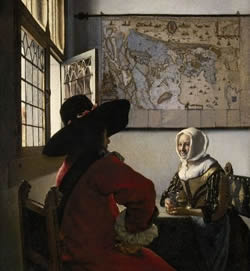
Johannes Vermeer
c. 1655–1660
Oil on canvas, 50.5 x 46 cm.
Frick Collection, New York
At this time, men did not remove their hats upon entering buildings or greeting women; that custom developed later. A gentleman uncovered his head only before a monarch, a gesture Dutch citizens rejected as inconsistent with their republican pride. Accordingly, Vermeer depicts men without hats only when they are engaged in work, such as musicians or scholars, not in social or courtship settings.
Vermeer’s own self-representations follow these conventions. In The Procuress, he appears as a musician wearing an extravagant beret slouched dramatically to one side, while in The Art of Painting, painted about a decade later, he adopts a smaller black beret, already a recognized sign of the artist’s profession. Across his work, the felt hat functions not as a casual accessory but as a clear signal of identity, occupation, and social posture within Dutch civic life.
In the seventeenth-century Netherlands, the gentleman’s hat was almost always made of felt, a dense, weather-resistant material prized for its durability, shape retention, and refined surface.The phrase "mad as a hatter" comes from the hat-making trade of the eighteenth and nineteenth centuries, when hatters commonly used mercury nitrate to process felt. Prolonged exposure to mercury fumes caused neurological symptoms—tremors, mood swings, and erratic behavior—that became popularly associated with the profession. The felt used for high-quality hats was not woven but created by matting animal fibers, most commonly beaver fur. Beaver pelts were valued because their fine, barbed underfur locked together tightly when worked, producing a smooth, resilient felt that could be molded into broad brims and tall crowns. European beaver populations had already been heavily depleted by the early seventeenth century, which meant that much of the raw material arrived through long-distance trade, especially from North America. As Timothy Brook emphasizes, the felt hat thus quietly embodied global exchange, linking Dutch civic life to transatlantic trapping networks and colonial commerce.Timothy Brook, Vermeer’s Hat: The Seventeenth Century and the Dawn of the Global World (London: Bloomsbury Publishing, 2009).
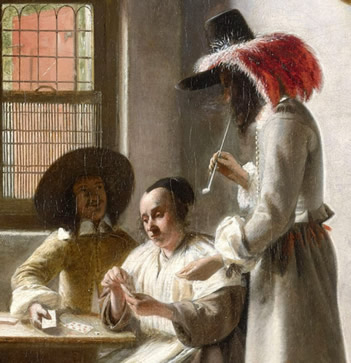
Pieter de Hooch
1658
Oil on canvas, 77.3 x 67.3 cm.
Royal Collection Trust, London
The process of making felt hats was labor-intensive and specialized. Beaver pelts were first cleaned and treated to separate the fine underfur from the coarser guard hairs. The fur was then layered, moistened, and subjected to heat, pressure, and repeated agitation, causing the fibers to interlock into a thick felt sheet. This felt was shaped over wooden blocks, shrunk further through steaming and rolling, and then stiffened, trimmed, and finished. Dyeing—often black or dark brown for formal wear—was achieved through repeated baths using metal salts and plant-based colorants. The final product was both practical and symbolic: water-shedding, long-lasting, and unmistakably associated with respectability, rank, and masculine presence in Dutch urban society, including the world depicted by Vermeer.
Recent examination by the Rijksmuseum conservation staff has revealed that Vermeer altered the officer’s hat in a way that changes the entire balance of the composition.Anna Krekeler, Francesca Gabrieli, Annelies van Loon, and Ige Verslyp, "Compositons in the Making ," in VERMEER, ed. Pieter Roelofs & Gregor Weber, Rijksmuseum, Amsterdam, 2023, 64. Technical imaging shows that the hat was originally taller and included at least one large feather plume rising from its crown. The plume gave the figure a more decorative, somewhat flamboyant profile, and the upper contour of the hat extended farther than it does today. During the course of painting, Vermeer suppressed the feather and reduced the height of the hat, leaving the broad, dark shape that now dominates the officer’s presence. The final silhouette is heavier, more compact, and far more imposing, creating a block of darkness that counters the girl’s brightly lit face. By removing the plume and lowering the hat’s outline, Vermeer tightened the contrast between the two figures and strengthened the spatial pressure of the foreground figure, which now feels closer and more forceful than it would have with the original, more decorative hat.
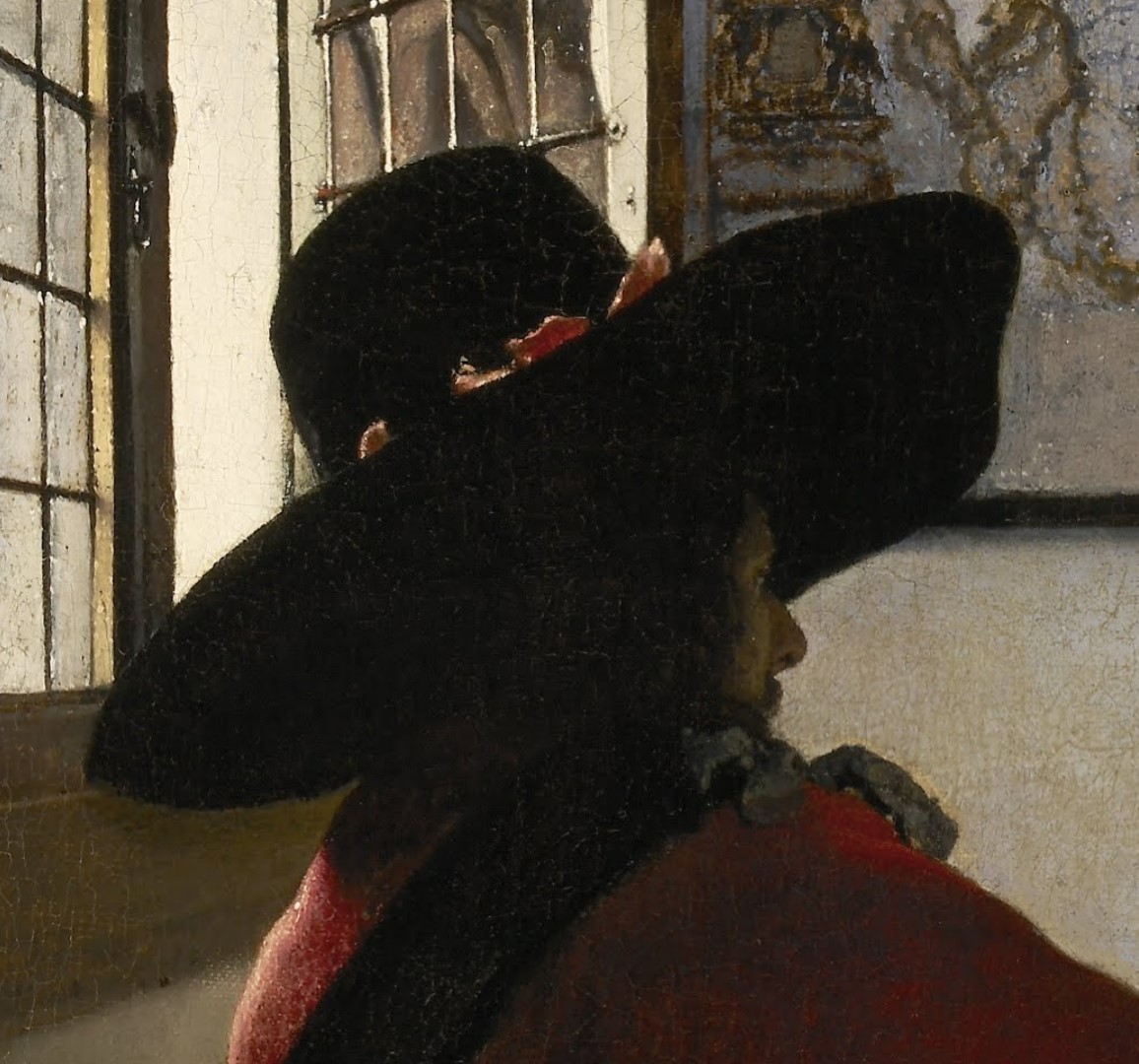
Johannes Vermeer
c. 1655–1660
Oil on canvas, 50.5 x 46 cm.
Frick Collection, New York