Missing Pieces
Some of the most revealing detials in Vermeer's paintings are not always clearly legible objects but, in the case of The Milkmaid, a pair of barely visible pentimenti on the background wall. These faint traces—almost erased from sight—offer a rare glimpse into Vermeer’s working process and his habit of testing, reconsidering, and ultimately refining his pictorial decisions. Technical examination has shown that he initially sketched and partially underpainted two objects on the rear wall (fig. 3), but then abandoned them at an early stage. They were never carried beyond a preparatory state, leaving only dark, summary forms beneath the finished surface.
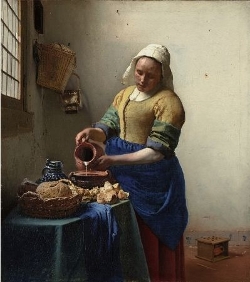
Johannes Vermeer
c. 1657–1661
Oil on canvas, 45.5 x 41 cm.
Rijksmuseum, Amsterdam

c. 1686 – 1710
Rijksmuseum, Amsterdam
In preparation for the 2023 Vermeer exhibition, the Rijksumseum conservation team conducted an intensive technical research campaign which formed a part of a broader reassessment of Vermeer's working process, bringing together high-resolution photography, infrared reflectography, X-radiography, and MA-XRF imagingMacroscopic X-ray fluorescence (MA-XRF) is a non-invasive imaging technique that maps the distribution of chemical elements across the surface of a painting by detecting the characteristic X-ray emissions of those elements when they are excited by an X-ray source. In the study of paintings, it allows researchers to identify pigments and visualize underlying paint layers and compositional changes without taking samples or disturbing the surface. to reveal compositional changes that are either invisible or only faintly perceptible to the naked eye.
"In The Milkmaid, the Rijksmuseum's conservators discovered that the apparently plain, whitewashed wall behind the figure had originally contained two distinct objects: a wooden wall shelf higher up, called a kannebort,A kannebort was a wooden wall shelf with metal hooks, where beer and wine jugs could be stored. The shelf, a plank of wood with nobs attached, was used in 17th-century kitchens for hanging up multiple ceramic jugs by the handle. A pantry in Vermeer’s own home contained a similar item, and a miniature version of just such a jug holder can be found elsewhere in the Rijksmuseum, in Petronella Oortman’s dolls’ house (c. 1690) and a fire basket Woven from willow stems, or withies, this type of basket was a standard household item for young families. A fire bowl containing glowing coals was placed in the basket to keep new-borns warm and to dry nappies. Seventeenth-century archival material including Vermeer’s own estate inventory reveals that just such an item stood in his house, home to his family of numerous children. In the painting, Vermeer later covered over the fire basket with the foot stove, Delftware tiles, and the floor. (or brazier basket) (fig. 1) lower down, to the right of the maid. These elements were not conjectural reconstructions but clearly identifiable forms revealed by imaging of earlier paint layers beneath the final surface.
"The shelf was detected primarily through infrared reflectography and corroborated by X-ray imaging. It appears as a narrow horizontal plank with simple supports, positioned roughly at head height behind the maid. On this shelf stood several utilitarian objects, including what seem to have been small earthenware or metal containers. Their silhouettes are legible in the underlayers, though Vermeer had not brought them to a fully finished state before deciding to suppress them. The shelf aligns closely with those seen in contemporary Dutch kitchen interiors, reinforcing that Vermeer initially conceived the setting as a more descriptively furnished domestic workspace. Pigment mapping shows that the shelf and objects were blocked in with darker tones containing iron-rich earth pigments, creating a visual band that would have competed with the strong contour of the maid’s upper body and head.

Gerard ter Borch
1656
Oil on canvas, 46.5 x 38 cm.
Mauritshuis, The Hague
"The Rijksmuseum research revealed that Vermeer must have discarded both items quickly, as they only appear as a sketch painted in black—with the basket additionally showing some underpainting—but were never indication of details laid-in further to be finished off in detail. The woven basket has been previously interpreted as a laundry basket. While laundry would typically consist of mostly white linens, the black underpainting Vermeer applied in preparation rather suggests a dark final colour, such as blue. Another possible interpretation is that of a fire basket. Equipped with wickerwork on top and featuring an earthenware basin with glowing coals, these baskets were used for heating and drying linens and swaddling clothes. However, rather than hanging loosely over a woven superstructure, the fabric in the initial composition of The Milkmaid appears to be tucked in, as the basket’s rim is entirely visible. Fabric being tucked in is reminiscent of that found on the backs of cradles. It is therefore also a possibility that Vermeer initially planned to include a cradle next to the milkmaid. The cradle would have been visible from the back, similar to the one depicted in Gerrit ter Borch’s Woman Sewing beside a Cradle (fig. 2). By abandoning the jug shelf and basket and opting for an empty rear wall, Vermeer directed the viewer’s attention solely to the maid and her task, minimizing distractions.
What is especially revealing is how Vermeer removed these objects. Rather than scraping them away, he painted them out by applying successive layers of lead white-rich paint, gradually neutralizing their forms and merging them into the softly modulated wall surface we see today. MA-XRF shows a strong lead signal in these covering layers, confirming deliberate suppression rather than accidental loss. The process was careful and incremental, suggesting reconsideration during the painting's development rather than a late or corrective intervention."Anna Krekeler, Francesca Gabrieli, Annelies van Loon, and Ige Verslype, "Compositon in the Making," in VERMEER, ed. Pieter Roelofs & Gregor Weber, Rijksmuseum, Amsterdam, 2023, 62–69.
