Foreshortening
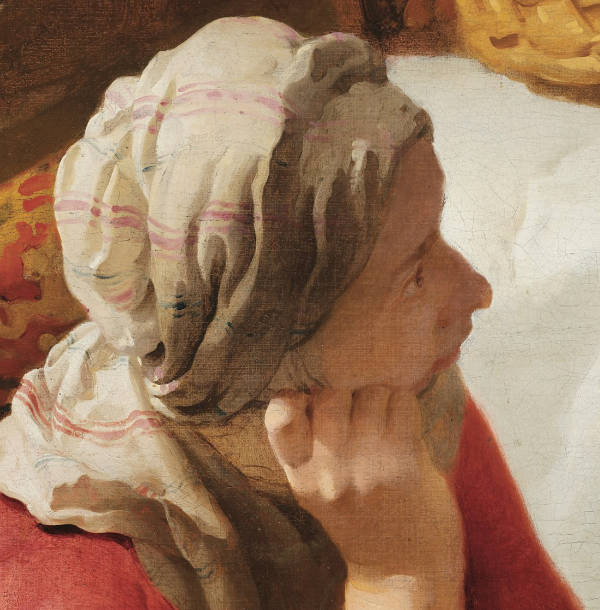
No doubt, the most exquisite passage in Vermeer's early Christ in the House of Martha and Mary is that of the figure of Mary who gazes upwards at the seated Christ, awaiting his comfort and words of wisdom. Vermeer's empathetic rendering of Mary, who in this context represents the contemplative life focused on the deeper meanings of life, may have struck a chord with the artist's own introspective nature.
Apart from the religious subject and the dramatic lighting, the proficient use of a technique called foreshorteningAlthough the Dutch mastered the method early, they did not invent it. The basic principle—rendering a form according to how it appears to the eye rather than according to its "ideal" shape—emerged in classical antiquity. Greek painters on wooden panels and vase painters of the fifth century BCE were already experimenting with shortened limbs seen at angles. Roman wall painting extended these ideas. After the fall of Rome, the practice receded in medieval Europe, where art generally favored symbolic clarity over optical realism. The systematic recovery of foreshortening is generally tied to the Italian Renaissance. Giotto (c. 1267–1337) is often credited with reintroducing a persuasive sense of bodies in space, but the first fully analytical uses appear in the early fifteenth century. Andrea Mantegna (c. 1431–1506) is the painter most often associated with its dramatic potential; his Dead Christ is the classic example in which the body is radically shortened yet reads as spatially coherent. of Mary's head suggests that Vermeer had likely trained with a classically oriented painter, although curiously there is no evidence of even passable foreshortening in his previous work, Diana and her Companions.
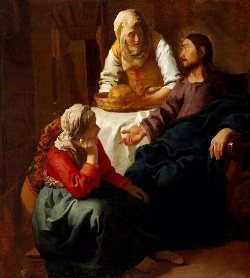
Johannes Vermeer
c. 1654–1656
Oil on canvas, 160 x 142 cm.
National Gallery of Scotland, Edinburgh
From a technical standpoint, foreshortening is the process of applying linear perspective to a single object, making it appear more or less compressed. It was one of the traditional skills required by any history painter. Foreshortening is particularly effective for enhancing the impression of three-dimensional volume and creating drama in a picture. The workshop system treated it as a foundational skill, and because the broader European tradition had by then adopted it as a measure of artistic competence.
Achieving the effect of foreshortening can be very challenging, especially when drawing complex anatomical features such as hands and the head. When applied to the human head, the principle behind foreshortening becomes especially clear, because the head is one sof the most familiar and biologically-relevant forms with strong expectations attached to it. We carry in our minds a "standard" or "ideal" template of a face: a simple oval-shaped head with feature place symetrically with fixed heigths and widths. The overall shape is usually treated as an oval that is slightly wider at the top than at the jaw. The eyes sit roughly halfway between the top of the skull and the bottom of the chin. This midpoint surprises many beginners, since we tend to think of the eyes as higher, but the cranium occupies considerable vertical space. The distance between the eyes is approximately the width of one eye, creating three equal horizontal segments across the upper face. The base of the nose lies about halfway between the eye line and the chin. The mouth falls a little above the midpoint between the nose and the chin. The corners of the mouth tend to align, loosely, with the centers of the eyes, though this varies more than most other features. The ears usually sit between the eye line and the base of the nose.These measurements act as a reference grid that orients the painter before dealing with likeness or expression. They describe the head as a balanced set of relationships. Once the head turns or tilts, nearly every one of these proportions will warp optically, and that is where foreshortening enters.
This mental template is what painters must unlearn when working in perspective. This requires a very specific set of perceptual and technical skills, most of which run counter to our ingrained "symbolic" way of seeing. To make a foreshortened head appear natural rather than merely deformed, a painter must train three interlocking capacities. First, there is the ability to override the mental template of the face. Humans are so attuned to facial structure that beginners tend to draw what they think a head looks like—full-sized eyes, a long nose, a symmetrical oval—even when the head is turned or tilted. The painter must learn to suppress this automatic schema and replace it with direct, dispassionate observation. This means looking for abstract shapes rather than named features: a compressed trapezoid instead of a cheek, a small wedge of an eye that nearly disappears under the brow, or a nose reduced to overlapping planes.
Second, the painter must develop confidence in contour and proportion even when they seem illogical. Foreshortening often results in pronounced asymmetry: one side of the head may shrink dramatically; features may cluster in a tight group; large stretches of the skull may vanish behind projecting forms. Accepting and drawing these disproportions requires a trained trust in visual logic. The student must understand that what looks “wrong” in isolation becomes persuasive once placed within the spatial envelope of the whole figure.
When a head is turned sharply or viewed from above or below, the familiar proportions no longer present themselves. Seen from a steep angle, one eye may appear much smaller than the other, the bridge of the nose becomes a short oval instead of a long outline, the mouth compresses into a narrow band, and the ear may disappear entirely behind the cheek. The skull itself becomes a series of overlapping planes rather than a symmetrical oval. In such views, the "ideal"schema we have internalized does not match what the eye actually perceives. Foreshortening requires the painter to relinquish the conceptual template and record the head as a set of observable shapes, even if they seem counterintuitive and can be mastered only with practice and the study of models by the masters.
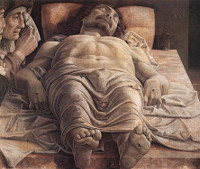
Andrea Mantegna
c. 1480
Tempera on canvas, 68 x 81 cm.
Pinacoteca di Brera, Milan
The foreshortened head of Mary—viewed from above and in profile—has a powerful psychological effect on the viewer. Viewed from an unfmilair point of view, the strong backlighting and the simplification of her features reduce the head to a minimal light-and-dark contrast, which obscures her full likeness and physcical structure. This distortion leaves much of the figure's head hidden. We cannot access her thoughts or identity directly, which heightens the sense of her introspective, pensive state. Being unable to grasp the particulars of an individual female head, the viewer is left to imagine what she might be contemplating, which makes the scene feel more intimate and participatory.
One of the most noted examples of foreshortening can be found in Mantegna's The Lamentation over the Dead Christ. At first glance, the painting seems to be a strikingly realistic study in foreshortening. However, careful scrutiny reveals that Mantegna reduced the size of the figure's feet so that they did not cover too much of the body. Vermeer employed foreshortening in a far less dramatic manner than that of Mantegna, but it is equally effective, enhancing the inquisitive glance of Mary.